Adult BMI with NHS ranges, in kg, stone and pounds or lb, plus your healthy weight range.
| Category | BMI | Weight at your height |
|---|
For adults aged 18 and over, using NHS and NICE ranges checked October 2026. BMI is an estimate, not medical advice: it does not separate muscle from fat and is not used in pregnancy. Speak to your GP or practice nurse if your result worries you.
This BMI calculator works out the body mass index of adults aged 18 and over in the UK, using the NHS ranges and the lower thresholds the NHS applies for some ethnic backgrounds. Enter your weight in kg, stone and pounds or lb and your height in cm or feet and inches to see your BMI, your category, the NHS overweight and obesity ranges applied to your height, and how much weight would bring you into the healthy range.
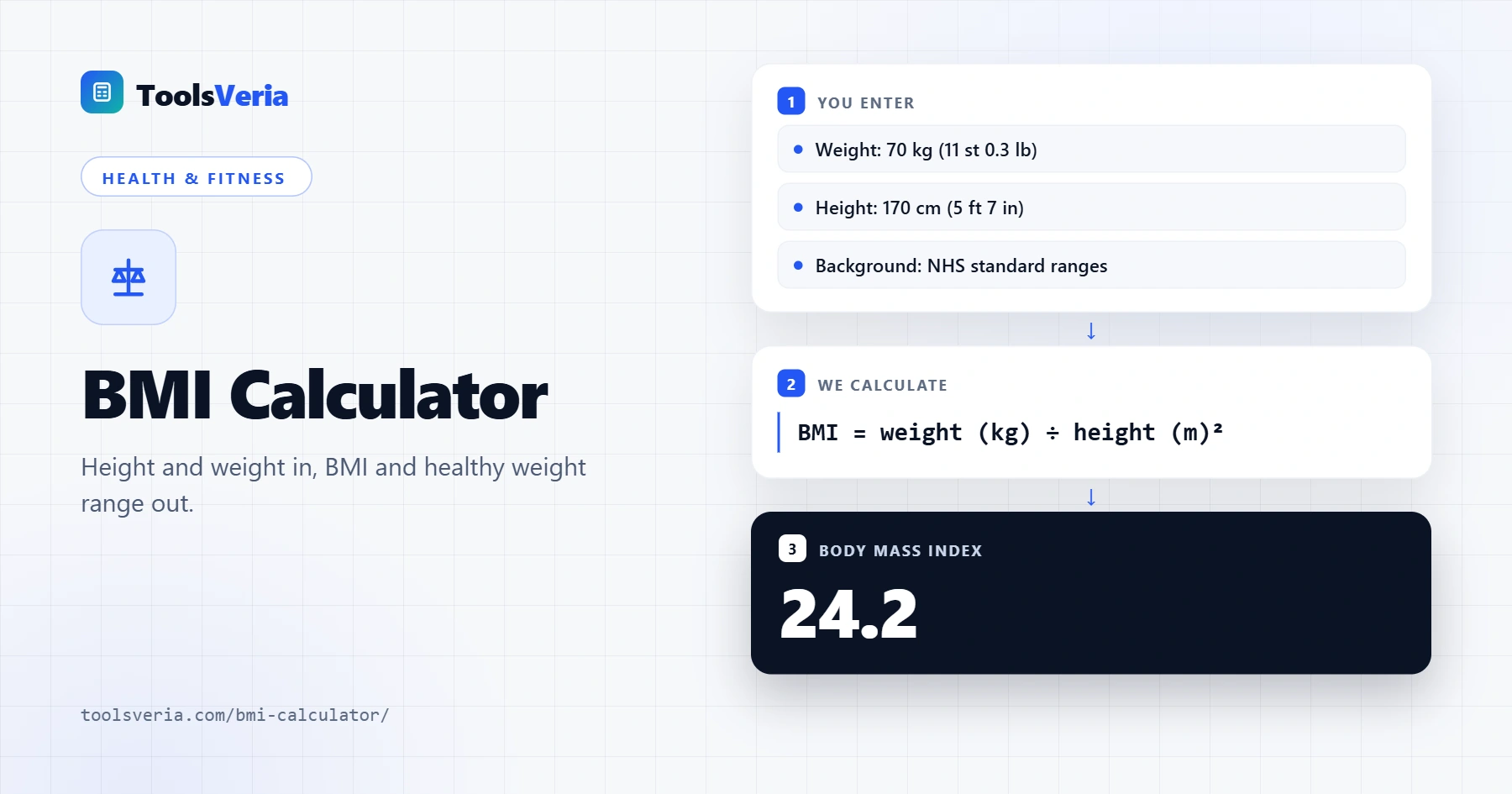
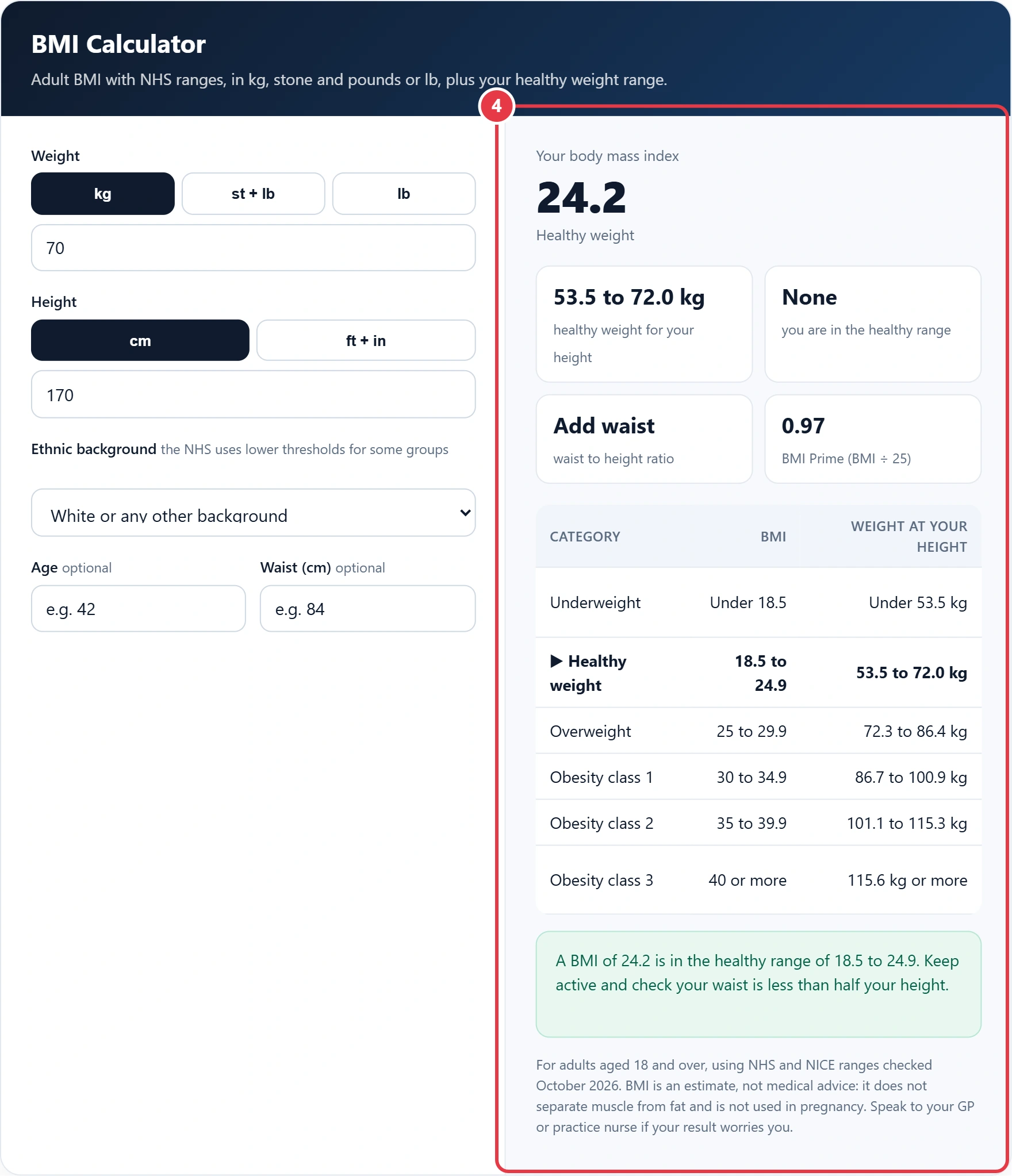
Quick answer: This BMI calculator divides your weight in kilograms by your height in metres squared. For most adults the NHS says 18.5 to 24.9 is healthy, 25 to 29.9 is overweight and 30 or more is obese. A person weighing 70 kg at 1.70 m has a BMI of 24.2, a healthy weight.
In This Guide
What Is BMI?
Body mass index (BMI) is a number that compares your weight with your height to show whether you are likely to be a healthy weight for your size. Doctors in the UK use it as a quick first check for underweight, overweight and obesity in adults.
The formula is weight in kilograms ÷ (height in metres × height in metres). At 1.70 m tall, 1.70 × 1.70 = 2.89, so a weight of 70 kg gives 70 ÷ 2.89 = 24.2. If you think in stone, the calculator converts for you: 1 stone is 14 lb or 6.35 kg, and 1 inch is 2.54 cm.
How to Use the BMI Calculator
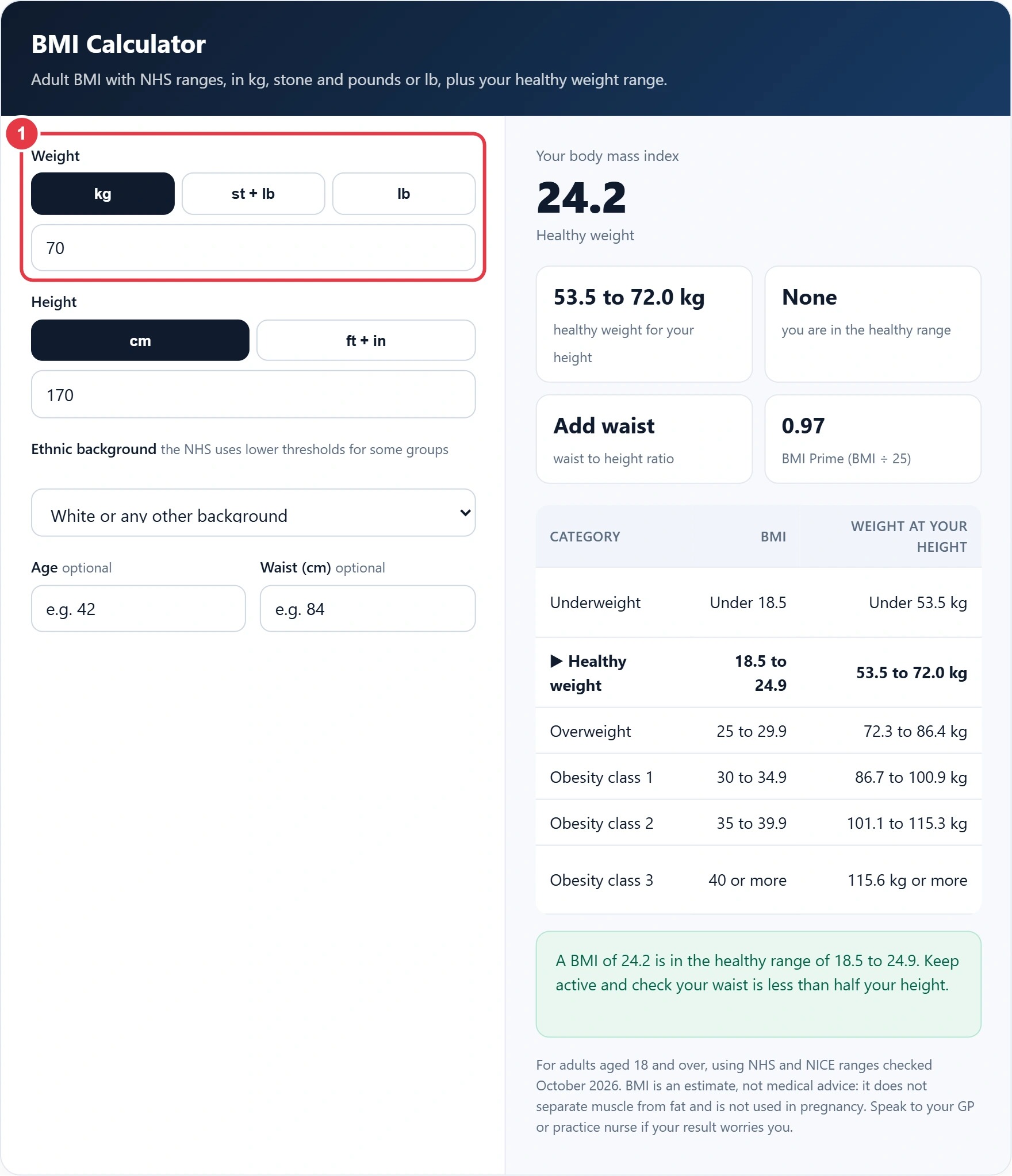
Step 1: Enter Your Weight
Choose kg, st + lb or lb, then type your weight. Weigh yourself in the morning in light clothing for the most consistent result. Switching units keeps your number, so you can see your weight in stone and kilograms side by side.
Step 2: Enter Your Height
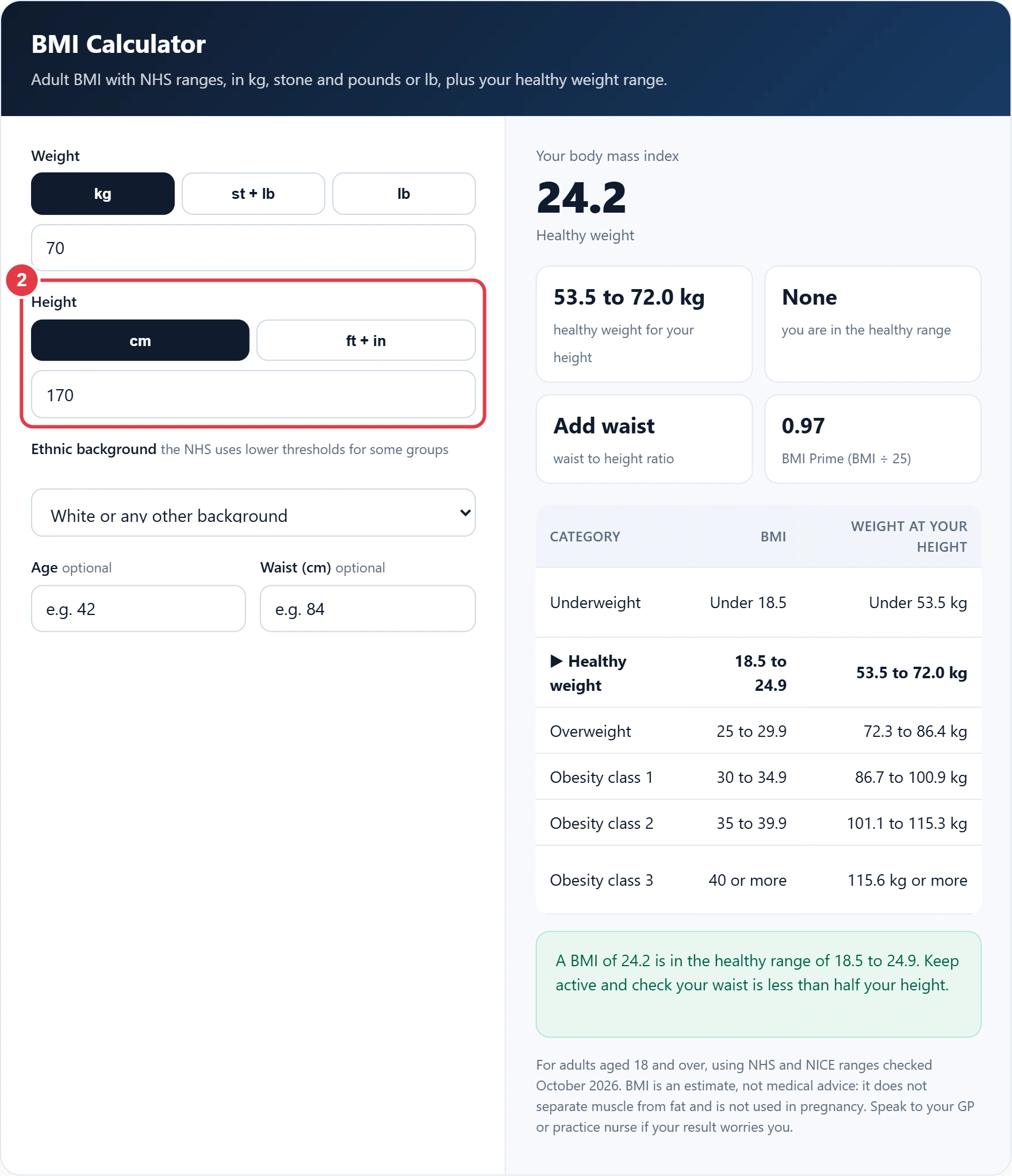
Pick cm or feet and inches and enter your height without shoes. A small error in height changes BMI more than the same error in weight, because height is squared in the formula.
Step 3: Choose Background, Age and Waist
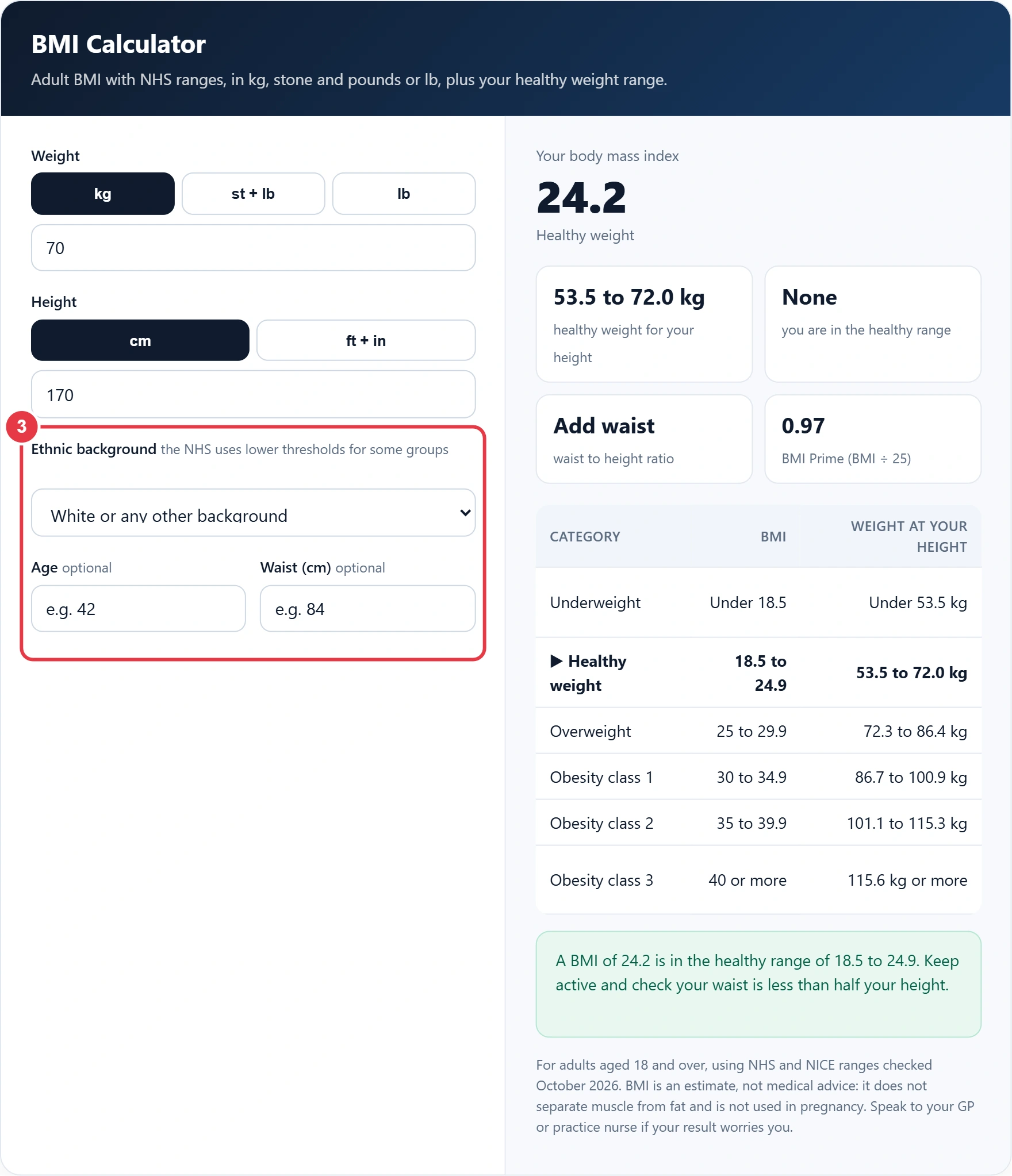
Select your ethnic background so the right NHS thresholds are used. Age is optional, but entering an age under 18 switches off adult categories. Add your waist, measured halfway between your lowest rib and the top of your hips, to get your waist to height ratio as well.
Step 4: Read Your Results
You see your BMI, your category, your healthy weight range and the change needed to reach it. The table converts every category boundary into a weight for your height, with your row marked. If your scales show kilograms and you think in stone, the kg to stone converter switches between the two. If you want to plan a change, the calorie deficit calculator turns a weight goal into a daily calorie target you can follow.
What Is a Healthy BMI for Adults in the UK?
A healthy BMI for most adults in the UK is 18.5 to 24.9. People from a South Asian, Chinese, other Asian, Middle Eastern, Black African or African-Caribbean background have a higher risk of type 2 diabetes and heart disease at a lower BMI, so the NHS and NICE use a healthy range of 18.5 to 22.9 for them.
| Category | Most adults | South Asian, Chinese, other Asian, Middle Eastern, Black African or African-Caribbean |
|---|---|---|
| Underweight | Under 18.5 | Under 18.5 |
| Healthy weight | 18.5 to 24.9 | 18.5 to 22.9 |
| Overweight | 25 to 29.9 | 23 to 27.4 |
| Obese | 30 or more (class 1: 30 to 34.9, class 2: 35 to 39.9, class 3: 40 or more) | 27.5 or more |
The table follows NICE guideline NG246 and NHS guidance, checked October 2026. Treat the result as a starting point for a conversation with your GP rather than a diagnosis.
How Do I Calculate My BMI in Stone and Pounds?
To calculate BMI in stone and pounds, convert your weight to pounds (stone × 14 plus pounds), multiply by 703, then divide by your height in inches squared. The calculator does this for you, but the worked example shows the steps.
Worked example: Sarah is 5 ft 5 in (65 inches, 1.651 m) and weighs 12 st 4 lb, which is 172 lb or 78.0 kg. Her BMI is 172 × 703 ÷ (65 × 65) = 28.6, which is overweight. Her healthy range at that height is 7 st 13.2 lb to 10 st 9.6 lb, so losing about 1 st 8.4 lb (10.1 kg) would bring her to a BMI of 24.9. If Sarah's family background were South Asian, her healthy range would top out at 9 st 11.6 lb, a BMI of 22.9.
| Height | Healthy weight (BMI 18.5 to 24.9) | In kg |
|---|---|---|
| 5 ft 0 in (152.4 cm) | 6 st 10.7 lb to 9 st 1.5 lb | 43.0 to 57.8 kg |
| 5 ft 4 in (162.6 cm) | 7 st 9.8 lb to 10 st 5.1 lb | 48.9 to 65.8 kg |
| 5 ft 6 in (167.6 cm) | 8 st 2.6 lb to 11 st 0.3 lb | 52.0 to 70.0 kg |
| 5 ft 8 in (172.7 cm) | 8 st 9.7 lb to 11 st 9.8 lb | 55.2 to 74.3 kg |
| 5 ft 10 in (177.8 cm) | 9 st 2.9 lb to 12 st 5.5 lb | 58.5 to 78.7 kg |
| 6 ft 0 in (182.9 cm) | 9 st 10.4 lb to 13 st 1.6 lb | 61.9 to 83.3 kg |
Is BMI Accurate for Everyone?
BMI is a useful screening number for most adults, but it is not accurate for everyone because it cannot tell muscle from fat. Rugby players and bodybuilders can show as overweight with little body fat, while older adults who have lost muscle can show as healthy with too much fat.
That is why the NHS suggests keeping your waist to less than half your height. A waist to height ratio of 0.5 to 0.59 means increased health risk and 0.6 or more means high risk, according to NICE. BMI is not used in pregnancy, and children are measured differently: the NHS child BMI calculator compares 2 to 17 year olds with others of the same age and sex using centiles. Results here are estimates for healthy adults and not medical advice, so speak to a GP, practice nurse or pharmacist if you are concerned.
What Should I Do If My BMI Is High?
If your BMI is 25 or more (23 or more for higher risk backgrounds), losing 5% to 10% of your weight (the percentage calculator works out the exact amount) can already improve blood pressure and blood sugar. Start with a small daily calorie deficit and regular activity rather than a crash diet.
Your GP can check your blood pressure, offer an NHS Health Check if you are 40 to 74, and refer you to a local weight management programme. To understand how many calories your body burns at rest, try the BMR calculator, then see how long a realistic goal takes with the weight loss timeline tool. Figures on this page were checked October 2026.
</>Embed this calculator on your website
Add the free BMI Calculator to your own site or blog. Copy the code below and paste it into an HTML block. It resizes itself and works on phones.
How we checked this tool: the Tools Veria Editorial Team built this tool by hand, checked it against the official rules or published standards where they apply, and tested it against worked examples. Results are estimates for planning, not personal financial or tax advice. Read our editorial policy and disclaimer, or report an error.
Frequently Asked Questions
What is a healthy BMI for a woman in the UK?
The NHS uses the same healthy range for women and men: a BMI of 18.5 to 24.9. Women from a South Asian, Chinese, other Asian, Middle Eastern, Black African or African-Caribbean background should aim for 18.5 to 22.9, because health risks start at a lower BMI.
Is a BMI of 25 overweight?
Yes, a BMI of 25 is the start of the overweight range for most adults, which runs from 25 to 29.9. For people from higher risk ethnic backgrounds the NHS counts 23 to 27.4 as overweight, so a BMI of 25 is overweight for them too.
How is BMI calculated in stone and pounds?
Convert your weight to pounds by multiplying the stone by 14 and adding the pounds, multiply by 703, then divide by your height in inches squared. For example, 11 st (154 lb) at 5 ft 7 in (67 inches) gives a BMI of 24.1.
Is BMI accurate if I am muscular?
No, BMI often overestimates body fat in muscular people because it only uses height and weight. If you train hard and your BMI says overweight, check your waist instead: a waist less than half your height usually means a healthy amount of belly fat.
Can children use this BMI calculator?
No, adult BMI ranges should not be used for anyone under 18. Children and teenagers aged 2 to 17 are assessed with BMI centiles that compare them with others of the same age and sex, using the NHS child BMI calculator.
What BMI is classed as obese in the UK?
A BMI of 30 or more is classed as obese for most adults in the UK, split into class 1 (30 to 34.9), class 2 (35 to 39.9) and class 3 (40 or more). For higher risk ethnic backgrounds, obesity starts at a BMI of 27.5.