Model dividend reinvestment, dividend growth and monthly top ups over time.
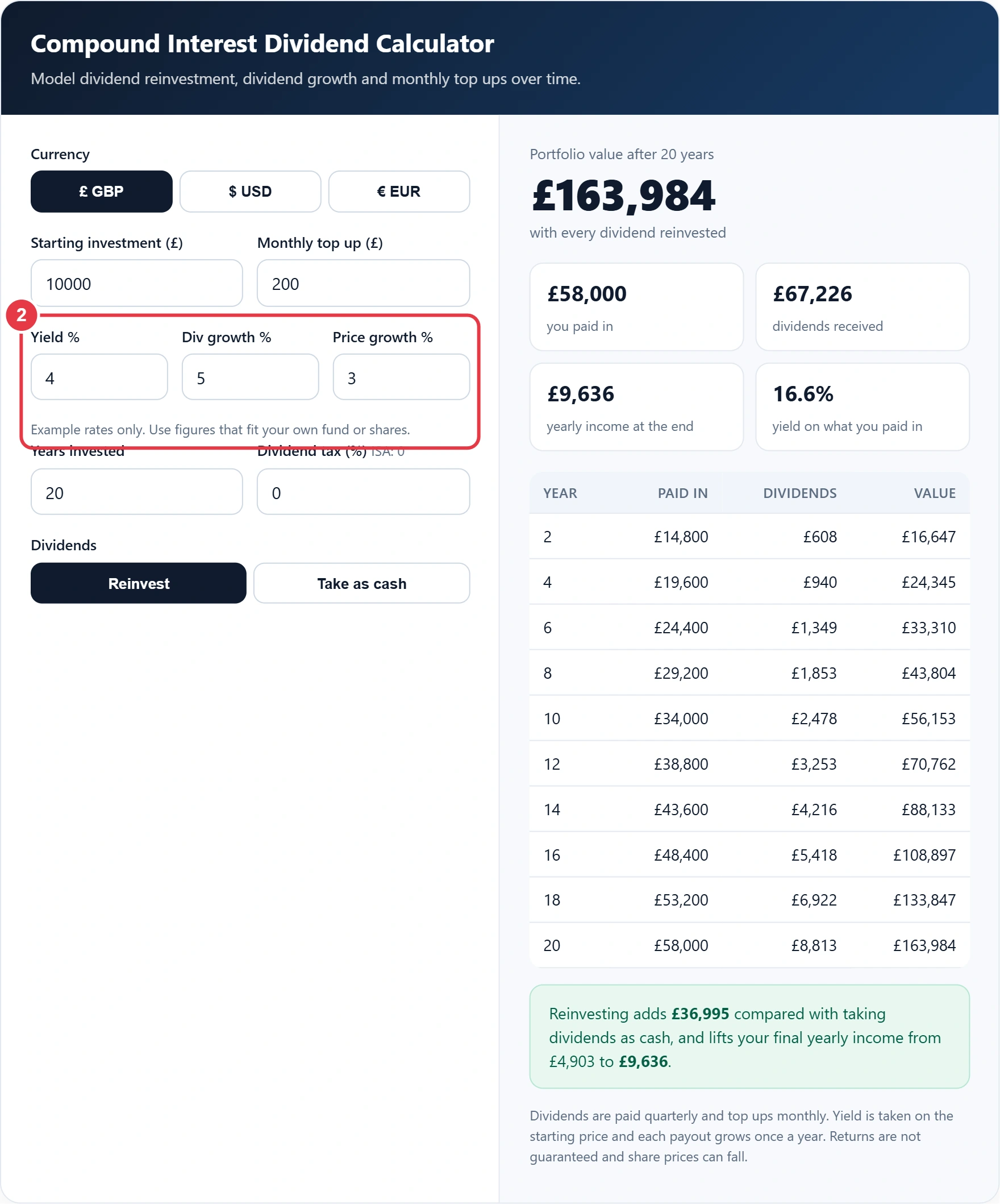
Example rates only. Use figures that fit your own fund or shares.
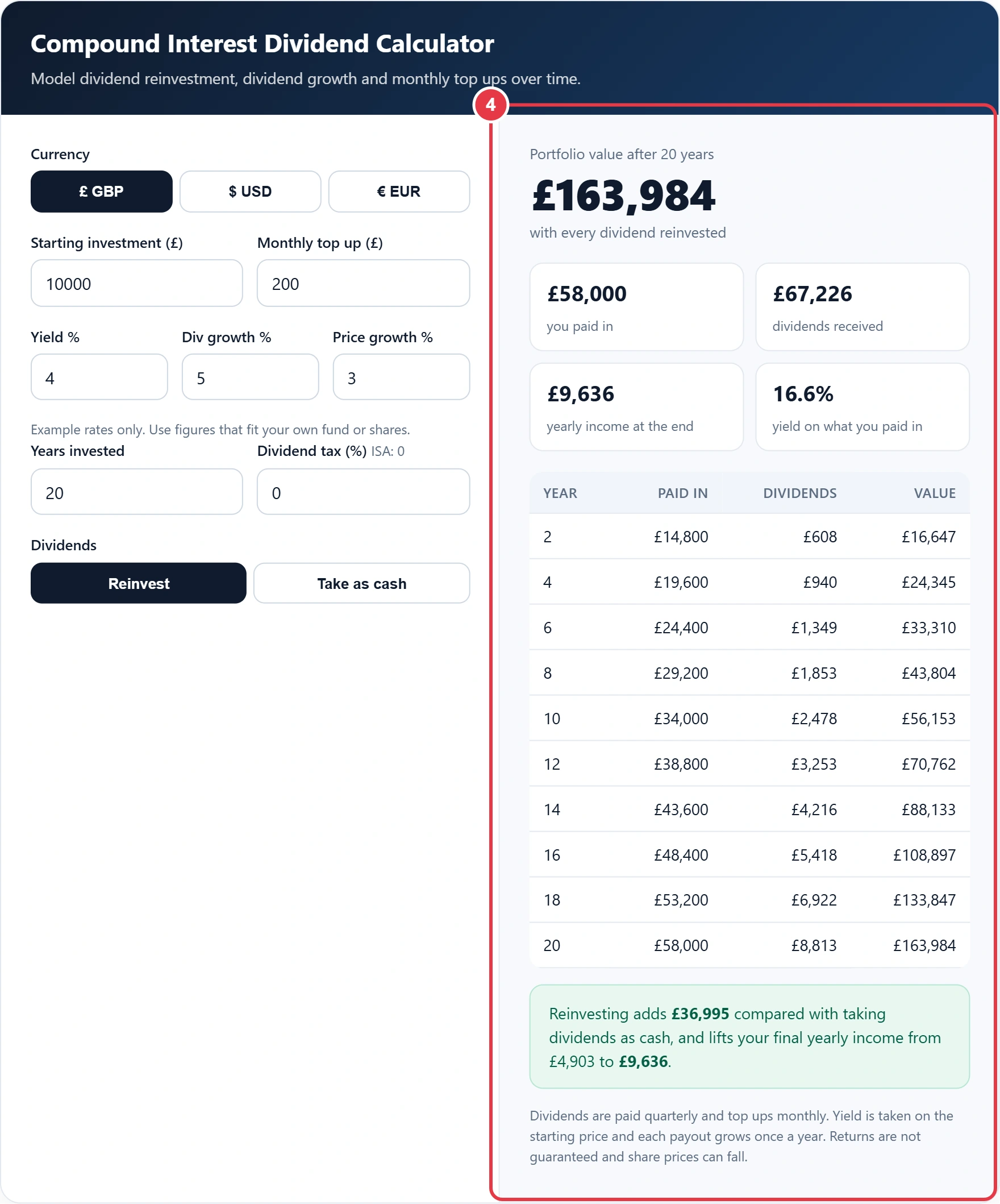
| Year | Paid in | Dividends | Value |
|---|
Dividends are paid quarterly and top ups monthly. Yield is taken on the starting price and each payout grows once a year. Returns are not guaranteed and share prices can fall.
Dividends feel small when they land, but spent or reinvested they lead to very different places. This compound interest dividend calculator models a portfolio where every payout buys more shares, which then pay their own dividends. It is built for income investors, so unlike our general compound interest calculator it separates dividend yield, dividend growth and share price growth instead of lumping them into one rate.
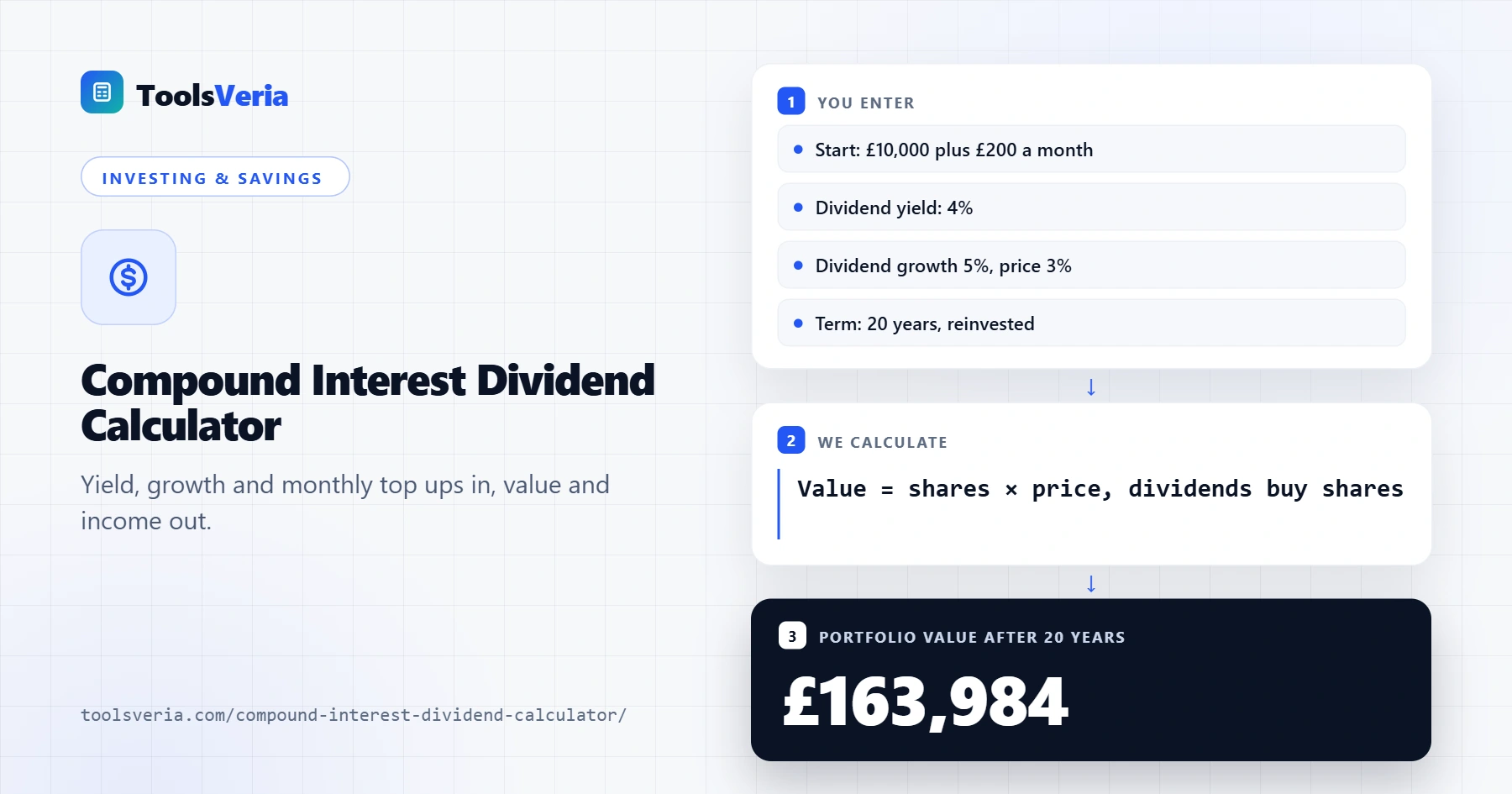
Quick answer: A compound interest dividend calculator reinvests every payout into more shares, so the value is shares held × share price. Investing £10,000 plus £200 a month for 20 years, with a 4% yield, 5% yearly dividend growth and 3% price growth, turns £58,000 paid in into £163,984, paying about £9,600 a year in dividends.
In This Guide
What Is Dividend Compounding?
When you reinvest, each dividend buys extra shares at the current price. Next quarter you are paid on a slightly larger holding, and if the company raises its payout, each of those shares pays a little more too. Two engines run together: the share count climbs through reinvestment, and the payout per share climbs through dividend growth. The value at any point is simply shares held × share price.
Consider Olivia, who opens a stocks and shares ISA with £10,000 in a global income fund and adds £200 a month. Her example assumptions are a 4% starting yield, payouts rising 5% a year and the price rising 3% a year. After 20 years she has paid in £58,000, and with dividends reinvested her pot is worth £163,984 and would pay about £9,600 a year in dividends. The calculator also shows how much smaller both figures would be had she spent each payout.
How to Use the Compound Interest Dividend Calculator
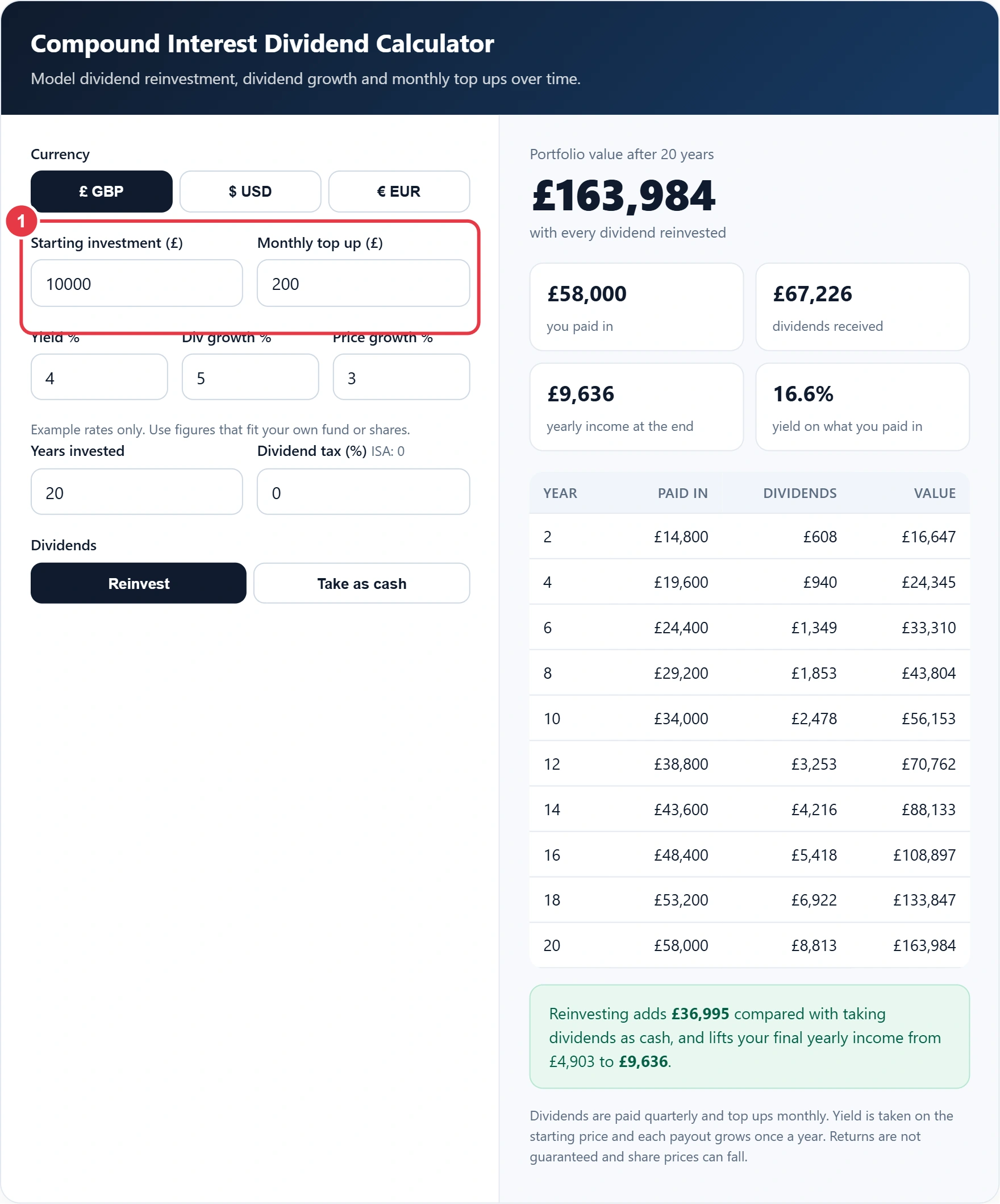
Step 1: Enter Your Starting Sum and Top Ups
Pick your currency, then add the lump sum you are investing now and what you plan to add each month. Set the monthly figure to zero to see a lump sum on its own.
Step 2: Set Yield and Growth Rates
The yield is the yearly dividend as a percentage of the price you pay, which most fund factsheets list. Dividend growth is how fast payouts rise each year, and price growth is the yearly change in the share or unit price. These are assumptions, so try a cautious set alongside a hopeful one.
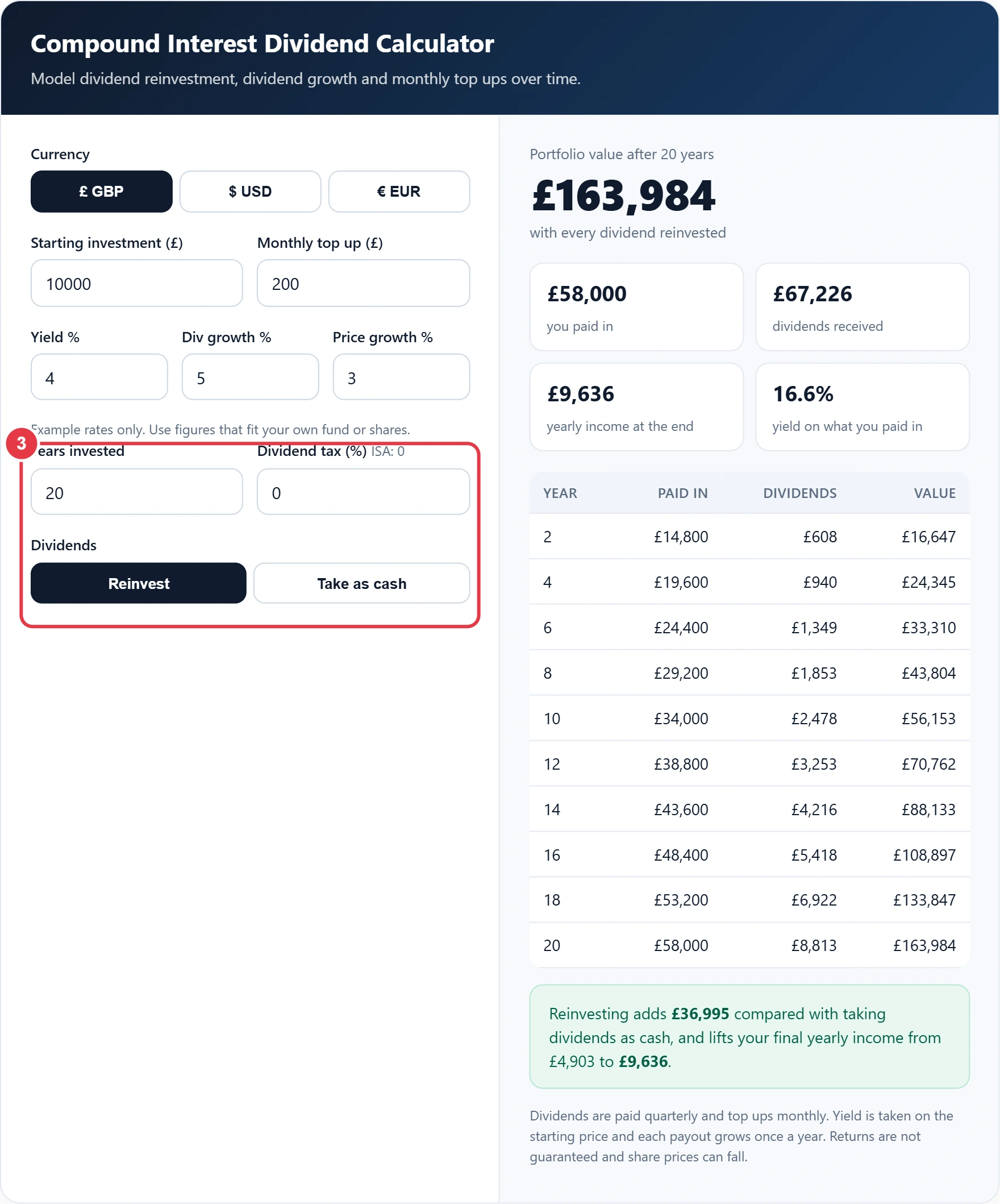
Step 3: Choose Term, Tax and Reinvestment
Enter how many years you will hold, then your tax rate on dividends. Inside an ISA or pension it is 0. Outside one, check the GOV.UK rules on dividend tax and use your rate as a rough average. The dividend tax calculator gives the exact bill if you need it.
Step 4: Read the Results
You see the final value, what you paid in, total dividends received, the yearly income the portfolio would pay at the end and your yield on cost. The message box compares reinvesting with taking cash.
Tips for Dividend Investors
- A very high yield can signal a payout at risk of being cut, so check how well dividends are covered by earnings.
- Accumulation fund units reinvest automatically, which saves dealing charges on small payouts.
- Dividend growth matters more than starting yield over long periods.
- Holding income shares in an ISA keeps every payout free of tax.
The ISA allowance for 2026/27 is £20,000, and the GOV.UK guide to ISAs explains how it splits across account types, so plan your monthly top ups to stay within it.
Compound Interest Dividend Calculator Terms Explained
These terms explain the income investing ideas used by the compound interest dividend calculator, so you can set realistic yield and growth assumptions.
- Dividend yield
- A company's or fund's yearly dividend expressed as a percentage of its current share or unit price. Because the price changes daily, the yield moves too, and a falling share price can push the yield up artificially.
- Dividend reinvestment
- Using each cash dividend to buy additional shares or fund units instead of withdrawing it. The new holding earns its own future dividends, which is how payouts compound alongside any growth in the share price.
- Dividend growth rate
- The yearly percentage increase in the dividend paid per share. A steady rise lifts income on the same number of shares and, over long holding periods, often adds more to returns than a high starting yield.
- Yield on cost
- The current yearly dividend income divided by the total amount originally invested. It rises over time as payouts grow and shares accumulate, showing how much income an investor's own capital now generates.
- Accumulation units
- A fund share class that automatically reinvests income inside the fund rather than paying it out. The unit price rises to reflect retained income, which avoids dealing charges on buying small amounts of new units.
- Dividend cover
- The ratio of a company's earnings to the dividends it pays. A ratio comfortably above one suggests the payout is affordable, while a ratio near or below one warns that the dividend could be cut.
</>Embed this calculator on your website
Add the free Compound Interest Dividend Calculator to your own site or blog. Copy the code below and paste it into an HTML block. It resizes itself and works on phones.
How we checked this tool: the Tools Veria Editorial Team built this tool by hand, checked it against the official rules or published standards where they apply, and tested it against worked examples. Results are estimates for planning, not personal financial or tax advice. Read our editorial policy and disclaimer, or report an error.
Frequently Asked Questions
Is dividend reinvestment the same as compound interest?
Not quite. Interest is a fixed rate on cash, while dividends can rise, fall or be cut and the share price moves too. The compounding effect works the same way, though.
Do I pay tax on dividends I reinvest?
Yes, outside an ISA or pension. Reinvested dividends count as income in the year they are paid, so set the tax field to your expected rate.
What dividend yield should I enter?
Use the yield on your fund factsheet or broker page. The figure changes daily with the price, so check it close to when you run the numbers.
What is yield on cost?
It is your yearly dividend income divided by the money you put in. It rises over time when payouts grow, even if the current yield stays flat.
Why does the calculator separate dividend growth and price growth?
Because they can differ. If payouts rise faster than the price, your yield climbs; if the price rises faster, your yield shrinks.
Does the calculator include fees?
No. Reduce the price growth rate by your yearly platform and fund charges to allow for them.