
Tom and Ellie completed on a £280,000 new build in Bedford in November 2021, with a 20% government equity loan that has cost them £1 a month ever since. This November the fifth anniversary arrives, and with it their first help to buy interest payment. They want to know three things: how much, how fast it grows and whether paying it gets them any closer to owning the house outright.
The answers are £81.67 a month to start, faster than most owners expect, and no. Each one is worked through below with their figures and a larger London loan, so you can match the pattern to your own paperwork.
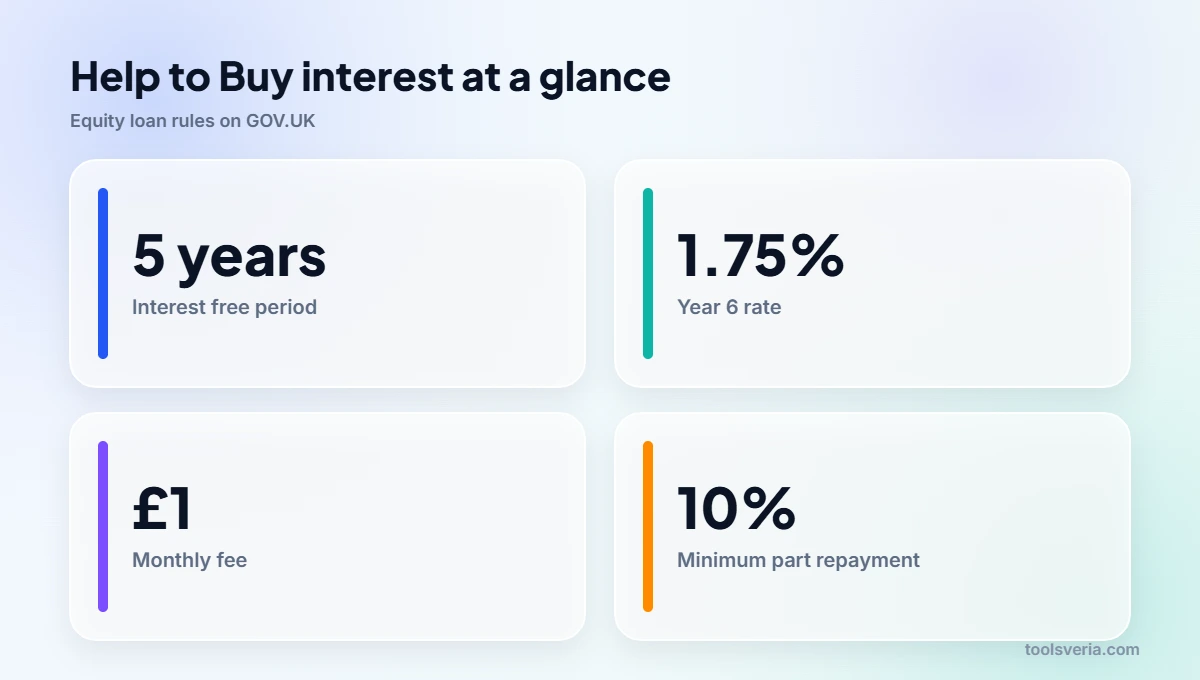
Quick answer: GOV.UK sets Help to Buy interest at 1.75% a year of the equity loan you originally borrowed, starting on the fifth anniversary of the loan and paid monthly with a £1 management fee. Each April the rate rises by RPI plus 1% (2013 to 2021 scheme) or CPI plus 2% (2021 to 2023 scheme). Interest never reduces the loan.
In This Guide
How much is Help to Buy interest in year 6?
Help to Buy interest in year 6 is 1.75% of the amount you originally borrowed, which works out at £17.50 a year for every £1,000 of equity loan. The figure is fixed by the loan amount on your completion statement, not by what your home is worth now.
Tom and Ellie borrowed 20% of £280,000, which is £56,000. Their year 6 interest is £56,000 × 1.75% = £980 a year, or £81.67 a month, plus the £1 fee. The GOV.UK Help to Buy interest page confirms the first five years are interest free and that the fee runs until the loan is repaid, so their real monthly bill becomes £82.67.
Rising house prices do not affect this. Even if their home is now worth £300,000, interest is still calculated on the original £56,000. The value only matters when they come to repay.
How does Help to Buy interest increase each year?
Help to Buy interest increases each April by multiplying the current rate by inflation plus a margin: RPI plus 1% for loans taken out between 2013 and 2021, or CPI plus 2% for the 2021 to 2023 scheme. The percentage is applied to the rate itself, not added to it.
This is the point most often misread. If CPI is 3%, the uplift on the 2021 to 2023 scheme is 5%, so 1.75% becomes 1.75% × 1.05 = 1.8375%, not 6.75%. The GOV.UK guidance on paying equity loan interest uses an RPI of 10% in its own example, where an 11% uplift takes 1.75% to 1.9425%. Homes England writes to owners each February with the new rate before it applies in April.
| Equity loan borrowed | Year 6 a year | Year 6 a month | Year 7 a month, RPI + 1% (RPI 3%) | Year 7 a month, CPI + 2% (CPI 3%) |
|---|---|---|---|---|
| £25,000 | £437.50 | £36.46 | £37.92 | £38.28 |
| £45,000 | £787.50 | £65.63 | £68.25 | £68.91 |
| £56,000 | £980.00 | £81.67 | £84.93 | £85.75 |
| £70,000 | £1,225.00 | £102.08 | £106.17 | £107.19 |
| £100,000 | £1,750.00 | £145.83 | £151.67 | £153.13 |
The 3% inflation figures are assumptions for illustration, not forecasts. With the same 3% inflation, the newer CPI scheme rises slightly faster because its margin is 2% rather than 1%. Our UK inflation calculator shows how much prices have actually moved in past years, which gives a feel for the range to test.
What will Help to Buy interest cost over five years?
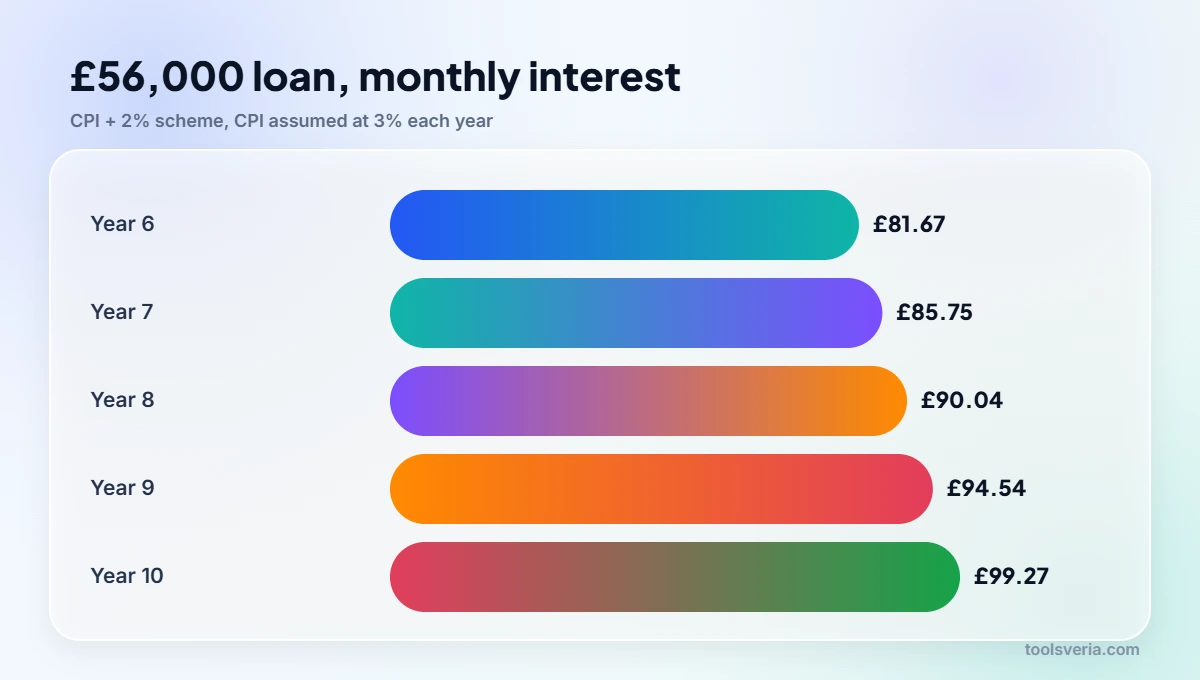
Over loan years 6 to 10, a £56,000 Help to Buy equity loan costs about £5,415 in interest if CPI stays at 3% a year, plus £60 in fees, and none of it reduces the debt. Because each rise builds on the last, the monthly bill climbs every year.
For Tom and Ellie, the monthly interest runs £81.67 in year 6, £85.75 in year 7, £90.04 in year 8, £94.54 in year 9 and £99.27 in year 10. By year 10 their rate is about 2.13%. At the end they still owe 20% of whatever the house is worth.
Sam: a 40% London loan on the older scheme
Sam bought a £450,000 flat in Croydon in 2019 with the London 40% equity loan, £180,000, under the 2013 to 2021 scheme. Year 6 interest was £3,150 a year, or £262.50 a month. Assuming RPI of 4% each year, each April uplift is 5%, and by year 8 his rate is about 1.93% and his interest £289.41 a month. On a loan this size, every year of delay costs thousands.
Does repaying part of the loan reduce Help to Buy interest?
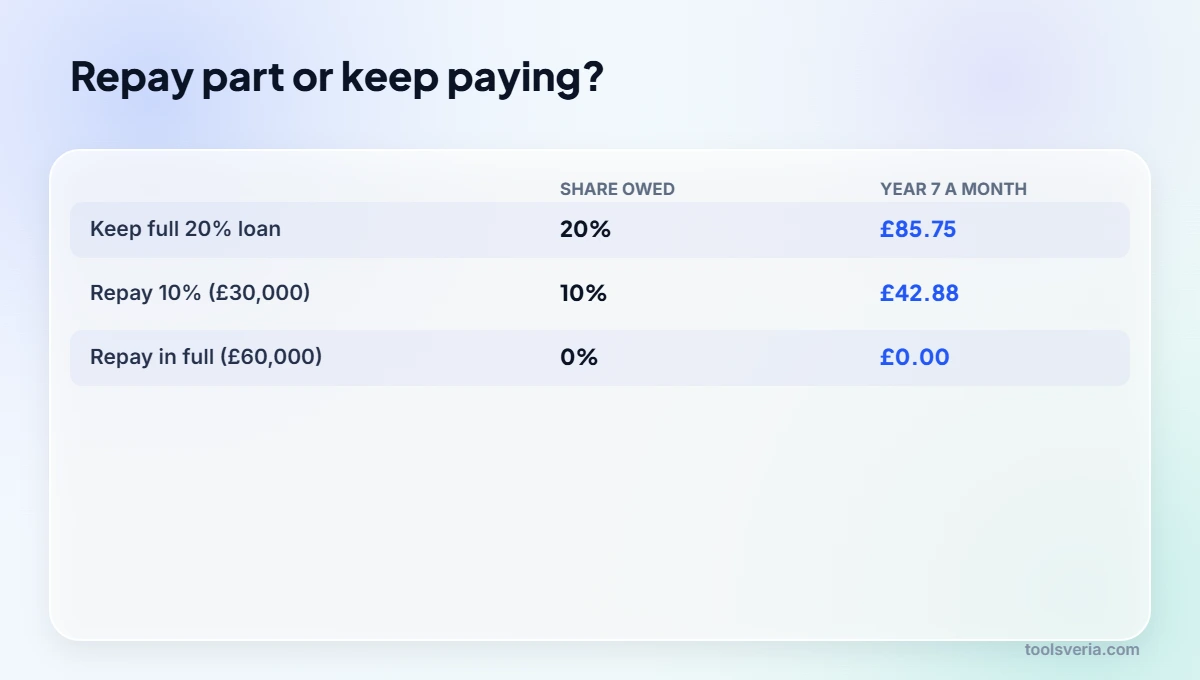
Yes, a part repayment reduces Help to Buy interest, because interest is then worked out on the percentage of the loan you still owe, applied to the original purchase price. Each part repayment must be at least 10% of your home’s current market value.
Suppose a RICS surveyor values Tom and Ellie’s home at £300,000 in year 7. Repaying 10% costs £30,000, and their remaining 10% share means interest on £28,000 instead of £56,000: £42.88 a month instead of £85.75. Repaying in full would cost £60,000, which is £4,000 more than they borrowed, because the loan tracks the value of the home. The GOV.UK equity loan repayment guide explains the valuation, admin fees and the 25 year term in full.
Most owners fund repayment by remortgaging onto a larger mortgage. Weigh the new mortgage cost against the interest you would stop paying: our mortgage refinance savings calculator compares deals side by side, and the mortgage overpayment calculator shows how quickly extra payments clear the larger balance afterwards.
One practical tip: if a remortgage is due around the fifth anniversary anyway, get the valuation done before the deal ends. Repaying shortly before interest starts saves the year 6 interest altogether, though rising values mean the repayment itself may be higher. This guide is general information, not advice, so speak to a mortgage adviser before you commit.
Key points
- Help to Buy equity loans are interest free for five years, then charge 1.75% a year on the amount originally borrowed.
- A £1 monthly management fee is payable from the start until the loan is repaid.
- Each April the rate is multiplied by RPI plus 1% (2013 to 2021 loans) or CPI plus 2% (2021 to 2023 loans).
- Interest payments never reduce the equity loan, which is repaid as a share of the home’s market value.
- Part repayments of at least 10% of market value cut the interest in proportion to the share repaid.
Help to Buy Interest Terms You Should Know
These terms explain how help to buy interest starts, grows and interacts with the value of your home, so your own paperwork makes sense.
- Original loan amount
- The cash sum borrowed at completion, recorded on the completion statement as a percentage of the purchase price. Equity loan interest is always calculated on this figure, so changes in the home’s value do not alter the interest bill.
- Compounding rate increase
- An annual uplift in which the existing interest rate is multiplied by a factor, rather than having points added to it. Each rise builds on the previous one, so the rate climbs gradually but steadily over many years.
- Management fee
- A fixed monthly charge payable from the start of an equity loan until it is repaid, separate from interest. It covers administration of the loan and continues alongside interest payments once the interest free years end.
- Shared equity
- An arrangement in which a lender or investor takes a proportion of a property’s value rather than lending a fixed sum. When the home is sold or the loan repaid, they receive that proportion of the value at the time.
- London Help to Buy
- The version of the scheme for homes in the capital, allowing a larger equity loan percentage to reflect higher prices. A bigger loan means a larger annual interest charge once the interest free period has finished.
- Fifth anniversary
- The date five years after the equity loan completed, which marks the end of the interest free period. Interest becomes payable from this point, and the first rate increase follows at the next annual adjustment in April.
Frequently Asked Questions
My home has gone up in value. Will my interest go up too?
No, Help to Buy interest is always based on the amount you originally borrowed, not today’s value. On a £56,000 loan, year 6 interest is £980 whatever the house is now worth. A higher value only raises the amount you need to repay the loan.
I read that year 7 is 1.75% plus CPI plus 2%. Is that right?
No, the uplift multiplies the rate rather than adding to it. With CPI at 3%, the 1.75% rate rises by 5% to 1.8375%, not to 6.75%. GOV.UK’s own example takes 1.75% to 1.9425% when RPI is 10%.
Have my £1 monthly payments been paying off the loan?
No, the £1 is a management fee and does not reduce what you owe. Interest payments from year 6 do not reduce the loan either, so you still owe the same percentage of your home’s value until you make a full or part repayment.
I can only afford to repay half my 20% loan. Is that worth doing?
It can be, because repaying 10% of a 20% loan halves your interest from that point. On a £56,000 loan in year 7 at CPI 3%, that cuts the monthly interest from £85.75 to £42.88. The repayment must be at least 10% of market value.
Tom and Ellie now know their first bill is £82.67 a month including the fee, and that it will rise every April until they repay. Put your own loan amount, start date and inflation guess into the calculator to see your figures. Figures checked October 2026.