Every business mile driven in a private car this tax year is worth more on paper than it was last spring. Under the HMRC mileage allowance 2026/27 rates, an employer can hand over as much as 55p for each of your first 10,000 business miles, then 25p for each mile beyond that, without a penny of tax or National Insurance. Paid less than that? HMRC will give you relief on the shortfall. Self employed? The same flat rates can replace a pile of fuel and garage receipts.
Quick answer: The HMRC mileage allowance 2026/27 rates let an employer pay up to 55p a mile for the first 10,000 business miles in a car or van, then 25p a mile, free of tax and National Insurance. Motorbikes get 24p, bicycles 20p and each business passenger adds 5p a mile.
Four drivers help us show how the numbers land in practice: one paid in full, one underpaid, one overpaid and one paid nothing. After that we cover the claim routes, which trips qualify, the log HMRC expects and how sole traders use the rates.
In This Guide
HMRC mileage allowance 2026/27: the approved rates
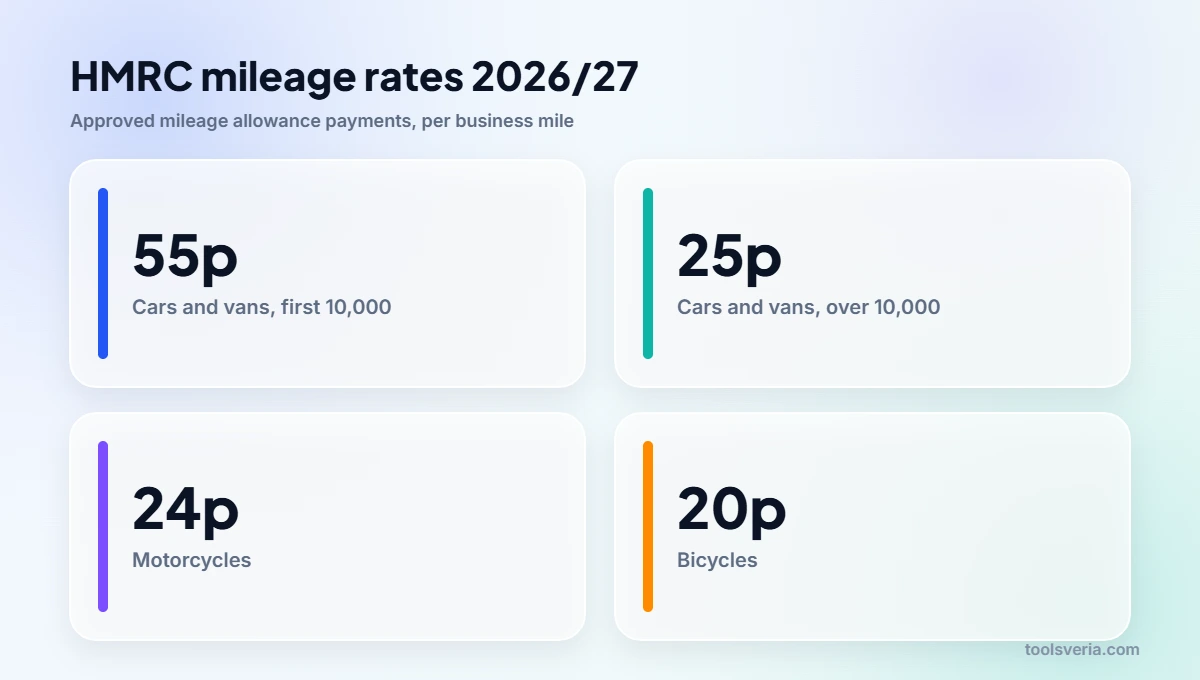
Payroll teams usually call these AMAPs, short for approved mileage allowance payments. The headline change for 2026/27 is the first car and van band, which jumped to 55p after sitting at 45p for well over a decade. Everything else is listed here:
| Vehicle | First 10,000 business miles | Over 10,000 business miles |
|---|---|---|
| Cars and vans | 55p a mile | 25p a mile |
| Motorcycles | 24p a mile | 24p a mile |
| Bicycles | 20p a mile | 20p a mile |
| Passenger in your car on the same business trip | 5p a mile per passenger | 5p a mile per passenger |
Under the HMRC mileage allowance 2026/27 rules, miles are tallied per tax year, so a driver who hits 10,000 in January starts again from zero in April. Think of the 55p as an all in figure: fuel, insurance, tyres, servicing and depreciation are all assumed to be inside it, so none of those can be added on as a separate claim. For awkward cases such as several employers or a shared car, the GOV.UK rules on business travel mileage are the place to check the detail.
Worked examples for employees
Example 1: Priya covers a whole sales region
Priya clocks up 12,000 business miles in her own car over 2026/27. Her first 10,000 miles at 55p total £5,500, and the next 2,000 at 25p bring in £500. Her company can reimburse the full £6,000 without any tax charge and without reporting it to HMRC.
Example 2: Gareth’s firm still pays 30p
Gareth, a service engineer, logs 8,000 business miles and receives 30p for each, so £2,400. At 55p he could have had £4,400 tax free. The £2,000 shortfall becomes Mileage Allowance Relief, which comes off his taxable pay rather than arriving as cash. Paying basic rate tax, he keeps 20% of £2,000, or £400; a colleague on higher rate would keep £800.
Example 3: Ellie’s employer pays 60p
Ellie drives 6,000 business miles and is paid 60p a mile, £3,600 in all. Only £3,300 (6,000 at 55p) is covered by the approved rate. Her employer must report the surplus £300, which is taxed as pay, while the £3,300 underneath stays free of tax.
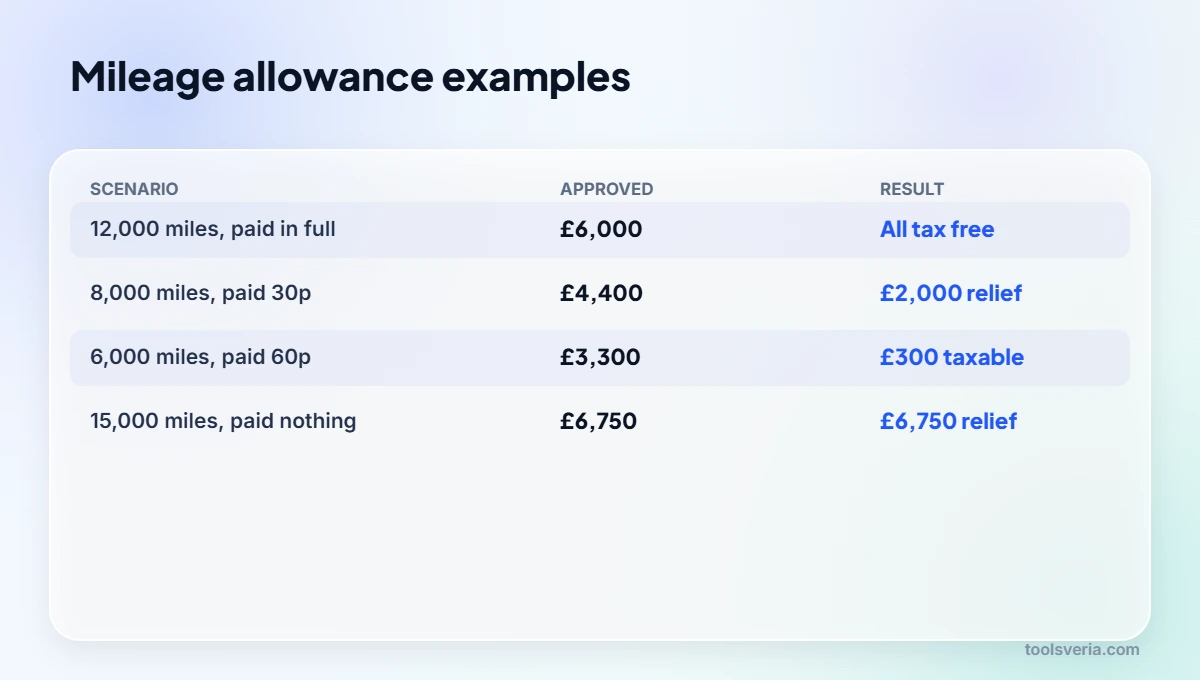
| Scenario | Approved amount | Paid by employer | Result |
|---|---|---|---|
| 12,000 miles, paid 55p then 25p | £6,000 | £6,000 | All tax free |
| 8,000 miles, paid 30p | £4,400 | £2,400 | £2,000 relief, worth £400 at 20% |
| 6,000 miles, paid 60p | £3,300 | £3,600 | £300 taxable |
| 15,000 miles, paid nothing | £6,750 | £0 | £6,750 relief, worth £1,350 at 20% |
Look hard at the bottom row. Someone driving 15,000 business miles with no reimbursement is owed relief on 10,000 at 55p (£5,500) plus 5,000 at 25p (£1,250), so £6,750, which puts £1,350 back in a basic rate taxpayer’s pocket. Rather than splitting the bands by hand, type your miles and your employer’s rate into the mileage allowance calculator and it handles the 10,000 mile break automatically.
How Do You Claim HMRC Mileage Allowance Relief?
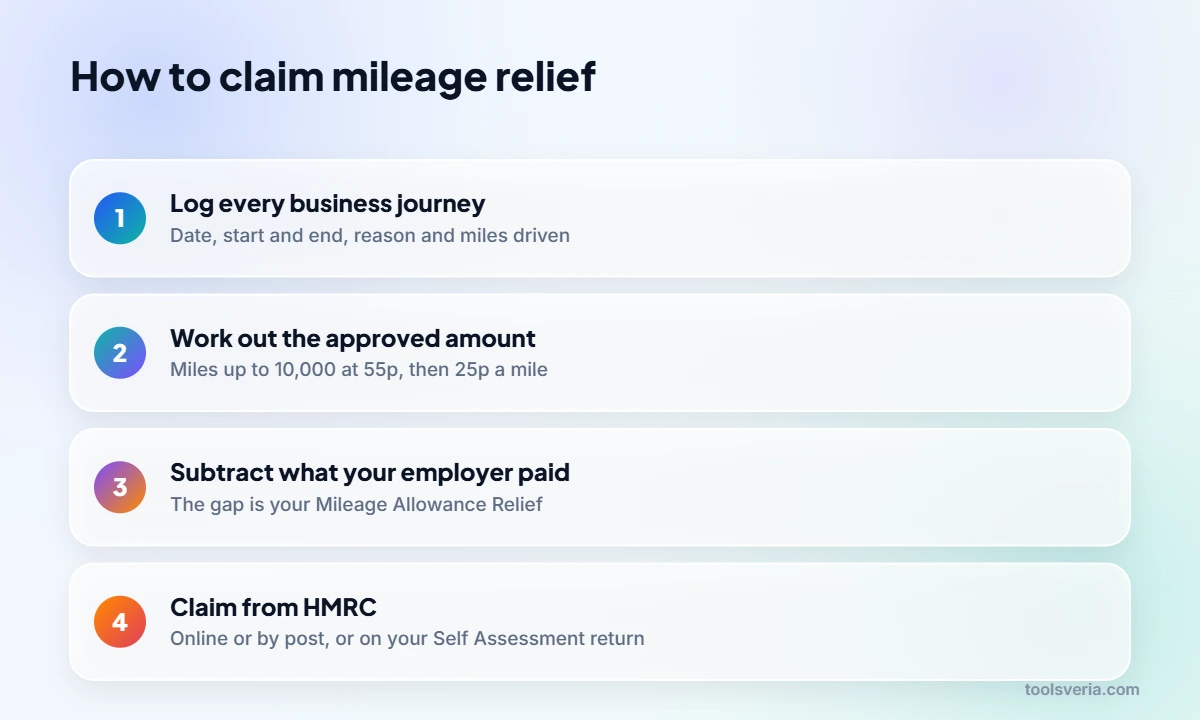
The relief comes straight from HMRC rather than your employer, and the route you take depends on whether you already file a tax return. Gareth’s employer has no part to play in his claim; the relief comes straight from HMRC. Which route he takes depends on whether he already files a tax return:
- No Self Assessment return? Use the online claim service or the paper form on GOV.UK, and HMRC will normally either change your tax code or send you a refund.
- Already filing a return? Put the figure in the employment section of that return instead.
Missed claims are rarely gone for good, since HMRC generally accepts claims stretching back four tax years alongside the current one. Gareth could therefore recover several years of underpaid mileage in one go. Eligibility and the claim link are on the GOV.UK page on relief for work vehicles.
What Counts as Business Mileage for HMRC?
A trip qualifies when the job itself sends you somewhere, but the daily run from home to your usual office never qualifies. A trip qualifies when the job itself sends you somewhere. Priya’s drive to a customer in Leeds counts, as does Gareth’s hop between two sites mid shift, and so would a week at a training centre that is only a temporary workplace. The daily run from home to your usual office never qualifies, even if you spend the whole drive on a work call.
Record each business journey as it happens: date, where you set off, where you went, why, and the miles. A phone note or spreadsheet filled in on the day carries far more weight with HMRC than a list pieced together from a diary the following spring, and it turns the year end sum into a five minute job.
Curious how much of that 55p actually goes into the tank? Jot down the litres at each fill and the MPG calculator converts them into pence per mile. If fuel costs you 17p a mile, the remaining 38p is what the allowance leaves for insurance, servicing and the car losing value.
What Mileage Rates Can Sole Traders Claim in 2026/27?
Sole traders and business partners can apply the same HMRC flat rates to cars, vans and motorbikes under simplified expenses in 2026/27. Sole traders and business partners can apply the same HMRC mileage allowance 2026/27 flat rates to cars, vans and motorbikes under simplified expenses. Nadia, a wedding photographer, drives 9,000 business miles in 2026/27. Rather than totting up fuel receipts, insurance, repairs and a share of what the car cost, she multiplies 9,000 by 55p and deducts £4,950 from her profits.
Two catches apply. Nadia cannot mix the flat rate with actual running costs for one vehicle, and once she picks simplified expenses for that car she has to stick with them for as long as it is used in the business. That £4,950 deduction cuts her tax bill, and the self employed tax calculator shows exactly how much it saves in income tax and Class 4 National Insurance.
Key points
- Cars and vans earn 55p a mile for the first 10,000 business miles of 2026/27, then 25p.
- Motorbikes get 24p, bicycles 20p, and each business passenger adds 5p.
- Underpaid drivers like Gareth claim relief on the gap from HMRC directly.
- Home to normal workplace driving never qualifies.
- A log written on the day is your best evidence.
Frequently Asked Questions
I passed 10,000 business miles in February. What rate applies to March?
25p a mile for cars and vans until the count resets on 6 April. Motorbikes stay at 24p and bicycles at 20p all year, whatever the distance.
My company pays 60p a mile. Will I be taxed on any of it?
Only on the extra 5p above the approved rate. On 6,000 miles, as in Ellie’s case, that means £300 is taxable and £3,300 is not.
Can I claim my insurance and MOT on top of the 55p?
No. HMRC treats the mileage rate as covering every running cost, from fuel and insurance through to servicing and depreciation, so there is nothing extra to add.
My employer pays nothing for my 15,000 business miles. Do I get £6,750 back?
Not as cash. The £6,750 reduces your taxable income, so a basic rate taxpayer gets £1,350 back and a higher rate taxpayer gets £2,700.
With the first band now at 55p, an untracked business mile costs you more than it ever has. Keep the log going from the first trip of the year, compare each payslip’s mileage line with the approved figure, and send HMRC a claim for any gap rather than funding your employer’s travel out of taxed income.