Sam rigs lighting for an events company. Some months he is booked almost every day, other months he gets a handful of shifts, and for years nobody could tell him clearly how much paid leave that patchy pattern earned. Questions about holiday pay for irregular hours used to land on payroll desks with no tidy answer, and casual staff, bank nurses and term time assistants were often given different figures by different employers.
Quick answer: Under holiday pay irregular hours rules, workers whose leave year began on or after 1 April 2024 build up leave at 12.07% of the hours worked in each pay period. The figure is 5.6 weeks divided by the 46.4 weeks a full timer works, so 120 hours of shifts earns 14.48 hours of paid leave.
Holiday pay irregular hours rules changed for leave years beginning on or after 1 April 2024. Workers like Sam now build up leave at 12.07% of the hours they actually put in during each pay period. Below we follow his payslips for three months, show where the 12.07% figure is derived from, and compare the two ways his employer is allowed to hand over the money.
In This Guide
Does the 12.07% Holiday Pay Irregular Hours Rule Cover Your Contract?
Two kinds of worker fall under the holiday pay irregular hours rules. The first is someone like Sam, whose paid hours swing from one pay period to the next, as on a zero hours deal or a casual bank. The second is the person who works only certain stretches of the year and receives nothing for the weeks in between, which describes many school support staff, summer festival crews and Christmas warehouse temps.
Sam’s colleague Aisha is different. She works Monday to Wednesday every single week, so hours never come into her calculation. Her leave is simply 5.6 lots of her three day week, which is 16.8 days, while a five day colleague reaches 28 days, the statutory ceiling. The GOV.UK holiday entitlement guide covers both routes, so match your contract to the right one before adding anything up.
Why Is Holiday Pay 12.07% and Not 10%?
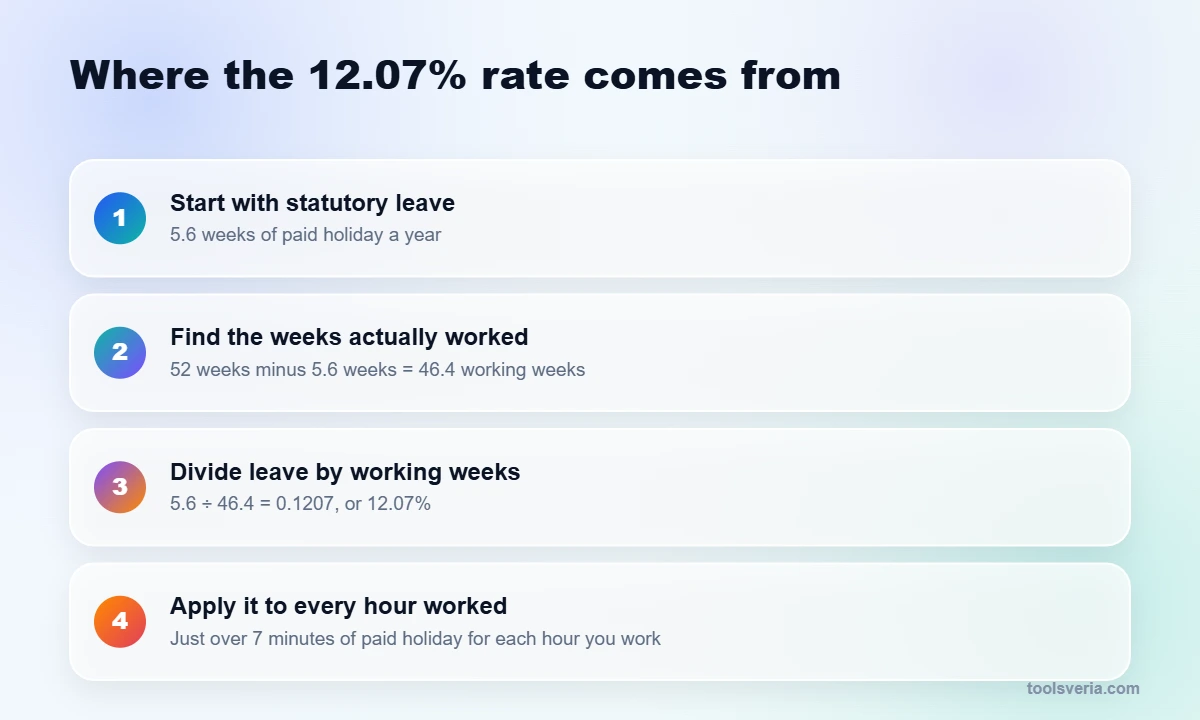
A full time worker gets 5.6 weeks off with pay, so across a 52 week year they are at work for 46.4 weeks, and 12.07% is that leave as a share of working time. Think about a full time colleague in Sam’s office. The law gives them 5.6 weeks off with pay, so across a 52 week year they are actually at work for 46.4 weeks. Their leave, as a share of the time they spend working, is therefore:
5.6 ÷ 46.4 = 0.1207, or 12.07%
Put in everyday terms, each hour Sam spends on a rig earns him a little over seven minutes of paid time off. Dividing by 52 instead of 46.4 would give roughly 10.77%, which short changes him, because the full timer is not working during their own holiday weeks. Whatever he builds up, the statutory part still tops out at 5.6 weeks in a leave year, though nothing stops an employer offering a more generous contract.
Sam’s Leave Over One Autumn
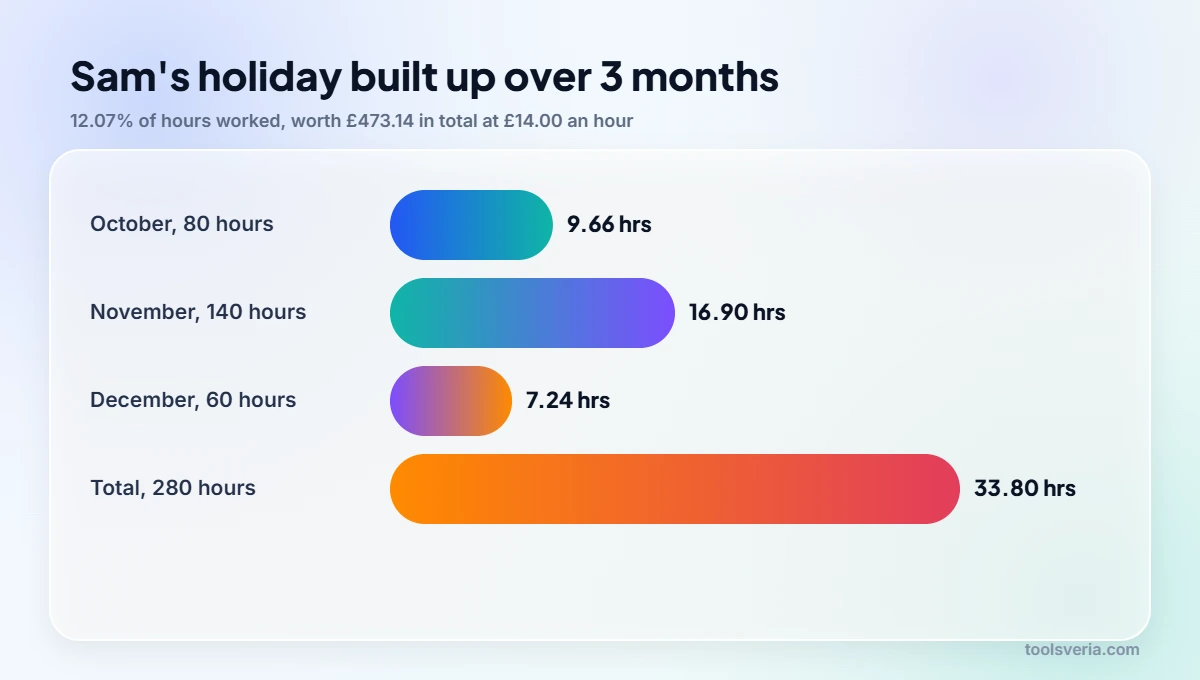
Sam is paid monthly at £14.00 an hour. At the close of each month, payroll takes the hours on his timesheet and multiplies them by 12.07% to see how much leave he has added.
| Month | Hours worked | Holiday accrued (× 12.07%) | Value at £14.00 an hour |
|---|---|---|---|
| October | 80 | 9.66 hours | £135.18 |
| November | 140 | 16.90 hours | £236.57 |
| December | 60 | 7.24 hours | £101.39 |
| Total | 280 | 33.80 hours | £473.14 |
By New Year he has 33.80 hours banked. His usual call is 7.5 hours, so that is roughly four and a half days he can take off with pay. November, with its run of Christmas parties, added close to double October’s leave, and that is how it should be: the more he works, the more rest he earns.
The holiday pay irregular hours calculation runs once per pay period, so weekly paid staff add leave every week and monthly paid staff every month. Sam keeps his start and finish times in a phone note, and totalling them in our time card calculator before payday lets him check the 12.07% line on his payslip in under a minute.
Putting a Pound Figure on Each Day Off
Banking hours is one half of the job. The other is deciding what each of those hours pays when Sam actually books a week off. For variable hours staff, the usual approach is to average his weekly pay across the last 52 weeks in which he earned something, skipping any blank weeks. That 52 week look back has been the standard since April 2020, and it stops one quiet January from dragging his holiday rate down.
For the first four weeks of statutory leave, basic pay alone is not enough. The government guidance on the 2024 holiday pay reforms lists what else has to go into the average: overtime he works regularly across that 52 week window, commission tied to his output, and any extra paid for seniority or a professional qualification. The final 1.6 weeks can be paid at the plain basic rate. Sam often stays late on derig nights, so he checks that those overtime earnings are in the average, since leaving them out would make each holiday day worth less.
What Is Rolled Up Holiday Pay?
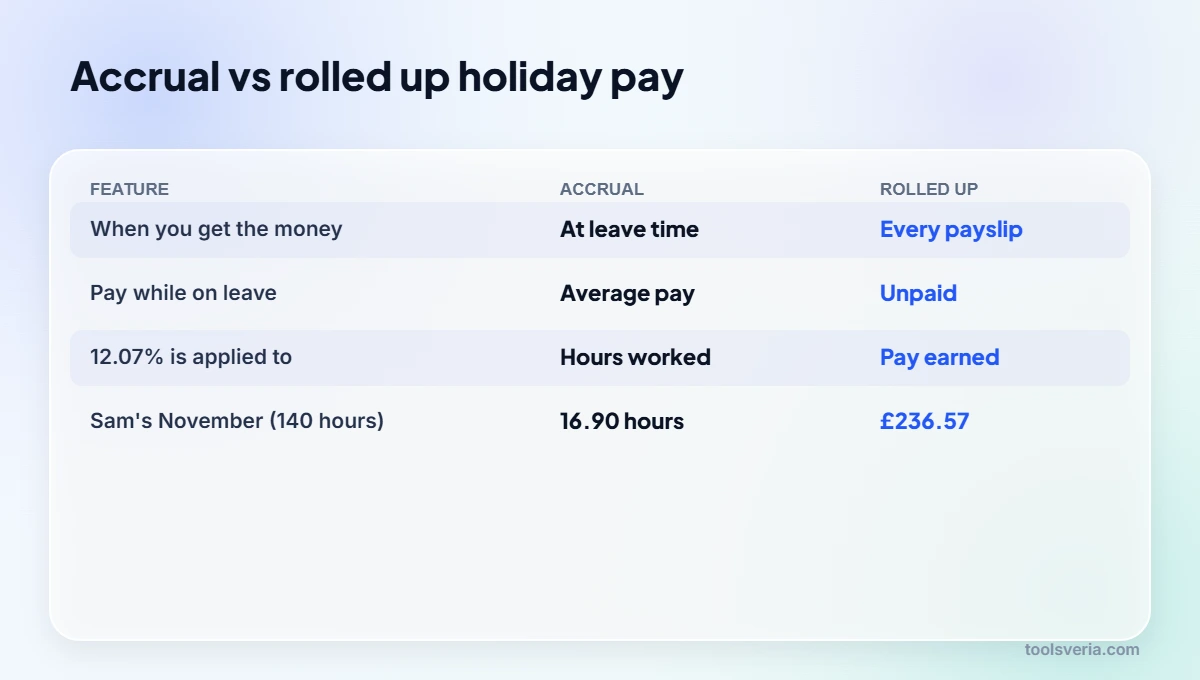
Rolled up holiday pay is an option that only exists for irregular hours and part year staff, where each payslip carries an extra 12.07% on top of earnings. Sam’s employer could instead choose rolled up holiday pay, an option that only exists for irregular hours and part year staff. Under it, nothing is held back for later. Each payslip carries an extra 12.07% on top of his earnings, and when he does take a break, those days come without pay because he has had the money already.
Take his busy November: 140 hours at £14.00 comes to £1,960.00. A rolled up payslip would add 12.07% of that, £236.57, on its own clearly labelled line. Month by month those extras add up to the value of his full statutory leave.
| Feature | Accrual (paid when leave is taken) | Rolled up holiday pay |
|---|---|---|
| Who it applies to | Irregular hours and part year workers | Irregular hours and part year workers only |
| When you get the money | When you take the leave | With every pay packet |
| Pay while on leave | Paid at your average rate | Unpaid, as already received |
| Payslip | Shows holiday pay when leave is taken | Must show holiday pay as a separate item every time |
Payroll teams like this method because it is easy to run, yet it leaves the budgeting to Sam. A fat November payslip is partly money for a February week off, and spending it all in December means an unpaid week later. His fix is to move the holiday line into a separate account on payday, and our savings interest calculator shows what that small pot earns while it sits there.
Payslip Errors Sam Learned to Spot
- 12.07% applied to a fixed week. Aisha’s Monday to Wednesday pattern uses 5.6 times her working week, not an hourly percentage.
- The percentage taken from the wrong base. Accrual multiplies hours worked; rolled up pay multiplies money earned.
- Holiday pay hidden inside a higher hourly rate. It has to sit on its own line every payday, or there is no way to see it was paid.
- Regular late finishes left out. Overtime worked as a normal habit, plus commission linked to output, belongs in the average for the first four weeks.
- Leave counted past the ceiling. The statutory share stops at 5.6 weeks per leave year, even if a contract adds more on top.
Key Points
- Variable hours and part year staff add leave at 12.07% of hours worked each pay period.
- The rate is 5.6 weeks off divided by the 46.4 weeks a full timer spends working.
- It covers leave years that began on or after 1 April 2024.
- The value of a day off normally reflects average pay over the last 52 weeks with earnings.
- Rolled up pay adds 12.07% to every payslip on a separate line, and leave is then unpaid.
Frequently Asked Questions
I did 120 hours of shifts last month. How much leave should my payslip show?
Multiply 120 by 0.1207 and you get 14.48 hours. If your employer rolls holiday pay up instead, the 0.1207 is applied to your pay for the month rather than your hours.
My agency adds a holiday line to every payslip. Is that allowed?
Yes, if you work irregular hours or part of the year and your leave year began on or after 1 April 2024. It must be paid alongside the wages it relates to and listed separately, as with Sam’s £236.57 in November.
My zero hours contract says nothing about holiday. Do I still get any?
You do. Statutory leave is a legal right that a contract cannot remove, and on variable hours it usually builds up at 12.07%, so 80 hours of work earns 9.66 hours off.
I work casual shifts in Belfast. Does 12.07% apply to me?
Not automatically. The 2024 reforms were made for Great Britain, and Northern Ireland has separate working time rules, so check nidirect or ask your employer which method they use.
Sam now checks two lines every payday: the hours he worked and the leave or holiday pay added for them. Once you know that 12.07% simply mirrors a full timer’s 5.6 weeks, spotting an error becomes easy, and raising it quickly is the surest way to get it corrected.