
Hannah owes £3,000 on a credit card charging 24.9% APR, and her statement asks for a minimum of £86.10. She paid exactly that for a year before asking the obvious question: how long to pay off credit card debt at this pace? The honest answer was about 15 years, and the fix turned out to be one simple change.
Three things set your timeline: the balance, the interest rate and what you pay each month. Below we run Hannah’s numbers through every realistic payment level, show the formula behind them and explain what UK rules require your card provider to do if the balance barely moves.
Quick answer: A £3,000 credit card balance at 24.9% APR takes 26 months to pay off at a fixed £150 a month, costing £792.64 in interest. Paying only a typical UK minimum of 1% plus interest, with a £25 floor, stretches it to about 15 years and £4,533 of interest. Tools Veria calculations, October 2026.
In This Guide
How long does it take to pay off a credit card?
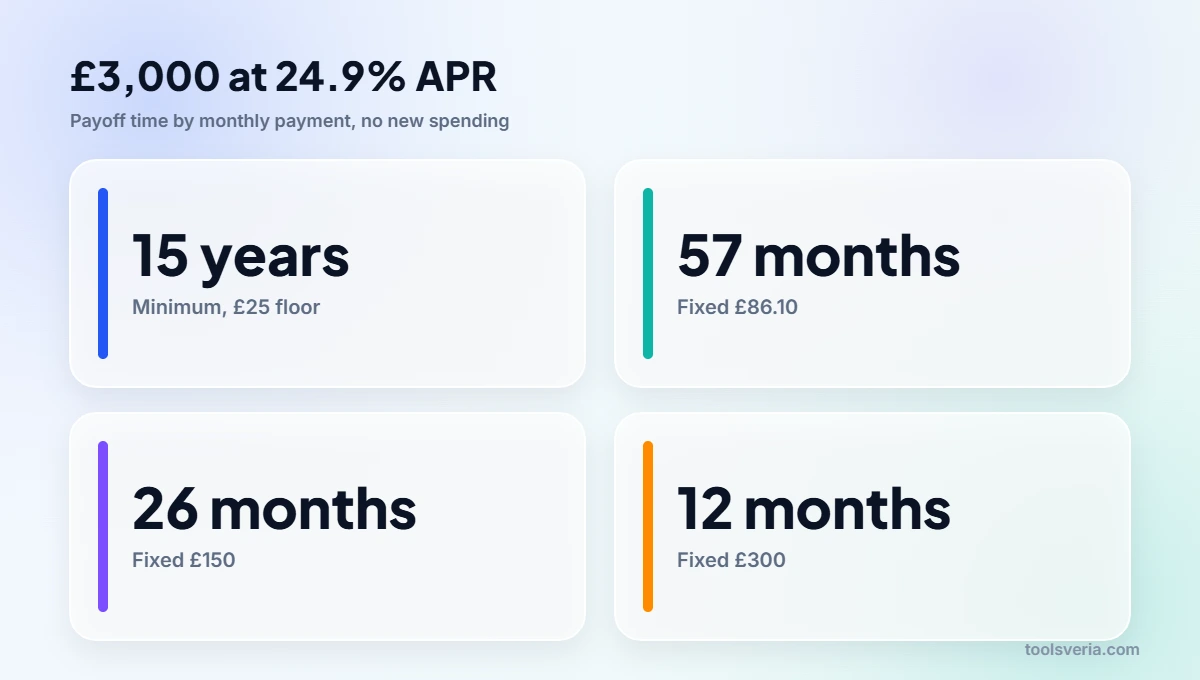
Paying off a £3,000 credit card at 24.9% APR takes between 12 months and about 28 years, depending entirely on the monthly payment. Every figure below assumes Hannah spends nothing new on the card and the rate stays the same.
| Monthly payment | Time to clear £3,000 | Total interest |
|---|---|---|
| Minimum, 1% plus interest, £5 floor | 28 years 5 months | £5,394.92 |
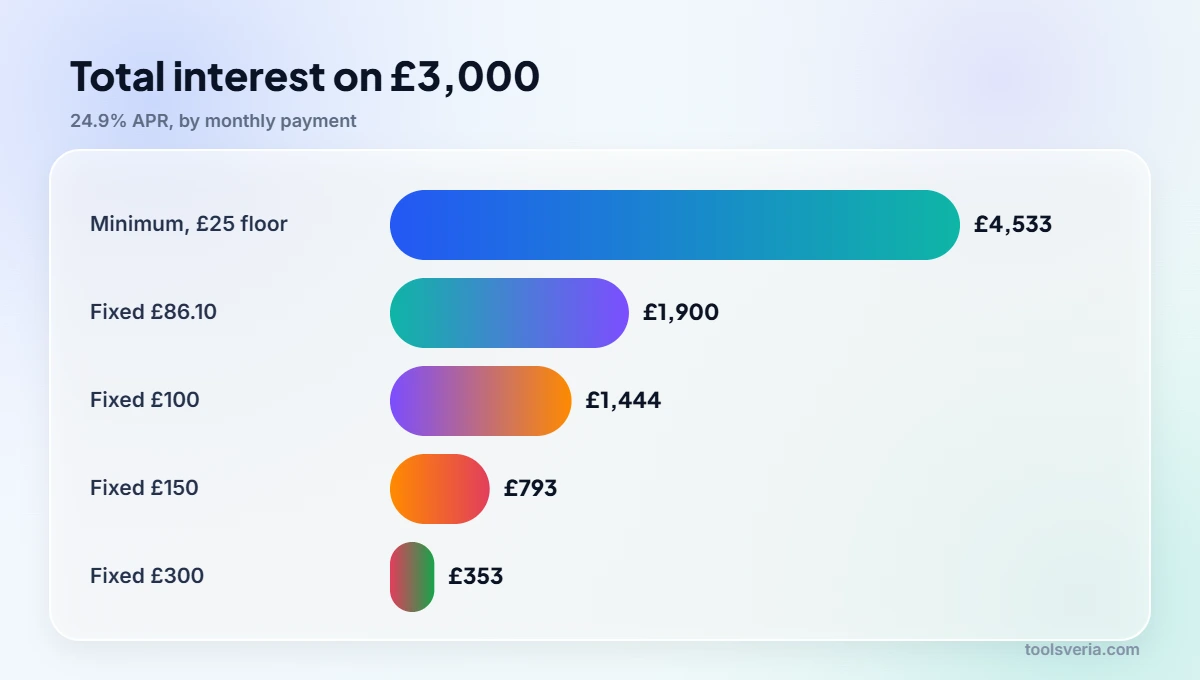
| Minimum, 1% plus interest, £25 floor | 15 years | £4,533.01 |
| £86.10 fixed (first minimum, kept level) | 4 years 9 months | £1,899.93 |
| £100 fixed | 3 years 9 months | £1,443.88 |
| £150 fixed | 2 years 2 months | £792.64 |
| £200 fixed | 1 year 6 months | £554.04 |
| £300 fixed | 1 year | £352.63 |
The jump between the first two rows and the third is the key finding. Hannah’s single change was to stop letting the payment shrink: she set a direct debit for a fixed £86.10, the same amount her first statement asked for, and her payoff time fell from 15 years to under 5 without finding a penny more.
Why do minimum payments take so long?
Minimum payments take so long because most of each one covers that month’s interest, and the minimum falls as the balance falls, so the debt shrinks more slowly every month. Many UK cards set the minimum at 1% of the balance plus interest and fees, or a fixed floor, whichever is higher.
At 24.9% APR, Hannah’s card charges about 1.87% a month. In month one that is £56.10 of interest on £3,000, so her £86.10 minimum knocks just £30 off the balance. The next month the minimum is slightly lower, and so on. The MoneyHelper guide to persistent debt describes typical minimums of around 2.5% of the balance or £5 to £25, so check the exact formula printed on your own statement, because it changes the answer.
One hard limit applies to everyone. If your payment is lower than the monthly interest, £56.10 in Hannah’s case, the balance grows instead of shrinking and the card will never be cleared.
What is the formula for credit card payoff time?
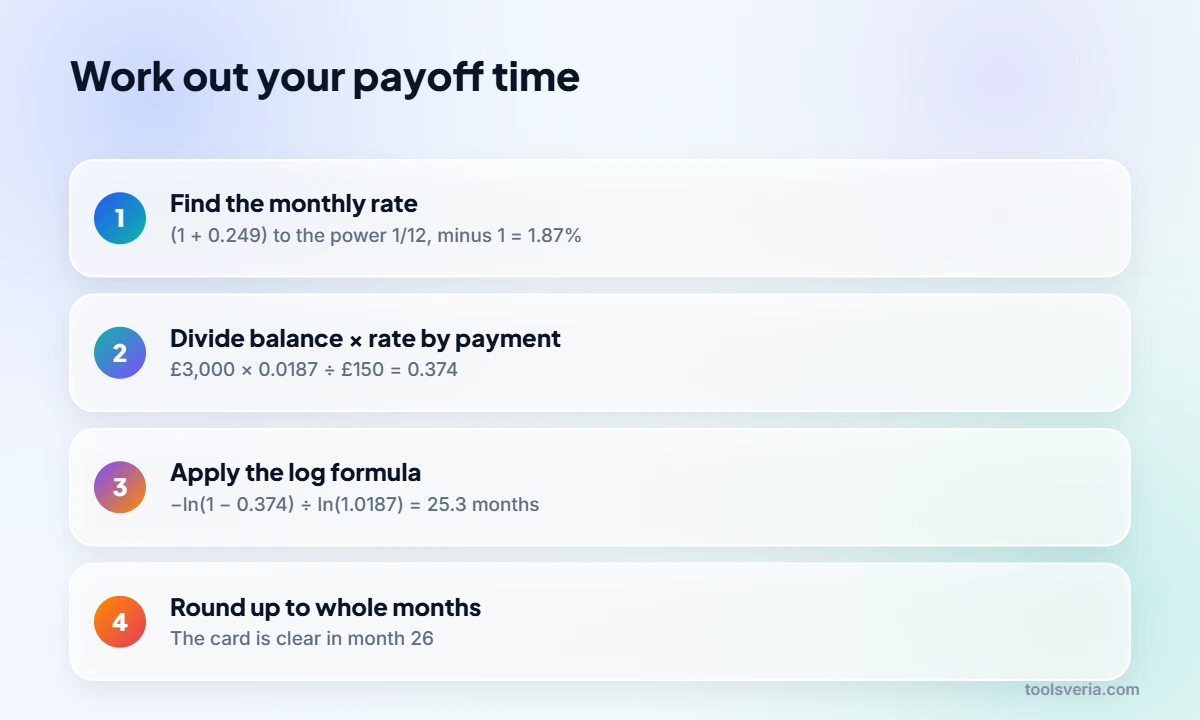
The formula for credit card payoff time is: months equals minus the natural log of (1 minus balance times monthly rate divided by payment), divided by the natural log of (1 plus monthly rate). The monthly rate comes from the APR as (1 + APR) to the power of one twelfth, minus 1.
- Monthly rate: 1.249 to the power of 1/12, minus 1, gives 0.0187, or 1.87%.
- Balance times rate over payment: £3,000 × 0.0187 ÷ £150 gives 0.374.
- Minus ln(1 minus 0.374) is 0.468, and ln(1.0187) is 0.0185.
- 0.468 ÷ 0.0185 gives 25.3, so the card is clear in the 26th month.
To work backwards from a target date, the same maths gives the payment you need. Clearing Hannah’s £3,000 in 12 months takes £281.42 a month, in 24 months £156.29 and in 36 months £115.26. Our loan calculator uses the identical repayment formula, which helps if you are weighing a consolidation loan against your card.
What happens if you only pay the minimum for 18 months?
If you pay more in interest, fees and charges than you repay of the balance over 18 months, the FCA treats you as being in persistent debt, and your card provider must contact you about paying more. Hannah crossed that line: in her first 18 months on minimums she paid £928.44 of interest and cleared only £496.46 of the debt.
The process does not stop at one letter, and each stage gives the provider a firmer duty towards you. Under the credit card rules the FCA introduced in 2018, a second prompt follows at 27 months, and once you reach 36 months the provider must offer a way to repay within a reasonable period. If you genuinely cannot afford that, it should show forbearance, which can mean reducing, waiving or cancelling interest, fees or charges, and it may suspend the card.
These letters are worth answering rather than ignoring. Free, confidential debt advice from MoneyHelper, StepChange or National Debtline is available if the numbers do not add up.
How can you pay off a credit card faster?
You pay off a credit card faster by fixing your payment at a set amount, adding even small extra sums, and cutting the interest rate through a 0% balance transfer if you qualify. Each step changes a different part of the formula.
Fix the payment, then nudge it up
Moving from £86.10 to £100 a month cuts Hannah’s time by a full year and saves £456 of interest. Going to £150 saves another £651. A direct debit for a fixed amount removes the temptation to pay whatever the statement suggests.
Try a 0% balance transfer
Suppose Hannah is accepted for a card with a 3% transfer fee and 20 months at 0%. Her £3,000 becomes £3,090, and £154.50 a month clears it before the offer ends, with the £90 fee as the only cost. Under many card terms a single late payment cancels the offer, and whatever is still owed when the 20 months end starts collecting interest at the standard APR.
Keep a small buffer
A modest cash cushion stops one unexpected bill from going back on the card. Our emergency fund calculator sets a sensible target, while every spare pound above it usually does more work against a 24.9% card than in a savings account.
A second example shows how rate and balance compound the problem. Daniel owes £6,000 at 29.9% APR. At a fixed £250 a month he is clear in 35 months with £2,633.38 of interest; on minimums of 1% plus interest with a £5 floor, he would still be paying after 34 years.
Key points
- A £3,000 balance at 24.9% APR clears in 26 months at £150 a month, with £792.64 of interest.
- Minimum payments of 1% plus interest with a £25 floor take about 15 years on the same balance.
- Fixing the payment at the first minimum, £86.10, cuts the time to 4 years 9 months.
- The FCA persistent debt rules start after 18 months of paying more in interest and charges than capital.
- A payment below the monthly interest means the balance will never be cleared.
Credit Card Payoff Terms Explained
These terms explain what decides how long to pay off credit card debt, from the interest rate to the minimum payment formula on your statement.
- Annual percentage rate (APR)
- The yearly cost of borrowing on a credit card, including interest and standard fees, expressed as a percentage. Card interest is charged monthly at roughly a twelfth of the annual figure on the outstanding balance.
- Minimum payment
- The smallest amount a cardholder must pay each month to keep the account in good standing. It is usually a percentage of the balance plus interest, or a fixed floor, so it shrinks as the debt falls and slows repayment.
- Persistent debt
- A situation, defined in UK consumer credit rules, where a cardholder pays more in interest, fees and charges than in capital over a sustained period. Card providers must then contact the customer and offer ways to repay faster.
- Amortisation
- The gradual reduction of a debt through regular payments that cover interest and part of the principal. A fixed payment speeds this up because, as interest falls, a growing share of each payment clears the balance.
- Balance transfer
- Moving a credit card balance to another card, often with a promotional low or zero interest rate for a limited time in exchange for a fee. It can cut interest costs if the debt is cleared before the offer ends.
- Negative amortisation
- An increase in the amount owed that occurs when a payment is smaller than the interest charged for the period. The unpaid interest is added to the balance, so the debt grows despite regular payments.
Frequently Asked Questions
I owe £3,000 and want to be clear in two years. What should I pay?
At 24.9% APR you need to pay about £156.29 a month to clear £3,000 in 24 months, with roughly £751 of interest. A lower APR or a 0% transfer reduces that monthly figure.
My minimum payment keeps dropping. Is that good news?
Not really, because a falling minimum slows your progress. Keep paying the higher amount you paid at the start, and on a £3,000 balance at 24.9% APR you cut the payoff time from about 15 years to 4 years 9 months.
Does paying twice a month clear the card faster?
Yes, slightly, because interest on many UK cards is worked out on the daily balance, so paying earlier lowers it. The bigger gain comes from the total you pay each month, not how many payments you split it into.
I got a persistent debt letter from my card provider. What now?
Reply and say what you can afford to pay, because FCA rules require the provider to help you clear the balance in a reasonable time. If you cannot increase payments, ask about reduced interest and contact a free debt advice service.
Hannah’s card will be clear in under five years at no extra monthly cost, and in just over two if she reaches £150. Enter your own balance, APR and payment to see your date and total interest. Figures checked October 2026.