
Leah has just started lifting weights twice a week, and the gym’s protein shake advert says she needs 150 g a day. Her mum, who is 72, has been told by a nurse to eat more protein, and her dad thinks they both just need more steak. The honest answer to how much protein do I need a day depends on your weight, your age and what you are asking your body to do.
The sums are simple multiplications, so you can work them out in under a minute. Below are the UK baseline, the higher targets that apply to training, dieting and later life, a table you can read your answer from, and what those grams look like on a plate.
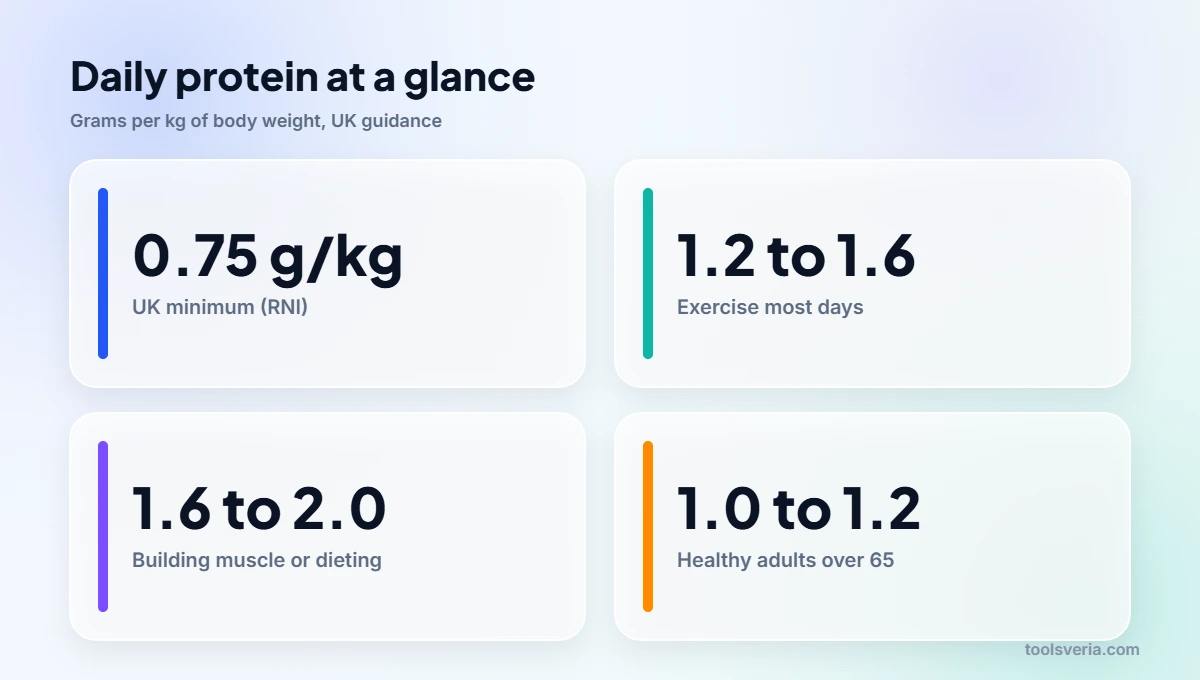
Quick answer: Most UK adults need at least 0.75 g of protein per kg of body weight a day, the UK Reference Nutrient Intake, which is about 45 g at 60 kg and 56 g at 75 kg. Regular exercisers usually aim for 1.2 to 1.6 g per kg, and adults over 65 for 1.0 to 1.2 g per kg.
In This Guide
How much protein does the average adult need a day?
The average healthy adult in the UK needs 0.75 g of protein for every kilogram of body weight each day, a figure known as the Reference Nutrient Intake. For a 60 kg woman that is 45 g, and for a 75 kg man it is about 56 g. American sites quote 0.8 g per kg, the US Recommended Dietary Allowance, which gives almost the same answer.
Treat this number as a floor rather than a goal. It was set to cover the basic needs of nearly everyone who is not especially active, and many people in Britain already eat more than that. Leah works in an office and weighs 68 kg, so her floor is 51 g. A bowl of porridge made with milk, a tuna sandwich and a chicken stir fry would clear that comfortably before any shake.
How do you work out your daily protein in grams?
You work out daily protein by multiplying your body weight in kilograms by the rate in grams per kg that matches your situation, so the answer to how much protein do I need a day is always a single multiplication. If you know your weight in stone, convert it first: multiply stones by 14, add the spare pounds, then multiply the total by 0.4536 to get kilograms.
| Body weight | 0.75 g/kg (UK minimum) | 1.0 g/kg | 1.2 g/kg | 1.6 g/kg | 2.0 g/kg |
|---|---|---|---|---|---|
| 55 kg (8 st 9 lb) | 41 g | 55 g | 66 g | 88 g | 110 g |
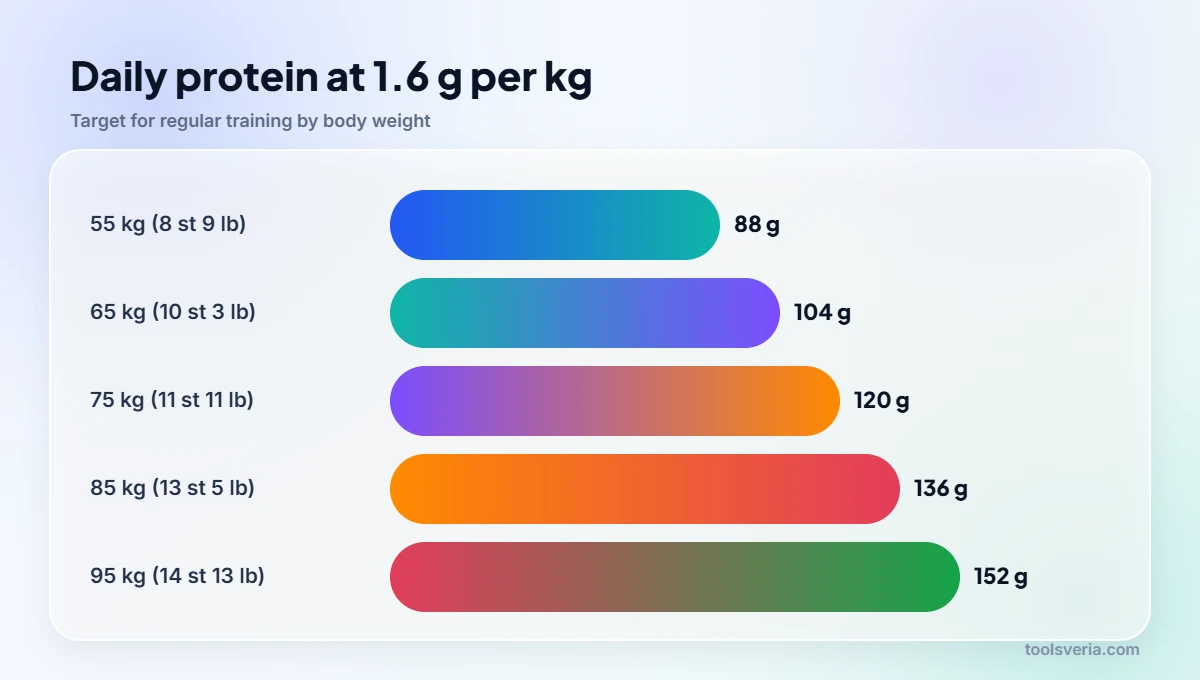
| 65 kg (10 st 3 lb) | 49 g | 65 g | 78 g | 104 g | 130 g |
| 75 kg (11 st 11 lb) | 56 g | 75 g | 90 g | 120 g | 150 g |
| 85 kg (13 st 5 lb) | 64 g | 85 g | 102 g | 136 g | 170 g |
| 95 kg (14 st 13 lb) | 71 g | 95 g | 114 g | 152 g | 190 g |
Mike weighs 12 stone exactly. That is 168 lb, or 76.2 kg, so his UK minimum is 57 g and a gym goer’s 1.6 g per kg target would be 122 g. If converting feels fiddly, our kg to stone converter gives the exact figure in both directions, and the protein calculator accepts stone directly.
How much protein do you need if you exercise or want to build muscle?
If you exercise on most days, 1.2 to 1.6 g of protein per kg is a sensible daily target, and people training hard to build muscle often aim for 1.6 to 2.0 g per kg. Above roughly 2.0 g per kg, there is little evidence of extra benefit for most people.
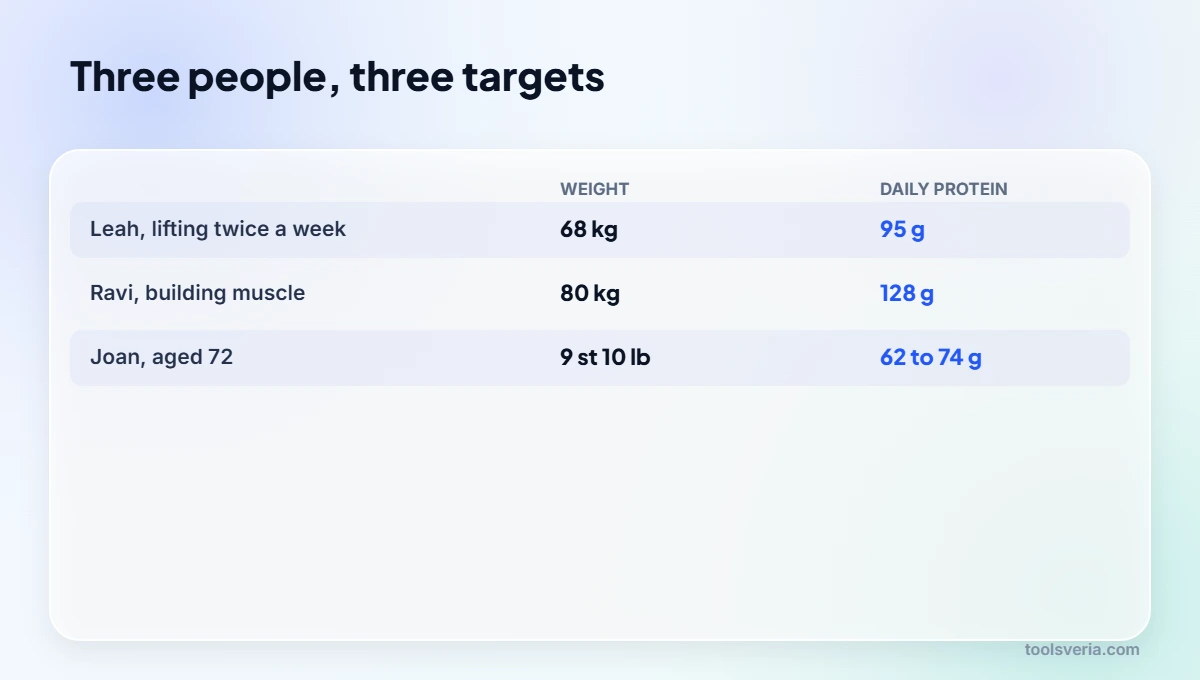
When sports scientists and dietitians set targets for active people, the most quoted guidance is the International Society of Sports Nutrition position stand on protein, which recommends 1.4 to 2.0 g per kg a day for people who exercise, spread across meals every three to four hours, with roughly 20 to 40 g at each sitting. Leah is lifting twice a week, so 1.4 g per kg is plenty: 68 × 1.4 gives 95 g, not the 150 g the advert suggested.
Ravi weighs 80 kg and trains four times a week to add muscle. At 1.6 g per kg he needs 128 g, and over four meals that is 32 g each, which is a chicken breast at dinner, a pot of Greek style yoghurt with a breakfast of eggs on toast, and so on. Splitting protein evenly tends to work better than squeezing most of it into the evening meal.
Do you need more protein when losing weight or getting older?
Yes, both situations call for more protein than the basic 0.75 g per kg: about 1.6 to 2.0 g per kg while dieting, and about 1.0 to 1.2 g per kg for healthy adults over 65. The reason is the same in both cases, holding on to muscle when the body is more inclined to lose it.
During a calorie deficit, extra protein helps you feel full and protects lean tissue, so more of what you lose is fat. If you are planning a full diet, our macro calculator sets protein by body weight first and fits fat and carbohydrate around it. For someone with a lot of weight to lose, many dietitians base the figure on goal weight to keep the number realistic.
Leah’s mum Joan is 72 and weighs 9 st 10 lb, which converts to 61.7 kg on the scales at her surgery. The PROT-AGE study group recommendations for older people suggest 1.0 to 1.2 g per kg for healthy over 65s, which gives Joan 62 to 74 g a day. Smaller appetites are common in later life, so protein at breakfast, such as eggs or yoghurt, often makes the target achievable when dinner alone cannot.
What does 25 g of protein look like in food?
About 25 g of protein is roughly a cooked chicken breast of 85 g, a small tin of drained tuna, or a large pot of Greek style yoghurt with a handful of nuts. Plant foods carry less per portion, so vegans and vegetarians usually combine two sources at a meal.
| Food and typical portion | Approx. protein |
|---|---|
| Cooked chicken breast, 100 g | 30 g |
| Tuna in spring water, drained, 100 g | 25 g |
| Firm tofu, 100 g | 12 to 14 g |
| Two medium eggs | 12 g |
| Greek style yoghurt (0% fat), 150 g pot | 15 g |
| Baked beans, half a 415 g tin | 10 g |
| Cooked red lentils, 100 g | 8 g |
| Semi skimmed milk, 250 ml | 9 g |
Values vary by brand, so check the label on what you buy. Beyond the grams, variety matters. The NHS Eatwell Guide recommends pulses such as beans, peas and lentils as lower fat sources that also bring fibre, at least two 140 g portions of fish a week with one of them oily, and eating less red and processed meat.
Can you eat too much protein?
For most healthy adults, eating up to about 2 g of protein per kg a day is not known to cause harm, but going much higher brings little benefit and can push fibre rich foods off the plate. People with kidney or liver disease are different and may need to limit protein, so they should follow advice from their GP or renal team.
The figures in this guide are estimates for healthy adults and are not medical advice. Speak to your GP, midwife or a registered dietitian before raising your protein if you have kidney disease, diabetes, gout or another long term condition, if you are pregnant or breastfeeding, if you are recovering from surgery or serious illness, or if you have lost weight without meaning to.
Key points
- The UK Reference Nutrient Intake for protein is 0.75 g per kg of body weight a day.
- A 60 kg adult needs at least 45 g of protein a day and a 75 kg adult about 56 g.
- Regular exercisers usually aim for 1.2 to 1.6 g per kg, and people building muscle or dieting for 1.6 to 2.0 g per kg.
- Healthy adults over 65 are advised to eat 1.0 to 1.2 g of protein per kg a day.
- Spreading protein across three or four meals of 20 to 40 g each works better than one large serving.
Key Protein Intake Terms You Should Know
These terms explain the numbers behind how much protein do I need a day, from the UK baseline to the higher rates used for training and later life.
- Protein
- A macronutrient made of chains of amino acids that the body uses to build and repair muscle, skin, enzymes and other tissues. Each gram supplies energy too, but its main role in daily targets is structural repair rather than fuel.
- Reference Nutrient Intake (RNI)
- The UK benchmark amount of a nutrient that covers the needs of almost everyone in a population group. For protein it is 0.75 g per kg of body weight a day, which acts as a minimum for inactive adults rather than an ideal goal.
- Recommended Dietary Allowance (RDA)
- The US equivalent of the UK reference intake, set by American nutrition authorities. For protein it is 0.8 g per kg of body weight, which is why American sources quote a slightly higher floor than British guidance for the same person.
- Grams per kilogram of body weight
- The rate used to scale protein needs to body size. Multiplying weight in kilograms by the chosen rate gives a daily target in grams, so an 80 kg person training at 1.6 g per kg needs 128 g.
- Muscle protein synthesis
- The process by which the body builds new muscle proteins after eating and exercise. It responds best to a moderate dose of protein at each meal, which is why spreading intake across the day is usually advised over one large serving.
- Sarcopenia
- The gradual loss of muscle mass and strength that comes with ageing. It is one reason older adults are advised to eat more protein per kilogram than younger adults, alongside regular strength exercise to help keep muscle working.
Frequently Asked Questions
I weigh 10 stone and walk most days. How much protein should I eat?
Ten stone is 63.5 kg, so the UK minimum is about 48 g a day. Daily walking is light activity, so 1.0 to 1.2 g per kg, or 64 to 76 g, is a comfortable target that ordinary meals can reach without shakes.
Do I need a protein shake after the gym?
No, a shake is only a convenient way to reach your daily total. A meal with 20 to 40 g of protein within a few hours of training does the same job, and your total for the whole day matters far more than exact timing.
I am vegetarian. Can I still hit 100 g a day?
Yes, with planning. Two eggs, a 150 g pot of Greek style yoghurt, 200 g of tofu, a 415 g tin of baked beans, 100 g of cooked lentils and 500 ml of milk together supply roughly 100 g. Combining dairy, eggs, soya and pulses across the day makes higher targets realistic.
Should my protein be based on my current weight or my goal weight?
Use current weight if you are near a healthy weight. If you have a lot to lose, goal weight gives a more realistic figure: at 110 kg with an 85 kg goal, 1.6 g per kg means 136 g instead of 176 g.
Leah settled on 95 g a day, Joan on about 70 g, and neither needed the steak her dad recommended. Enter your own weight and goal in the protein intake calculator, then plan meals around the per meal figure rather than one big dinner. Figures checked October 2026.