
Ollie is fitting a shelf and needs to stack a 3/8 inch spacer on a 5/16 inch batten. His daughter Isla, meanwhile, is following a recipe that calls for 2/3 of a cup of oats and 3/4 of a cup of milk. Both problems come down to how to add fractions, and both use the same four steps whether the numbers are inches, cups or homework.
This guide is written for students revising for exams, parents helping with homework and anyone who works with imperial measurements or recipes. It covers fractions with the same denominator, different denominators, mixed numbers, three or more fractions and negative fractions, and it shows the mistakes that cost marks.
Quick answer: To add fractions, give them a common denominator, then add the numerators and keep the denominator. For example, 1/4 + 1/6: the lowest common denominator is 12, so rewrite them as 3/12 + 2/12 = 5/12. If the denominators already match, just add the numerators: 2/9 + 5/9 = 7/9. Finally, simplify.
In This Guide
Why do fractions need a common denominator?
Fractions need a common denominator because you can only add pieces of the same size. The denominator, the bottom number, tells you how many equal parts make a whole; the numerator, the top number, tells you how many of those parts you have. The Wikipedia article on fractions sets out the terms formally.
Think of a pizza cut into quarters and another cut into sixths. One quarter plus one sixth is not “two somethings”, because the slices are different sizes. Cut both pizzas into twelfths, though, and a quarter becomes 3 slices while a sixth becomes 2. Now the slices match and you have 5 twelfths.
How to add fractions with the same denominator
When the denominators already match, add the numerators and keep the denominator unchanged. So 2/9 + 5/9 = 7/9, and 3/10 + 4/10 = 7/10. The denominator stays the same because the size of each piece has not changed; you simply have more pieces.
If the answer has a numerator bigger than its denominator, it is an improper fraction, and you may want to rewrite it as a mixed number. For example, 5/8 + 7/8 = 12/8. Eight goes into 12 once with 4 left over, giving 1 4/8, which simplifies to 1 1/2.

How do you add fractions with different denominators?
To add fractions with different denominators, find the lowest common denominator, convert each fraction so it uses that denominator, add the numerators, then simplify. Ollie’s shelf problem shows the four steps clearly.
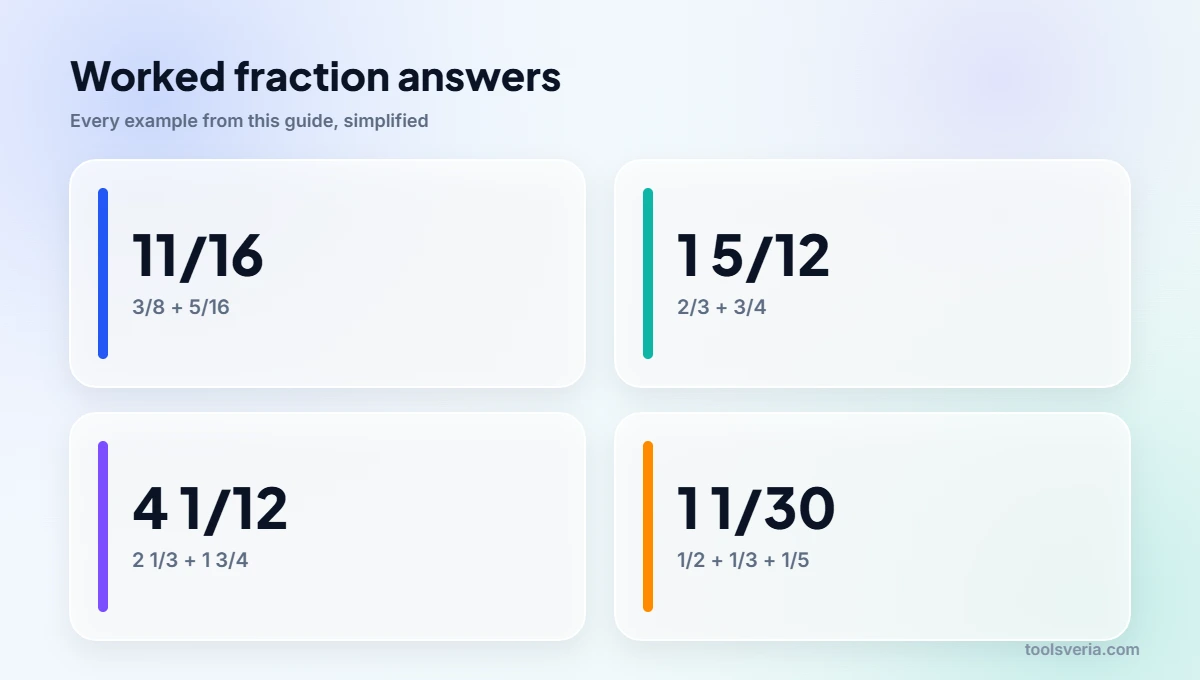
- Find the lowest common denominator of 8 and 16. Sixteen is a multiple of 8, so the answer is 16.
- Convert: 3/8 becomes 6/16, because both top and bottom are multiplied by 2. The 5/16 stays as it is.
- Add the numerators: 6/16 + 5/16 = 11/16.
- Simplify if possible. Eleven is prime and does not divide 16, so 11/16 inch is the final answer.
Isla’s recipe needs one more step. The denominators are 3 and 4, which share no factors, so the lowest common denominator is 3 × 4 = 12. Two thirds becomes 8/12 and three quarters becomes 9/12. Together they make 17/12, which is 1 5/12 cups. If your recipe is metric, converting first may be easier; our guide on converting centimetres to inches shows how imperial fractions arise from metric measurements in the first place.
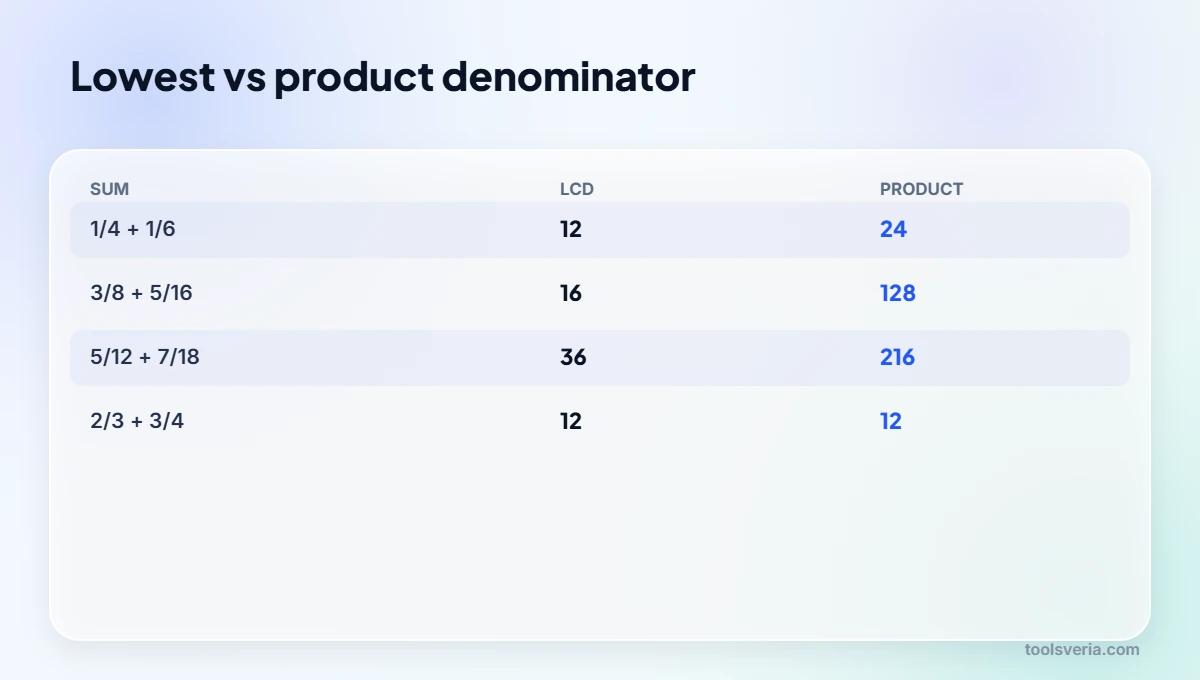
Finding the lowest common denominator quickly
The lowest common denominator is the least common multiple of the denominators. For small numbers, list multiples of the larger one until the smaller one divides it: for 4 and 6, the multiples of 6 are 6 and 12, and 4 divides 12, so the answer is 12.
For larger numbers, prime factors are quicker. Take 5/12 + 7/18. Twelve is 2 × 2 × 3 and eighteen is 2 × 3 × 3. Take each prime the greatest number of times it appears in either: two 2s and two 3s, which gives 36. So 5/12 becomes 15/36, 7/18 becomes 14/36 and the sum is 29/36.
You can always just multiply the denominators together. It gives a common denominator, but not always the lowest, so you will have more simplifying at the end.
| Fractions | Lowest common denominator | Product of denominators | Sum, simplified |
|---|---|---|---|
| 1/4 + 1/6 | 12 | 24 | 5/12 |
| 3/8 + 5/16 | 16 | 128 | 11/16 |
| 2/3 + 3/4 | 12 | 12 | 1 5/12 |
| 5/12 + 7/18 | 36 | 216 | 29/36 |
| 1/2 + 1/3 + 1/5 | 30 | 30 | 1 1/30 |
How do you add mixed numbers?
To add mixed numbers, either add the whole numbers and the fractions separately and then combine them, or convert both to improper fractions first. Both methods give the same answer. Try 2 1/3 + 1 3/4.
Using the first method, the whole numbers give 2 + 1 = 3. The fractions give 1/3 + 3/4 = 4/12 + 9/12 = 13/12, which is 1 1/12. Add that to 3 and you get 4 1/12. Using the second method, 2 1/3 is 7/3 and 1 3/4 is 7/4. Over a denominator of 12 these become 28/12 + 21/12 = 49/12, and 49 divided by 12 is 4 remainder 1, so 4 1/12 again.
The separate method is faster in your head, but watch the carry: when the fractions add up to more than one, the extra whole must move across. The improper method avoids that trap and is easier when negative numbers are involved.
Three fractions, negatives and simplifying
Three or more fractions work in exactly the same way, using one denominator for all of them. For 1/2 + 1/3 + 1/5 the lowest common denominator is 30, giving 15/30 + 10/30 + 6/30 = 31/30, or 1 1/30.
Negative fractions follow the usual sign rules once the denominators match. For 3/4 + (negative 5/6), convert to twelfths: 9/12 minus 10/12 gives negative 1/12. To simplify any answer, divide the top and bottom by their greatest common divisor. For 18/24 that divisor is 6, leaving 3/4.
A good final check is to convert to decimals. Since 1/4 is 0.25 and 1/6 is about 0.167, the sum should be about 0.417, and 5/12 is indeed 0.4167. The fraction to decimal converter does that check instantly, and the fraction calculator shows the simplified answer for any sum.
The mistakes that cost marks
The classic error is adding tops and bottoms: 1/2 + 1/3 written as 2/5. A moment’s thought shows it cannot be right, because 2/5 is smaller than 1/2, and adding a positive amount cannot make a number smaller. The correct answer is 3/6 + 2/6 = 5/6.
The second is changing the denominator without changing the numerator. Rewriting 3/8 as something over 16 means multiplying both numbers by 2, giving 6/16, not 3/16. The third is forgetting to simplify, which many exam mark schemes penalise when the question asks for the simplest form.
Key points
- Fractions can only be added once their denominators match.
- The lowest common denominator is the least common multiple of the denominators.
- Multiply top and bottom by the same number when converting: 3/8 becomes 6/16.
- Mixed numbers can be added in parts or as improper fractions: 2 1/3 + 1 3/4 is 4 1/12.
- Simplify by dividing by the greatest common divisor, so 18/24 becomes 3/4.
Key Fraction Addition Terms Explained
These terms describe each part of a fraction sum and each step in how to add fractions, from matching denominators to simplifying the final answer.
- Numerator
- The top number of a fraction, counting how many equal parts you have. When denominators match, only numerators are added, so 6/16 plus 5/16 gives a numerator of 11 over 16.
- Denominator
- The bottom number of a fraction, showing how many equal parts make one whole. Fractions can only be added once their denominators match, which is why 3/8 is rewritten as 6/16.
- Lowest common denominator
- The smallest number that every denominator in a sum divides into exactly, which is the least common multiple of the denominators. For 5/12 plus 7/18 it is 36.
- Mixed number
- A whole number written alongside a proper fraction, such as 4 1/12. Mixed numbers can be added in parts, carrying any extra whole, or after conversion to improper fractions like 49/12.
- Greatest common divisor
- The largest whole number that divides both the numerator and the denominator. Dividing by it puts a fraction into simplest form, so 18/24 divided through by 6 becomes 3/4.
Frequently Asked Questions
Can I just multiply the two denominators every time?
Yes, it always gives a common denominator, but not always the lowest. For 1/4 + 1/6 it gives 24 and an answer of 10/24, which you then have to simplify to 5/12. Using 12 from the start saves that step.
My child wrote 1/2 + 1/3 = 2/5. How do I explain the mistake?
Point out that 2/5 is less than 1/2, so adding something has made it smaller, which is impossible. Then cut a drawing into sixths: a half is 3 sixths, a third is 2 sixths, and together they make 5/6.
Do I have to turn an improper fraction into a mixed number?
Only if the question or context asks for it. In algebra, 17/12 is usually preferred. In a recipe or on a tape measure, 1 5/12 cups or 1 1/2 inches is far easier to use, so convert for practical tasks.
How do I add a whole number and a fraction?
Write the whole number next to the fraction as a mixed number. So 3 + 2/5 is 3 2/5. If you need an improper fraction, multiply 3 by 5 and add 2 to get 17/5.
Is subtracting fractions done the same way?
Yes. Find the common denominator, convert, then subtract the numerators instead of adding them. For 3/4 minus 1/6, use twelfths: 9/12 minus 2/12 leaves 7/12, which cannot be simplified further.
How can I check my answer without a calculator?
Estimate with benchmarks. Two thirds is a bit under 1 and three quarters is a bit under 1, so their sum should be a little under 2. An answer of 1 5/12 fits; an answer of 5/7 clearly does not.
Ollie’s spacer and batten together measure 11/16 inch, and Isla’s recipe needs 1 5/12 cups of liquid and oats combined. Whatever the numbers, knowing how to add fractions comes down to matching the denominators, adding the tops and simplifying. Figures checked October 2026.