Kieran supervises a warehouse shift in Derby on £15 an hour, and in the run up to Christmas he picks up weekend work most weeks. He assumed the law guaranteed him time and a half for it. It does not. Overtime pay in the UK is mostly a matter of contract, and the legal protections sit elsewhere: a floor on average pay, a ceiling on weekly hours, and rules on how regular extra work shows up in holiday pay.
Quick answer: Overtime pay UK employers offer is set by your contract rather than by law, and is worked out as extra hours × basic hourly rate × multiplier. On £15 an hour, time and a half is £22.50 and double time is £30, but average pay across every hour must still meet the £12.71 National Living Wage from April 2026.
Using Kieran’s payslip and two salaried colleagues, the sections below show how the usual enhanced rates are worked out, what tax takes from them, and which rights hold however your contract is worded.
In This Guide
Common Overtime Pay UK Rates Explained
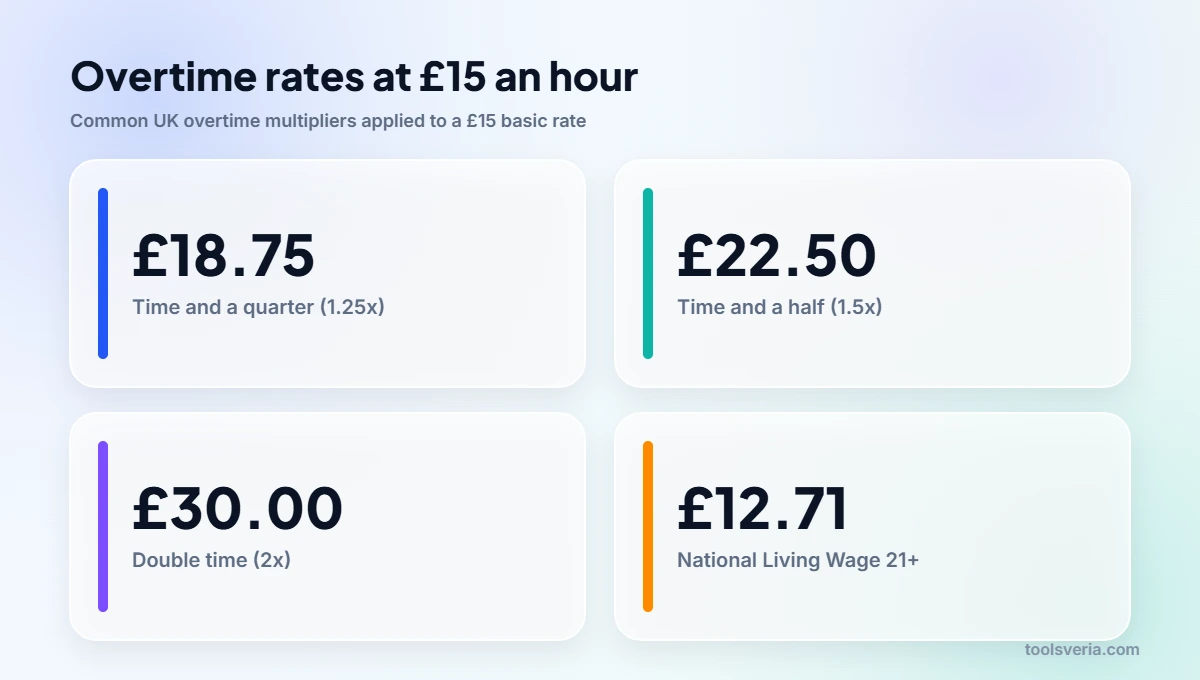
Hours past the ones in your contract are what payroll treats as overtime. Where a company pays a premium, it normally quotes it as a multiple of the basic hourly figure. Here is how those multiples look on Kieran’s £15:
- Time and a quarter (1.25x), £18.75: some firms use it for early starts or the first couple of extra hours.
- Time and a half (1.5x), £22.50: the rate most people meet for evenings and Saturdays.
- Double time (2x), £30: typical for Sundays, bank holidays and being called in at short notice.
- Plain time (1x), £15: the extra hours simply paid at the normal rate.
- Time off in lieu (TOIL): no extra cash, but the hours come back to you as paid leave later.
Part timers often see a twist. Kieran’s colleague Sam is contracted for 20 hours; when he does 25, his employer pays those 5 at his ordinary rate, and a premium only kicks in once his week passes the full time threshold. Check your handbook, since that is where this arrangement is normally written down.
How Do You Calculate Overtime Pay in the UK?
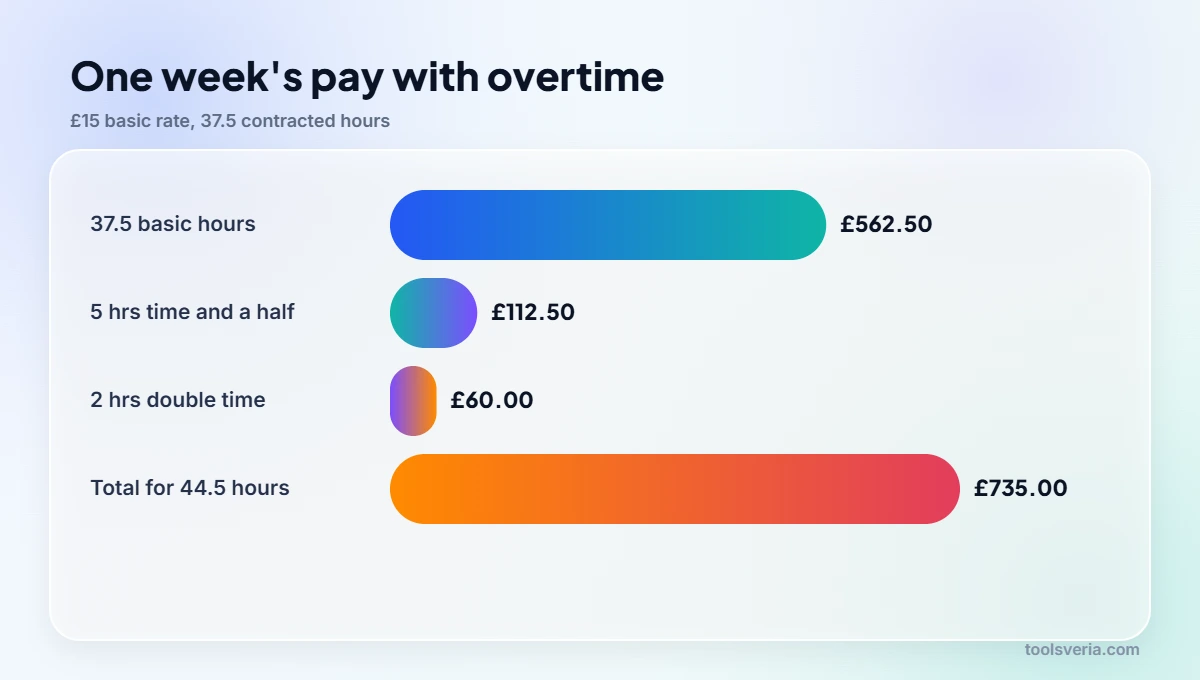
Three numbers multiply together to work out overtime pay: the extra hours, the basic rate and the multiplier. Three numbers multiply together to work out the overtime pay UK employers owe: the extra hours, the basic rate and the multiplier. Kieran’s busiest November week looked like this, with his usual 37.5 hours plus five on Saturday at time and a half and two on Sunday at double time:
| Hours | Rate | Calculation | Pay |
|---|---|---|---|
| 37.5 basic hours | £15.00 | 37.5 × £15.00 | £562.50 |
| 5 hours at time and a half | £22.50 | 5 × £22.50 | £112.50 |
| 2 hours at double time | £30.00 | 2 × £30.00 | £60.00 |
| Total, 44.5 hours | £735.00 |
Seven extra hours lifted his gross by £172.50. Spread across all 44.5 hours, his week averaged roughly £16.52 an hour. Kieran logs clock in and clock out times on his phone, then drops them into our time card calculator to total each day, which makes separating basic from premium hours quick before payday.
If you are on a salary
Priya, an office manager earning £30,000, has no hourly rate on her payslip, so she builds one. Dividing the salary by 52 gives £576.92 a week; dividing that by her 37.5 contracted hours gives £15.38. Her time and a half rate therefore comes to £23.08. To confirm the figure HR is using, run it backwards or forwards through the hourly to annual salary calculator and compare.
How Is Overtime Taxed in the UK?
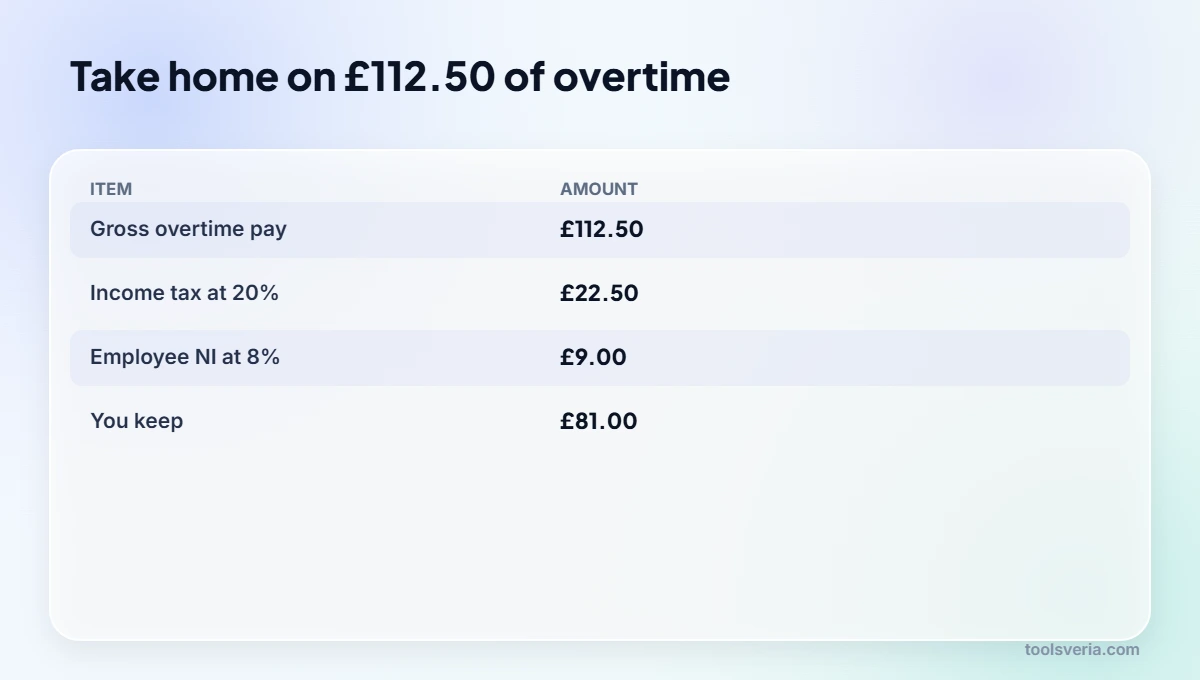
Overtime is taxed like normal wages, and for yearly pay between £12,570 and £50,270 each extra pound in 2026/27 loses 20p to income tax and 8p to National Insurance, leaving 72p. Payroll lumps Saturday’s premium in with the rest of the month’s wages; nothing on the payslip marks it out for different treatment. For someone like Kieran, whose yearly pay falls between £12,570 and £50,270, each additional pound in 2026/27 loses 20p to income tax and 8p to employee National Insurance, leaving 72p.
Take his £112.50 Saturday premium: £22.50 goes in tax and £9 in National Insurance, so £81 reaches his account. Why do bumper months sometimes seem to be hit harder? PAYE looks at each pay period in isolation, as if you earned that much every month, so a spike can be over deducted at first. Provided the annual total stays in the same band, the year generally balances out. Earn above £50,270 and the marginal rates switch to 40% tax and 2% National Insurance.
Your overtime rights in the UK
Before agreeing to a run of long weeks, it helps to know where the legal lines fall. The full detail is on the GOV.UK overtime rights guidance; in practice it comes down to four points:
- Premium rates are optional: whether extra hours are paid, and how much, is set by your contract.
- Being told to stay late: a manager can insist on extra hours only where a written clause in your contract already allows it.
- A 48 hour average cap: most staff cannot be required to exceed 48 hours a week averaged over a reference period, usually 17 weeks, unless they sign an opt out.
- The pay floor: total pay divided by every hour worked, unpaid ones included, must stay at or above the minimum wage for your age.
That last point on overtime pay UK rules catches salaried people most. Since April 2026 the National Living Wage for anyone 21 or older has been £12.71 an hour, a figure listed on the GOV.UK minimum wage rates page. Consider Jess, a 26 year old administrator on £24,000. That is about £461.54 a week, or £12.31 an hour across 37.5 hours, which is under the £12.71 floor before any extra time. If she regularly stays until 45 hours, her real rate sinks to around £10.26. The precise test uses her pay reference period, but a shortfall that size is worth putting to her manager in writing.
Does Overtime Count Towards Holiday Pay?
Overtime worked on a regular basis should usually feed into holiday pay, so leave reflects what you actually earn, while an occasional one off shift is not normally counted. Kieran’s Saturdays have become part of his normal pattern, and that matters when he books a week in the sun. Under overtime pay UK rules, overtime worked on a regular basis should usually feed into holiday pay, so leave reflects what he actually earns rather than just 37.5 basic hours. An occasional one off shift is different and is not normally counted.
To see roughly what a week off should be worth, enter your typical earnings into the holiday pay calculator, then compare the result with the leave payment on your next payslip.
Key points
- Overtime pay = extra hours × basic hourly rate × multiplier.
- On £15 an hour, time and a half is £22.50 and double time £30.
- Enhanced rates come from your contract, not from statute.
- Pay averaged over all hours must meet the minimum wage, £12.71 for those 21 and over from April 2026.
- Overtime is taxed like normal pay, and regular overtime belongs in holiday pay.
Frequently Asked Questions
My new job pays extra hours at my normal rate. Is that allowed?
Yes, if the contract says so. A premium is not required by law, but your pay across every hour you work must still average at least £12.71 if you are 21 or over.
I earn £15 an hour and did 5 hours at time and a half. What should I see?
£112.50 gross. The rate is £15 × 1.5 = £22.50, multiplied by 5 hours; a basic rate taxpayer keeps about £81 of it.
My manager says Saturday shifts are mandatory. Can I refuse?
Only if your contract has no compulsory overtime clause. Even where it does, your average week cannot be pushed past 48 hours unless you have signed an opt out.
I did loads of overtime in March and my tax jumped. Was I overcharged?
Possibly for that month only. PAYE treats a big month as if it repeats all year, and the excess normally corrects later. The rate itself is still 20% tax plus 8% National Insurance for basic rate earners.
Kieran now checks each payslip against his own time log, and so can you. Know your hourly figure, record every shift, and any shortfall in overtime, minimum wage or holiday pay becomes obvious within minutes.