Priya moved £30,000 into a one year bond paying 4.5% and only later wondered whether the personal savings allowance would cover the interest. It did not quite, and nobody told her: banks pay interest gross, so the first sign of a bill is often a changed tax code months afterwards.
Quick answer: In 2026/27 the personal savings allowance is £1,000 for basic rate payers, £500 for higher rate payers and nothing for additional rate payers. Interest beyond it is taxed at 20%, 40% or 45%, rising to 22%, 42% or 47% from April 2027. ISA interest and Premium Bond prizes sit outside it entirely.
Using Priya and three other savers, we will work out how much interest each person can receive tax free in 2026/27, where the little known starting rate adds extra headroom, and what changes once April 2027 arrives.
In This Guide
How Big Is Your Personal Savings Allowance?
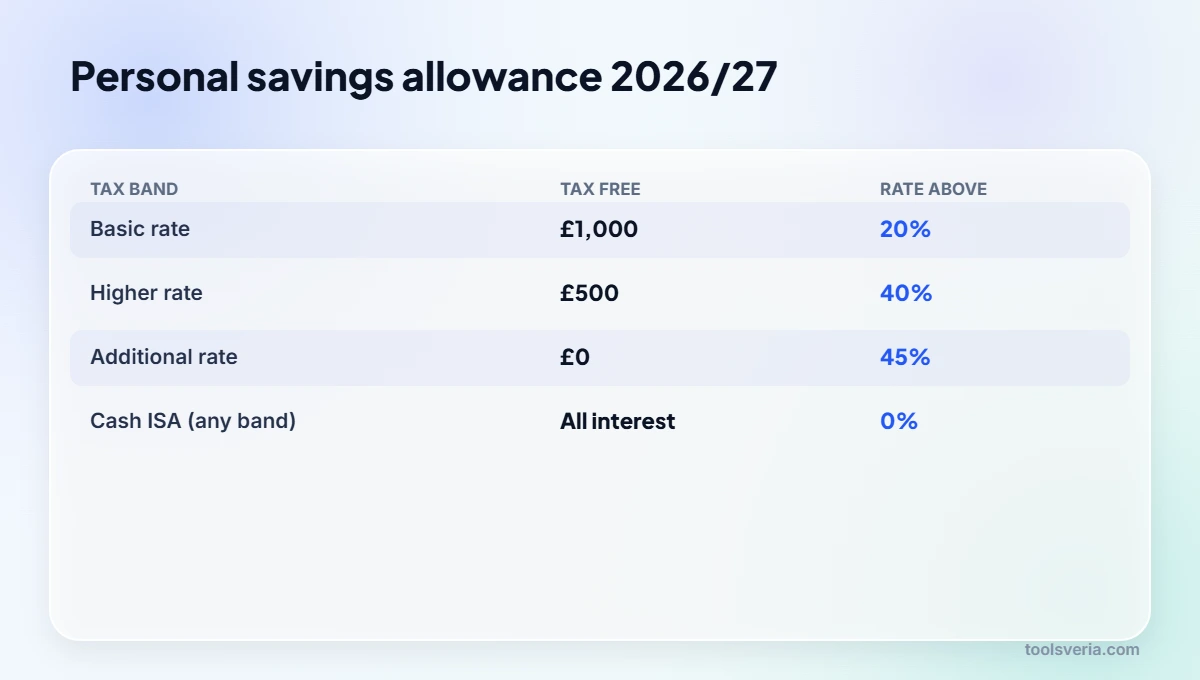
The size of your personal savings allowance depends on your income tax band, and interest above it is charged at the savings rate for your band: 20%, 40% or 45% during 2026/27. Think of the allowance as a 0% slice carved out of your interest. How big that slice is depends on your income tax band, and your band is judged on everything you earn in the year, interest included. Whatever interest spills past the slice is charged at the savings rate for your band: 20%, 40% or 45% during 2026/27.
| Tax band in 2026/27 | Taxable income (England, Wales, NI) | Personal savings allowance | Tax on interest above it |
|---|---|---|---|
| Basic rate | Up to £50,270 | £1,000 | 20% |
| Higher rate | £50,271 to £125,140 | £500 | 40% |
| Additional rate | Above £125,140 | £0 | 45% |
Bank and building society accounts, fixed term bonds, most credit union accounts and certain investments all feed into the total. Two things never do: interest earned inside an ISA, and Premium Bond prizes. For the full list of what HMRC treats as savings income, see the GOV.UK page on tax on savings interest before you add up your own figures.
Priya’s £30,000 bond under four different tax bands
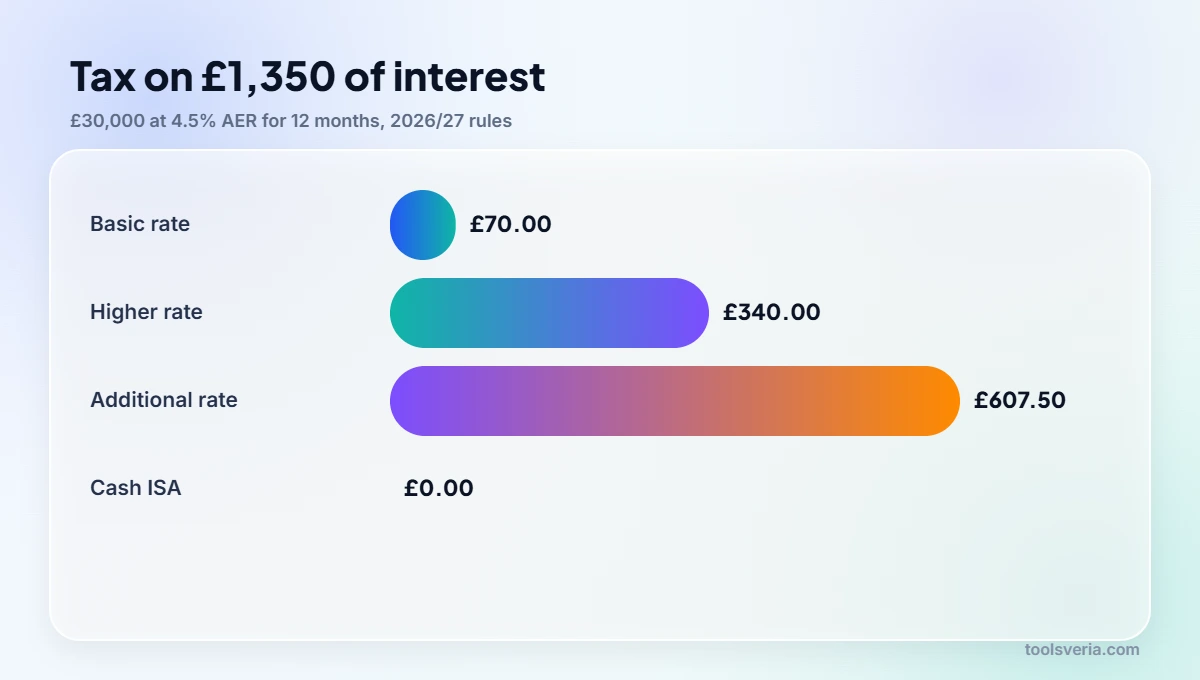
Priya’s bond pays 4.5% AER, so after twelve months it credits £1,350. Here is what she, or someone in a different band holding the identical bond, would actually keep:
| Taxpayer | Interest | Tax free | Taxable | Tax due | Interest kept |
|---|---|---|---|---|---|
| Basic rate | £1,350 | £1,000 | £350 | £70.00 | £1,280.00 |
| Higher rate | £1,350 | £500 | £850 | £340.00 | £1,010.00 |
| Additional rate | £1,350 | £0 | £1,350 | £607.50 | £742.50 |
| Any band, in a cash ISA | £1,350 | £1,350 | £0 | £0.00 | £1,350.00 |
Priya is a basic rate payer, so she owes £70. Flip the question round and it becomes easier to plan: at 4%, roughly £25,000 is the balance at which a basic rate saver’s yearly interest reaches £1,000, while a higher rate saver hits the £500 ceiling with only about £12,500 put away. Anyone adding to savings month by month can use our compound interest calculator to see in which year their balance is likely to cross one of those marks.
Can Low Earners Get More Tax Free Savings Interest?
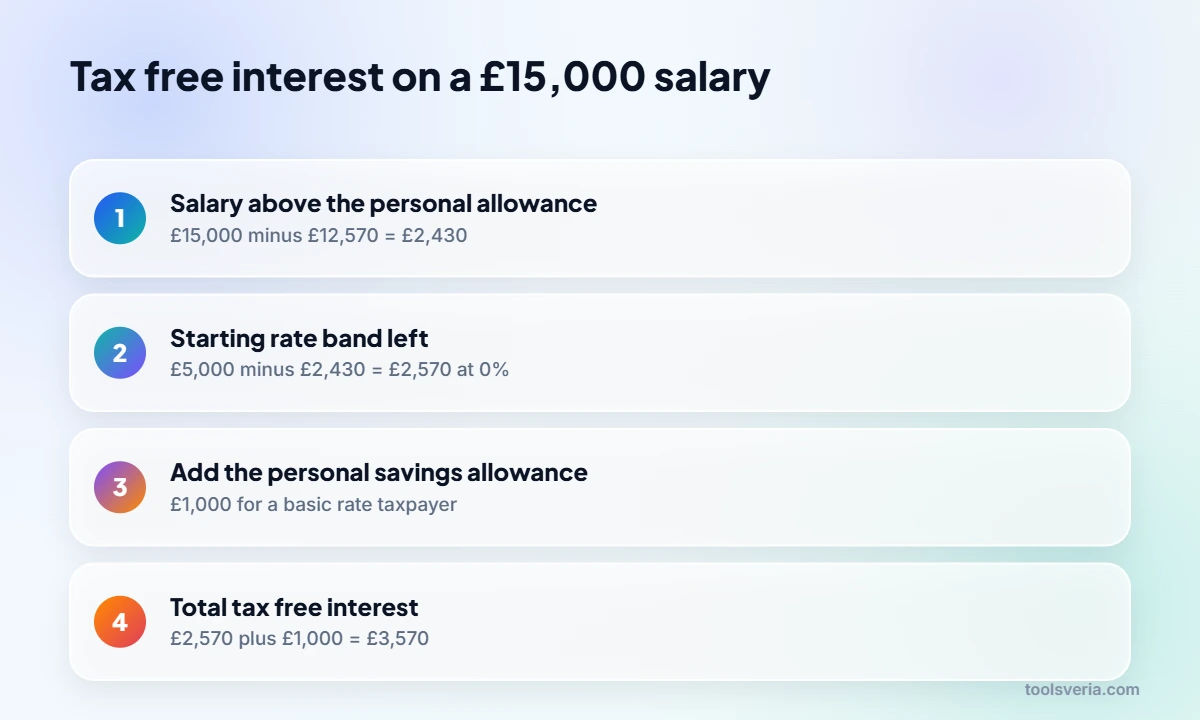
Low earners can unlock a starting rate for savings, a separate 0% band worth up to £5,000 of interest, which disappears once non savings income reaches £17,570. Callum works three days a week and earns £15,000. Because his wages sit only a little above the £12,570 personal allowance, he also qualifies for the starting rate for savings, a separate 0% band worth up to £5,000 of interest. That band is trimmed by £1 for each £1 of non savings income over £12,570, and disappears completely once such income reaches £17,570.
Callum’s sums run like this:
- Wages over the personal allowance: £15,000 minus £12,570 leaves £2,430.
- Starting rate band remaining: £5,000 minus £2,430 leaves £2,570.
- As a basic rate payer he also gets the £1,000 personal savings allowance.
- Interest he can receive without tax: £2,570 plus £1,000, a total of £3,570.
Even £3,000 of interest in 2026/27 would leave Callum with nothing to pay. His retired aunt Margaret, whose only other income is a £10,000 pension, has even more room. She has £2,570 of personal allowance going spare, which can absorb interest first, and then the whole £5,000 starting rate band and the £1,000 allowance follow. Together that is £8,570 of interest before any tax arises.
What counts is your other taxable income across the entire tax year, not a single payslip. Part time workers can feed their weekly hours into the pro rata salary calculator to get an annual figure, then check it against the £12,570 and £17,570 marks. Interest credited in March counts just as much as interest paid in May, so project the full year rather than the amount received to date.
How £1,000 of interest cost Dan £200
Dan’s salary is £49,800, and his easy access pot paid £1,000 of interest this year. Added together that is £50,800, which lands him above the £50,270 line, so HMRC treats him as a higher rate taxpayer and his allowance shrinks from £1,000 to £500.
Half his interest is sheltered. The other £500 falls into the 40% band, producing a £200 bill. Had Dan earned £1,000 less, he would have remained a basic rate payer and owed nothing on the same interest. Savers sitting close to that line often shift money into an ISA, or raise pension contributions to lower adjusted income, so the bigger allowance survives.
Dividends are stacked above interest when HMRC works out which band applies, and they carry their own £500 allowance. Dan also holds some shares outside a wrapper, so he ran them through the dividend tax calculator to check whether the two income streams combined push him further over the threshold.
Who Collects Tax on Savings Interest?
Your bank sends details of the interest it pays straight to HMRC, and employees and pensioners normally have any tax owed recovered through a future tax code. Your bank sends details of the interest it pays straight to HMRC. For employees and pensioners such as Priya and Margaret, any tax owed is normally recovered by tweaking a future tax code. People who already file a Self Assessment return simply include their interest there. GOV.UK also says that if your savings interest goes above £10,000 in a year, you need to report it on a Self Assessment return.
Sheltering cash in an ISA removes the question altogether. Up to £20,000 a year can go into ISAs, and under the rules for individual savings accounts the interest is never taxed and never eats into your allowance. That shelter becomes more valuable soon: from 6 April 2027 the savings rates rise to 22%, 42% and 47%. On Priya’s £350 of taxable interest, a basic rate bill of £70 would become £77.
Key points
- The 2026/27 allowance is £1,000 for basic rate payers, £500 for higher rate payers and nothing for additional rate payers.
- Interest beyond it costs 20%, 40% or 45% this year, rising to 22%, 42% or 47% from April 2027.
- Lower earners may add up to £5,000 through the starting rate for savings.
- Interest is part of your income, so it can tip you into a higher band, as it did for Dan.
- ISA interest stays outside the calculation entirely.
Frequently Asked Questions
My partner and I share a joint account. Do we get one allowance or two?
Two. If you are both basic rate payers, up to £2,000 of interest between you can be tax free, and interest on a joint account is normally divided equally.
My three year bond pays everything at the end. Is that a problem?
It can be. HMRC looks at when the bank hands the interest over to you, not when it was quietly building up, so three years of growth could all be taxed in the maturity year and blow well past a £1,000 allowance.
I earned £1,350 of interest. Do I have to contact HMRC myself?
Normally no, because your bank reports it and HMRC adjusts your tax code. Check the new code when it arrives. A Self Assessment return only becomes necessary if savings interest exceeds £10,000 or you already file one.
I won £500 on Premium Bonds. Does that use up my £1,000?
No. Premium Bond prizes are tax free and sit outside the allowance, just like interest earned in an ISA, so your full £1,000 remains available.
Priya’s £70 bill was small, but it came as a surprise, and the higher rates from 2027 will make surprises like that larger. Total up the interest you expect between now and April, compare it with your slice, and steer any savings that would overflow into an ISA.