Leah left her agency job last spring to freelance as a graphic designer, and her first tax return is now on the horizon. Her self employed tax 2026/27 bill is made of just two pieces, income tax and Class 4 National Insurance, and both are worked out on her profit. They kick in at the same £12,570 point, they change rate at the same £50,270 point, and nothing comes off her invoices along the way: HMRC collects both through Self Assessment.
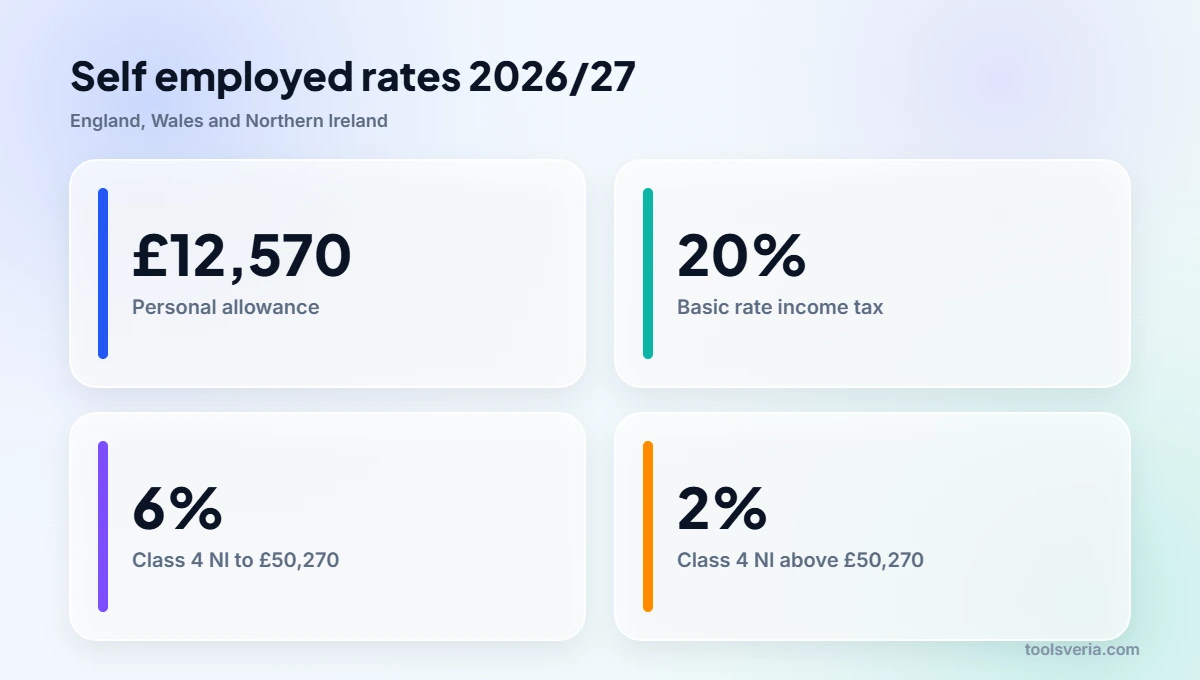
Quick answer: Self employed tax 2026/27 is income tax plus Class 4 National Insurance on your profit. Both start at £12,570: income tax is 20% up to £50,270, 40% to £125,140 and 45% above, while Class 4 is 6% up to £50,270 and 2% above. A £35,000 profit costs £5,831.80 in total outside Scotland.
Following Leah’s numbers, and three other sole traders on different profits, we cover what counts as profit, the 2026/27 rates, full worked bills, the payments on account that surprise so many people in year two, and a practical savings habit to cover it all.
In This Guide
What Income Do You Pay Self Employed Tax On?
HMRC taxes your profit rather than your turnover, which means you subtract the running costs of the business from what you invoiced. Leah invoiced £48,000 over the 2026/27 year. That figure is not what HMRC taxes. From it she subtracts the running costs of the business: her Adobe subscription, a new monitor, accountancy fees, professional indemnity cover and the work share of her phone bill. Those add up to £13,000, which leaves a taxable profit of £35,000. The test for each cost is whether it was spent purely for the business; a laptop also used for family films only partly qualifies.
Someone with almost no costs, such as a weekend tutor, can knock a flat £1,000 trading allowance off income instead, though not alongside itemised expenses. Car travel is often the biggest deduction for tradespeople and visiting freelancers, and our mileage allowance calculator applies the flat 55p a mile for the first 10,000 business miles so you can see what your driving is worth.
Self Employed Tax 2026/27: Income Tax and Class 4 NI Rates
Leah lives in Bristol, so the bands below apply to her, as they would to anyone in England, Wales or Northern Ireland. Very high earners face a squeeze: each £2 of profit beyond £100,000 costs them £1 of allowance, so someone on £125,140 has none left.
| Band | Profit range | Income tax | Class 4 NI |
|---|---|---|---|
| Personal allowance | Up to £12,570 | 0% | 0% |
| Basic rate | £12,571 to £50,270 | 20% | 6% |
| Higher rate | £50,271 to £125,140 | 40% | 2% |
| Additional rate | Over £125,140 | 45% | 2% |
A freelancer in Glasgow would pay a different income tax figure, because Holyrood sets its own bands for earned income, yet the Class 4 percentages are identical in every part of the UK. Rates can change at each Budget, so glance at the GOV.UK income tax rates page before you submit a return.
Class 2 contributions used to be compulsory but no longer are. Sole traders whose profits fall below the small profits threshold can still opt in at £3.65 a week in 2026/27, which keeps their record building towards the State Pension and certain benefits. Whether that makes sense for you is covered on the GOV.UK page on National Insurance for the self employed.
Worked examples at four profit levels
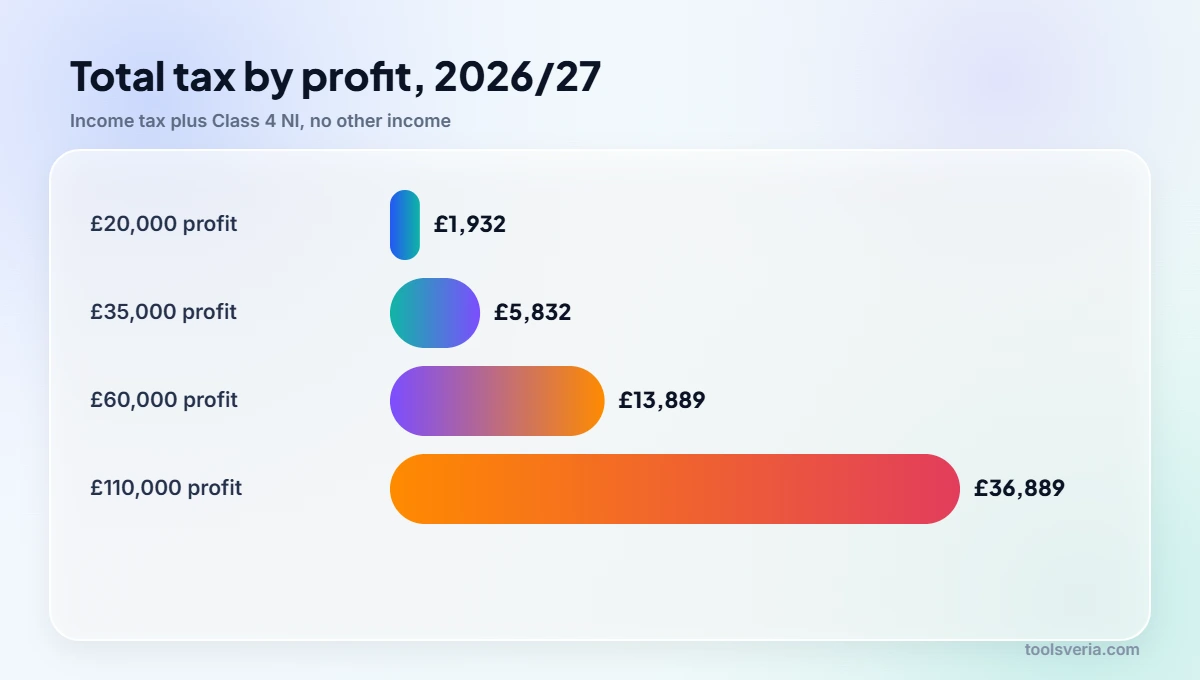
Leah, £35,000 profit. Her first £12,570 is free of both charges, leaving £22,430 exposed. Income tax at 20% on that slice comes to £4,486, and Class 4 at 6% on the same slice is £1,345.80. Together she owes £5,831.80 and keeps £29,168.20, so roughly 16.7p of each pound of profit goes to HMRC.
Callum, an electrician on £60,000. His full £37,700 basic band costs £7,540 at 20%, and the £9,730 sitting above £50,270 costs £3,892 at 40%, so income tax is £11,432. For Class 4, the basic band attracts 6% (£2,262) and the top slice 2% (£194.60), giving £2,456.60. His combined bill is £13,888.60.
Anita, a consultant on £110,000. She is £10,000 past the £100,000 mark, so half of that, £5,000, is stripped from her allowance, which drops to £7,570. Her taxable income is therefore £102,430: the basic band costs £7,540 and the remaining £64,730 at 40% costs £25,892, totalling £33,432. Class 4 ignores the taper and still starts at £12,570, giving £2,262 plus 2% of £59,730 (£1,194.60), or £3,456.60.
| Profit | Income tax | Class 4 NI | Total tax | Take home | Effective rate |
|---|---|---|---|---|---|
| £20,000 | £1,486.00 | £445.80 | £1,931.80 | £18,068.20 | 9.7% |
| £35,000 | £4,486.00 | £1,345.80 | £5,831.80 | £29,168.20 | 16.7% |
| £60,000 | £11,432.00 | £2,456.60 | £13,888.60 | £46,111.40 | 23.1% |
| £110,000 | £33,432.00 | £3,456.60 | £36,888.60 | £73,111.40 | 33.5% |
Every row of these self employed tax 2026/27 figures assumes someone living outside Scotland with no salary, savings income or pension payments alongside the business. A part time PAYE job, for instance, eats into the bands before the business profit is counted and can push more of it into 40%. Directors who also pay themselves from a limited company can work out that side with the dividend tax calculator, which uses the separate 2026/27 dividend rates, and then add both totals together.
When Is Self Employed Tax Due for 2026/27?
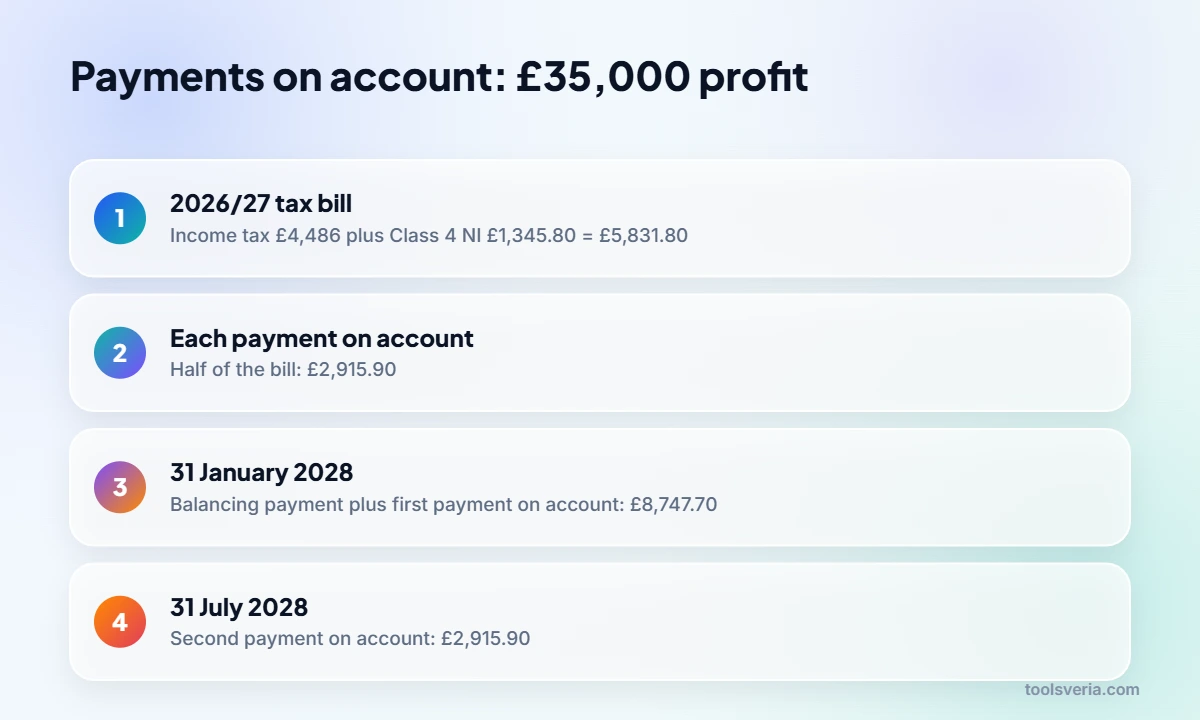
Your 2026/27 return has to reach HMRC online by 31 January 2028, and your tax is due the same day. Leah’s self employed tax 2026/27 return has to reach HMRC online by 31 January 2028, and her tax is due the same day. Because her bill tops £1,000 and almost none of it was deducted at source (the cut off is 80%), HMRC will also ask for advance instalments towards 2027/28. Each instalment equals half of the year just finished, with one due on 31 January and the other on 31 July.
In cash terms: half of £5,831.80 is £2,915.90. On 31 January 2028 Leah pays the full £5,831.80 plus her first £2,915.90 instalment, which is £8,747.70 in one go, and a further £2,915.90 leaves her account on 31 July 2028. Her Class 4 contributions are folded into those instalments too.
Callum and Anita have an extra job to do. Since April 2026, sole traders and landlords whose qualifying income exceeds £50,000 fall under Making Tax Digital for Income Tax, which means keeping records in approved software and filing a short update every quarter.
How Much Should You Set Aside for Self Employed Tax?
Setting aside a fixed percentage of every client payment works well, and with an effective rate near 16.7% on £35,000 profit, putting away 17% of profit covers a normal year. Leah now sweeps a fixed percentage of every client payment into a separate savings pot the day it clears. With an effective rate near 16.7% on £35,000, putting away 17% of profit covers a normal year. Her first year with instalments is different, since January asks for about 18 months of tax at once, so she aims to build the extra cushion during the summer. Freelancers still setting their prices can use the hourly to annual salary calculator to see what a day or hourly rate becomes over a year, and check that it leaves room for tax, expenses and unpaid holidays.
Key points
- HMRC taxes profit after business costs, so Leah’s £48,000 of invoices became £35,000.
- Income tax runs at 20% from £12,570, 40% from £50,270 and 45% beyond £125,140.
- Class 4 is 6% between £12,570 and £50,270, then 2% on everything above.
- Class 2 is optional, at £3.65 a week.
- Diary both 31 January and 31 July for instalments.
Frequently Asked Questions
My profit came out at £30,000 after expenses. Roughly what will I owe?
About £4,531.80 outside Scotland. The £17,430 above your allowance costs £3,486 in income tax at 20% and £1,045.80 in Class 4 at 6%.
My profit is tiny this year. Is it worth paying Class 2 anyway?
It can be. At £3.65 a week it is voluntary, but paying keeps your National Insurance record growing towards the State Pension in a year when your profits are too low to do that on their own.
I started freelancing in June 2026. When must I tell HMRC?
By 5 October 2027, the 5 October after the tax year you started in ends. Registration is generally needed once your self employed income passes £1,000.
I lose part of my personal allowance above £100,000. Does my Class 4 start later too?
No. The taper only touches income tax, so Anita’s Class 4 still kicks in at £12,570 of profit while her income tax allowance has shrunk to £7,570.
Once you know your profit, the rest of the bill follows a fixed pattern. Keep your records up to date through the year, run the figures against the 2026/27 rates, and put money aside for both the balancing payment and the instalments, so the end of January feels routine rather than frightening.