
Jade has been offered 25 hours a week at a Sheffield dental surgery, and the nursery her son needs costs £1,100 a month after his funded hours. The job only makes sense if Universal Credit childcare costs support covers most of that bill, so she needs real numbers, not a percentage, before she accepts.
The rules are generous but strict about timing, and the caps catch out families with two children in nursery. Jade and two other households are worked through below, from the first invoice to the payment landing in the account.
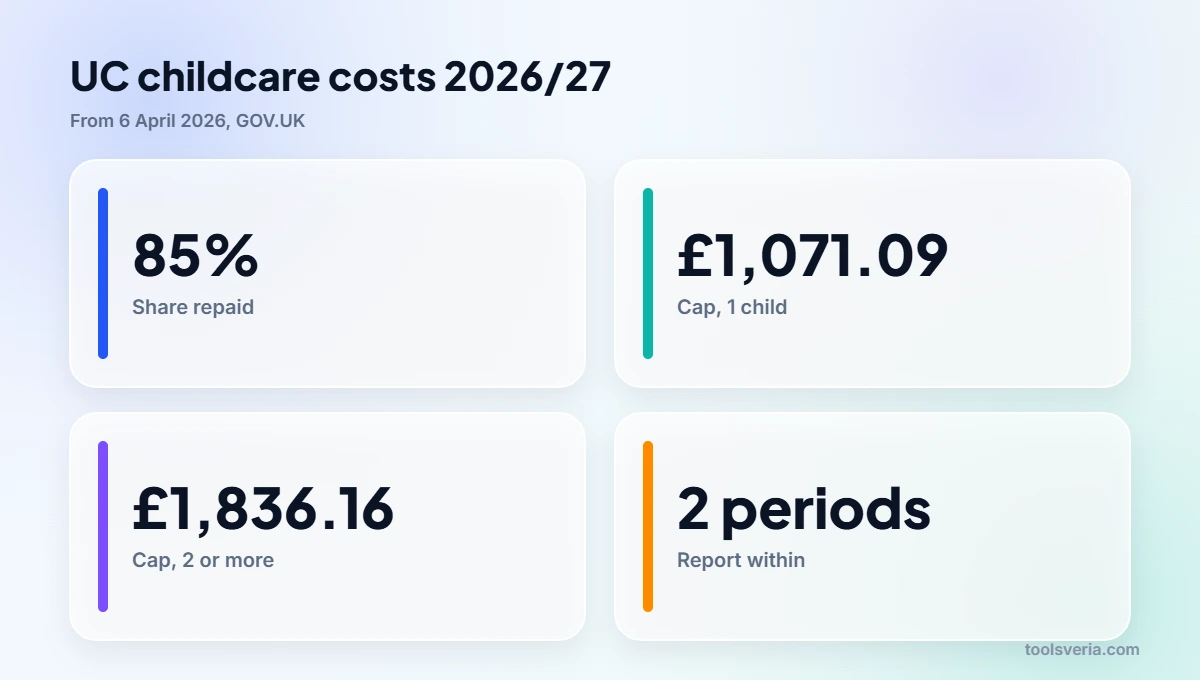
Quick answer: From 6 April 2026, GOV.UK says Universal Credit pays back 85% of registered childcare costs, up to £1,071.09 a month for one child or £1,836.16 for two or more. You pay the provider first, then report the cost in the same or next assessment period to get it back.
In This Guide
How much childcare does Universal Credit pay in 2026/27?
Universal Credit pays 85% of the registered childcare costs you pay in each monthly assessment period in 2026/27, up to a maximum of £1,071.09 for one child or £1,836.16 for two or more children, and you cover the remaining 15% yourself.
In plain words: add up what you paid for childcare in the assessment period, take 85% of it, and compare that with the cap for the number of children in paid childcare. You receive whichever is lower. The caps are the most you receive, not the most you can spend, so a cost of £1,500 for one child does not give 85% of the cap. It gives the cap itself, £1,071.09.
| Monthly childcare cost | 1 child: Universal Credit pays | 2 or more children: Universal Credit pays |
|---|---|---|
| £500 | £425.00 | £425.00 |
| £1,000 | £850.00 | £850.00 |
| £1,260.11 | £1,071.09 (cap reached) | £1,071.09 |
| £1,800 | £1,071.09 (capped) | £1,530.00 |
| £2,160.19 | £1,071.09 (capped) | £1,836.16 (cap reached) |
| £2,600 | £1,071.09 (capped) | £1,836.16 (capped) |
The two break even points are worth remembering: £1,260.11 a month for one child and £2,160.19 for two or more. Below them you get a full 85%. Above them, each extra pound of childcare comes entirely from your own pocket. Some ranking pages still quote older caps such as £646.35 or £1,014.63, which no longer apply.
Who can get help with childcare costs on Universal Credit?
You can get help with childcare costs on Universal Credit if you are in paid work or have a job offer starting within the next month, your partner also works unless they cannot care for the children, and you use a registered provider for a child up to the 31 August after their 16th birthday.
- Work: there is no minimum number of hours, so a few paid hours a week count.
- Partners: both must work, unless one has limited capability for work, cares for a severely disabled person or is temporarily away, for example in hospital.
- Leave: maternity, paternity, adoption and neonatal care leave count while you receive statutory pay or Maternity Allowance.
- Providers: nurseries, childminders, registered nannies, breakfast and after school clubs and holiday clubs registered with Ofsted, the Care Inspectorate in Scotland or Care Inspectorate Wales.
Settling in sessions and childcare while you travel to work can also count, and the full list of conditions sits in the GOV.UK guidance on Universal Credit childcare costs. Grandparents and unregistered babysitters do not qualify, however reliable they are. If you are returning from leave, the maternity pay calculator shows how long statutory pay runs before your first refund arrives.
Three families, three results
Running real bills through the 85% rule shows why two families paying similar amounts can end up with very different refunds, depending on how many children are in paid care.
Jade: one child, below the cap
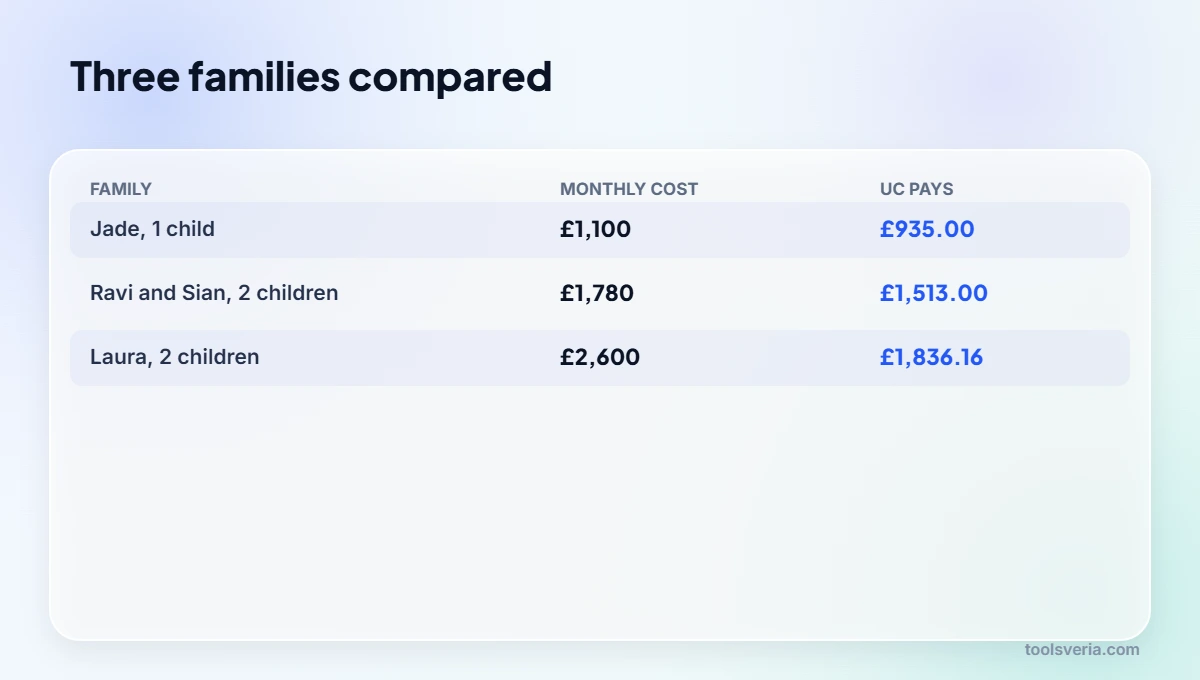
Jade’s £1,100 a month is under the £1,260.11 break even point, so Universal Credit adds 85% of it, £935, to her award. She pays £165 a month herself. Her son’s funded hours are not part of the claim, because only what you actually pay counts, and the 30 hours free childcare income checker shows whether she qualifies for 30 funded hours, which would shrink the bill further.
Ravi and Sian: two children, still under the cap
Ravi and Sian both work in Cardiff. Their toddler’s nursery costs £1,500 a month and their 8 year old’s after school club £280, a total of £1,780. 85% of that is £1,513, which is under the £1,836.16 cap for two or more children, so they receive the full £1,513 and pay £267 themselves.
Laura: two children in a London nursery, capped
Laura pays £2,600 a month for two children under three. 85% would be £2,210, but the cap stops the refund at £1,836.16, so she pays £763.84, an effective refund of about 70.6%. Cutting one day of nursery a week would save her far more than it costs in Universal Credit, because she sits above the £2,160.19 break even point.
When do you get Universal Credit childcare costs back?
You get Universal Credit childcare costs back in your next payment after you report them, provided you report each cost, with proof, in the assessment period you paid it or the one straight after, because later reports may not be repaid.
Jade’s assessment period runs from the 15th of one month to the 14th of the next. She pays September’s nursery invoice on 1 September, inside the period ending 14 September, so her last safe day to report it is 14 October. She uploads the invoice and bank statement in her journal the same day she pays, which removes the risk of forgetting.
Paying a term in advance is allowed. You can claim up to 3 assessment periods of future costs at once if you have already paid them. When you start a job or increase your hours, ask your work coach about help with upfront costs, such as the first month’s fees or a deposit, before your start date.
How do earnings affect the childcare amount?
Earnings do not reduce the childcare amount directly, but your whole Universal Credit award, which includes the childcare amount, falls by 55p for every £1 you earn above your work allowance.
Parents, and people whose award includes a health or disability element, keep a slice of their monthly earnings before the taper starts, and the GOV.UK page on how wages affect Universal Credit sets that 2026/27 work allowance at £427 a month if your award includes help with housing, or £710 if it does not. Jade will earn £1,400 a month and gets housing support, so £973 of her pay is above the allowance and £535.15 comes off her total award. Her £935 childcare amount alone exceeds that deduction, so she still receives a payment before her standard allowance and other amounts are even counted.
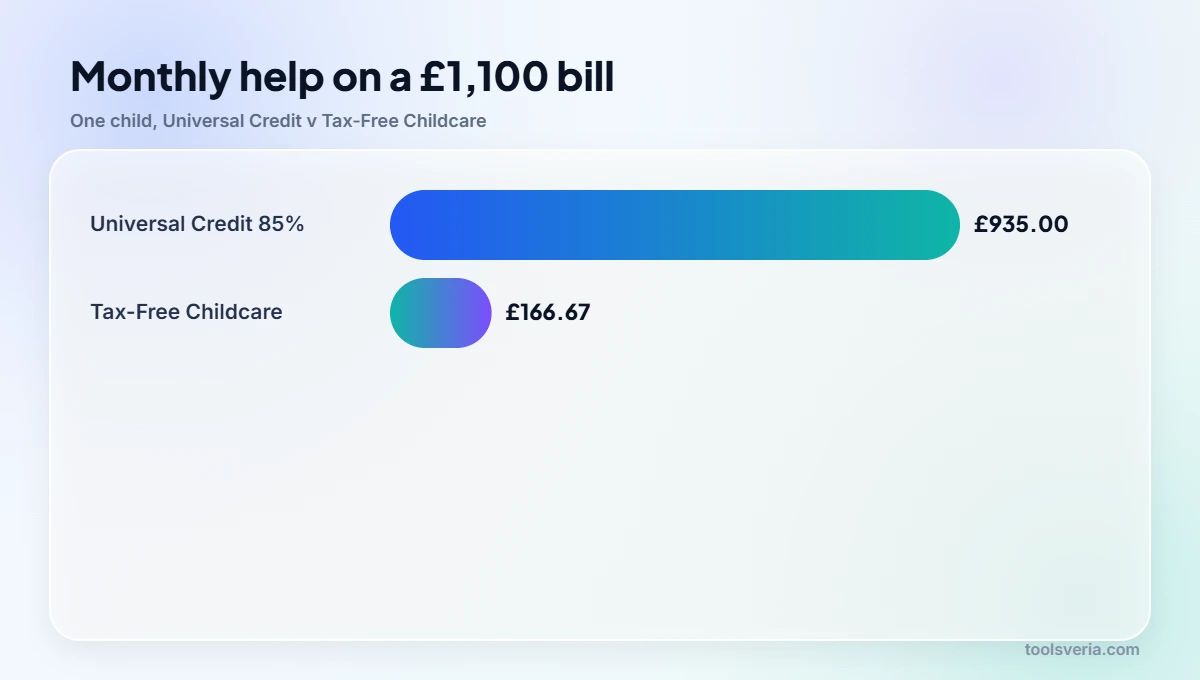
For a higher earner the taper can wipe out the award altogether, and then Tax-Free Childcare may be worth more. You cannot use both at once. The GOV.UK Tax-Free Childcare scheme adds £2 for every £8 you pay, up to £500 every 3 months per child, which on Jade’s bill is just £166.67 a month against £935 from Universal Credit. Modelling extra hours in the pro rata salary calculator shows what a bigger contract does to monthly earnings before you apply the taper.
Key points
- From 6 April 2026, Universal Credit repays 85% of registered childcare costs.
- The monthly maximum is £1,071.09 for one child and £1,836.16 for two or more children.
- The caps are reached at monthly costs of £1,260.11 for one child and £2,160.19 for two or more.
- Costs must be reported with proof in the assessment period paid or the next one.
- Tax-Free Childcare cannot be claimed at the same time as Universal Credit.
What the Universal Credit Childcare Costs Terms Mean
These terms explain the timing, eligibility and cap rules behind Universal Credit childcare costs, helping you plan a claim before accepting a job or new nursery place.
- Reporting window
- The deadline for telling Universal Credit about childcare you have paid, which is the same or the next assessment period. Costs reported later than that are usually lost, so keeping invoices and receipts ready matters.
- Cap break even point
- The monthly childcare spend at which 85% exactly equals the cap: £1,260.11 for one child and £2,160.19 for two or more. Any spending above these levels must be met entirely by the family.
- Funded hours
- Free early education or childcare hours paid directly to the provider by the government. Because the parent does not pay for them, only the charges left after these hours can be reported for the childcare element.
- Limited capability for work
- A Universal Credit assessment outcome showing that health or disability restricts a person’s ability to work. When one partner has it, the couple can still claim childcare support even though only the other partner works.
- Paid work condition
- The rule that a claimant, and a partner if they have one, must be working or have a job offer starting within the next month. There is no minimum number of hours, so small amounts of paid work qualify.
Frequently Asked Questions
My mum looks after my daughter and I pay her £400 a month. Can I claim it?
Usually not, because Universal Credit only repays registered childcare. If your mum registers, for example as an Ofsted childminder, and cares for your daughter outside your home, the £400 could qualify and bring £340 back each month.
I forgot to report last month’s nursery bill. Is it lost?
Not yet, if you are still within the assessment period after the one you paid in. Report it now with the invoice and proof of payment. Once that second period ends, you might not get the money back.
Does my 14 year old’s holiday club count?
Yes, if the club is registered and you need it to work. Children count until the 31 August after their 16th birthday, so a £300 summer club would bring £255 back, assuming you are under the cap.
I work 6 hours a week. Is that enough?
Yes, Universal Credit has no minimum hours for childcare costs, so any paid work counts. If you have a partner, they must also work unless a health condition, disability or caring role means they cannot look after the children.
Jade took the job: £935 a month back on a £1,100 bill made the sums work, and she reports every invoice the day she pays it. Enter your own costs per child in the calculator to see where you sit against the caps. Figures checked October 2026 against GOV.UK for 2026/27.