See how long your money takes to double, or the return you need to double it in time.
| Return | Rule of 72 | Exact years |
|---|
Exact figures assume the return is compounded once a year and stays constant. Real investment returns vary from year to year.
You do not need a spreadsheet to know roughly when your money will double. This rule of 72 calculator divides 72 by your yearly return to give a quick answer, then sets it beside the exact figure worked out with logarithms, so you can see how good the centuries old shortcut really is at your rate. It also runs in reverse, telling you the return needed to double a sum by a chosen date.
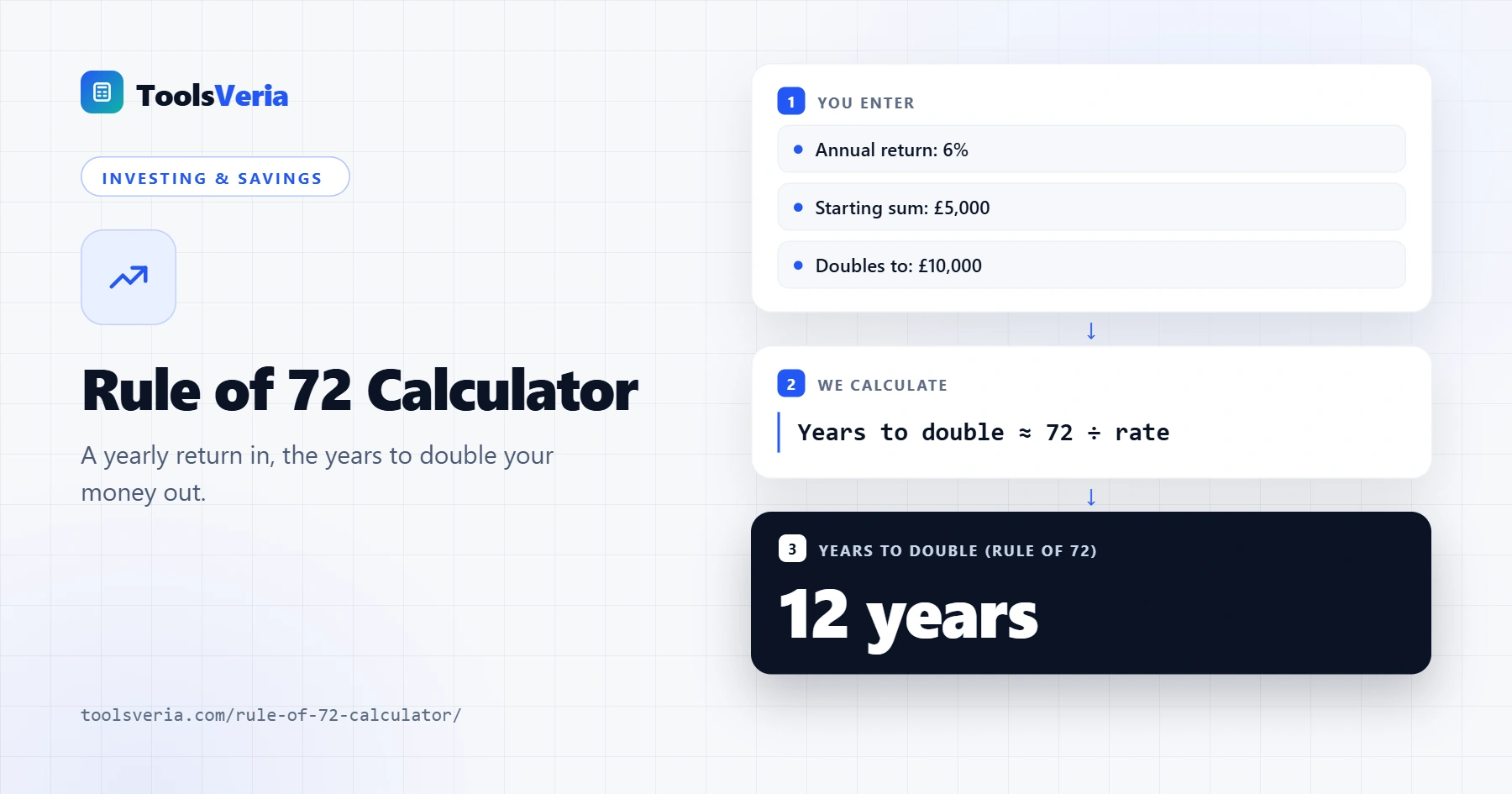
Quick answer: A rule of 72 calculator divides 72 by your annual percentage return to estimate how many years a sum takes to double. At 6% a year, 72 ÷ 6 = 12 years, against an exact answer of 11.9 years, so the shortcut is out by less than 1%. Doubling in 8 years needs about 9% a year.
In This Guide
What Is the Rule of 72?
It is a mental arithmetic trick for compound growth. Divide 72 by the annual percentage return and you get the approximate number of years for a sum to double. Flip it round and 72 divided by the years gives the return you need. The exact version is years = ln(2) ÷ ln(1 + r), but 72 is close enough for everyday rates and divides neatly by 2, 3, 4, 6, 8, 9 and 12.
Here is how it plays out. Marcus has £5,000 in a global fund he expects to return 6% a year after charges. The rule says 72 ÷ 6 = 12 years to reach £10,000. The exact answer is 11.9 years, so the shortcut is out by less than 1%. If Marcus wanted to double his money in just 8 years, he would need about 9% a year, which means taking on more risk.
How to Use the Rule of 72 Calculator
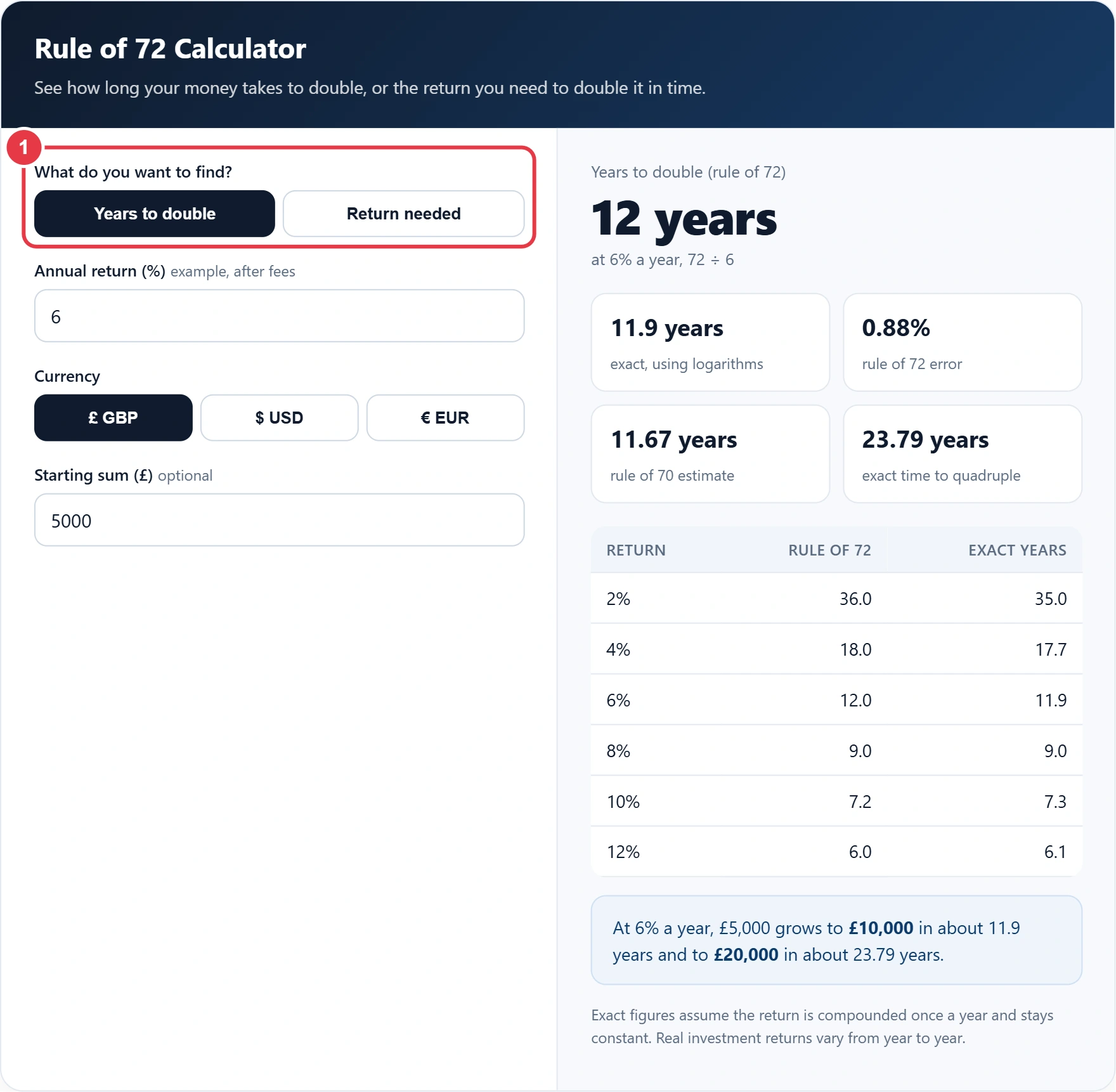
Step 1: Choose What to Find
Pick Years to double if you know your expected return, or Return needed if you have a deadline in mind, such as doubling a pot before retirement.
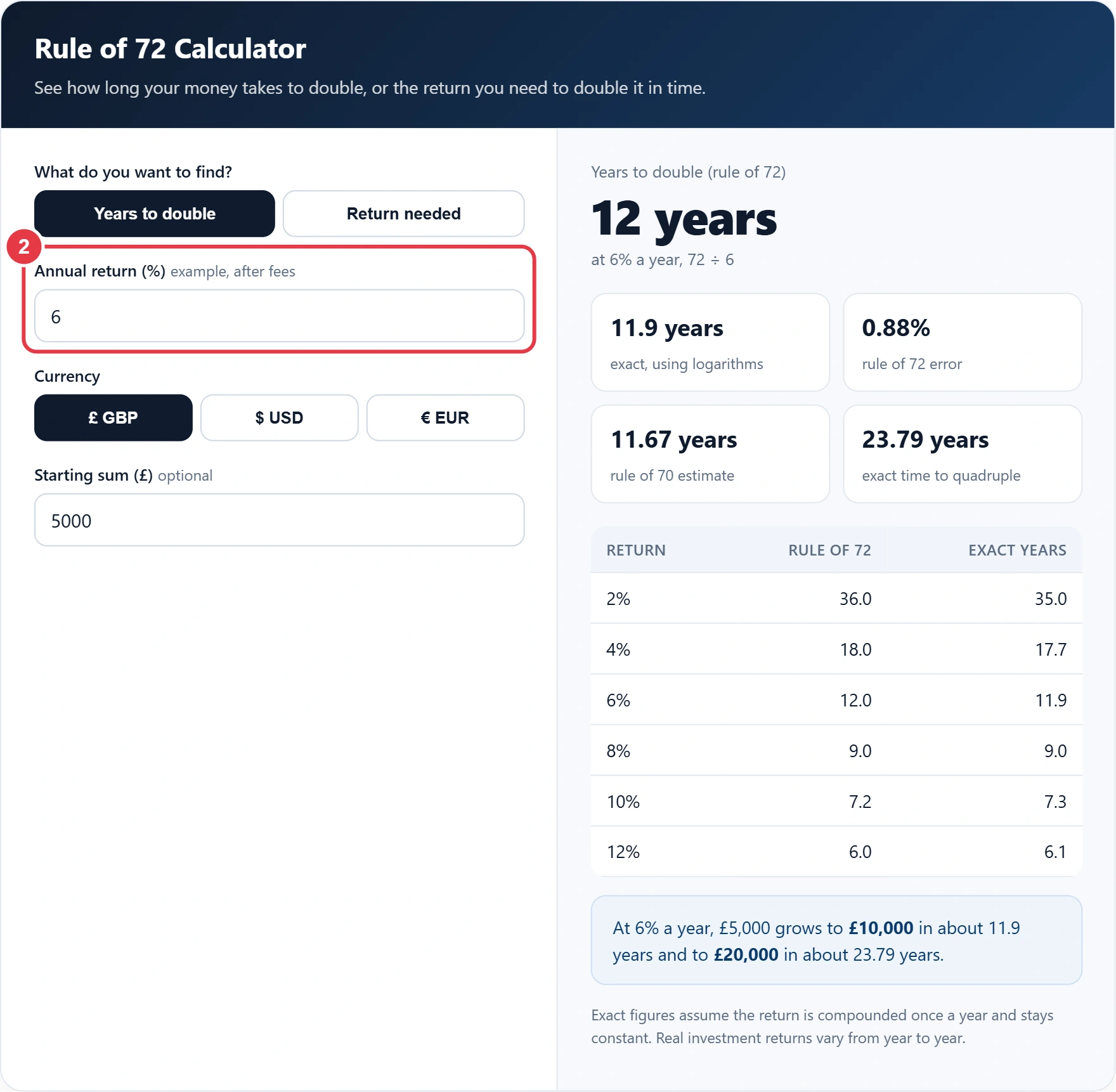
Step 2: Enter Your Return or Time Frame
Use a return after fees, because a 1% platform and fund charge noticeably stretches the doubling time. A savings account rate works too: at 4%, cash takes around 18 years to double before tax.
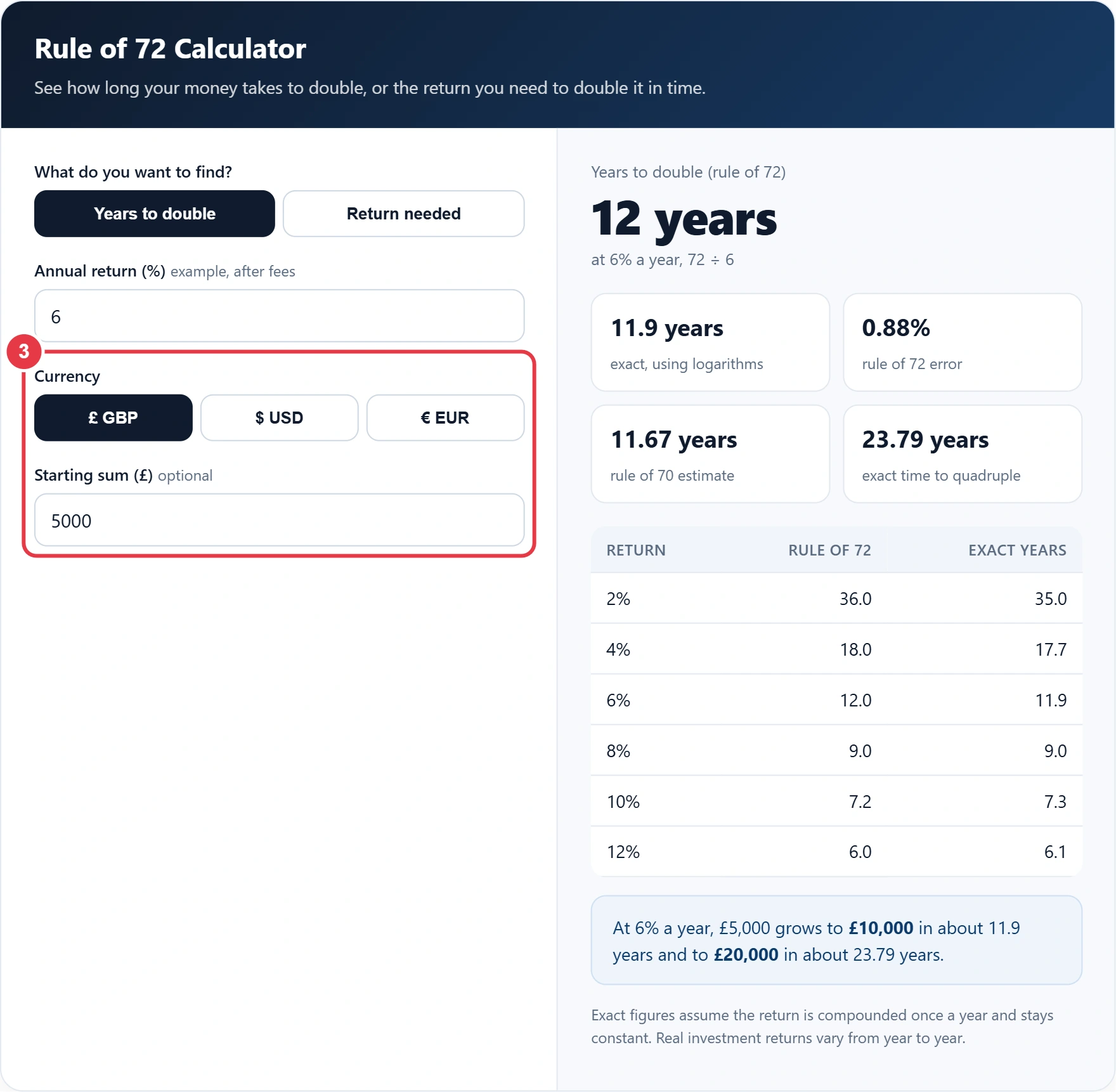
Step 3: Add a Starting Sum
This is optional, but seeing real money makes the result easier to judge. Choose your currency and type the amount. For a full projection with monthly deposits, the compound interest calculator takes the same rate and shows the balance year by year.
Step 4: Compare the Results
The big figure is the rule of 72 estimate. Next to it you get the exact answer, the size of the error, the rule of 70 version and the time or return needed to quadruple your money.
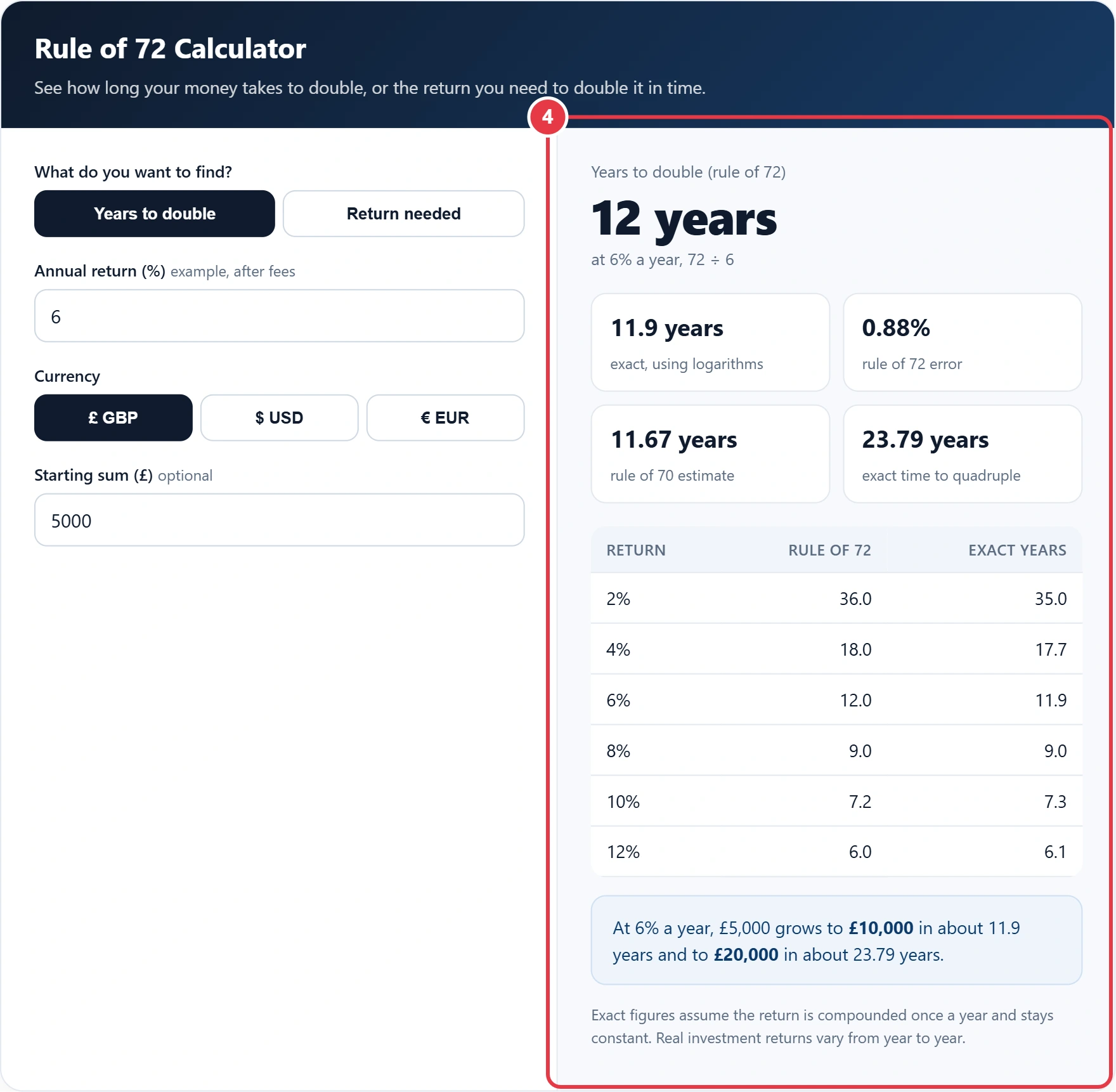
Rule of 72 Accuracy at Common Rates
| Annual return | Rule of 72 | Exact years |
|---|---|---|
| 2% | 36 | 35.0 |
| 4% | 18 | 17.7 |
| 6% | 12 | 11.9 |
| 8% | 9 | 9.0 |
| 10% | 7.2 | 7.3 |
| 12% | 6 | 6.1 |
The rule works the other way for costs too. Prices rising at 3% a year double in roughly 24 years, and the UK inflation calculator shows how closely past prices have followed that pattern. The maths behind all of this is the same compound interest formula that banks use, just rearranged to solve for time.
Rule of 72 Calculator Terms Explained
These finance and maths terms explain how the rule of 72 calculator estimates doubling time, helping you compare its quick answer with the exact logarithmic result.
- Doubling time
- The period a quantity growing at a constant rate needs to become twice its size. For an investment it depends only on the compound rate of return and not on the starting sum, so £100 and £100,000 double equally fast.
- Natural logarithm
- The logarithm to base e, written ln, which turns exponential growth into a straight-line relationship. The exact doubling time divides ln 2, roughly 0.693, by the natural logarithm of one plus the yearly rate as a decimal.
- Rule of 70
- A variant that divides 70 rather than 72 by the growth rate, widely used in economics and population studies and for continuous compounding. It is slightly more accurate at low rates, whereas 72 offers more convenient whole-number divisors.
- Annual compounding
- Adding interest or investment growth once a year, so the following year's return is earned on the enlarged balance. The calculator's exact figures assume this pattern, together with a rate of return that stays the same every year.
- Net return
- The return left after fund charges, platform fees and other costs have been taken off. Using it instead of the headline figure matters, because even a 1% yearly charge noticeably stretches the time a sum needs to double.
</>Embed this calculator on your website
Add the free Rule of 72 Calculator to your own site or blog. Copy the code below and paste it into an HTML block. It resizes itself and works on phones.
How we checked this tool: the Tools Veria Editorial Team built this tool by hand, checked it against the official rules or published standards where they apply, and tested it against worked examples. Results are estimates for planning, not personal financial or tax advice. Read our editorial policy and disclaimer, or report an error.
Frequently Asked Questions
Why 72 and not 70?
72 divides evenly by many common rates, which makes mental maths easy. It is also slightly more accurate than 70 for returns between about 6% and 10% compounded yearly.
How long does money take to double at 5%?
The rule of 72 gives 14.4 years. The exact answer with yearly compounding is 14.2 years.
Does the rule of 72 work for high returns?
It becomes less accurate above about 20%. At 30% it gives 2.4 years against an exact answer of 2.64 years, so use the exact figure the calculator shows.
Can I use the rule of 72 for debt?
Yes. A card balance charging 24% a year with no repayments would double in about three years, which is a stark reminder to clear it.
Does the rule of 72 include tax and fees?
No. It only uses the rate you enter, so put in the return you expect after charges and any tax to get a realistic answer.
What is the rule of 69.3?
It is the version for continuous compounding, because the natural log of 2 is about 0.693. It suits daily compounding better than 72 does.