A 2026 estimate of what comes off a US paycheck and what you keep. Amounts are per paycheck.
| Per paycheck | Per year |
|---|
Estimate only. Federal tax uses 2026 IRS brackets and the standard deduction on annualised pay, not your W-4 withholding. Social Security is 6.2% up to the $184,500 wage base, Medicare 1.45% plus 0.9% withheld on wages over $200,000. 401(k) deferrals are capped at $24,500. Local taxes and credits are not included.
This paycheck deductions estimator gives US employees a quick 2026 estimate of how much federal income tax, Social Security, Medicare, 401(k) and state tax come off each paycheck. It applies the IRS 2026 tax brackets and standard deduction to your annualised pay, so you can sanity check a job offer or a raise before your first payslip arrives.
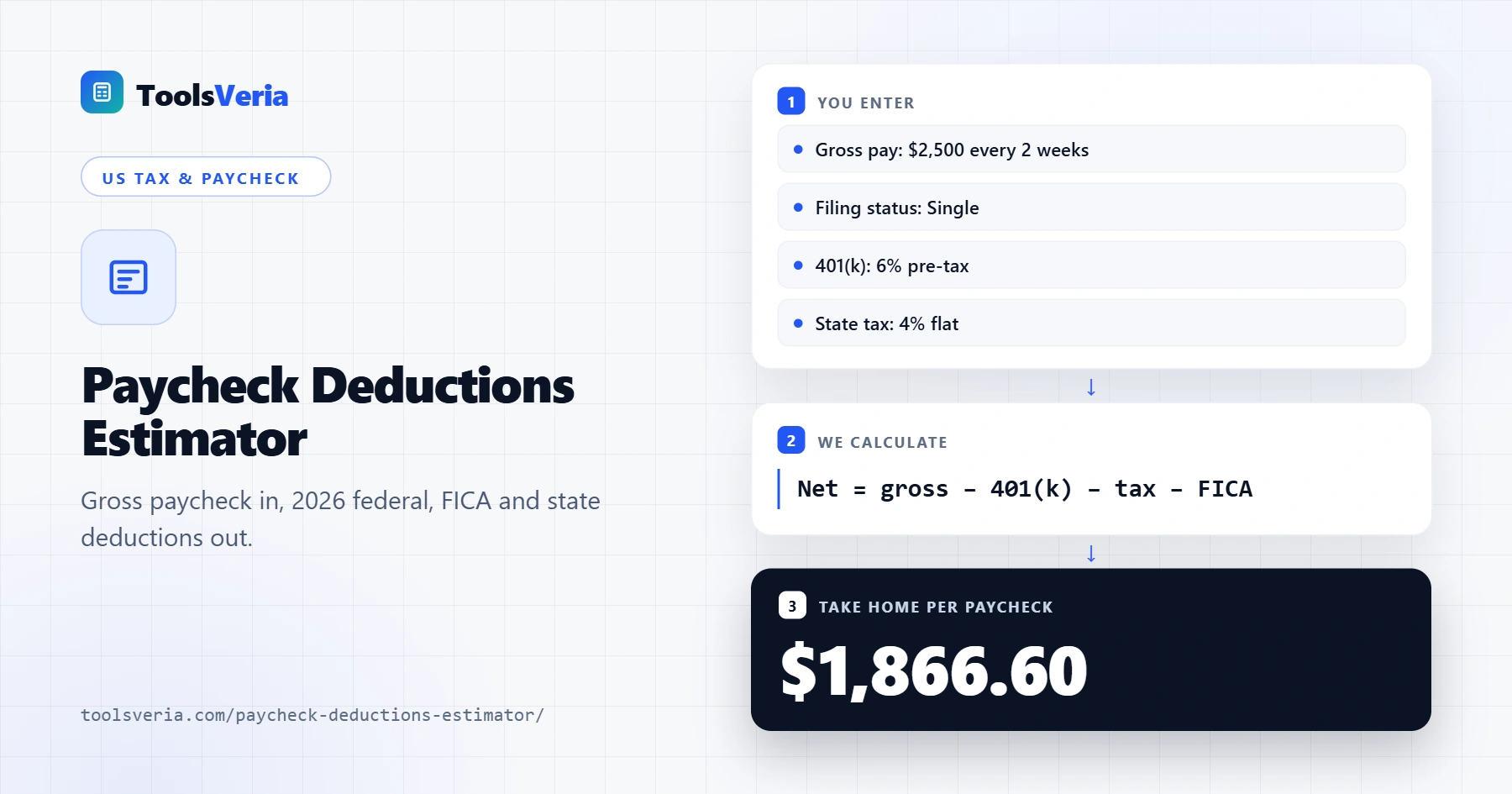
Quick answer: A paycheck deductions estimator subtracts pre-tax 401(k) and benefits, federal and state income tax, Social Security and Medicare from gross pay. For a single filer saving 6% in a 401(k) with a 4% flat state tax, about $633 comes out of a $2,500 biweekly paycheck, leaving $1,866.60.
In This Guide
What Are Paycheck Deductions?
Paycheck deductions are the amounts your employer withholds from gross pay before paying you, mainly income taxes, FICA payroll taxes and any retirement or benefit contributions you choose. In plain words: take home pay = gross pay minus pre-tax 401(k) and benefits, minus federal and state income tax, minus Social Security and Medicare.
Traditional 401(k) deferrals reduce income tax but not FICA, while Section 125 benefits such as health premiums reduce both. Federal tax is progressive, so for a single filer in 2026 the first $12,400 of taxable income is taxed at 10%, the next slice up to $50,400 at 12% and income up to $105,700 at 22%.
How to Use the Paycheck Deductions Estimator
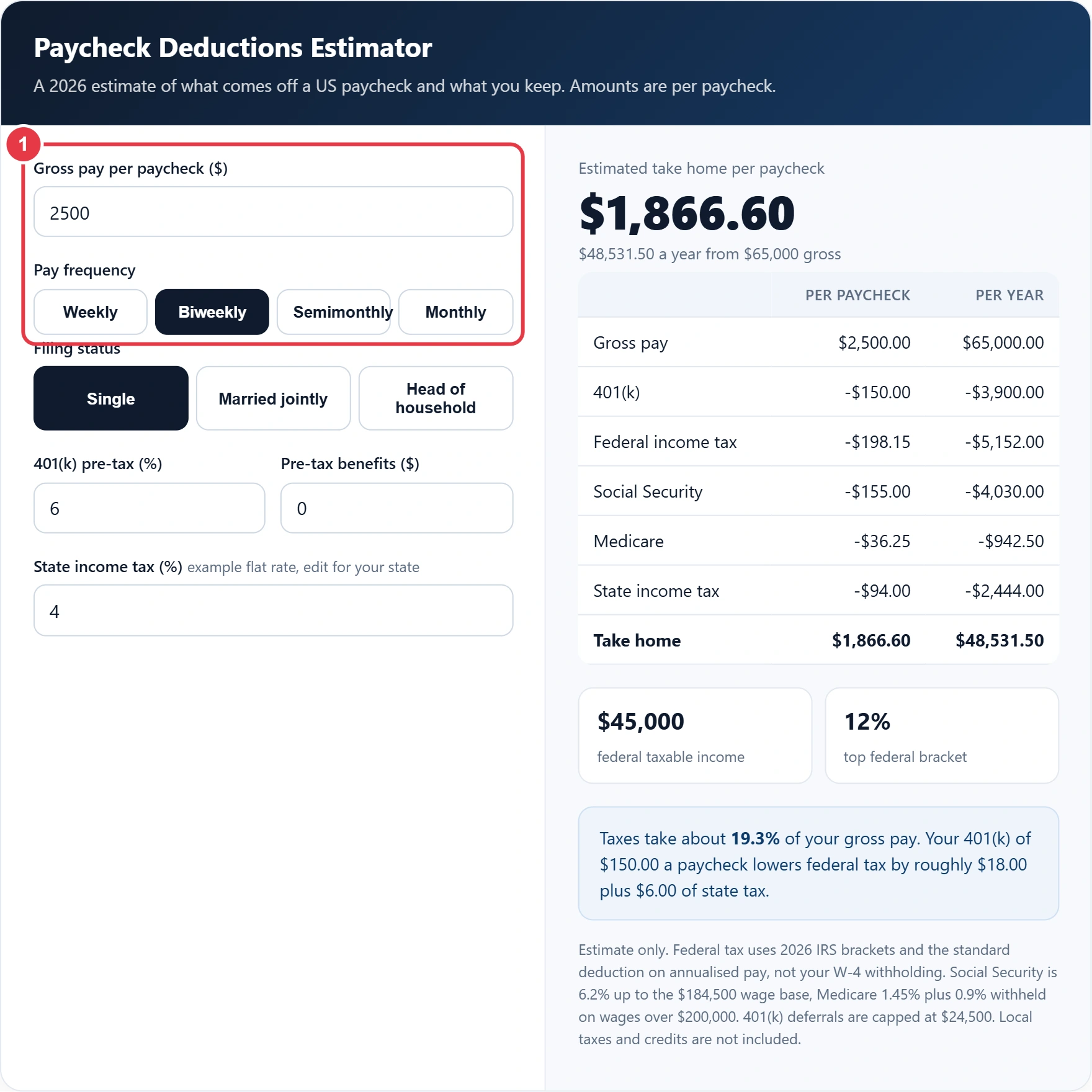
Step 1: Enter Gross Pay and Frequency
Type your pay before deductions for one paycheck and choose how often you are paid. Biweekly means 26 paychecks a year and semimonthly means 24, which changes the size of each one.
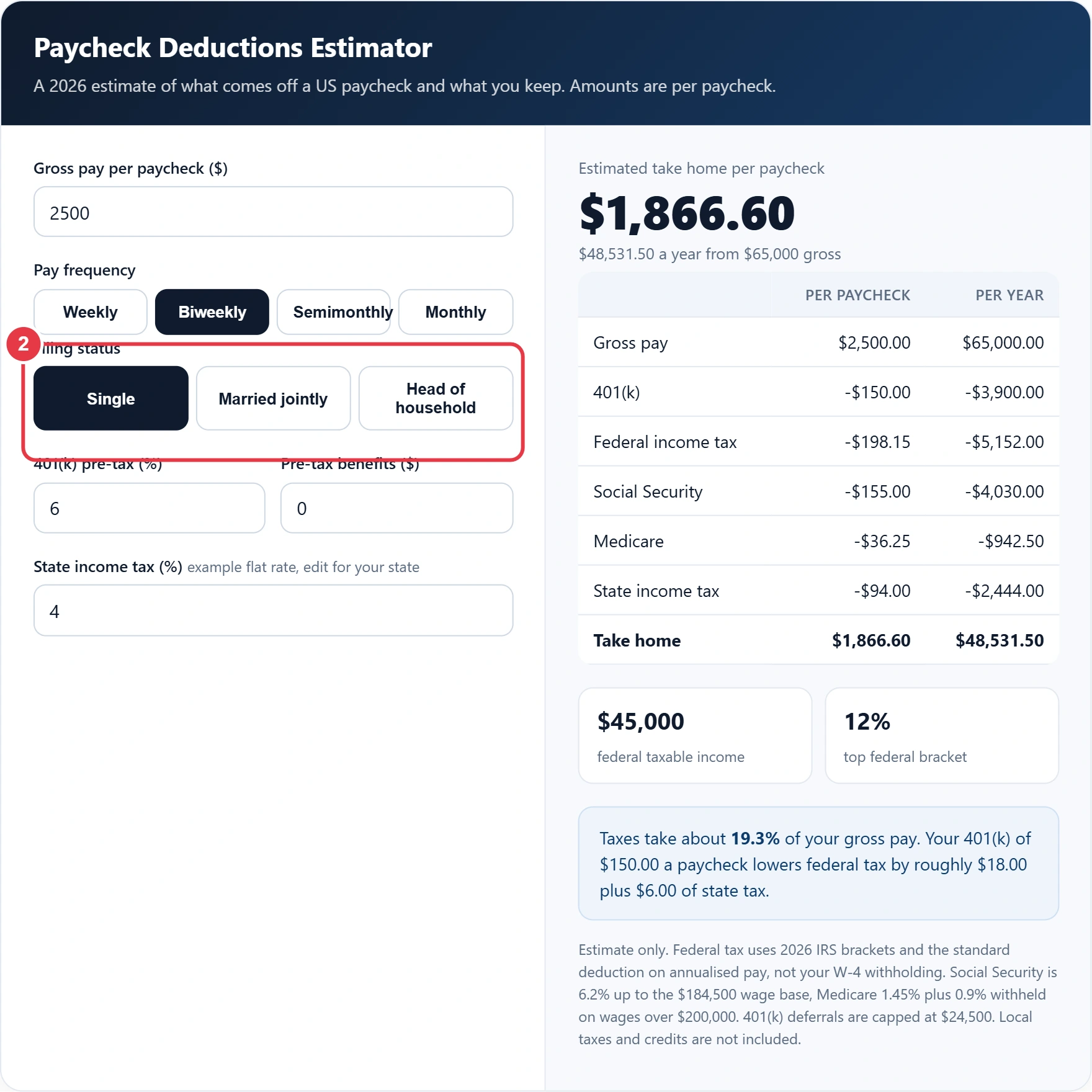
Step 2: Choose Your Filing Status
Single, married filing jointly and head of household each have their own standard deduction and brackets. Married filers whose spouse also works should treat the result as a rough guide, because the brackets assume one combined household income.
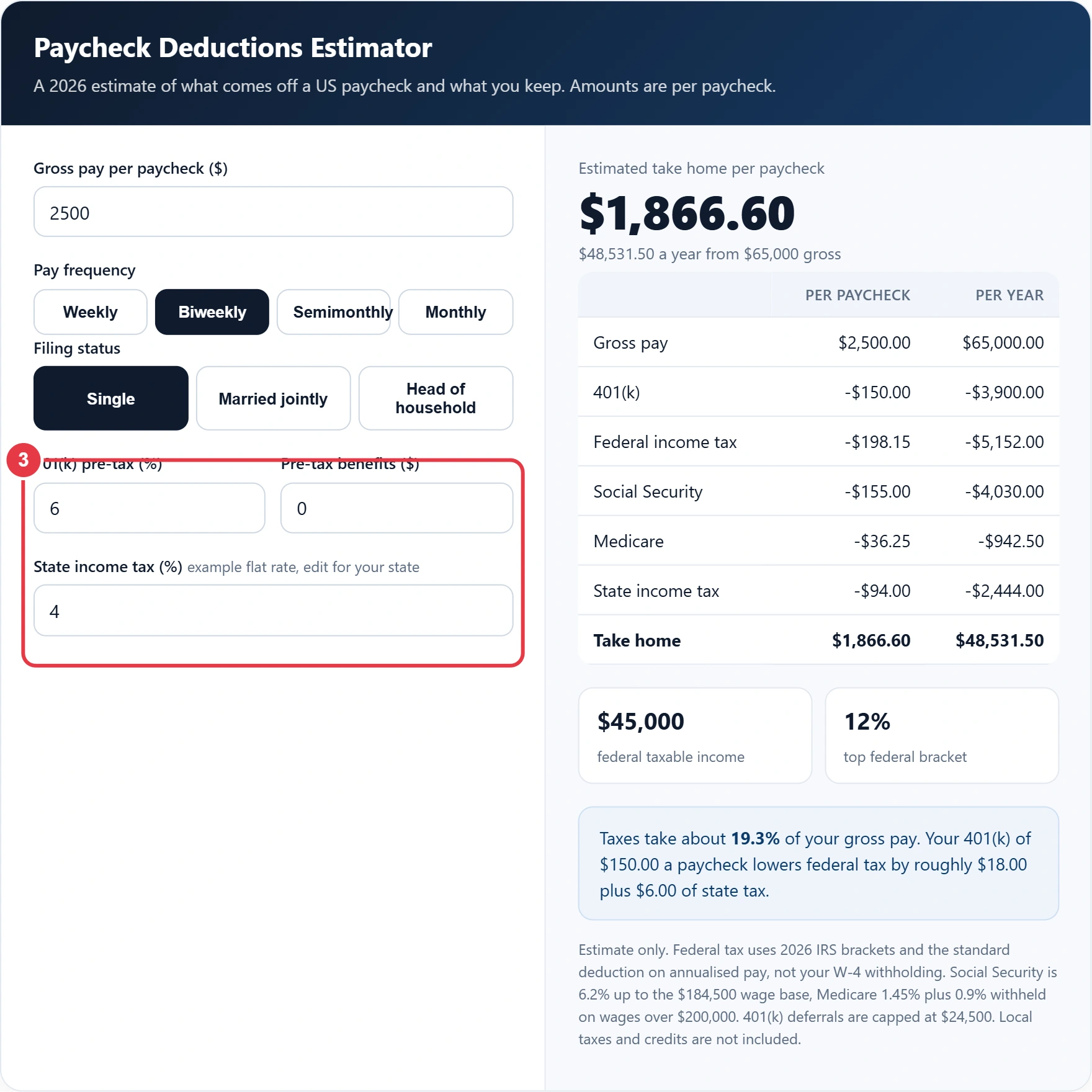
Step 3: Add 401(k), Benefits and State Tax
Enter your 401(k) percentage and any pre-tax benefit premiums. State rules vary widely, so the state box takes a flat percentage you can edit, and 0% suits states with no wage tax. For pay worked out from hours, the time card calculator totals a week of shifts before you enter the gross figure.
Step 4: Read Your Estimated Take Home Pay
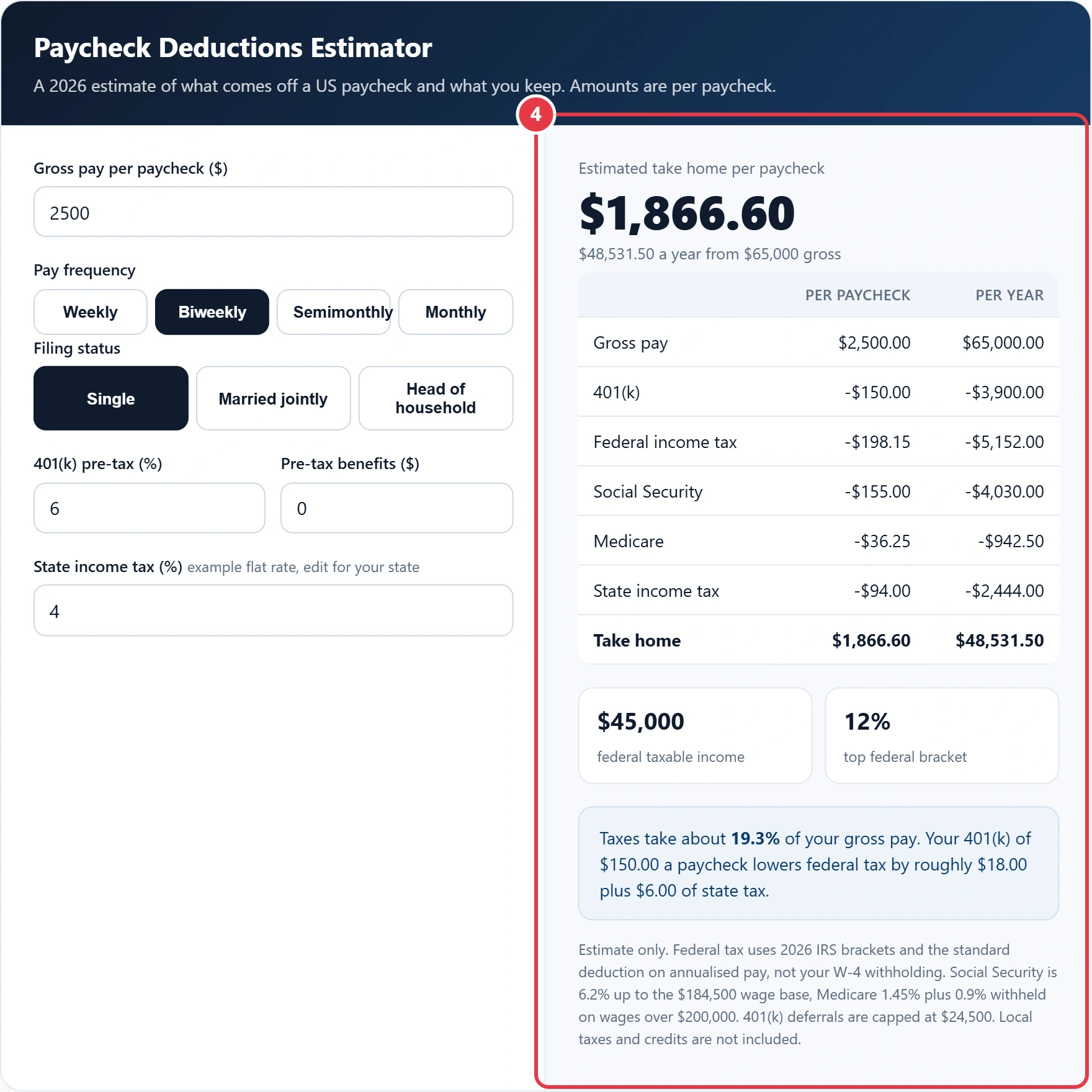
The table shows each deduction per paycheck and per year. If you are paid by the hour, the hourly to annual salary converter turns your rate into a yearly figure you can compare with the total here.
How Much Is Taken Out of a $2,500 Paycheck?
About $633 is taken out of a $2,500 biweekly paycheck for a single filer saving 6% in a 401(k) in a state with a 4% flat tax, leaving $1,866.60. Marcus earns $65,000 a year. His 401(k) takes $150.00, federal income tax $198.15, Social Security $155.00, Medicare $36.25 and state tax $94.00 per paycheck.
| 2026 payroll item | Employee rate | Limit |
|---|---|---|
| Social Security | 6.2% | Wages up to $184,500 |
| Medicare | 1.45% | No limit |
| Additional Medicare | 0.9% | Withheld on wages over $200,000 |
| 401(k) deferral | Your choice | $24,500 (under 50) |
| Standard deduction | Not a rate | $16,100 single, $32,200 joint |
High earners see the Social Security line stop part way through the year, because the cap is set by the SSA contribution and benefit base for 2026. Your actual withholding depends on your W-4 and may differ from this estimate.
Key Paycheck Deductions Terms Explained
These payroll terms explain each line the paycheck deductions estimator shows, helping US workers understand their withholding and plan around changes to pay or benefits.
- FICA
- The Federal Insurance Contributions Act payroll taxes, made up of Social Security and Medicare, which employers withhold from wages and match with their own share. Unlike income tax, they are not reduced by traditional 401(k) deferrals.
- Social Security wage base
- The annual earnings limit above which no further Social Security tax is withheld. Once a worker's year to date pay passes it, that deduction stops for the rest of the calendar year, so take-home pay rises.
- 401(k) plan
- An employer sponsored US retirement savings plan funded through payroll deductions. Traditional contributions are taken before income tax, lowering taxable wages now, while tax is paid when the money is withdrawn in retirement.
- Standard deduction
- A fixed amount, set by filing status, that is subtracted from income before federal income tax brackets are applied. Most taxpayers use it instead of itemizing individual expenses because it is larger or simpler.
- Section 125 plan
- A cafeteria plan that lets employees pay for certain benefits, such as health insurance premiums, from pre-tax pay. These deductions reduce both federal income tax and FICA, which makes them more valuable than 401(k) deferrals per dollar.
- Form W-4
- The IRS form an employee gives an employer to set federal income tax withholding, recording filing status, extra jobs, dependents and any additional amount to withhold. Actual withholding can therefore differ from an estimate based on brackets alone.
</>Embed this calculator on your website
Add the free Paycheck Deductions Estimator to your own site or blog. Copy the code below and paste it into an HTML block. It resizes itself and works on phones.
How we checked this tool: the Tools Veria Editorial Team built this tool by hand, checked it against the official rules or published standards where they apply, and tested it against worked examples. Results are estimates for planning, not personal financial or tax advice. Read our editorial policy and disclaimer, or report an error.
Frequently Asked Questions
What is the Social Security wage base for 2026?
The 2026 Social Security wage base is $184,500. Employees pay 6.2% on wages up to that amount, so the most anyone pays is $11,439 for the year; wages above the cap are not taxed for Social Security.
What is the standard deduction for 2026?
For 2026 the standard deduction is $16,100 for single filers, $32,200 for married couples filing jointly and $24,150 for heads of household. It is subtracted from income before the federal brackets apply.
Does a 401(k) contribution reduce Social Security and Medicare tax?
No. Traditional 401(k) deferrals lower federal income tax, and in most states state tax, but Social Security and Medicare are still charged on the full wages. Section 125 health premiums reduce both.
When does the additional 0.9% Medicare tax start?
Employers must withhold an extra 0.9% Medicare tax on wages above $200,000 in a calendar year, whatever your filing status. Your final liability uses $250,000 for joint filers when you file your return.
Why is this estimate different from my actual paycheck?
Real withholding follows your W-4, the IRS percentage method and any local taxes, credits or after-tax deductions. This tool annualises pay and applies the 2026 brackets directly, so treat it as an estimate within a few dollars.
What is the 401(k) contribution limit for 2026?
The 2026 employee deferral limit is $24,500. Workers aged 50 or over can add catch-up contributions on top of that figure, which this estimator does not include.