Leah went freelance as an illustrator in April 2025, put money aside for her first tax bill and felt ready. Then her online account showed a figure about 50% higher than she expected, all due on 31 January 2027. Nothing had gone wrong. She had met payments on account, the system HMRC uses to collect Self Assessment tax in advance, and almost every new sole trader meets it the same way.
Below, Leah and two other taxpayers show who pays in advance, how each instalment is sized and how a plumber called Tom cut his instalments without running up much interest.
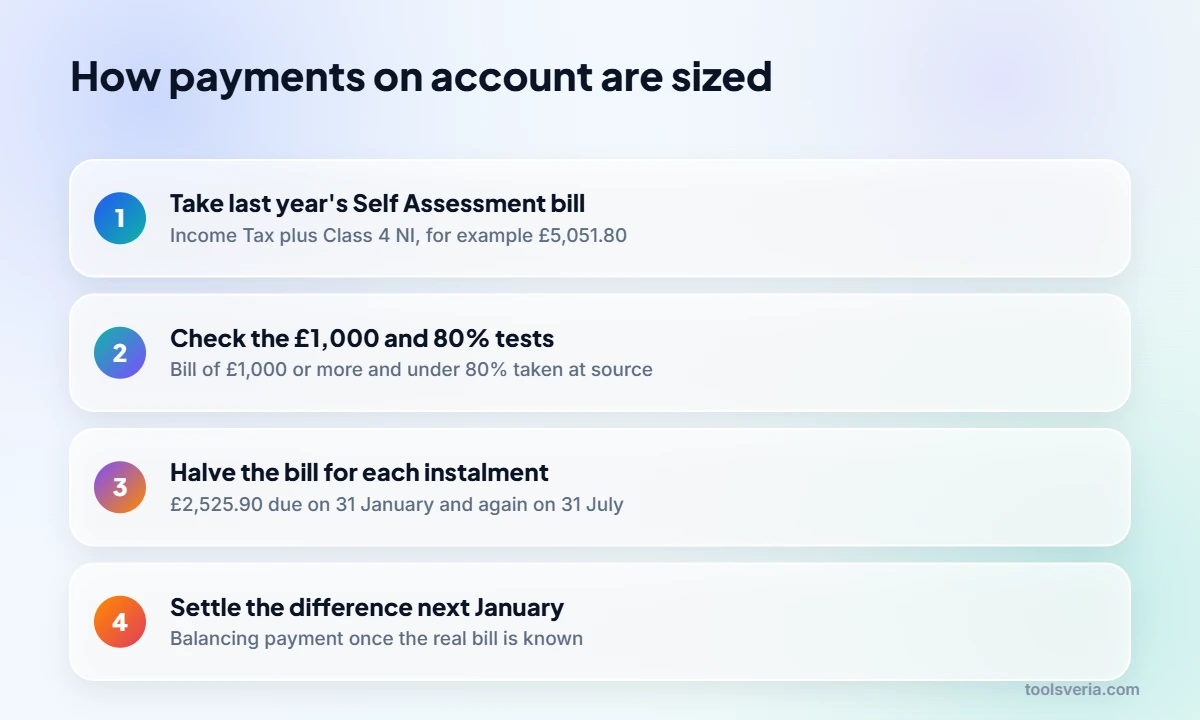
Quick answer: HMRC payments on account are two advance instalments towards next year’s Self Assessment bill, each half of last year’s Income Tax and Class 4 National Insurance, due on 31 January and 31 July. GOV.UK says you pay them when your bill is £1,000 or more and under 80% of your tax was taken at source.
In This Guide
What are payments on account and who has to make them?
Payments on account are advance instalments of your next Self Assessment bill, and you have to make them when last year’s bill was £1,000 or more and less than 80% of your total tax was already deducted at source. Both conditions must be met. A bill of £950 means no advance payments at all, however much you earn next year.
Each instalment is half of the previous year’s Self Assessment liability for Income Tax and Class 4 National Insurance. The official GOV.UK guide to payments on account confirms the two dates and that self employed people include Class 4 contributions in the sum, which is why sole traders feel the system more sharply than landlords or investors.
Tax taken at source means PAYE through a tax code, plus any tax deducted before income reaches you. That is why the 80% test matters so much to people who are mainly employed. Priya earns £40,000 on PAYE and makes £6,000 profit from a rented flat. In 2026/27 her employer deducts £5,486 of Income Tax, and her rental profit adds £1,200 at the 20% basic rate. Her Self Assessment bill is £1,200, above the £1,000 line, yet 82% of her total tax of £6,686 was collected through payroll. She escapes payments on account entirely.
When are payments on account due?
Payments on account are due by midnight on 31 January during the tax year and by midnight on 31 July just after it ends. For the 2026/27 tax year, which runs from 6 April 2026 to 5 April 2027, the instalments fall on 31 January 2027 and 31 July 2027, and any balance left over is settled on 31 January 2028.
Each January therefore carries two jobs: the balancing payment for the year just reported and the first instalment for the year you are in. July carries only the second instalment.
| Date | What Leah pays | Amount |
|---|---|---|
| 31 January 2027 | 2025/26 balancing payment plus first 2026/27 instalment | £7,577.70 |
| 31 July 2027 | Second 2026/27 instalment | £2,525.90 |
| 31 January 2028 | 2026/27 balancing payment plus first 2027/28 instalment | £4,865.90 |
When you file, put both dates and sums in your diary. The July instalment is the one people forget, because no return is due alongside it.

Why is the first January bill so big?
The first January bill is big because it contains a whole year of tax plus half of the next year’s tax in advance, so it lands at around 150% of the year’s liability.
Her 2025/26 profit was £32,000. The Personal Allowance of £12,570 and the 20% basic rate applied in 2025/26 just as they do in 2026/27, so her Income Tax came to £3,886. Class 4 National Insurance at 6% on profits above £12,570 added £1,165.80, giving a bill of £5,051.80. Because she had no PAYE income, none of it was collected at source.
HMRC therefore asks for the £5,051.80 plus a first instalment of £2,525.90 towards 2026/27, a total of £7,577.70 on 31 January 2027. In July she pays another £2,525.90. If you want to see your own version before the return is filed, our self employed tax calculator works out Income Tax and Class 4 from your profit, and halving that total gives each instalment.
Year two: the balancing payment
Leah’s profit rises to £38,000 in 2026/27, which produces £5,086 of Income Tax and £1,525.80 of Class 4, a bill of £6,611.80. She has already paid £5,051.80 through her two instalments, so the balancing payment on 31 January 2028 is £1,560. Added to her first instalment for 2027/28, half of £6,611.80 or £3,305.90, that January costs £4,865.90. After the first year, the system simply runs a year behind your profits.
How do you reduce payments on account?
You reduce payments on account by asking HMRC to lower them, either in your online Self Assessment account or on form SA303, when you expect this year’s bill to be smaller than last year’s. You can do it at any point before the final figure is known, and HMRC refunds anything you have overpaid.
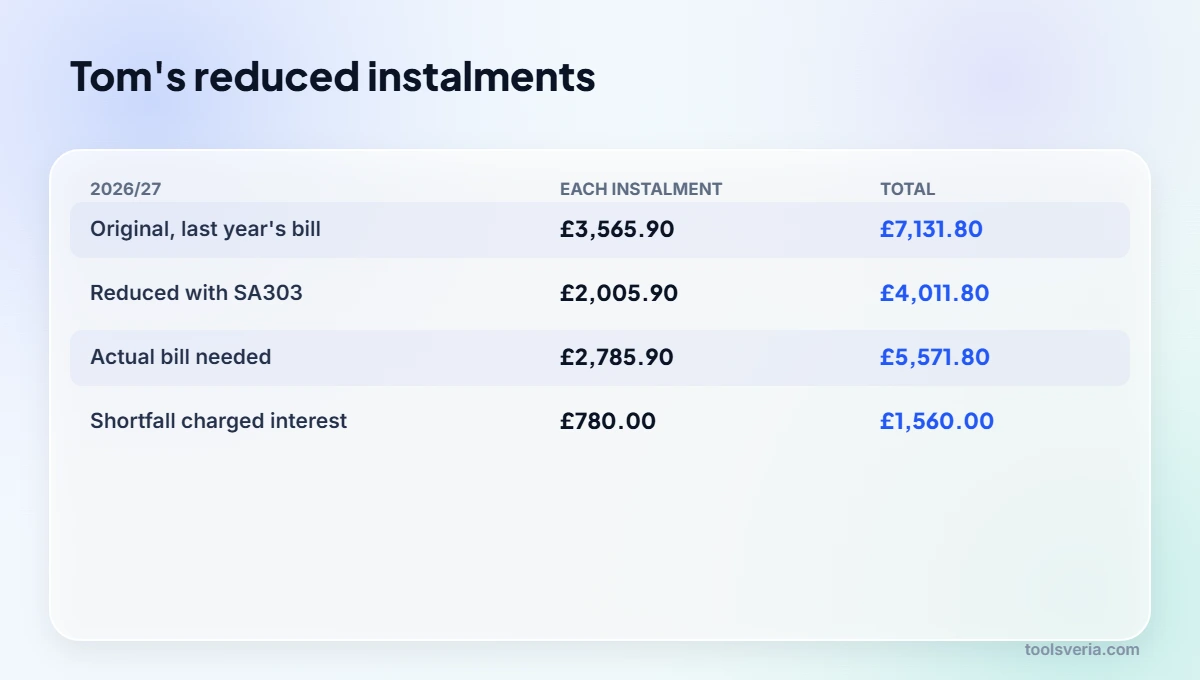
Tom is a plumber who made £40,000 profit in 2025/26, giving a bill of £7,131.80 and two instalments of £3,565.90. After a hand injury he expects only £28,000 profit for 2026/27, a bill of £4,011.80. Reducing each instalment to £2,005.90 keeps £1,560 in his account in January and again in July.
What it costs if you cut too far
Tom’s recovery goes better than planned and he finishes the year on £34,000, a bill of £5,571.80. Each instalment should have been £2,785.90, so he underpaid £780 twice. HMRC charges interest on each shortfall from its original due date, at the HMRC late payment interest rate, which has been the Bank of England base rate plus 4 percentage points since 6 April 2025. At the 7.75% rate set on 9 January 2026, about £91 of interest builds up by 31 January 2028.
That is cheaper than overpaying £1,560 twice, provided Tom’s estimate is honest. A sensible approach is to reduce to a cautious figure, keep the difference in an easy access account and update the claim if trade picks up. Our savings interest calculator shows what that set aside money earns while it waits.
| Tom’s 2026/27 instalments | Original | Reduced | Should have been |
|---|---|---|---|
| 31 January 2027 | £3,565.90 | £2,005.90 | £2,785.90 |
| 31 July 2027 | £3,565.90 | £2,005.90 | £2,785.90 |
| Total paid in advance | £7,131.80 | £4,011.80 | £5,571.80 |
Which taxes are left out of the instalments?
Student loan repayments, Capital Gains Tax and voluntary Class 2 National Insurance are left out of payments on account and are paid in full with the balancing payment on 31 January. Budget for those sums separately.
Dividend tax is different. It is part of your Income Tax, so it does count towards the instalments, and a director who draws most of their income as dividends can face payments on account even with a small salary. Our dividend tax calculator applies the 2026/27 rates of 10.75%, 35.75% and 39.35% above the £500 allowance, which helps when estimating a reduced claim.
Making Tax Digital for Income Tax does not move the payment dates. Since 6 April 2026, sole traders and landlords with qualifying income above £50,000 send quarterly updates through software, but those updates are reports, not payments. The 31 January and 31 July instalments carry on as before.
What happens if you pay late?
A late payment on account attracts daily interest at the HMRC late payment rate from the due date until it is paid. Unpaid balancing tax can also attract penalties of 5% of the amount owed at 30 days, 6 months and 12 months, so a missed January payment is more expensive than a missed July one.
If you cannot pay, contact HMRC before the deadline. A payment plan still costs interest but avoids the escalating penalties. Self employed people can soften the January peak by moving a fixed share of each invoice into a separate account, about 26p of every pound of profit above £12,570 for a basic rate sole trader in 2026/27.
Key points
- Payments on account are two instalments, each half of last year’s Income Tax and Class 4 National Insurance bill.
- They apply when the Self Assessment bill is £1,000 or more and under 80% of total tax was collected at source.
- The due dates are 31 January and 31 July, with any balancing payment due the following 31 January.
- A first year sole trader with a £5,051.80 bill pays £7,577.70 in January, about 150% of the bill.
- Reducing instalments with SA303 is allowed, but HMRC charges interest at base rate plus 4 points on any shortfall.
Payments on Account Terms Explained
These definitions explain the tax rules, deadlines and figures behind payments on account, so you can predict each instalment and plan your cash before HMRC asks.
- Balancing payment
- The settlement due on 31 January after a tax year’s return is filed, equal to the final Self Assessment liability for that year minus the two advance instalments already paid. If those instalments exceeded the true bill, the surplus is credited or refunded instead.
- Tax deducted at source
- Income Tax collected before money reaches you, chiefly through PAYE on wages and pensions. HMRC weighs this against your total tax when applying the 80% test, so people taxed mainly through payroll frequently escape advance instalments altogether.
- Class 4 National Insurance
- A contribution charged on the profits of self-employed people above a lower threshold and collected through Self Assessment together with Income Tax. Because it forms part of the liability used to size each instalment, sole traders also pay it in advance.
- Reducing payments on account
- A claim to HMRC asking for smaller instalments when you expect next year’s bill to fall, for example after losing a contract. If the reduced figures prove too low, interest is charged on the shortfall from the original due dates.
- UK tax year
- The twelve-month period running from 6 April to the following 5 April, which each Self Assessment return covers. Instalments for a given year straddle its end, with one falling in January within the year and the other in July just afterwards.
Frequently Asked Questions
My first tax bill was £980. Will HMRC still ask for July money?
No. A Self Assessment bill under £1,000 means no payments on account for the next year, so you pay the £980 by 31 January and nothing in July. If your next bill reaches £1,000 or more, instalments start from the January after that.
I stopped trading in March. Do I still have to pay the July instalment?
You can usually reduce it, because the instalment is only an estimate of a bill that will now be smaller. Ask HMRC online or on SA303 to lower it to your expected final liability, which could be nil if your last year’s profit sits below the £12,570 Personal Allowance.
Does my Plan 2 student loan go into the instalments?
No. Student loan repayments collected through Self Assessment are paid in full with the balancing payment on 31 January and are never split into payments on account. Capital Gains Tax is treated the same way, so set money aside for both.
I paid £3,000 too much in advance. How do I get it back?
Once your return shows the lower bill, the overpayment appears as a credit in your HMRC online account. You can claim it as a repayment or leave it to cover your next instalment, and HMRC adds repayment interest for the time it held the money.
Leah now treats each January as a two part bill and saves for both parts, while Tom reduces only to a figure he can defend. Put last year’s bill into the calculator, check both dates and decide whether a reduction is worth the interest risk. Figures checked October 2026.