Self Assessment payments on account, the balancing payment and every due date.
| Due date | Payment | Amount |
|---|
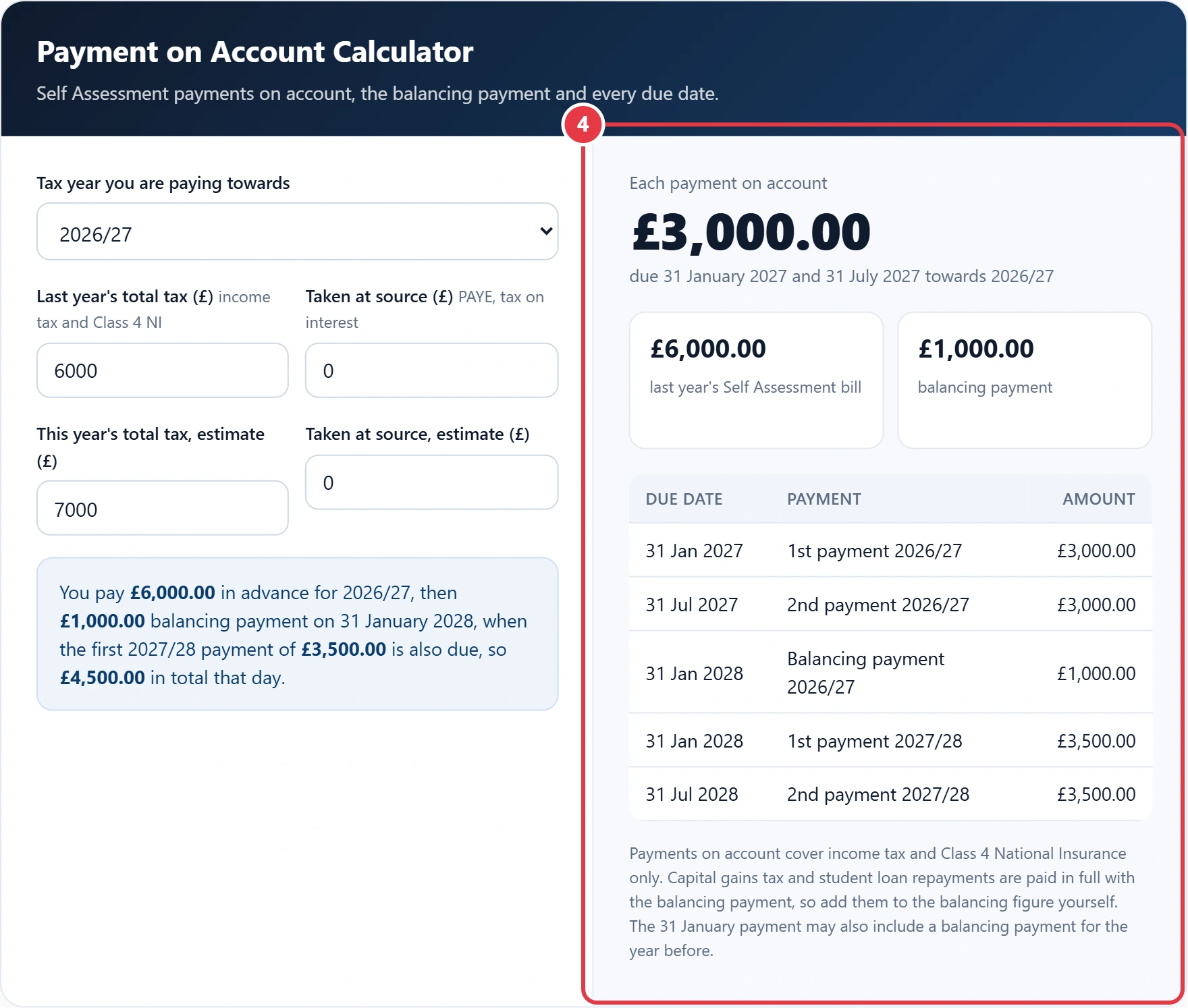
Payments on account cover income tax and Class 4 National Insurance only. Capital gains tax and student loan repayments are paid in full with the balancing payment, so add them to the balancing figure yourself. The 31 January payment may also include a balancing payment for the year before.
Your first Self Assessment bill often comes as a shock, because HMRC asks for part of next year's tax at the same time. This payment on account calculator works out whether you need to make advance payments, how much is due on 31 January and 31 July, and what your balancing payment will be. It follows the GOV.UK rules on payments on account, including the £1,000 and 80% tests, and lays out every date in one table.
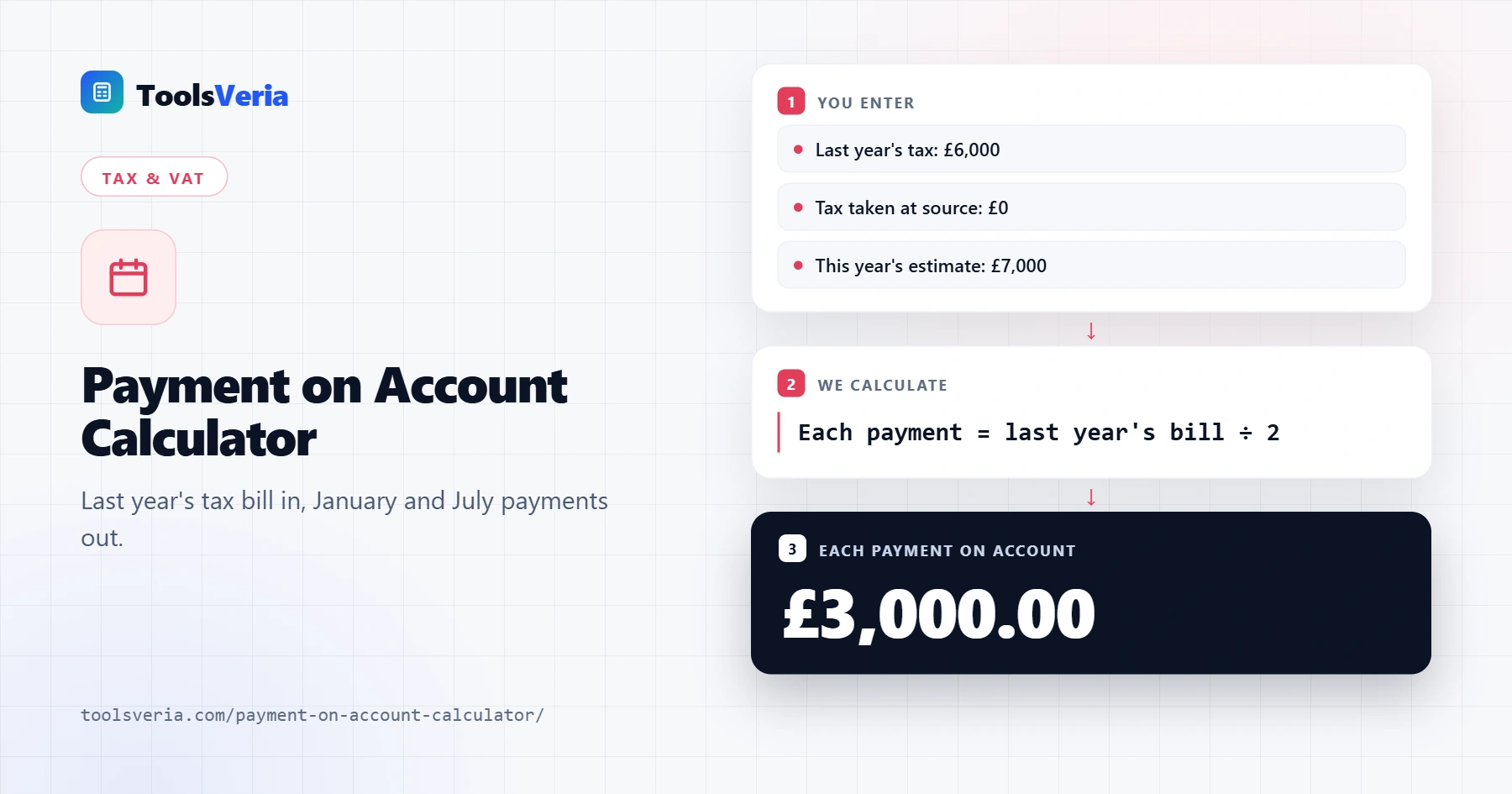
Quick answer: A payment on account calculator applies the HMRC rule that each payment on account is half of last year's Self Assessment bill. You do not need to pay if last year's bill was under £1,000 or more than 80% of your tax was taken at source. For 2026/27, payments are due on 31 January 2027 and 31 July 2027.
In This Guide
What Is a Payment on Account?
A payment on account is an advance payment towards your next Self Assessment bill. HMRC assumes your income will be similar to last year, so it asks for two instalments, each half of last year's Self Assessment bill. They cover income tax and Class 4 National Insurance, but not capital gains tax or student loan repayments.
You do not have to make payments on account if last year's bill was under £1,000, or if more than 80% of your total tax was already taken at source, for example through PAYE. Once your return is filed, any tax still owed is the balancing payment: this year's bill minus the payments on account already made.
How Do You Use the Payment on Account Calculator?
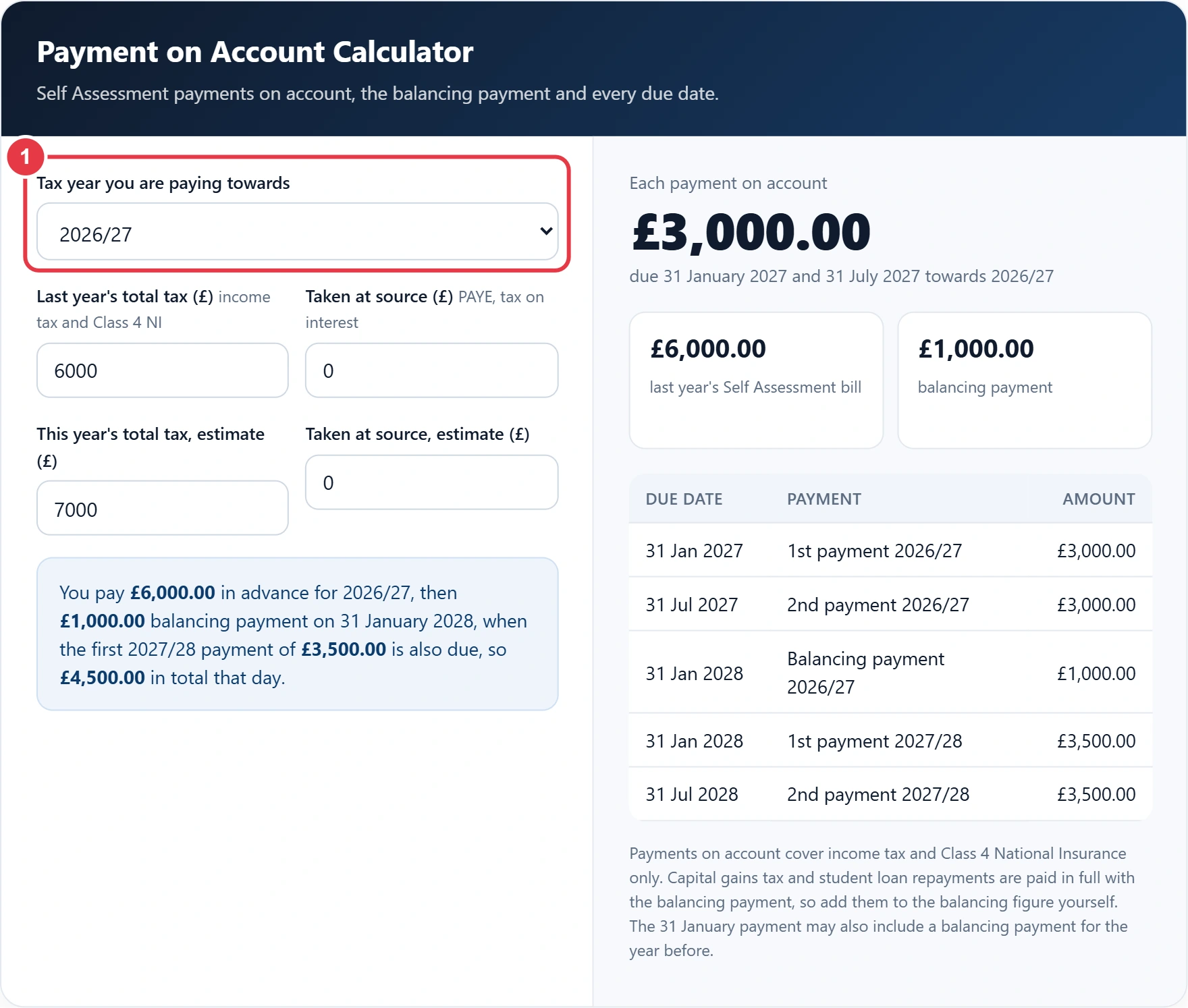
Step 1: Choose the Tax Year
You pick the tax year the payments go towards, and for 2026/27 they are due on 31 January 2027 and 31 July 2027. Pick the tax year the payments go towards. For 2026/27 the payments are due on 31 January 2027 and 31 July 2027, with the balancing payment on 31 January 2028.
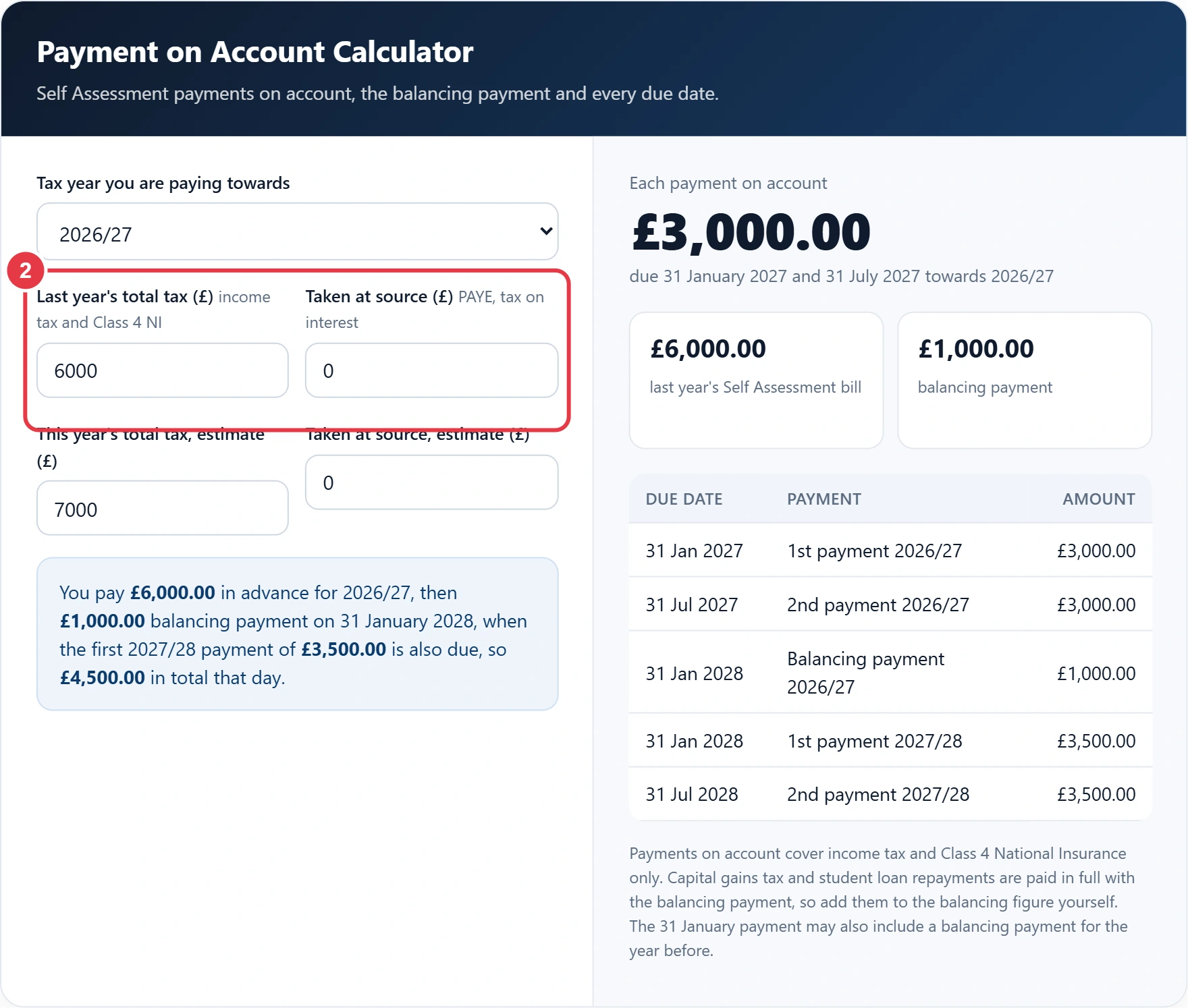
Step 2: Enter Last Year's Tax
Enter the total income tax and Class 4 NI from your last return, then any tax already taken at source. If you are not sure of the figure, our self employed tax calculator estimates it from your profit, so you can check the bill before you enter it.
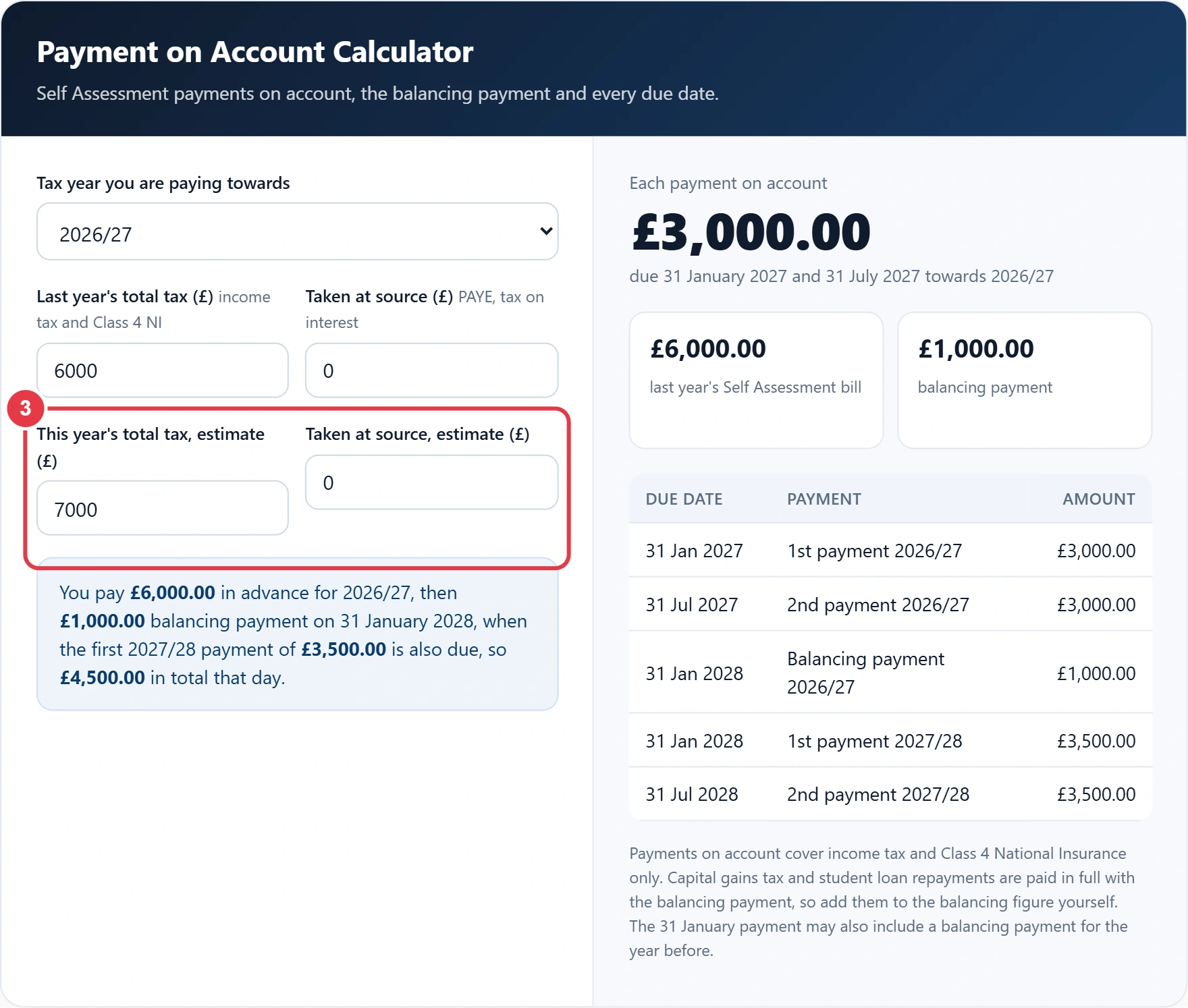
Step 3: Estimate This Year's Tax
Add your best estimate for the current year. Company directors who take dividends can get a figure from the dividend tax calculator and add any tax on other income, which gives a realistic balancing payment.
Step 4: Read Your Payment Schedule
The results show each payment on account, the balancing payment and a dated schedule, including the first instalment for the following year that falls on the same 31 January.
How Do Payments on Account Work in Practice?
| Due date | Payment | Amount |
|---|---|---|
| 31 January 2027 | 1st payment on account 2026/27 | £3,000 |
| 31 July 2027 | 2nd payment on account 2026/27 | £3,000 |
| 31 January 2028 | Balancing payment 2026/27 | £1,000 |
| 31 January 2028 | 1st payment on account 2027/28 | £3,500 |
| 31 July 2028 | 2nd payment on account 2027/28 | £3,500 |
After a £6,000 bill last year, you pay £3,000 on 31 January 2027 and £3,000 on 31 July 2027, then a £1,000 balancing payment if this year's bill is £7,000. This example uses a £6,000 bill last year and a £7,000 bill this year. If your income has fallen, you can ask HMRC to reduce your payments on account, and the Self Assessment deadlines page lists every filing and payment date you need, so put them in your diary early. Interest is charged if you reduce the payments too far.
</>Embed this calculator on your website
Add the free Payment on Account Calculator to your own site or blog. Copy the code below and paste it into an HTML block. It resizes itself and works on phones.
How we checked this tool: the Tools Veria Editorial Team built this tool by hand, checked it against the official rules or published standards where they apply, and tested it against worked examples. Results are estimates for planning, not personal financial or tax advice. Read our editorial policy and disclaimer, or report an error.
Frequently Asked Questions
How are payments on account calculated?
Each payment is half of your previous year's Self Assessment bill for income tax and Class 4 National Insurance, after tax taken at source.
When are payments on account due?
The first is due by midnight on 31 January and the second by midnight on 31 July. Any balancing payment is due on the following 31 January.
Do I have to make payments on account?
Not if last year's Self Assessment bill was under £1,000, or if more than 80% of your tax was already paid at source, such as through PAYE.
Are capital gains tax and student loans included?
No. Capital gains tax and student loan repayments are not included in payments on account. They are paid in full with the balancing payment.
Can I reduce my payments on account?
Yes. If you expect a lower bill, you can apply online or with form SA303. If the final bill is higher, HMRC charges interest on the shortfall.
What happens if I overpay?
If your payments on account are more than the final bill, HMRC refunds the difference or sets it against your next payment.