
Marcus draws children’s book illustrations at a desk in his spare room in Bristol, five days a week, all year. Every January he wonders what he can deduct for the heating and electricity his work uses. The working from home allowance self employed people can claim answers that with a fixed monthly figure based on hours, so he never has to split a single bill.
That flat rate is not the only option, and it is not always the best one. Marcus and two other sole traders are worked through below, with the rates, the alternative actual costs method and the extras that sit on top of both.
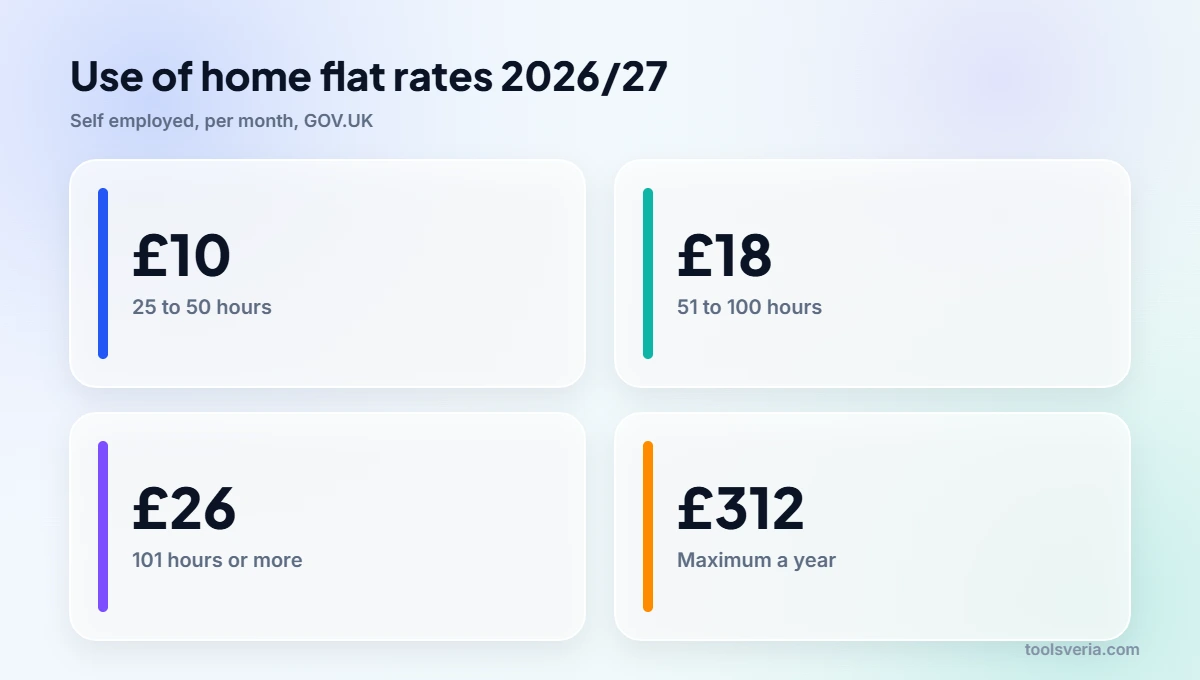
Quick answer: For 2026/27, GOV.UK lets self employed people claim £10 a month for 25 to 50 hours worked at home, £18 for 51 to 100 hours and £26 for 101 hours or more, up to £312 a year. Phone and broadband are claimed separately, and limited companies cannot use these rates.
In This Guide
How much is the working from home allowance for the self employed?
The working from home allowance for the self employed is £10, £18 or £26 for each month, depending on how many hours of business work you did at home that month, and a month with fewer than 25 hours earns nothing.
| Business hours at home in the month | Flat rate for that month | If every month is the same |
|---|---|---|
| Under 25 | £0 | £0 a year |
| 25 to 50 | £10 | £120 a year |
| 51 to 100 | £18 | £216 a year |
| 101 or more | £26 | £312 a year |
Unchanged since the scheme began, these monthly figures appear on the GOV.UK simplified expenses page for working from home for 2026/27. They cover heating, lighting and power, so you cannot add a share of your gas and electricity bills on top of the flat rate.
Marcus works about 140 hours a month at home, every month, so he claims £26 for twelve months, which is £312. As a basic rate taxpayer he saves 20% Income Tax plus 6% Class 4 National Insurance on that amount, 26% in all, which is £81.12. A higher rate sole trader would save 42%, and one paying the additional rate 47%, because Class 4 drops to 2% above £50,270.
Which hours count towards the flat rate?
Only hours you spend at home doing work for the business count towards the flat rate, such as serving clients, making the product, keeping your books and marketing, while time when family members simply use the same room does not.
- Count: client calls, design or production work, invoicing, bookkeeping, quoting and planning.
- Do not count: travel to clients, work done in a café or client office, and personal use of the room.
- Keep: a simple diary or timesheet of hours per month, because each month is banded on its own.
Ellie: why averaging the year can overstate a claim
Ellie is a wedding photographer in York. From April to September 2026 she is out shooting most days and edits at home for only about 20 hours a month, which earns £0 for each of those months. From October 2026 to March 2027 she edits at home for around 120 hours a month, earning £26 a month, or £156 for the year.
Averaging the year gives 70 hours a month, which would suggest the £18 band for all twelve months and a claim of £216. That would overstate her deduction by £60, because HMRC bands each month separately. A part year claim also stops when the business stops: three months of trading at £26 gives £78, not a year’s worth.

Is the flat rate or actual costs better for working from home?
The flat rate is usually better when you work in one room for part of the day, while actual costs win when you use several rooms, run heavy equipment or have unusually high bills, because the business share of real bills can then pass £312 a year.
To work out actual costs, divide a year’s energy bills by the number of habitable rooms, then multiply by the share of time each room you use is used for work. A home using Ofgem’s typical 2,700 kWh of electricity and 11,500 kWh of gas would pay about £1,936 a year if the October to December 2026 price cap rates of 26.32p and 7.97p per kWh, plus standing charges, applied for twelve months. Swap in your own usage with the energy bill calculator, then divide the result by your rooms and apply the share of time each one is used for work.
| Household (5 habitable rooms, £1,936 energy) | Actual costs share | Flat rate at 101+ hours | Better method |
|---|---|---|---|
| 1 room, used 50% for work | £193.60 | £312 | Flat rate |
| 1 room, used 75% for work | £290.40 | £312 | Flat rate |
| 2 rooms, each used 75% for work | £580.80 | £312 | Actual costs |
Dev, an IT consultant in Reading, runs a home office and a separate server and testing room, both used for business three quarters of the time. His actual costs share of £580.80 beats the flat rate by £268.80, so he keeps his bills and a short note of how he split them. Running both sums before you file takes a few minutes and can be worth more than £100 in tax.

What can you claim on top of the flat rate?
On top of the flat rate you can claim the business share of phone and broadband, and a separate deduction for fixed costs such as council tax, home insurance and mortgage interest where a clear business proportion can be identified.
Extras like these sit outside the monthly amount and are claimed separately, as HMRC explains in its Business Income Manual guidance on the flat rate, which also allows the full broadband cost when private use is not significant. Marcus uses his £360 a year broadband for work about 60% of the time, so he adds £216. With the £312 flat rate, his claim reaches £528 and his saving at 26% rises to £137.28.
One caution applies to fixed costs. Claiming that a room is used only for business can affect Private Residence Relief on part of your gain when you sell the house, so most sole traders keep some private use. Business travel is a separate simplified expense, and the mileage allowance calculator values it at 55p a mile for the first 10,000 miles.
Who cannot use the working from home flat rate?
Limited companies cannot use the working from home flat rate, and nor can partnerships that have a company as a partner, while employees lost the right to claim homeworking relief from HMRC on 6 April 2026.
Sole traders, partners in ordinary partnerships and freelancers can relax about the April 2026 change, because the GOV.UK policy paper on homeworking relief confirms that it applies to employees only. Employers, including your own company if you are a director, can still pay homeworking costs tax free, and HMRC’s Employment Income Manual accepts £6 a week, or £26 a month, without evidence. Directors comparing pay routes can use the limited company take home pay calculator to see the full picture.
Owners who live at their business premises, such as a small B&B or care home, use a different flat rate. They add up all premises costs, then subtract £350 a month for one person living there, £500 for two or £650 for three or more, to remove the private element.
Key points
- Self employed people can claim £10, £18 or £26 a month for 25 to 50, 51 to 100 or 101+ business hours at home.
- The maximum flat rate is £312 a year, and a month under 25 hours earns nothing.
- Each month is banded separately, so an annual average can give the wrong figure.
- Phone, broadband, council tax, insurance and mortgage interest shares can be added on top.
- Employees cannot claim homeworking relief from HMRC from 6 April 2026, but sole traders are unaffected.
Working From Home Allowance Terms for the Self Employed
These terms explain the claim methods and tax effects behind the working from home allowance for self employed people, helping you choose the option that saves most.
- Sole trader
- A self employed person who runs a business as an individual, keeping the profits and being personally responsible for its debts. Sole traders report profits through Self Assessment and can use HMRC’s flat rates for home working.
- Allowable expense
- A cost incurred wholly and exclusively for running the business, which can be deducted from income to work out taxable profit. Home running costs qualify only for the part that relates to business use.
- Actual costs method
- An alternative to the flat rate in which the business share of real household bills is calculated, typically by rooms used and hours worked. It needs more records but can give a larger claim when bills are high.
- Monthly banding
- The rule that each month’s hours are matched to a rate on their own instead of averaging the year. Seasonal workers can lose money if they average, because months below 25 hours earn nothing.
- Combined marginal saving
- The tax saved on each pound of expense, adding Income Tax and Class 4 National Insurance. For a basic rate sole trader it is 26%, while higher rate and additional rate traders save 42% and 47%.
Frequently Asked Questions
I work from home 20 hours a week. Which band am I in?
Twenty hours a week is roughly 86 hours a month, which puts you in the £18 band for 51 to 100 hours. Over twelve similar months you would claim £216, worth £56.16 to a basic rate sole trader once Class 4 National Insurance is included.
I started trading in January. Can I claim for the whole tax year?
No, you can only claim for the months you traded and worked at home. Starting in January 2027 gives January, February and March, so at least 101 hours a month would give 3 × £26, which is £78 for 2026/27.
I am employed and freelance in the evenings. What can I claim?
Your freelance business can use the flat rate for hours spent on that work at home, through Self Assessment. Your employment cannot, because employees lost homeworking relief from HMRC on 6 April 2026, so only an employer reimbursement helps with that side.
Do I need receipts to claim the flat rate?
You do not need energy bills for the flat rate, but you should keep a record of your business hours each month to support the band you claim. Actual costs, broadband and council tax shares need bills and a note of how you split them.
Marcus now claims £528 rather than nothing, Ellie claims the correct £156 and Dev chooses actual costs. Put your own monthly hours into the calculator, check your overall bill with the self employed tax calculator, and plan for any payments on account due in January and July. Figures checked October 2026 against GOV.UK and HMRC guidance for 2026/27.