HMRC flat rate for sole traders and partnerships working from home, 2026/27.
| Hours a month | Rate | Your months | Claim |
|---|
Estimate only, check with HMRC. Flat rates from GOV.UK simplified expenses guidance: 25 to 50 hours £10, 51 to 100 hours £18, 101 hours or more £26 a month. Not available to limited companies or to employees. Figures checked October 2026.
This use of home simplified expenses calculator shows UK sole traders and partners how much they can claim for working from home in the 2026/27 tax year using HMRC's flat rate, and whether a share of actual bills would give more. Enter your hours, month by month if they change, and it applies the £10, £18 or £26 monthly rate, adds any separate claims and estimates the tax and National Insurance you save.
Quick answer: Self employed people who work at home 25 to 50 hours a month can deduct £10 a month, 51 to 100 hours £18, and 101 hours or more £26, which is £312 a year at the top rate. The use of home simplified expenses calculator adds these month by month and compares them with actual costs.
In This Guide
What Are Use of Home Simplified Expenses?
Use of home simplified expenses are a fixed monthly deduction that HMRC lets sole traders and business partnerships claim for household running costs instead of working out the business share of each bill. The flat rate covers heating, lighting and power. It does not cover phone or broadband, which you claim separately at their business proportion.
The formula in plain words: for each month, count the hours you spent at home on core business work such as serving clients, keeping records and marketing. Match that number to the band, then add the twelve monthly amounts. A month under 25 hours earns nothing, so a single annual average can overstate your claim if your hours swing. The rates have not changed since the scheme began in 2013/14, and the official GOV.UK working from home rates still list the same three bands for 2026/27, so the table below is current.
| Business hours at home per month | Flat rate per month | Full year at that rate |
|---|---|---|
| Under 25 | £0 | £0 |
| 25 to 50 | £10 | £120 |
| 51 to 100 | £18 | £216 |
| 101 or more | £26 | £312 |
How to Use the Use of Home Simplified Expenses Calculator
Step 1: Enter Your Business Hours
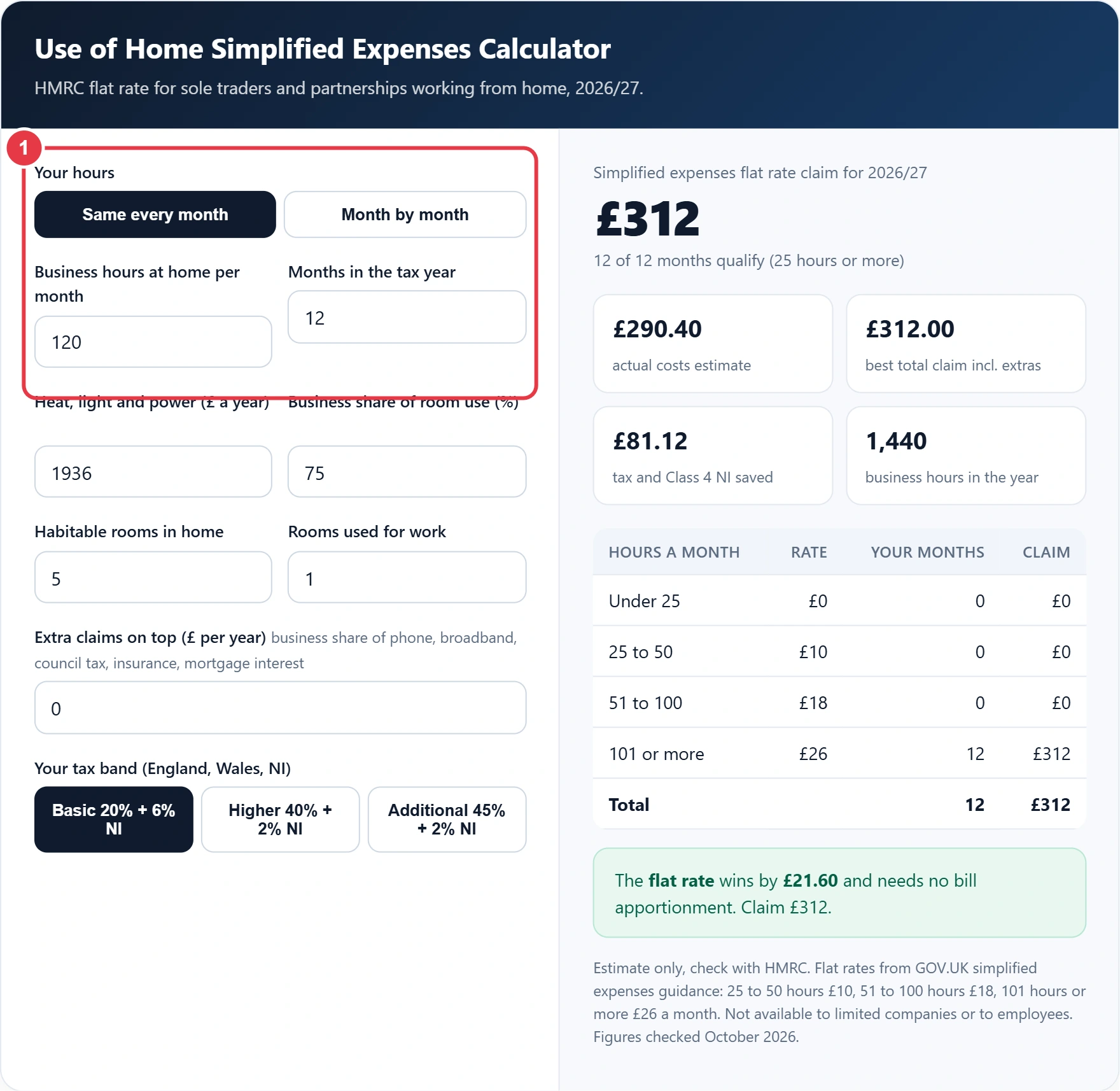
If your hours are steady, keep Same every month and enter your monthly hours and the number of months you worked from home. If they change with the seasons, switch to Month by month and fill in April 2026 to March 2027 separately, because each month is banded on its own.
Step 2: Add Bills for the Actual Costs Check
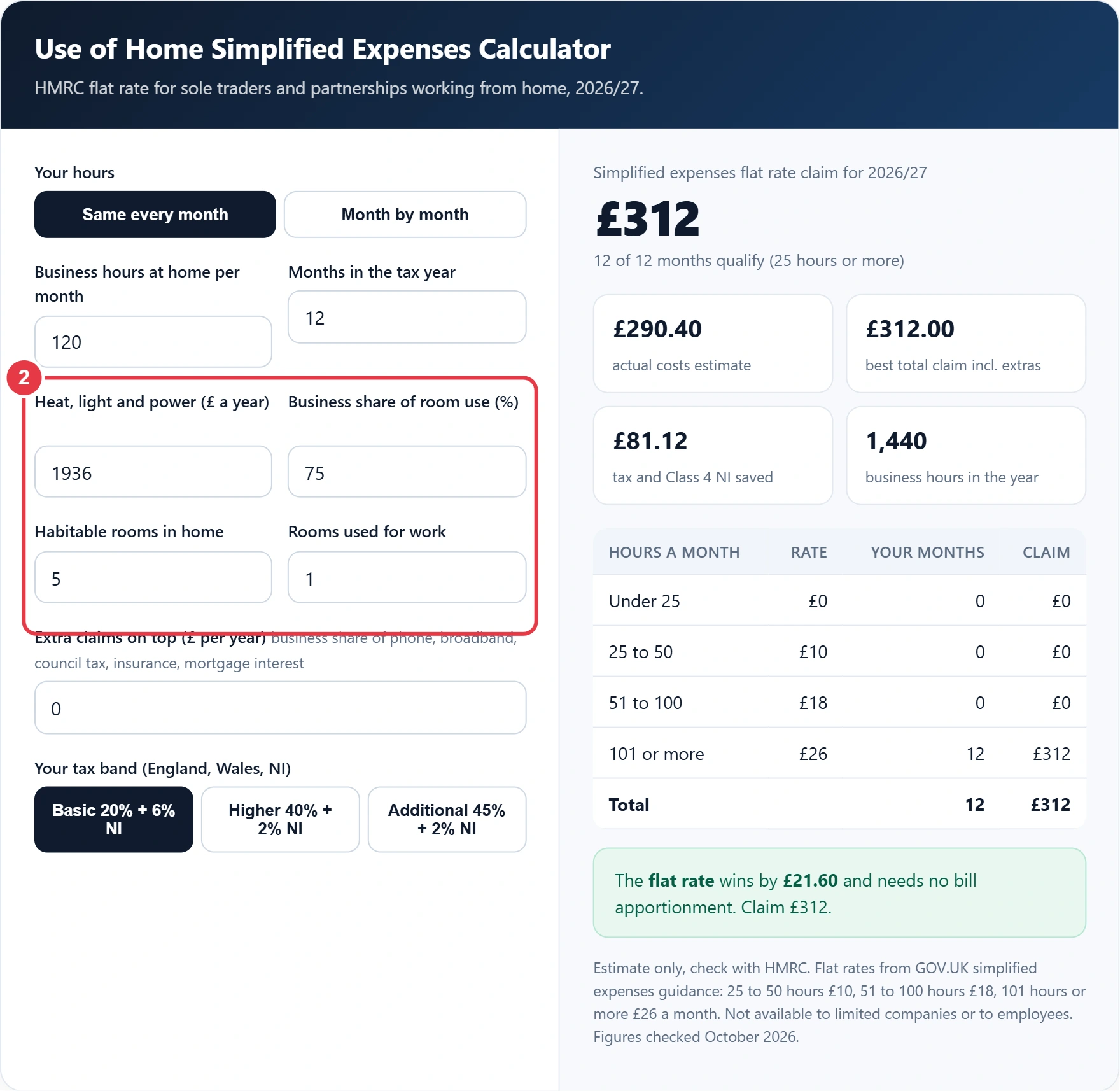
Enter your yearly gas and electricity, the number of habitable rooms and how many you use for work. The default of £1,936 is what a home using Ofgem's typical 2,700 kWh of electricity and 11,500 kWh of gas would pay over a year at the October to December 2026 cap rates. The business share is the part of that room's use that is work rather than family time.
Step 3: Add Extras and Pick Your Tax Band
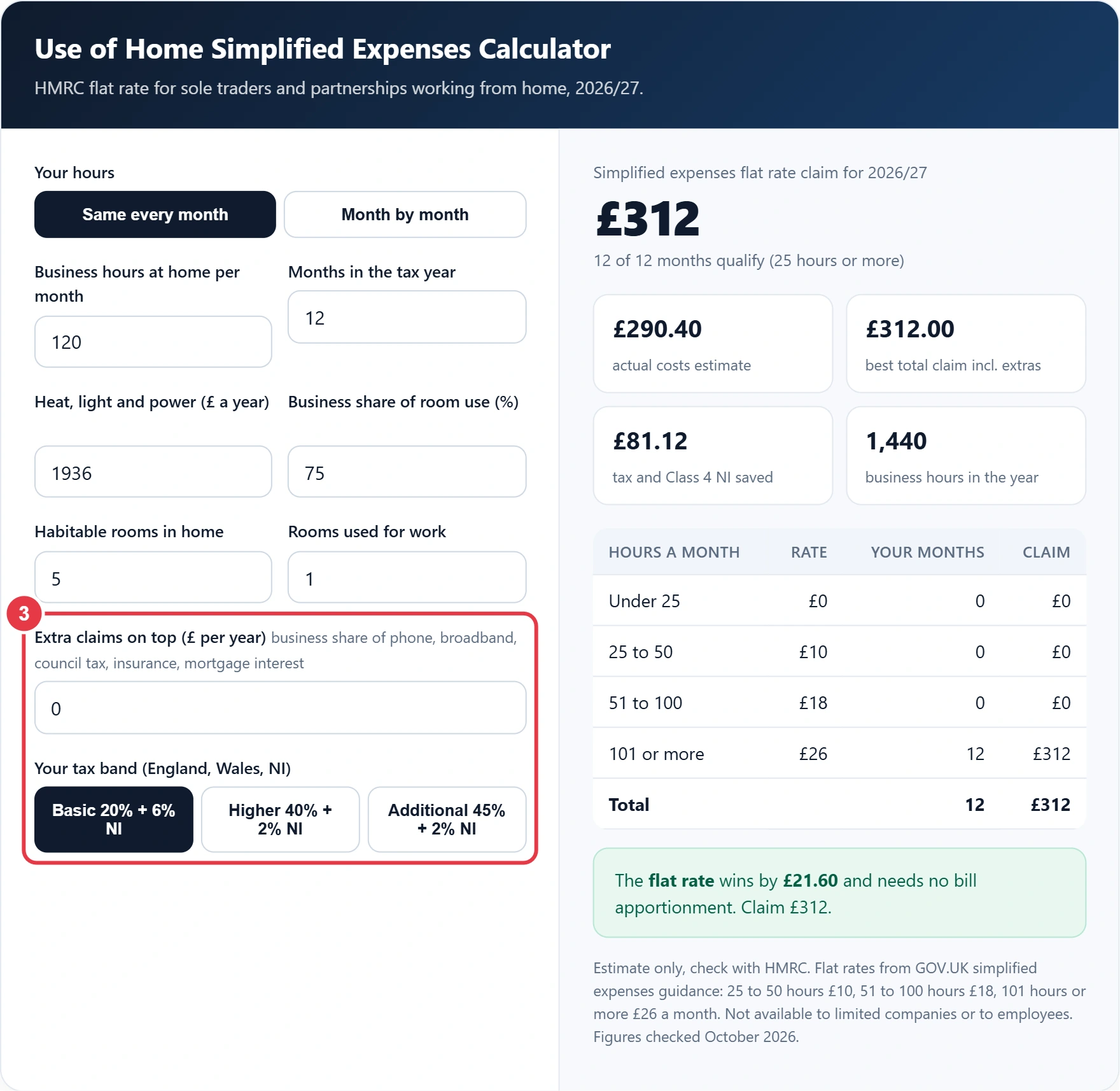
Add the business share of phone, broadband, council tax, home insurance and mortgage interest, which you can claim on top of either method. Then choose your band so the saving reflects Income Tax plus Class 4 National Insurance at 6% or 2%. The self employed tax calculator shows your band if you are unsure.
Step 4: Read Your Result
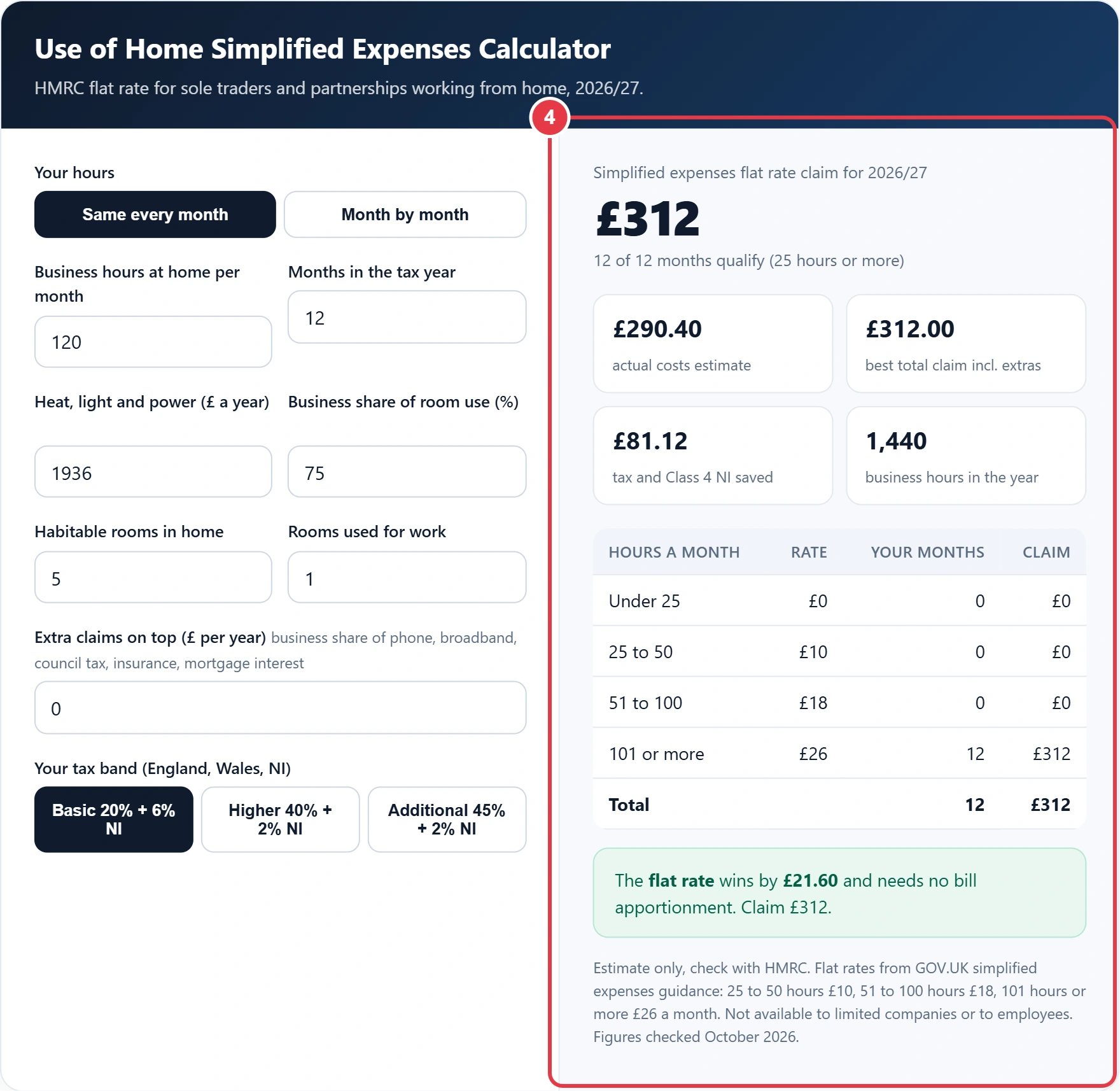
The headline in the use of home simplified expenses calculator is your flat rate claim for the year. The table shows how many months fall in each band, the stats compare actual costs and the best total claim, and the box tells you which method to put on your Self Assessment return.
How Much Can I Claim for Working From Home if Self Employed?
Most self employed people working from home full time can claim £312 a year under the flat rate, because a 25 hour week is well over 101 hours a month. Part time or seasonal work earns less, since every month is banded separately.
Worked example: Sophie is a self employed bookkeeper in Nottingham. From April to December 2026 she works 120 hours a month at her kitchen table office, then drops to 40 hours a month from January to March 2027 while she covers a client's office. Nine months at £26 give £234 and three months at £10 give £30, so her claim is £264. As a basic rate taxpayer she saves 26% of that, about £68.64 in Income Tax and Class 4 National Insurance. Averaging her year to 100 hours a month would have put her in the £18 band for all twelve months, giving £216 and understating the claim by £48.
Is the Flat Rate or Actual Costs Better?
The flat rate is usually better for a single room used during the working day, because a fair share of normal bills rarely beats £312. Actual costs win when you use several rooms, run energy hungry equipment or have unusually high bills.
Using the defaults in the use of home simplified expenses calculator, £1,936 of energy split over 5 rooms is £387.20 a room, and 75% business use of one room gives £290.40, which is £21.60 below the flat rate. If the same person used 2 of 5 rooms, the actual figure would be £580.80 and the actual costs method would win comfortably. If you choose actual costs, keep bills and a short note of how you split them.
What Can You Claim on Top of the Flat Rate?
You can add the business proportion of fixed costs such as council tax, home insurance and mortgage interest, plus phone and broadband. HMRC's Business Income Manual guidance on the flat rate confirms these sit outside the monthly amount, so a designer who uses broadband 60% for work can add 60% of a £360 yearly bill, which is £216.
Claiming a room as used only for business can affect Private Residence Relief when you sell your home, so most people keep some private use. If you also drive for work, the mileage allowance calculator applies the 55p a mile simplified rate, which is the other common simplified expense for sole traders.
Who Cannot Use Simplified Expenses for Use of Home?
Limited companies cannot use the flat rate, and nor can partnerships with a company as a partner. Directors working from home need their company to reimburse costs instead. Partners sharing one home get a single deduction based on their combined hours, with no hour counted twice.
Employees also lost the option to claim homeworking relief from HMRC from 6 April 2026, when the £6 a week employee claim ended. The GOV.UK policy paper on homeworking expenses says employers can still reimburse eligible costs tax free, so an employee should ask their employer rather than use this use of home simplified expenses calculator. Separate rates apply if you live at your business premises, such as a guest house, where you deduct £350, £500 or £650 a month for 1, 2 or 3 or more residents.
</>Embed this calculator on your website
Add the free Use of Home Simplified Expenses Calculator to your own site or blog. Copy the code below and paste it into an HTML block. It resizes itself and works on phones.
How we checked this tool: the Tools Veria Editorial Team built this tool by hand, checked it against the official rules or published standards where they apply, and tested it against worked examples. Results are estimates for planning, not personal financial or tax advice. Read our editorial policy and disclaimer, or report an error.
Frequently Asked Questions
How much is the working from home flat rate for self employed?
The flat rate is £10 a month for 25 to 50 hours of business use, £18 for 51 to 100 hours and £26 for 101 hours or more. A full year at the top rate is £312 for the 2026/27 tax year.
Can I claim working from home allowance if I work fewer than 25 hours a month?
No flat rate applies below 25 hours in a month, so that month adds £0. You can still claim a fair business share of actual household costs instead if you can show how you worked it out.
Does the flat rate include broadband and phone?
No. The £10, £18 and £26 rates cover heating, lighting and power only. Claim the business share of phone and broadband separately, for example 60% of a £360 broadband bill is £216.
Can a limited company director use simplified expenses for working from home?
No. Simplified expenses are only for sole traders and partnerships with no company partners. A director's company can reimburse household costs instead, which is a company expense rather than a Self Assessment deduction.
Can employees still claim working from home tax relief in 2026/27?
No. From 6 April 2026 employees can no longer claim relief from HMRC for non reimbursed homeworking costs, which was £6 a week. Employers can still reimburse eligible costs without deducting tax or National Insurance.
Which hours count towards the use of home flat rate?
Count hours spent wholly and exclusively on core business work at home: providing goods or services, keeping business records and marketing or finding new work. Breaks, personal admin and hours worked away from home do not count.