
Leah, a 34 year old nurse in Leeds, sets her alarm for 6.30am and usually falls asleep around midnight. She assumed six and a half hours was plenty until she noticed she was reaching for a second coffee by 10am every weekday. Asking how much sleep do I need is really asking where your own body sits inside a range, and the honest answer is a band of hours that you then narrow down for yourself.
Below you will find the NHS adult range, the hours recommended for every age from newborns to over 65s, a two week method that shows your personal figure, and a bedtime table built from common UK wake up times. The final sections cover what to try first when sleep goes wrong and the signs that mean a GP appointment is the better step.
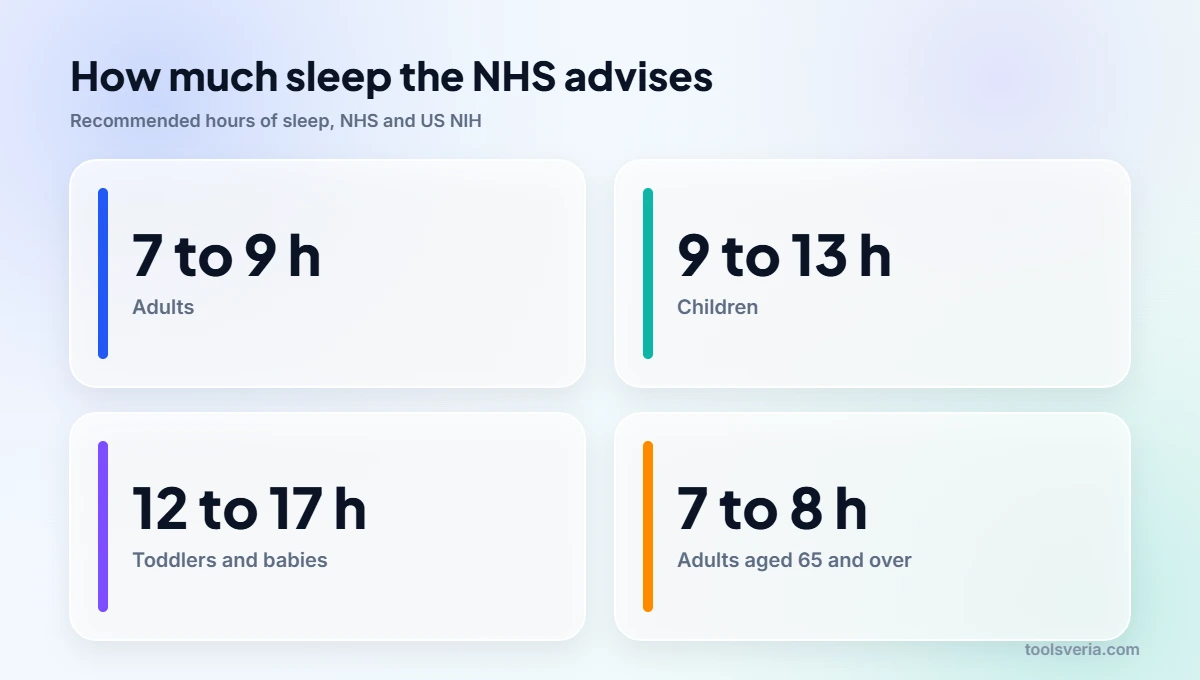
Quick answer: The NHS says most adults need 7 to 9 hours of sleep a night, children need 9 to 13 hours, and toddlers and babies need 12 to 17 hours. The US National Institutes of Health gives 7 to 8 hours for people aged 65 and over. Your own need is the amount that leaves you alert without an alarm.
In This Guide
How much sleep do adults need each night?
Most adults need between 7 and 9 hours of sleep each night, according to the NHS. The NHS insomnia guidance gives that range for adults, and the US National Institutes of Health breaks it down further: at least 7 hours from 18 to 60, 7 to 9 hours from 61 to 64, and 7 to 8 hours from 65 onwards.
Those figures mean hours actually asleep, not hours in bed. Leah lies down at 11.45pm, takes about 15 minutes to drift off and wakes at 6.30am, so her real sleep is 6 hours 30 minutes. To check the gap between any two clock times without mental arithmetic, our time duration calculator gives the hours and minutes straight away. Leah’s total sits a full half hour below the bottom of the adult range, which fits the mid morning slump she keeps noticing.
A two hour band is wide on purpose. Genes, age, recent illness, pregnancy and how physically demanding your day is all shift where you land, so two healthy adults of the same age can need noticeably different amounts. Treat 7 hours as a floor rather than a target.
How much sleep do children and teenagers need?
Children need more sleep than adults: the NHS gives 9 to 13 hours for children and 12 to 17 hours for toddlers and babies, with daytime naps counting towards the total for the youngest groups. The narrower age bands below come from the NIH child health institute’s sleep figures, which draw on recommendations from the American Academy of Sleep Medicine.
| Age group | Recommended sleep | Counted over |
|---|---|---|
| Newborns, 0 to 3 months | 14 to 17 hours | 24 hours, naps included |
| Infants, 4 to 12 months | 12 to 16 hours | 24 hours, naps included |
| Toddlers, 1 to 2 years | 11 to 14 hours | 24 hours, naps included |
| Preschool, 3 to 5 years | 10 to 13 hours | 24 hours, naps included |
| School age, 6 to 12 years | 9 to 12 hours | 24 hours |
| Teenagers, 13 to 18 years | 8 to 10 hours | 24 hours |
| Adults, 18 to 60 years | 7 hours or more | Per night |
| Adults, 61 to 64 years | 7 to 9 hours | Per night |
| Adults, 65 and over | 7 to 8 hours | Per night |
Teenagers are the group most likely to fall short in practice. Leah’s son Sam is 15 and needs at least 8 hours, yet his school bus leaves at 7.20am. If he must be up by 6.50am, the latest he can be asleep is 10.50pm, and closer to 9.50pm if his body wants the full 9 hours. Late night phone use is the usual culprit, so a household rule of chargers outside the bedroom tends to work better than nagging.

How can you find your own sleep number?
You can find your own sleep number by sleeping without an alarm for several nights in a row, once early tiredness has worn off, and averaging how long you sleep. A week off work or a fortnight with flexible mornings is ideal, because the first few nights usually run long while you catch up.
Tom, a 41 year old project manager, tried this during a two week break. He went to bed at 11pm every night and wrote down when he woke naturally. Nights one to four ran past 9 hours as he caught up, then settled. Over the last seven nights he averaged 8 hours 5 minutes, so his personal number is about 8 hours.
Back at work, Tom was sleeping 6 hours 45 minutes on weeknights. That is 1 hour 15 minutes short each night, or 6 hours 15 minutes across a five day week, which is close to a whole night of sleep missing by Friday. He moved his lights out time to 10.30pm and kept his 6.45am alarm, giving him 8 hours in bed and roughly 7 hours 45 minutes asleep.
- Signs you are near your number: you wake within a few minutes of the alarm, stay alert through the afternoon and do not need caffeine to function.
- Signs you are below it: you fall asleep within moments of lying down, nod off in meetings or on the sofa, and sleep two or more hours longer at weekends.
What time should I go to bed to get enough sleep?
Your bedtime is your wake up time minus the hours of sleep you need, minus the time it usually takes you to fall asleep. In plain words: wake time, take away sleep target, take away drift off time. With a 6.30am alarm, a 7.5 hour target and 15 minutes to fall asleep, lights out is 10.45pm.
The table assumes 15 minutes to fall asleep, a common figure for people who sleep well. Add more if you usually lie awake longer.
| Wake up time | For 7 hours | For 7.5 hours | For 8 hours |
|---|---|---|---|
| 6.00am | 10.45pm | 10.15pm | 9.45pm |
| 6.30am | 11.15pm | 10.45pm | 10.15pm |
| 7.00am | 11.45pm | 11.15pm | 10.45pm |
| 7.30am | 12.15am | 11.45pm | 11.15pm |
Many sleep calculators also count in cycles of roughly 90 minutes, aiming for you to wake at the end of one rather than in the middle. That length is an average and varies from person to person and through the night, so use cycles as a way to fine tune a bedtime rather than a strict rule. Our sleep calculator lets you change both the cycle length and the time it takes you to drift off.

What happens if you regularly get too little sleep?
Regularly sleeping less than you need tends to show up first as daytime tiredness, poor concentration, irritability and slower reactions, and the NHS lists these among the effects of ongoing insomnia. Short nights also make it harder to stick to plans for exercise or eating well, because tired people reach for quick energy.
Habits that help are simple, free and well tested. Going to bed and getting up at similar times every day comes first in the NHS Every Mind Matters sleep tips, alongside keeping the bedroom dark, quiet and cool, putting screens away for an hour before bed and cutting back on caffeine later in the day. Daytime activity helps too, and if you train hard, our heart rate zone calculator shows which sessions are easy enough to finish a few hours before bed without leaving you wired.
Shift workers face a harder sum. Priya works three night shifts a week as a care assistant, so she protects a fixed sleep block from 9am to 4.30pm on work days, uses blackout blinds and an eye mask, and keeps her phone on silent. Counting the hours to her next shift with the time duration calculator helps her decide whether a short nap before work fits.
When should you see a GP about your sleep?
You should see a GP if better sleep habits have not helped, if you have had trouble sleeping for months, or if poor sleep is affecting your daily life, which are the triggers the NHS gives for insomnia. Book sooner if a partner notices loud snoring with pauses in your breathing, or if you feel sleepy while driving.
For long term insomnia, GPs usually start with cognitive behavioural therapy for insomnia rather than medicine, delivered face to face or through an online programme. NICE recommended a digital CBT programme for insomnia in 2022, and its guidance treats sleeping pills as short term relief only. The figures in this guide are general estimates for healthy people and are not medical advice, so speak to your GP, health visitor or pharmacist about any sleep problem in a baby, child, pregnancy or long term condition.
Key points
- The NHS says most adults need 7 to 9 hours of sleep a night.
- Children need 9 to 13 hours, and toddlers and babies need 12 to 17 hours including naps.
- The US National Institutes of Health gives 7 to 8 hours for adults aged 65 and over.
- Your bedtime equals your wake time minus your sleep target minus the time you take to fall asleep.
- Sleeping 1 hour 15 minutes short on five weeknights adds up to 6 hours 15 minutes of lost sleep.
- The NHS advises seeing a GP when sleep problems last months or affect daily life.
What the Key Sleep Need Terms Mean
These terms make it easier to answer how much sleep do I need for your own age and routine, and to judge whether your current nights fall short.
- Sleep duration
- The time actually spent asleep, measured from the moment of falling asleep to final waking, rather than the total time spent lying in bed. Recommended ranges always refer to this figure, so the time taken to drift off should be subtracted.
- Sleep latency
- The time it takes to move from full wakefulness to sleep after lying down. A latency of around 15 minutes, as in Leah’s routine, quietly trims real sleep, so a planned bedtime should allow for it.
- Sleep cycle
- A repeating sequence of lighter, deeper and dream stages that the brain passes through during the night. Waking at the end of a cycle often feels easier than being woken from deep sleep, which is why some bedtime planners count in cycles.
- Sleep debt
- The running shortfall between the sleep a person needs and the sleep they actually get. It builds across consecutive short nights and partly explains why the first nights of a holiday run long while the body catches up.
- Circadian rhythm
- The body’s internal clock, running on a roughly daily cycle, which drives the timing of sleepiness and alertness. Teenagers’ rhythms tend to shift later, which makes early school starts harder for them to sleep around.
- Insomnia
- Persistent difficulty getting to sleep, staying asleep or waking too early, despite having the chance to sleep. When it lasts for weeks and affects daytime functioning, it is a reason to speak to a GP rather than rely on self help alone.
Frequently Asked Questions
I feel fine on 6 hours. Do I really need more?
Probably, because 6 hours is below the NHS adult range of 7 to 9 hours, and very few people function at their best on less. People who are short of sleep often stop noticing it. Try the no alarm test on a week off and compare the average with your usual 6 hours.
Does a Saturday lie in make up for short weeknights?
A lie in helps you feel better, but it rarely covers a full week of short nights and can make Sunday night harder. Tom was 6 hours 15 minutes short by Friday. The NHS recommends similar bed and wake times every day, so moving bedtime earlier works better than one long morning.
My 15 year old goes to sleep at midnight. Is that a problem?
It can be if school starts early, because teenagers aged 13 to 18 need 8 to 10 hours. Asleep at midnight and up at 7am gives only 7 hours. Bringing lights out forward by 15 minutes every few nights and keeping phones out of the bedroom usually helps.
I am 70 and wake at 5am every day. Am I sleeping too little?
Not necessarily, since adults aged 65 and over need 7 to 8 hours and many naturally sleep and wake earlier. If you fall asleep by 10pm, 5am gives 7 hours. If you feel tired through the day or nap for long spells, mention it to your GP.
Leah now goes to bed at 10.45pm, sleeps about 7.5 hours and has dropped the second coffee. Start with the age table, run the no alarm test when you can, then set a bedtime with the calculator and keep it for two weeks before judging the result. Figures checked October 2026.