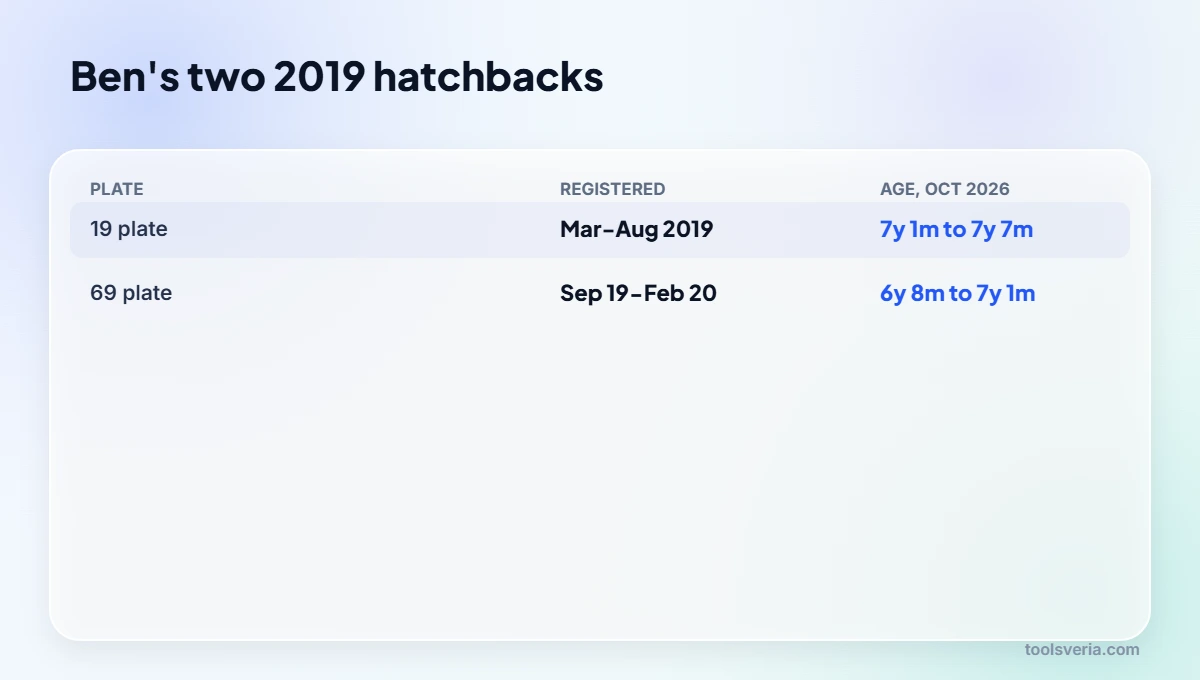
Ben is comparing two used hatchbacks on a forecourt in Leeds. One wears a 19 plate, the other a 69 plate, and the salesman calls them both “2019 cars”. Before he negotiates, Ben wants a straight answer to how old is my car by number plate, because six months either way changes the price, the warranty left and the date of the next MOT.
The two digits in the middle of a modern British plate carry that answer, and older plates hide it in a single letter at the front or back. Below, Ben decodes five plate styles, turns each one into an age in October 2026, and checks where a plate can mislead.
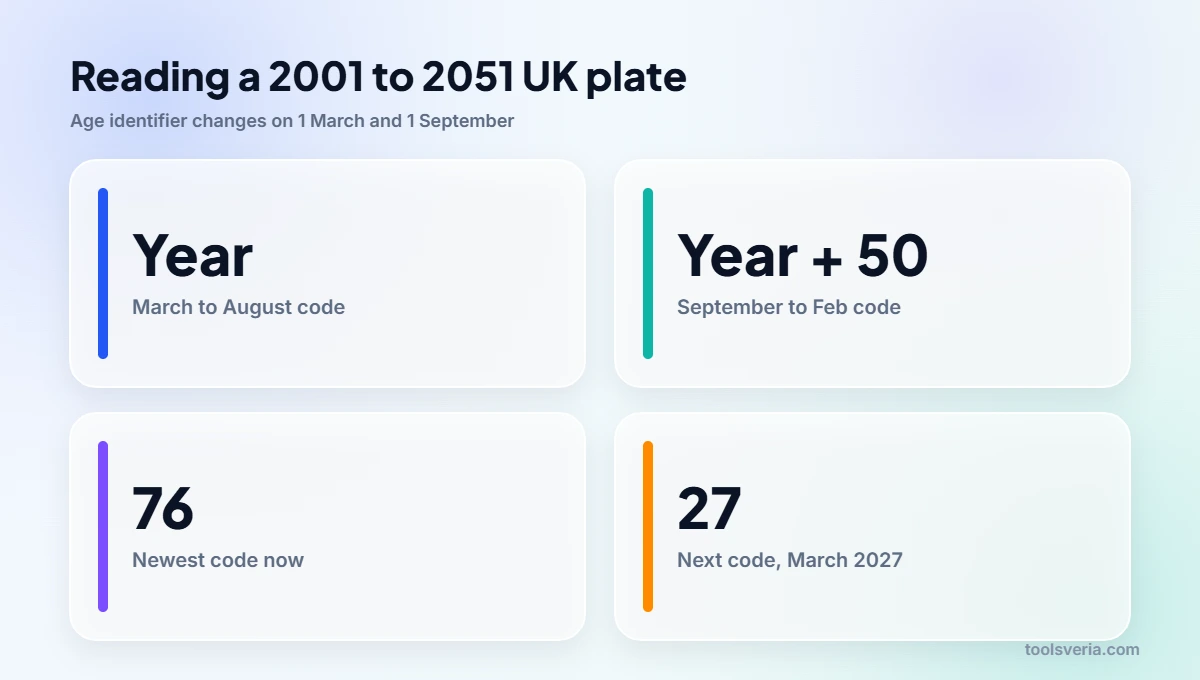
Quick answer: On a UK plate issued since September 2001, the pair of digits records when the car was first registered. A number below 50 is the year, issued from March to August (19 = 2019). A number above 50 means September to February, so subtract 50 (69 = September 2019 to February 2020), according to DVLA’s system.
In This Guide
How do you tell a car’s age from its number plate?
You tell a car’s age from a current style number plate by reading the third and fourth characters, which form a two digit age identifier that changes on 1 March and 1 September every year. In a plate such as LM19 XKT, the 19 is the age identifier, LM is the local memory tag and XKT is a random sequence.
The rule is simple once written down. From 1 March to 31 August, the code equals the last two digits of the year. From 1 September to the end of February, the code is the year plus 50. Ben’s 19 plate was registered between March and August 2019, which makes the car between 7 years 1 month and 7 years 7 months old in October 2026. The 69 plate was registered between September 2019 and February 2020, so it is 6 years 8 months to 7 years 1 month old: up to a year younger than the “same year” car beside it.
| Year | Issued 1 March to 31 August | Issued 1 September to end of February |
|---|---|---|
| 2019 | 19 | 69 |
| 2020 | 20 | 70 |
| 2021 | 21 | 71 |
| 2022 | 22 | 72 |
| 2023 | 23 | 73 |
| 2024 | 24 | 74 |
| 2025 | 25 | 75 |
| 2026 | 26 | 76 |
A car on a 76 plate today is brand new, since that code started on 1 September 2026 and runs until the end of February 2027. The next code, 27, arrives on 1 March 2027. Two digits that have not been issued yet, such as 77, are a sign the plate is fake or misread.
How old is a car with a letter at the start of the plate?
A car with a single letter at the start of its plate, such as R123 ABC, was registered between August 1983 and August 2001, and that first letter is the year identifier. The prefix letters started at A in August 1983 and changed every 1 August until 1999, when they moved to March and September.
The sequence ran A 1983, B 1984, C 1985, D 1986, E 1987, F 1988, G 1989, H 1990, J 1991, K 1992, L 1993, M 1994, N 1995, P 1996, R 1997 and S 1998, each starting on 1 August. T followed in March 1999, V in September 1999, W in March 2000, X in September 2000 and Y in March 2001. The letters I, O, Q, U and Z were never used as year letters. Ben’s uncle owns an R registered estate, which dates it to between August 1997 and July 1998, making it about 28 to 29 years old.
What about plates with a letter at the end?
A plate with a single letter at the end, such as ABC 123K, is a suffix plate issued between 1963 and July 1983, and that final letter shows the year. The suffix letters ran from A in 1963 to Y, which covered August 1982 to July 1983.
The change date moved partway through. Suffix letters switched every January at first, and from 1967 they switched every August, so K means August 1971 to July 1972. That makes a K suffix car about 54 to 55 years old now. The same letter can mean two different decades depending on its position: V at the start points to 1999, while V at the end points to 1979. The Wikipedia history of UK registration plates lists every letter with its dates if you need to confirm a classic.
When does a number plate not show the car’s age?
A number plate does not show the car’s age when it is a private registration, a Northern Ireland mark, a Q plate, or a plate on a car that was imported or registered long after it was built. In each case the plate tells you less than the official record does.
- Private plates: a dateless or older plate can go on a newer car, so a cherished mark may make a car look older. The rules do not allow a private plate to make a car look newer than it is.
- Northern Ireland: marks such as ABZ 1234 carry no age identifier at all.
- Q plates: given to vehicles whose age cannot be proved, such as some kit cars and rebuilt vehicles.
- Imports: the plate reflects when the car was registered in the UK, which can be years after it was built abroad.
Altering or rearranging characters to fake a newer identifier is a separate problem. GOV.UK warns that driving with incorrectly displayed plates can bring a fine of up to £1,000 and an MOT failure, so a plate with odd spacing is worth a closer look before you buy.
How can you check the exact registration date?
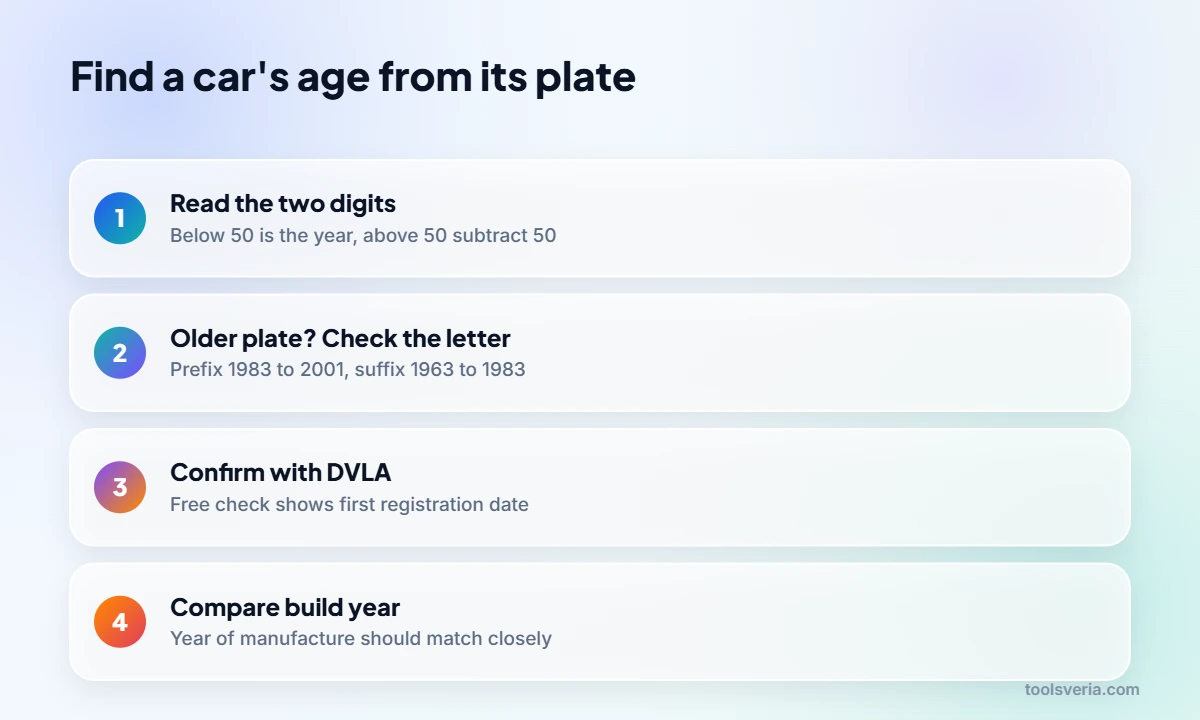
You can check the exact first registration date for free with DVLA, using only the registration number. The GOV.UK vehicle enquiry service shows the date of first registration, the year of manufacture, the MOT expiry date and the tax status, and the same date appears on the V5C logbook.
Ben ran both hatchbacks through it. The 19 plate was first registered on 14 June 2019 and built in 2019. The 69 plate was first registered on 2 September 2019, less than three months later, and both cars were built in 2019, so the plate codes make them look further apart than they really are. If the year of manufacture and the plate disagree by more than a year, ask why.
A second opinion comes from the chassis itself: our VIN model year decoder reads the tenth character of the 17 character VIN, printed at the base of the windscreen and on the V5C, and it catches imports registered years after they were built.
Age drives other dates too. A car in Great Britain needs its first MOT by the third anniversary of registration, which our first MOT due date calculator works out from the plate or the exact date. Tyres age separately from the car, so read the four digit sidewall code with the tyre age calculator too, because a seven year old car can easily be riding on original rubber.
Key points
- Since 1 September 2001, the two digit code on a UK plate changes every 1 March and 1 September.
- A March code is the year (26 for March to August 2026) and a September code is the year plus 50 (76).
- Prefix plates from August 1983 to August 2001 show the year in the first letter, from A to Y.
- Suffix plates from 1963 to July 1983 show the year in the last letter.
- DVLA’s free vehicle enquiry service shows the exact first registration date and year of manufacture.
Frequently Asked Questions
Is a 24 plate newer than a 74 plate?
No, a 74 plate is newer. A 24 plate was issued from March to August 2024, while a 74 plate covers September 2024 to February 2025, so a 74 plate car is up to a year younger.
My car has no numbers in the plate at all. How do I find its age?
Your car probably carries a private, dateless or Northern Ireland registration, none of which shows age. Enter the registration into DVLA’s free vehicle enquiry service on GOV.UK, which shows the first registration date and year of manufacture.
Could a dealer put a newer plate on an older car to make it look younger?
Not legally. DVLA rules let a private plate make a car look older but never newer, so a 2018 car cannot carry a 22 plate. If the plate and the DVLA record disagree, walk away until the seller explains it.
How long will the current two digit system last?
The current format runs until 2051. The last codes are 50, for March to August 2050, and 00, for September 2050 to February 2051, after which DVLA will need a new format.
Ben bought the 69 plate car, after confirming its exact registration date and knocking a little off the price for the MOT due within a year. Type any plate into the identifier to get the same answer in seconds. Figures checked October 2026.