Helen booked a Christmas market break in Vienna for 10 to 14 December 2026, glanced at her passport, saw an expiry date of 20 August 2027 and relaxed. A week later a friend mentioned the passport 10 year rule Europe trips depend on, and Helen found out her passport would be turned away at the gate even though it had eight months left to run.
Since the UK left the EU, British passports are judged on two dates, not one. Helen, her husband Mark and their neighbour Dev each hold a passport that behaves differently, and their three cases below show how to find your own last safe day to travel.
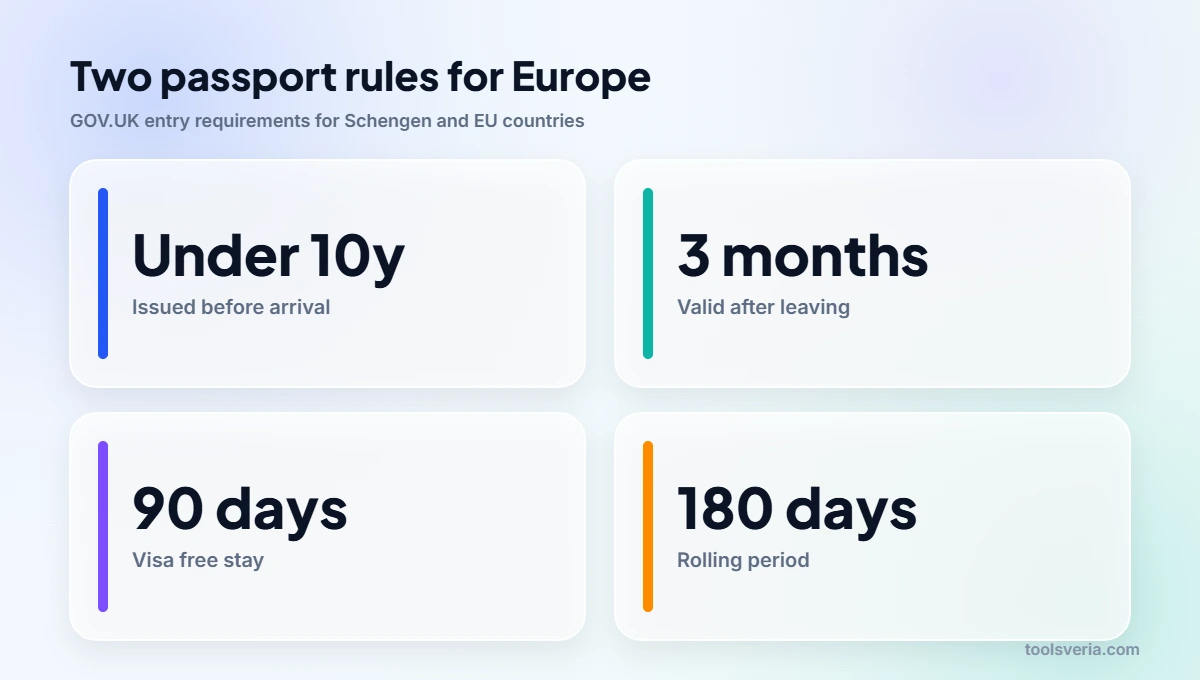
Quick answer: For trips to Schengen and EU countries, GOV.UK says a British passport must have been issued less than 10 years before the day you arrive and must expire at least 3 months after the day you plan to leave. Both rules apply together in 2026. Ireland is the main exception, with no passport legally required for British citizens.
In This Guide
What is the 10 year passport rule for Europe?
The 10 year passport rule for Europe means your British passport must have been issued less than 10 years before the date you enter a Schengen or EU country. It sits alongside a second rule: the passport must still be valid for at least 3 months after the date you plan to leave.
Both conditions appear on every Schengen country’s travel advice page, and the GOV.UK entry requirements for Spain set them out in the same terms used for France, Italy, Greece and the other Schengen states. Border guards check the issue date printed inside your passport, not just the expiry date that most people look at.
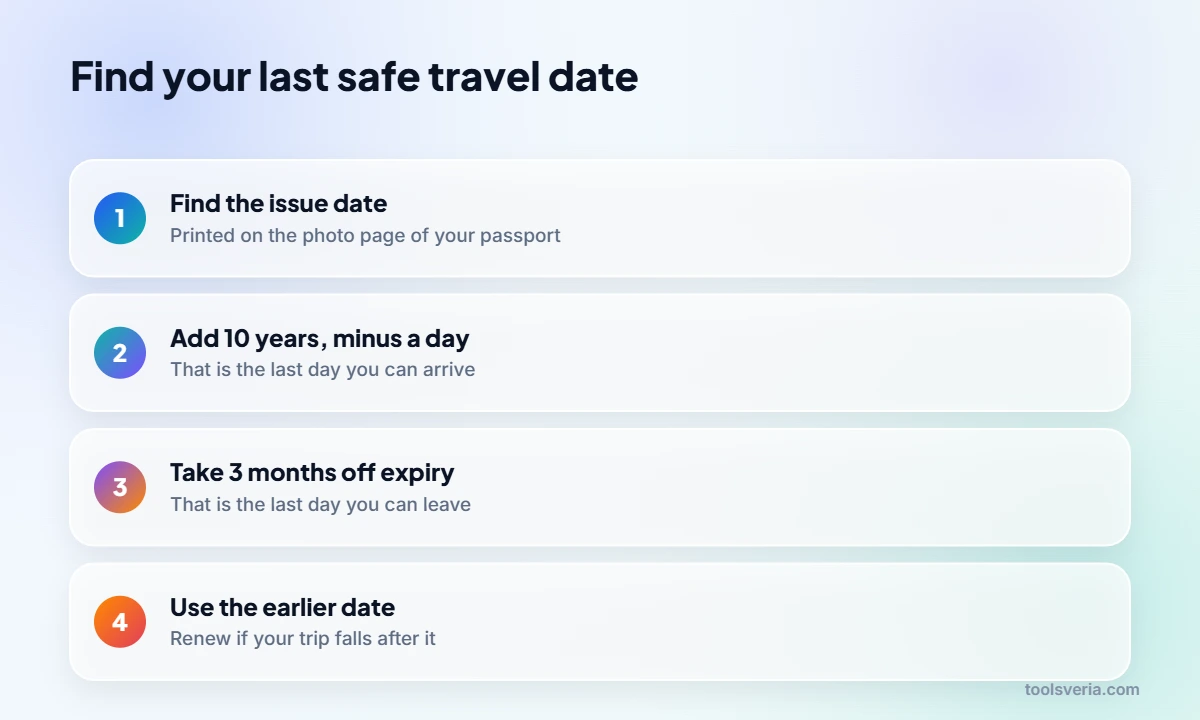
Turn the two rules into dates and the check takes a minute. Your last day to arrive is the day before the tenth anniversary of the issue date. Your last day to leave is three months before the expiry date. Whichever comes first is the real end of your passport for European travel.
Why do some in date passports fail the 10 year rule?
Some in date passports fail the 10 year rule because they were renewed early before October 2018, when HM Passport Office added up to 9 unused months from the old passport to the new one. Those passports can run for up to 10 years and 9 months, but EU border rules ignore the extra months.
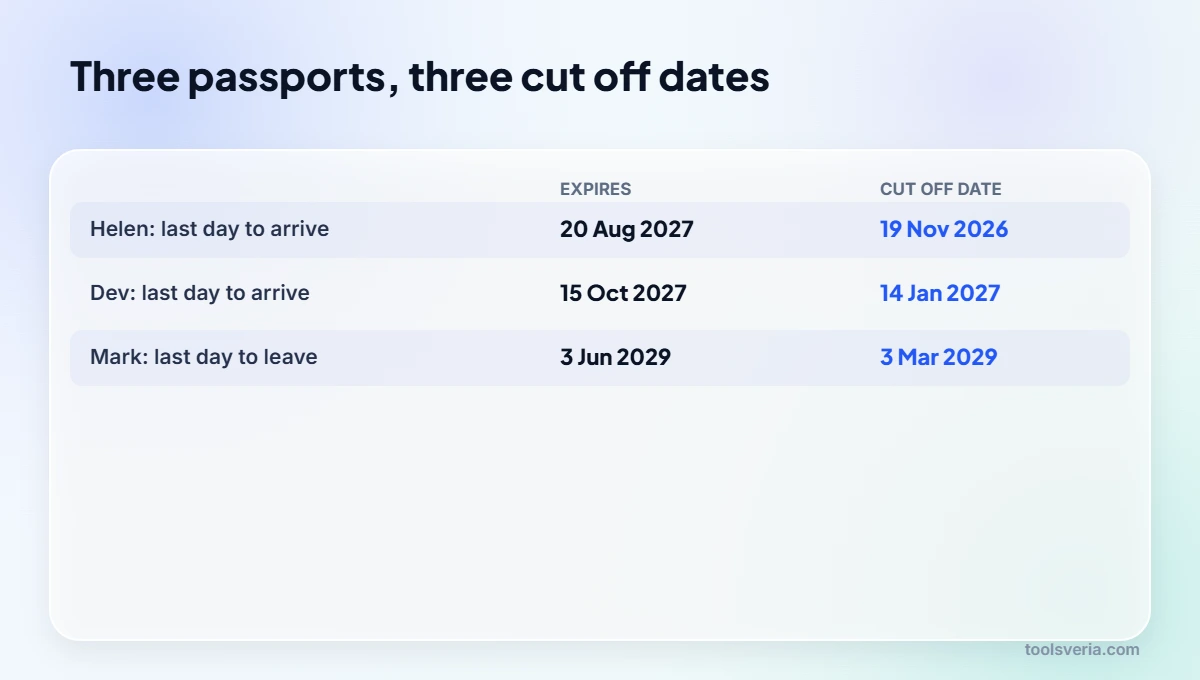
Helen renewed on 20 November 2016 with nine months carried over, so her passport expires on 20 August 2027. The 10 year rule means she must arrive in the Schengen area by 19 November 2026. Her Vienna trip starts on 10 December, three weeks too late, even though the 3 month rule alone would let her travel until 20 May 2027. The issue date, not the expiry, ends her passport’s European life.
Mark’s passport was issued on 3 June 2019 and expires on 3 June 2029, exactly 10 years later, because extra months were no longer added by then. For anyone with a passport issued from October 2018 onwards, the 3 month rule always bites first: Mark’s last day to leave Europe is 3 March 2029.
| Traveller | Issued | Expires | Last day to arrive | Last day to leave | Real cut off |
|---|---|---|---|---|---|
| Helen | 20 Nov 2016 | 20 Aug 2027 | 19 Nov 2026 | 20 May 2027 | Arrive by 19 Nov 2026 |
| Dev | 15 Jan 2017 | 15 Oct 2027 | 14 Jan 2027 | 15 Jul 2027 | Arrive by 14 Jan 2027 |
| Mark | 3 Jun 2019 | 3 Jun 2029 | 2 Jun 2029 | 3 Mar 2029 | Leave by 3 Mar 2029 |
Dev wants a ski week in Austria in February 2027. His passport, renewed in January 2017 with nine extra months, looks fine until October 2027, but he must arrive by 14 January 2027, so a February trip needs a new passport first. Counting forward exactly ten years by hand is where people slip, and our days between dates calculator double checks any gap between your issue date and arrival day.
Which countries use the 10 year rule?
The 10 year rule applies when British citizens visit Schengen area countries, which include most EU members plus Iceland, Liechtenstein, Norway and Switzerland. Cyprus, an EU member outside Schengen, uses the same two validity rules according to GOV.UK.
The Republic of Ireland is different. Under the Common Travel Area, British citizens do not legally need a passport to enter Ireland, although airlines and ferry companies usually ask for photo ID, and a passport is the simplest one to carry. Countries outside the EU set their own rules, and some ask for 6 months of validity on arrival, so check each destination’s GOV.UK page.
Drivers have one more document to think about. If you are taking the car to France, our Crit’Air sticker checker shows whether you need a clean air sticker for cities such as Paris and Lyon, which is easy to forget when the passport has taken all your attention.
How long can you stay in Europe without a visa?
British citizens can stay in the Schengen area for up to 90 days in any 180 day period without a visa, for holidays, family visits and short business trips. The count is rolling, so every day spent in any Schengen country within the last 180 days counts.
Dev spent 62 days in Portugal between January and March 2026. If he returns in early May 2026, those 62 days are still inside the 180 day window, so he has 28 days left before he must leave. A passport that passes both validity rules does not extend this limit.
Two newer systems are separate from passport validity. The EU’s Entry/Exit System records your fingerprints and photo at Schengen borders, costs nothing and keeps your record for 3 years. ETIAS, a paid travel authorisation, still had no confirmed start date from the European Commission at the time of writing, so check GOV.UK before booking.
What should you do if your passport fails the rule?
If your passport fails either rule for your trip dates, renew it before you travel, because airlines can refuse to let you board and border guards can refuse entry.
Helen applied online straight away, the same evening she checked her dates. The GOV.UK passport fees page lists an adult renewal at £102 online or £115.50 on a paper form, and a child passport at £66.50 online. Faster services cost more. Her new passport carries a fresh issue date, so both rules reset and she can travel to Vienna in December with ten clear years ahead.
Check every passport in the family, not just your own. Children’s passports last 5 years, so the 3 month rule usually bites first, and a mix of old and new passports in one household is common. If you are also renewing other documents before a trip, our driving licence renewal date calculator shows when your photocard runs out.
Key points
- A British passport must be issued less than 10 years before the day you arrive in a Schengen or EU country.
- The same passport must expire at least 3 months after the day you plan to leave.
- Passports renewed early before October 2018 can carry up to 9 extra months that the 10 year rule ignores.
- British citizens can stay up to 90 days in any 180 day period without a visa.
- Ireland does not apply the rule, and British citizens do not legally need a passport there.
Frequently Asked Questions
My passport was issued in 2019. Do I need to worry about the 10 year rule?
Not usually. Passports issued from October 2018 onwards expire exactly 10 years after issue, so the 3 month rule ends their European use first. Your practical cut off is leaving Europe at least 3 months before the expiry date.
I arrive before the 10 year date but fly home after it. Is that allowed?
Yes, the 10 year rule is checked against your arrival date, so passing the tenth anniversary during the trip is fine. You still need at least 3 months of validity left after your leaving date.
Does the rule apply on a ferry to Ireland?
No, the 10 year rule does not apply to the Republic of Ireland. British citizens travel there under the Common Travel Area without a passport legally required, though ferry and airline staff usually ask for photo ID.
Will the airline check my issue date at check in?
Often yes, because airlines are expected to check travel documents before you fly, and many test both dates before boarding. Treat a failing passport as a reason to renew, not something to argue at the gate.
Helen’s new passport arrived well before December, Dev booked his ski week after renewing, and Mark knows he is safe until early 2029. Put your own issue, expiry and trip dates into the checker before you book anything non refundable. Figures checked October 2026.