Overdrachtsbelasting for 2026: starter exemption, 2%, 8% and 10.4% rates, per buyer.
Use each buyer's age on the day of transfer at the notary.
| Rate on this price (2026) | Tax |
|---|
Estimate only, check with your notary or the Belastingdienst. The tax base is the price, or the market value if higher. Figures checked October 2026.
This overdrachtsbelasting calculator works out Dutch transfer tax in English for anyone buying a home or other property in the Netherlands in 2026, including expats and first time buyers. It applies the 2026 rates published by the Belastingdienst and tests the starter exemption for each buyer separately, so a couple with one partner over 35 sees the Dutch tax rules applied to their own shares rather than a single blanket rate. Figures checked October 2026.
Quick answer: Dutch transfer tax in 2026 is 2% for a home you will live in, 8% for a second home or rental home and 10.4% for other property. Buyers aged 18 to 34 pay 0% once on a home worth up to €555,000. This overdrachtsbelasting calculator tests each buyer: a €450,000 flat shared with a 37 year old costs €4,500.
In This Guide
What Is Overdrachtsbelasting?
Overdrachtsbelasting is the Dutch tax a buyer pays once when ownership of a property in the Netherlands passes to them at the notary. It is set out in the Legal Transactions Taxes Act (Wet op belastingen van rechtsverkeer), and the notary collects it from you at the transfer and pays it to the tax office.
In plain words: transfer tax = (price minus movable items) × your share × the rate that applies to you. The base is the purchase price, or the market value if that is higher. The rate depends on how the property will be used and, for a home you will live in, on whether each buyer qualifies as a starter.
| Property and buyer (2026) | Rate | Tax on €450,000 |
|---|---|---|
| Home you will live in, buyer aged 18 to 34, first use, value up to €555,000 | 0% | €0 |
| Home you will live in, all other buyers | 2% | €9,000 |
| Other home: rental, investment, second or holiday home | 8% | €36,000 |
| Not a home: office, shop, separate garage, building land | 10.4% | €46,800 |
Who Qualifies for the Starter Exemption in 2026?
You qualify for 0% transfer tax in 2026 if you are 18 to 34 on the transfer date, have never used the exemption before, will live in the home yourself, and the home is worth no more than €555,000. You confirm these points in a written statement to the notary. According to Rijksoverheid, if the value is above €555,000 the exemption does not apply at all, so the full value is taxed at 2%.
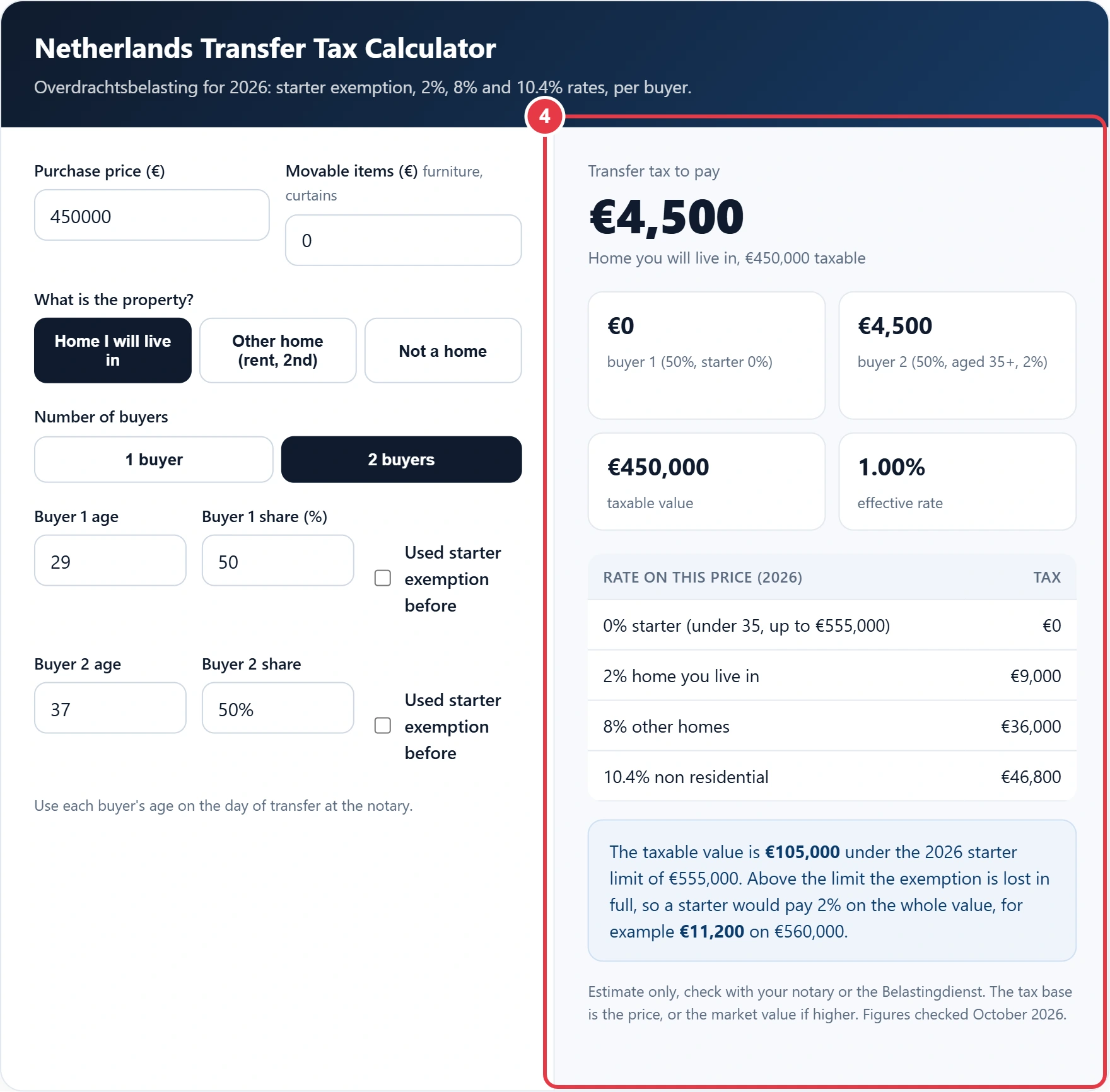
Take Daan, 29, and Priya, 37, who are buying a €450,000 flat in Utrecht together, half each. Daan meets every condition, so his half is exempt. Priya is over 35, so she pays 2% on her €225,000 half, which is €4,500. If the same flat cost €560,000, Daan would lose the exemption completely and the couple would pay €11,200 between them. Each buyer can use the exemption only once, so Daan cannot claim it again on a later home.
How to Use the Overdrachtsbelasting Calculator
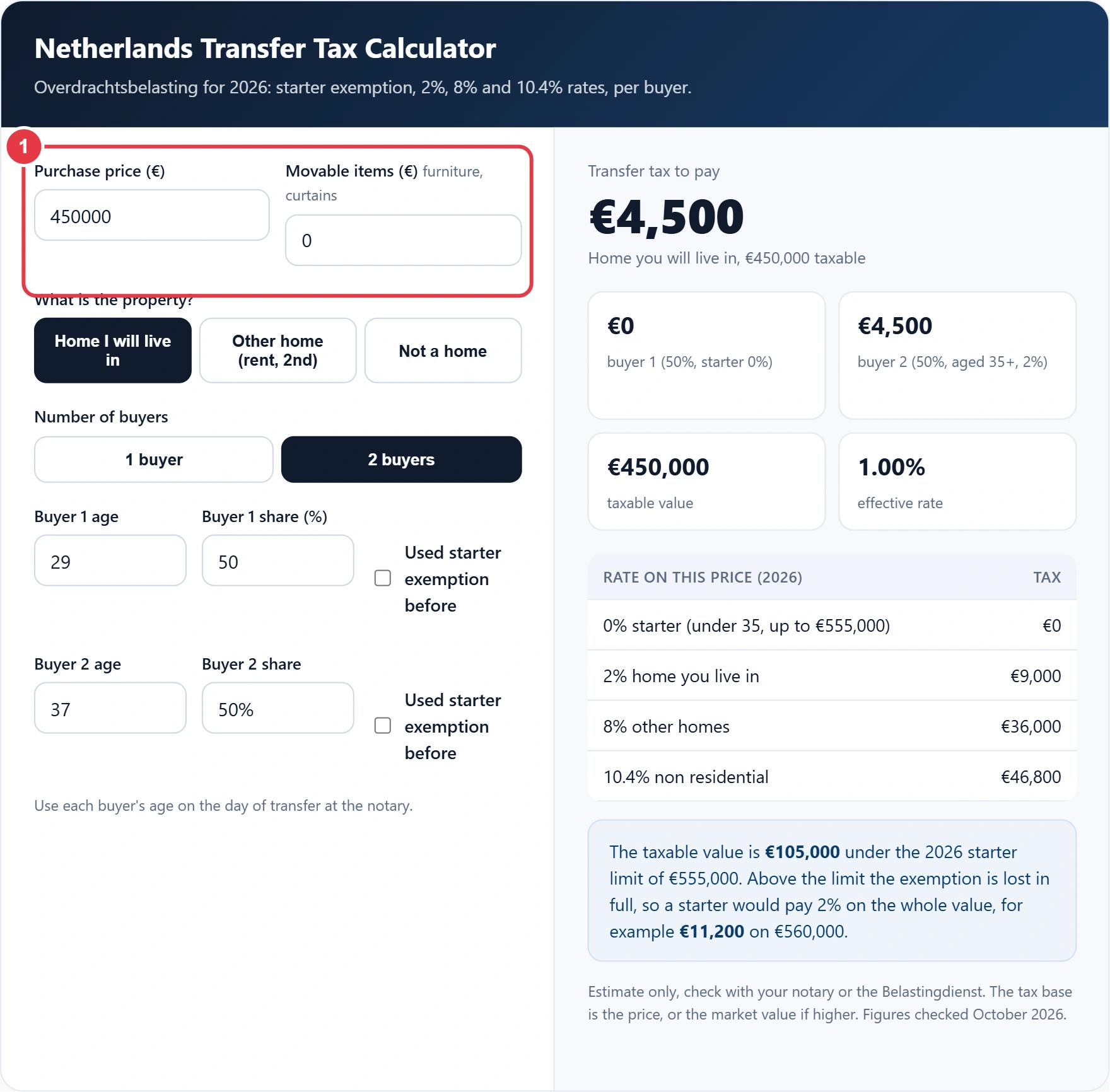
Step 1: Enter the Price and Movable Items
Type the price from the purchase agreement. If the deal includes curtains, flooring that can be lifted, furniture or a garden shed priced separately, enter their fair value. The tax office can challenge an inflated figure, so keep it realistic.
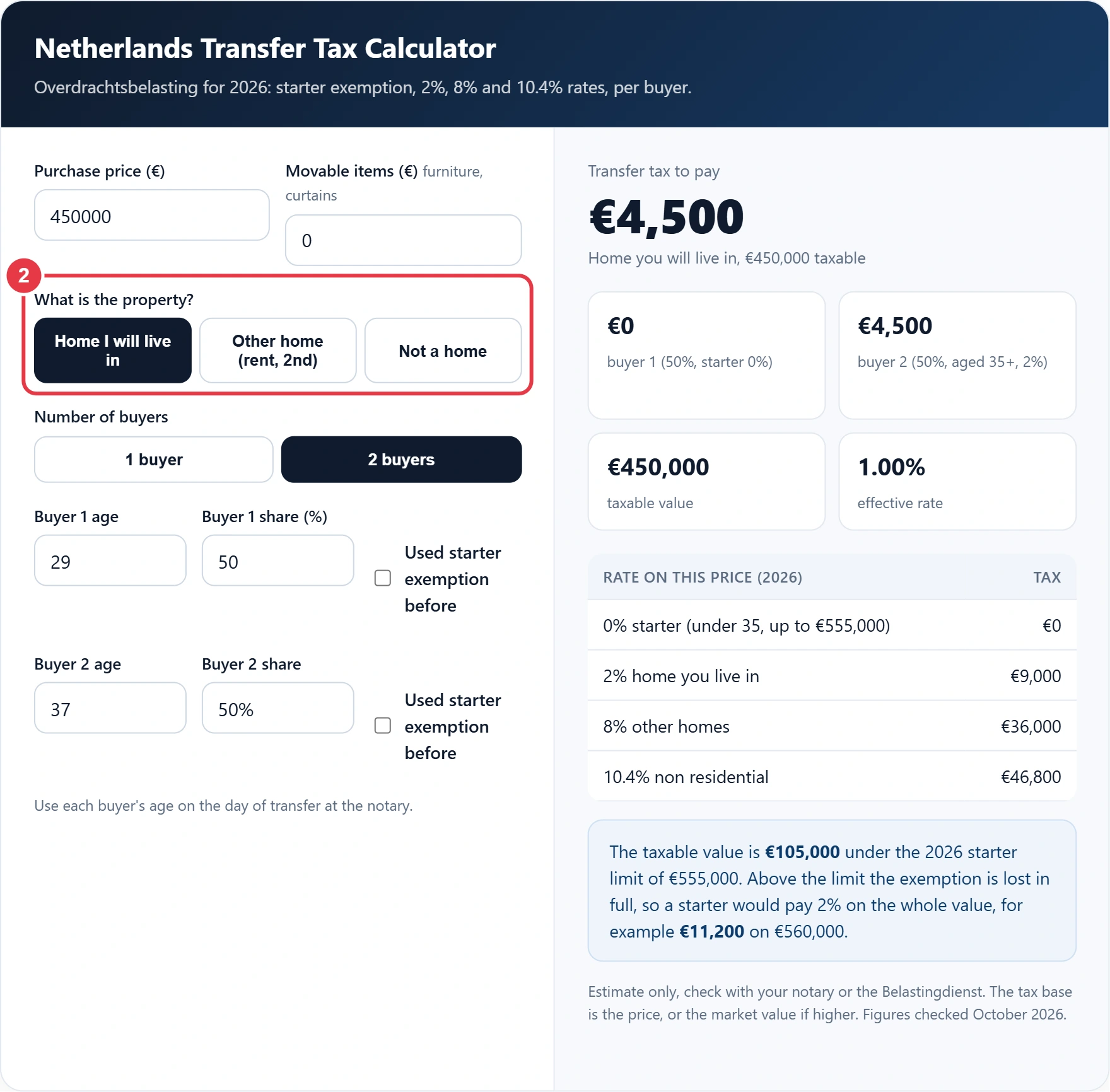
Step 2: Choose How the Property Will Be Used
Pick Home I will live in only if it becomes your main residence. Choose Other home for a buy to let, a holiday home or a flat for a student child, and Not a home for offices, shops, a garage bought on its own or building land.
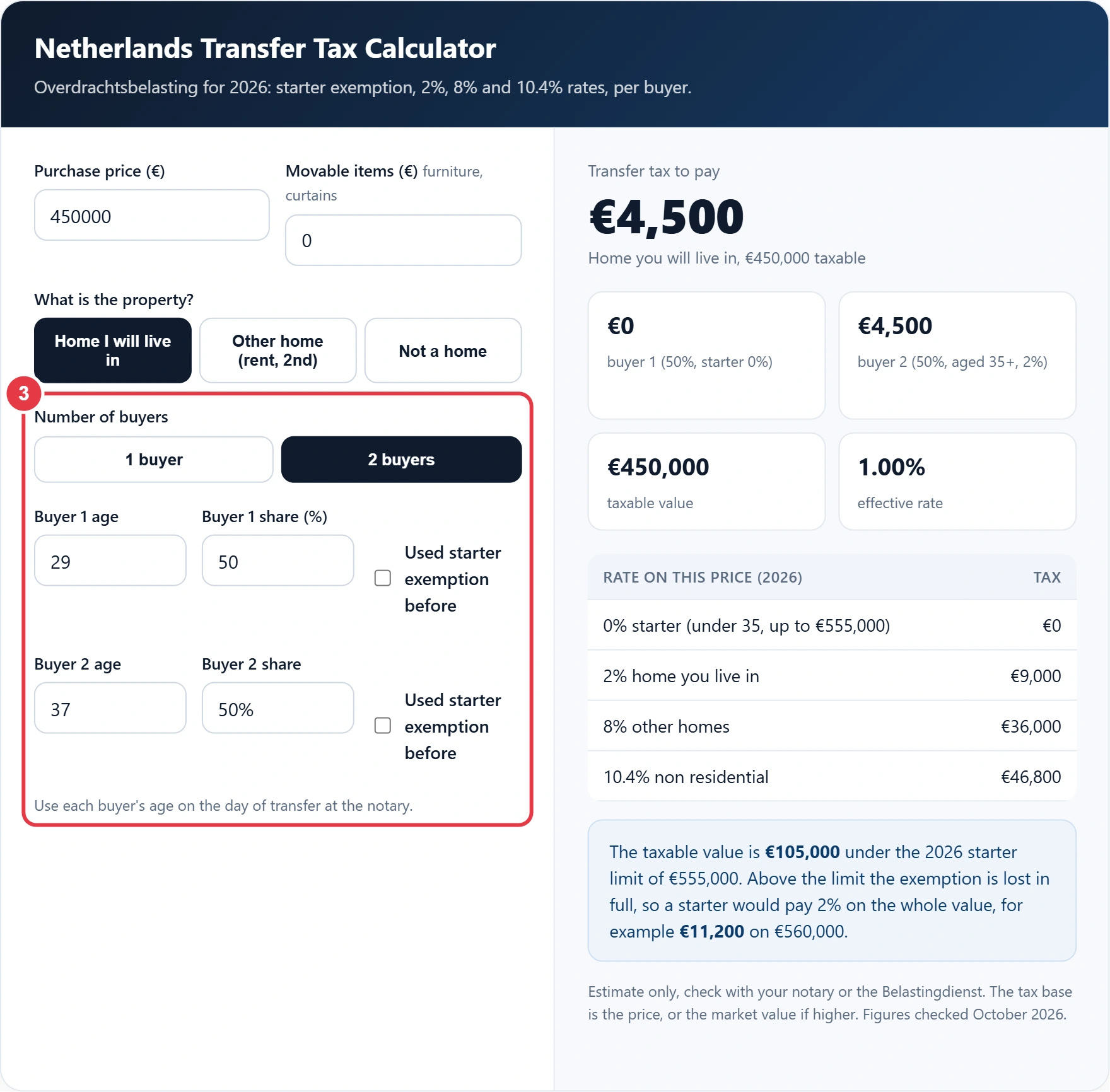
Step 3: Add Each Buyer
Enter one or two buyers with their age on the transfer date and their ownership share. Tick the box if a buyer has used the starter exemption before. The second buyer's share fills in automatically so the total is always 100%.
Step 4: Read the Tax and Comparison
You see the total tax, the amount for each buyer with the reason, the taxable value and the effective rate. The table shows the same price at all four rates, and the message box warns how close you are to the €555,000 limit. Transfer tax is only one part of the costs, and the Germany property transfer tax calculator shows how a purchase across the border compares, with rates of 3.5% to 6.5% by state.
When Do You Pay Transfer Tax in the Netherlands?
You pay transfer tax on the day of transfer at the notary, as part of the money you send to the notary's client account before signing. There is no separate bill from the tax office in a normal home purchase. The tax point is the transfer date, not the date you signed the purchase agreement, so a buyer who signs at 34 but completes after their 35th birthday no longer qualifies as a starter.
The 0% and 2% rates rest on your statement that you will live in the home as your main residence. If you buy at 2% and then let the property out instead of moving in, the Belastingdienst can reclaim the difference up to the 8% rate, possibly with a fine. Plan any rental before you sign the declaration, and if you are unsure, ask the notary which rate fits before the deed is drawn up.
How Much Are the Total Buying Costs in the Netherlands?
Total buying costs (kosten koper) for a home you live in typically come to about 4% to 6% of the price when you pay 2% transfer tax, and roughly 1.5% to 3.5% for a starter who pays 0%. Besides the tax, budget for:
- Notary fees for the transfer deed and the mortgage deed, which vary by notary, so compare quotes.
- Land Registry (Kadaster) registration fees, charged through the notary.
- A valuation report for the mortgage lender and, if you use one, a buying agent's fee.
- Mortgage advice and, if you use the National Mortgage Guarantee (NHG), its one off fee.
Investors gained the most from the 2026 changes, because the rate for homes you do not live in fell from 10.4% to 8%. On a €300,000 rental flat that means €24,000 instead of €31,200. If you are moving to the Netherlands for work, the UK government's living in the Netherlands guide covers registration and tax for British residents, and the Netherlands holiday allowance calculator shows the 8% payment that can help towards these costs each May.
</>Embed this calculator on your website
Add the free Netherlands Transfer Tax Calculator to your own site or blog. Copy the code below and paste it into an HTML block. It resizes itself and works on phones.
How we checked this tool: the Tools Veria Editorial Team built this tool by hand, checked it against the official rules or published standards where they apply, and tested it against worked examples. Results are estimates for planning, not personal financial or tax advice. Read our editorial policy and disclaimer, or report an error.
Frequently Asked Questions
How much is overdrachtsbelasting in 2026?
Overdrachtsbelasting in 2026 is 2% for a home you will live in, 8% for other homes such as rentals and second homes, and 10.4% for non residential property. Starters aged 18 to 34 can pay 0% once on a home worth up to €555,000.
What is the starter exemption limit for 2026?
The woningwaardegrens for 2026 is €555,000. A buyer aged 18 to 34 who has not used the exemption before and will live in the home pays 0% if its value is €555,000 or less.
What happens if the house costs more than €555,000?
The starter exemption is lost completely, not just on the part above the limit. A starter buying a €560,000 home pays 2% on the full price, which is €11,200.
We are buying together and one of us is over 35. What do we pay?
Each buyer is tested on their own share. On a €450,000 home bought 50/50, the buyer under 35 who qualifies pays €0 and the buyer aged 35 or over pays 2% on €225,000, which is €4,500.
Do I pay 8% transfer tax on a buy to let in 2026?
Yes. From 1 January 2026 homes you will not live in yourself, including buy to lets and holiday homes, are taxed at 8%, down from 10.4% in 2025. On €300,000 that is €24,000.
Who pays transfer tax in the Netherlands, buyer or seller?
The buyer pays Dutch transfer tax. The notary collects it from the buyer at the transfer and pays it to the Belastingdienst, unless the sale is agreed as vrij op naam, where the seller covers it.