2026/27 levy, monthly payments and apprenticeship funds, including connected companies.
Estimate using HMRC rules: levy 0.5% of the annual pay bill, £15,000 allowance a year (£1,250 a month) shared by connected employers, no levy where the combined pay bill is £3 million or less. Funds and co-investment follow the Department for Education changes from 1 August 2026: no 10% top-up, 12 month expiry, 25% employer share for apprentices aged 25 and over once funds run out.
This apprenticeship levy calculator is for UK employers, payroll teams and finance managers who need their 2026/27 Apprenticeship Levy bill and what it buys in training. It applies the 0.5% charge and £15,000 allowance from HMRC's Apprenticeship Levy guidance, handles connected companies, and models the English funds and co-investment rules that changed in August 2026. Figures checked October 2026.
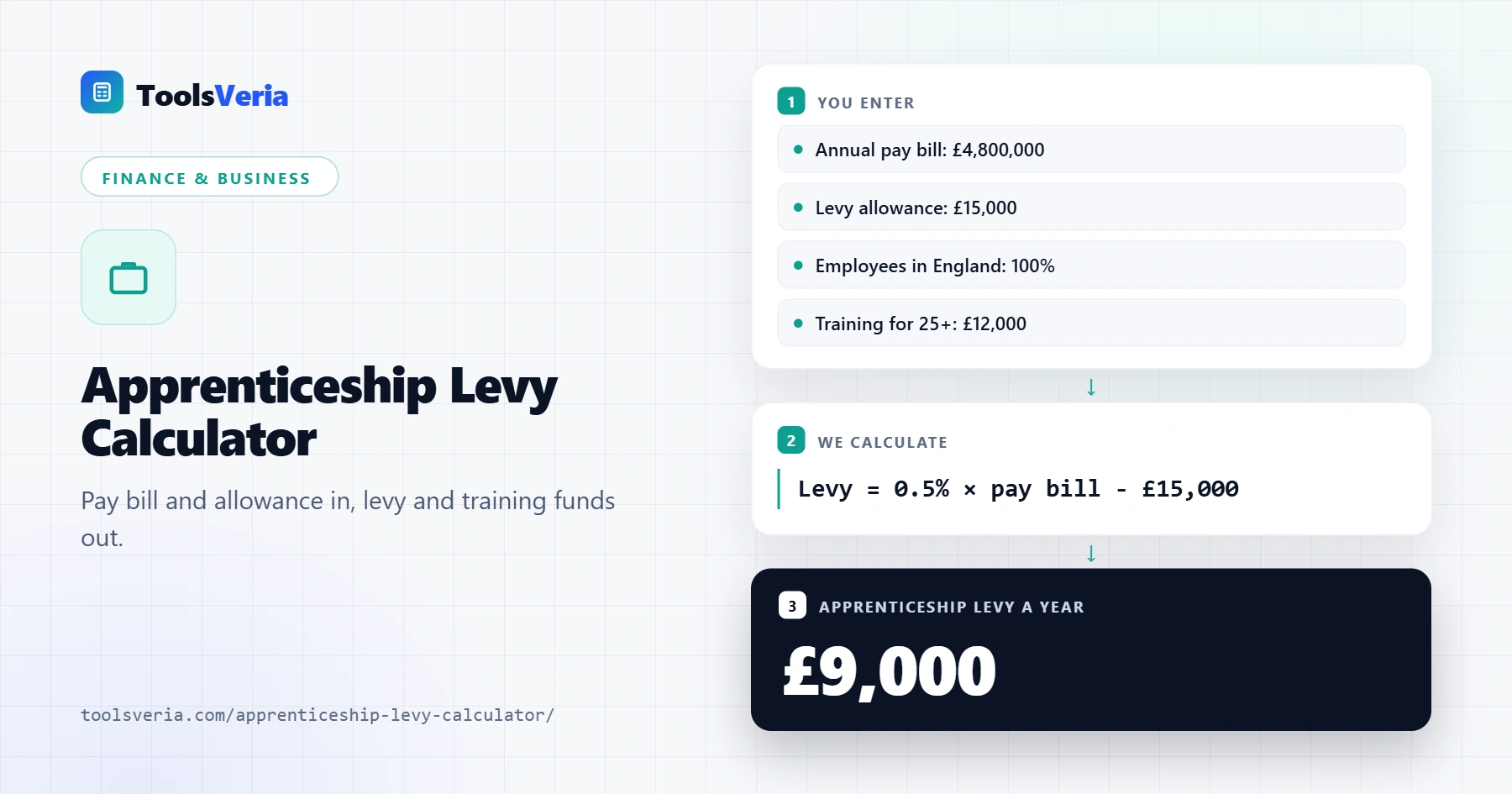
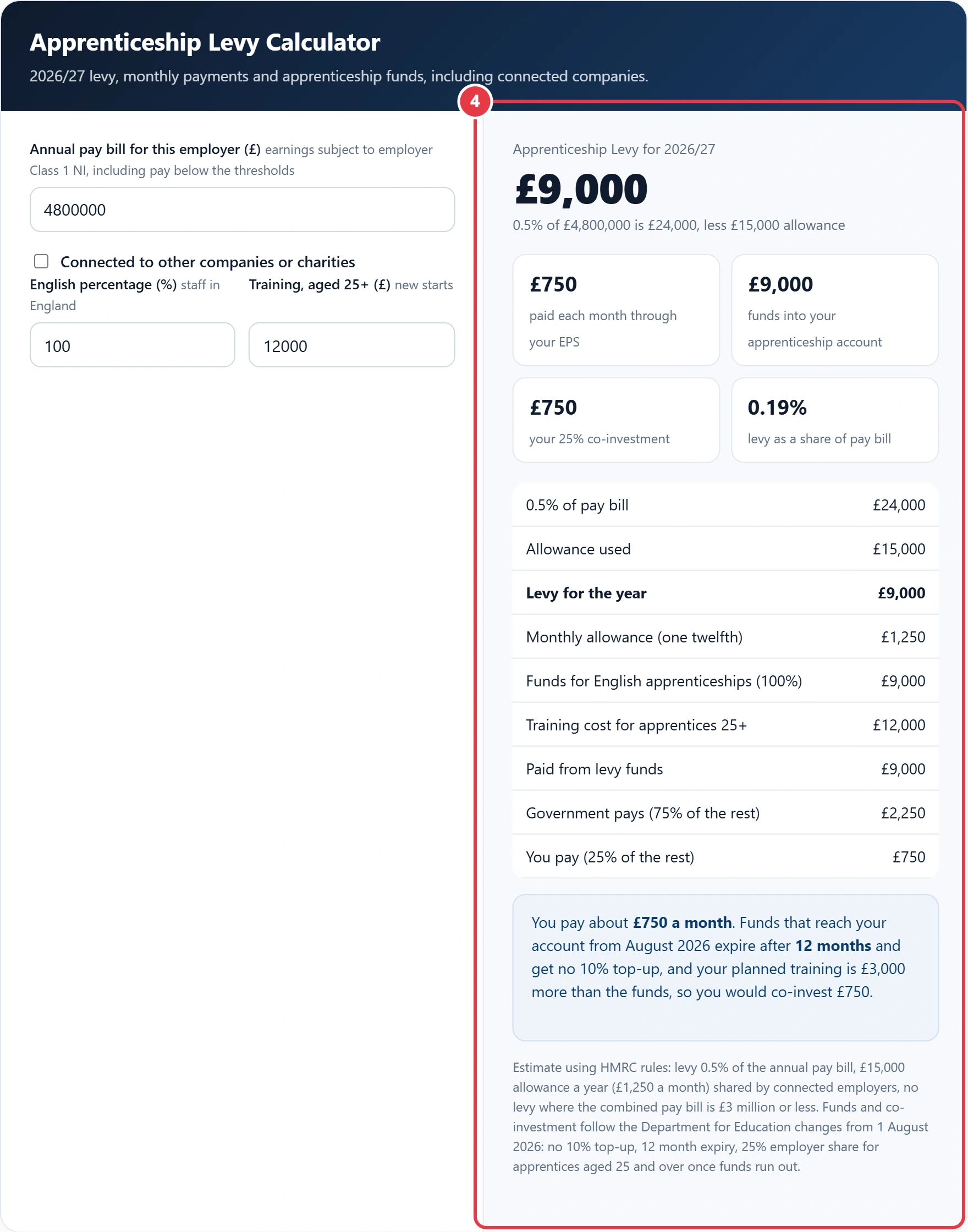
Quick answer: The Apprenticeship Levy is 0.5% of your annual pay bill minus a £15,000 allowance, so only employers with a pay bill over £3 million pay it. An apprenticeship levy calculator shows a £4.8 million pay bill costs £24,000 less £15,000, which is £9,000 a year or £750 a month.
In This Guide
What Is the Apprenticeship Levy?
The Apprenticeship Levy is a UK wide employer charge of 0.5% of the annual pay bill, reported and paid monthly to HMRC through the Employer Payment Summary. The pay bill is every payment subject to employer Class 1 secondary National Insurance, such as wages, bonuses and commission, including pay below the NI thresholds, pay to under 21s and pay to apprentices under 25. Benefits in kind are left out.
The formula in plain words: multiply the pay bill by 0.5%, then subtract your allowance. Each employer, or each group of connected employers, gets one £15,000 allowance a year, used at £1,250 a month on a cumulative basis. Unused allowance cannot be carried into the next tax year. Because 0.5% of £3 million is exactly £15,000, nobody with a pay bill of £3 million or less pays anything.
How to Use the Apprenticeship Levy Calculator
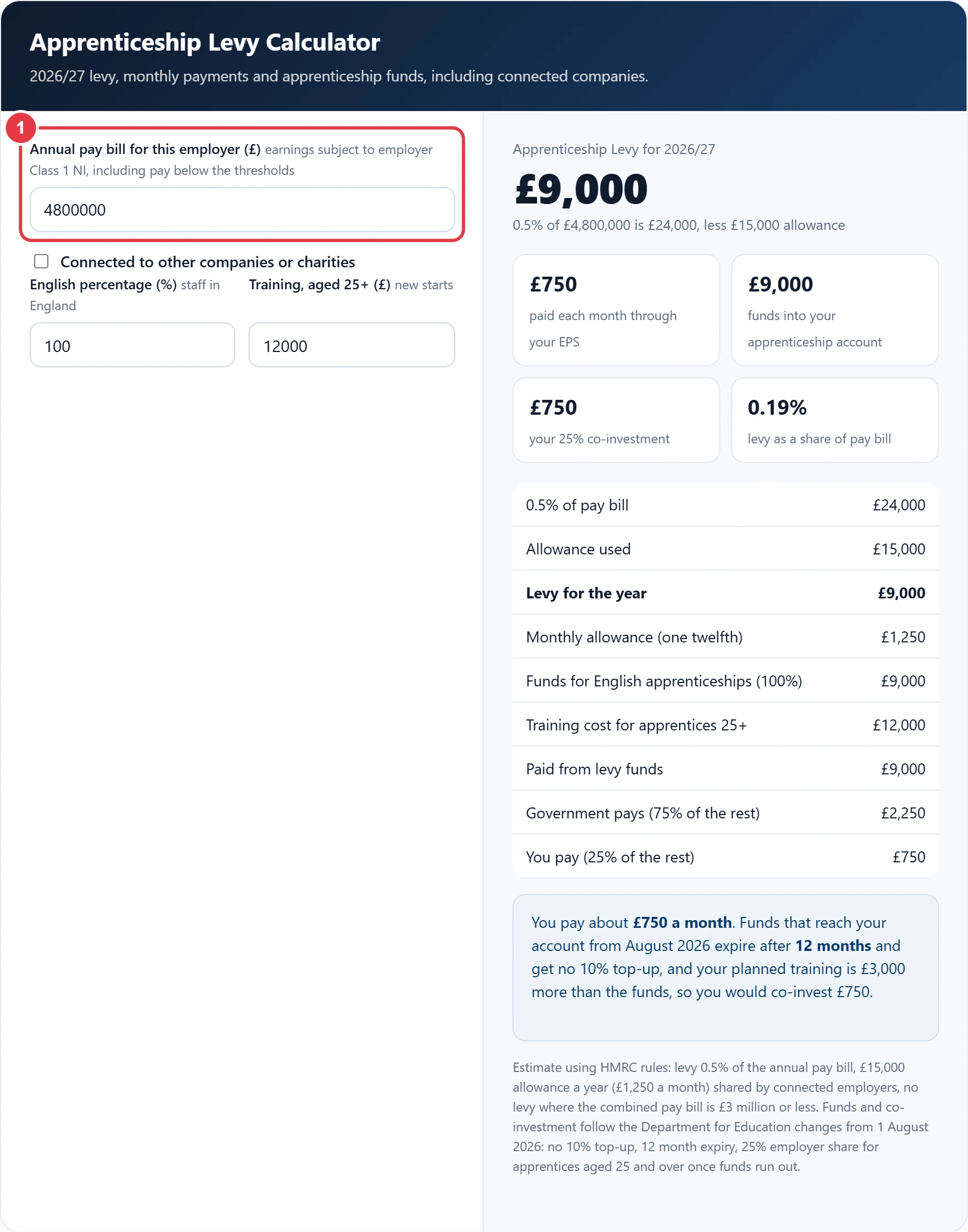
Step 1: Enter Your Pay Bill
Enter the expected 2026/27 pay bill for this employer. Use gross earnings that attract employer Class 1 NI, even where the actual NI is zero, such as pay to staff under 21. Leave out workers under 16 and anyone outside UK NI rules. Your payroll software's year to date NIable pay is the usual starting point.
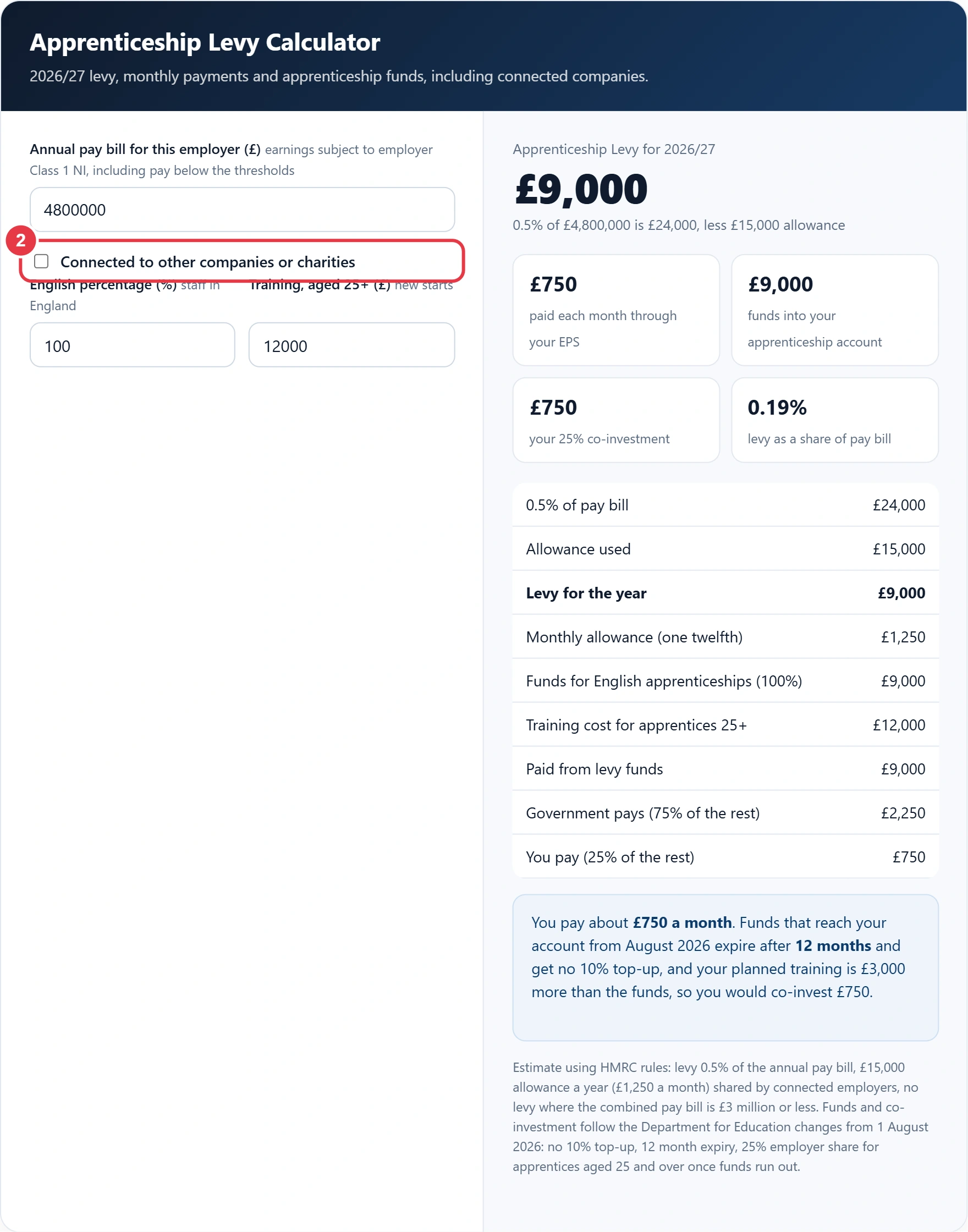
Step 2: Add Connected Companies
If the company is connected to others under the Employment Allowance rules, tick the box. Enter the combined group pay bill, which decides whether the levy applies at all, and the share of the single £15,000 allowance given to this employer. Each connected company then works out its own levy against its own share.
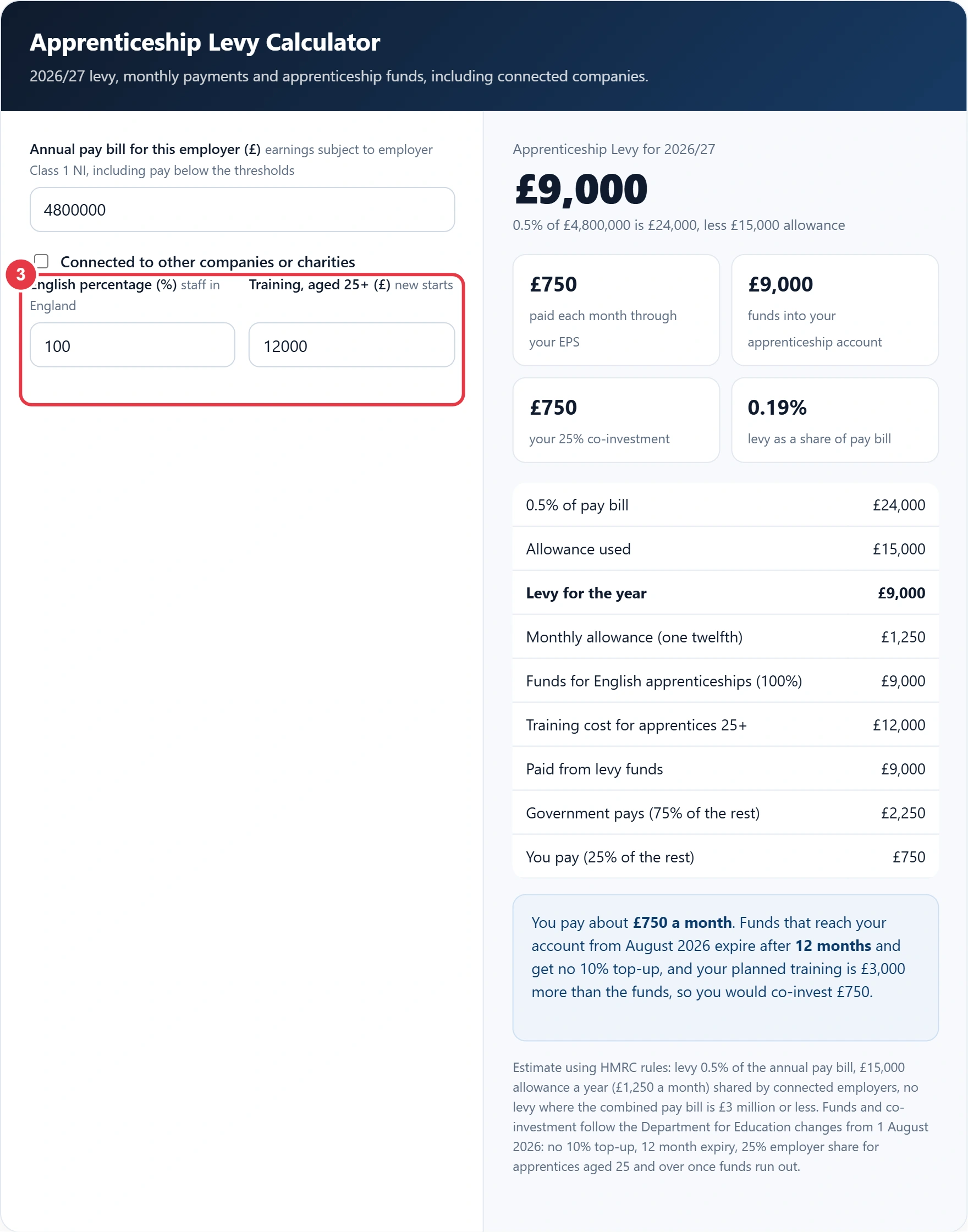
Step 3: Set the English Percentage and Training Plans
The English percentage is the share of your pay bill paid to employees who live in England, which HMRC works out from home addresses. Only that share reaches your apprenticeship service account. Then enter planned training costs for apprentices aged 25 and over starting this year, so the tool can show any co-investment.
Step 4: Read the Levy and Your Funds
The headline is the levy for the year. The stats show the monthly payment for a steady pay bill, the funds that reach your account, your 25% co-investment and the levy as a share of pay. The table and message flag wasted connected company allowance and the 12 month expiry of new funds.
How Much Apprenticeship Levy Will I Pay?
You pay 0.5% of everything above a £3 million pay bill when you have the full allowance, so the levy grows by £5,000 for every extra £1 million of pay. The table shows typical bills for a single employer that is not connected to any other.
| Annual pay bill | 0.5% of pay bill | Levy for the year | Monthly payment |
|---|---|---|---|
| £3,000,000 | £15,000 | £0 | £0 |
| £4,000,000 | £20,000 | £5,000 | £417 |
| £4,800,000 | £24,000 | £9,000 | £750 |
| £10,000,000 | £50,000 | £35,000 | £2,917 |
| £50,000,000 | £250,000 | £235,000 | £19,583 |
Worked example: a care provider has a steady monthly pay bill of £400,000, or £4.8 million a year. In month 1 it owes 0.5% of £400,000, which is £2,000, less one twelfth of the allowance, £1,250, so £750. HMRC's manual method in ALM09200 repeats this cumulatively each month, so with steady pay it pays £750 every month and £9,000 for the year. If a bonus month pushes pay up, the cumulative sum catches it in that month's payment.
How Does the Apprenticeship Levy Work for Connected Companies?
Connected companies share one £15,000 allowance, and the levy applies if their combined pay bill is over £3 million, even when each company alone is below it. You decide the split at the start of the tax year and cannot move it between connected companies at the end.
Worked example: Alder Ltd has a £2.4 million pay bill and its sister company Birch Ltd has £1.8 million, so the group total is £4.2 million and both are in the levy. If Alder takes £9,000 of allowance and Birch £6,000, each pays £3,000, a group total of £6,000. If all £15,000 went to Birch, whose 0.5% charge is only £9,000, Birch would waste £6,000 of allowance and Alder would pay £12,000, doubling the group bill. Tick the connected box in the tool to test your own split.
What Changed for Levy Funds in August 2026?
From 1 August 2026, levy funds in England lost the 10% government top-up, new funds expire after 12 months instead of 24, and employers pay 25% of training for new apprentices aged 25 and over once funds run out. These are the Growth and Skills Levy changes set out in the Department for Education factsheet.
| Rule | Before 1 August 2026 | From 1 August 2026 |
|---|---|---|
| Government top-up on monthly funds | 10% | None |
| Expiry of funds entering the account | 24 months | 12 months (older funds keep 24 months) |
| Employer share when funds run out, apprentices 25+ | 5% | 25% for new starts |
| Apprenticeship units for staff 25+ | Not available | Can be paid from levy funds |
A few other points from the same reform matter when you plan next year's apprentices. The Growth and Skills Levy factsheet lists a £1,000 payment for hiring apprentices aged 16 to 18 and says existing apprentices keep the old 95% government rate. Funding stops for 16 standards for new starts from September 2026, so check the list before you plan a cohort.
Tips for Payroll and Finance Teams
- Report on the EPS every month once you pay the levy, even if the pay bill later dips below £3 million.
- Keep levy working records for at least 3 years after the tax year they relate to.
- Staff in Scotland, Wales and Northern Ireland still count for the levy, but their share of funds goes to the devolved apprenticeship schemes.
- The levy is charged on the same pay as employer NI, and the National Insurance calculator helps you check NIable pay per employee. For part time roles, the pro rata salary calculator gives the annual pay to budget.
</>Embed this calculator on your website
Add the free Apprenticeship Levy Calculator to your own site or blog. Copy the code below and paste it into an HTML block. It resizes itself and works on phones.
How we checked this tool: the Tools Veria Editorial Team built this tool by hand, checked it against the official rules or published standards where they apply, and tested it against worked examples. Results are estimates for planning, not personal financial or tax advice. Read our editorial policy and disclaimer, or report an error.
Frequently Asked Questions
What is the apprenticeship levy rate for 2026/27?
The rate is 0.5% of your annual pay bill, less a £15,000 allowance a year. That means only employers, or groups of connected employers, with a pay bill over £3 million pay it, for example £5,000 on a £4 million pay bill.
Who has to pay the apprenticeship levy?
Any UK employer with an annual pay bill over £3 million pays it, and so do connected companies or charities whose combined pay bill is over £3 million. It applies across England, Scotland, Wales and Northern Ireland.
How is the apprenticeship levy paid?
It is reported on your Employer Payment Summary and paid to HMRC monthly with PAYE. Each month you take 0.5% of the year to date pay bill, subtract £1,250 of allowance for each month so far and deduct levy already paid.
Do connected companies get one apprenticeship levy allowance?
Yes. Connected companies or charities share a single £15,000 allowance and choose how to split it at the start of the tax year. They cannot change the split between companies at the end of the year.
Does the apprenticeship levy still get a 10% top-up?
No. The 10% government top-up on monthly levy funds stopped from 1 August 2026, and new funds entering an account from then expire after 12 months instead of 24 months.
What happens when my apprenticeship levy funds run out?
You co-invest. For new apprentices aged 25 and over starting from 1 August 2026, you pay 25% of the remaining training cost and the government pays 75%. Apprentices already on programme keep the 5% employer rate.