Transition zone (Übergangsbereich) contributions for 2026: €603.01 to €2,000 a month.
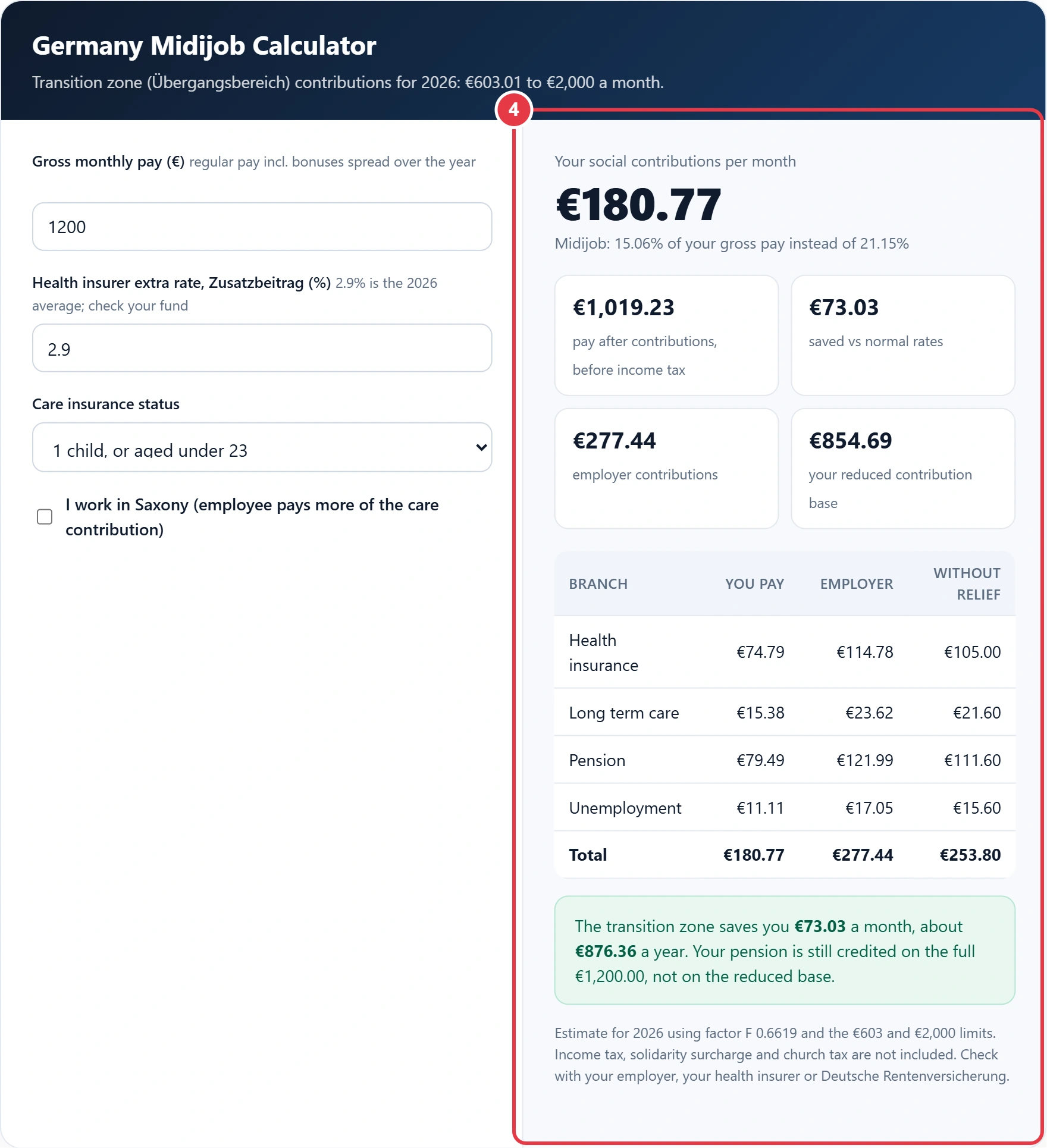
| Branch | You pay | Employer | Without relief |
|---|
Estimate for 2026 using factor F 0.6619 and the €603 and €2,000 limits. Income tax, solidarity surcharge and church tax are not included. Check with your employer, your health insurer or Deutsche Rentenversicherung.
This midijob calculator is for employees and small employers in Germany who want to check, in English, the reduced social contributions on pay between €603.01 and €2,000 a month in 2026. It applies the transition zone formula in section 20 of the German Social Code Book IV, shows every branch of German social insurance separately, and compares your share with what you would pay without the relief. Figures checked October 2026.
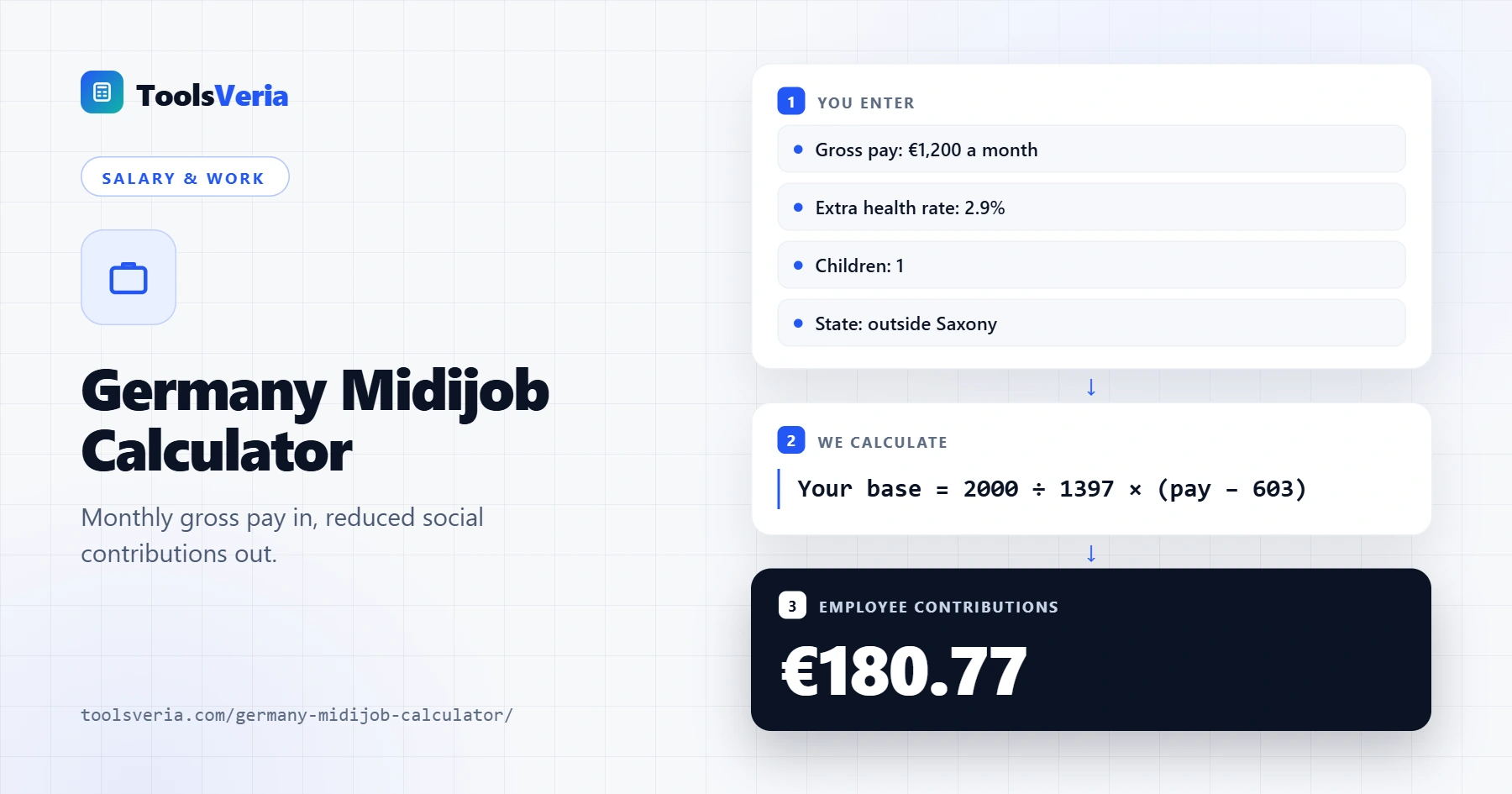
Quick answer: A Midijob is a job paying €603.01 to €2,000 a month. You pay contributions on a reduced base of 2,000 ÷ 1,397 × (pay minus €603), so your share rises gradually. This midijob calculator shows that on €1,200 a month you pay €180.77, not the €253.80 a normal job would cost you.
In This Guide
What Is a Midijob?
A Midijob is employment in Germany's transition zone, the Übergangsbereich, where monthly pay sits above the Minijob limit of €603 and no higher than €2,000 in 2026. You are fully insured for health, long term care, pension and unemployment, but your own contributions start low and climb to the normal level by €2,000. The old name was Gleitzone, and many payslips still use it.
Two formulas do the work. Your contribution base = 2,000 ÷ (2,000 minus 603) × (pay minus 603), and your share of each branch is half the normal rate applied to that base. The total base = F × 603 + (2,000 ÷ 1,397 minus 603 ÷ 1,397 × F) × (pay minus 603), with F = 0.6619 for 2026, and the employer pays the total contribution on that base minus your share. BARMER and TK, both statutory health insurers, publish the same 2026 factor, which was announced in the Bundesanzeiger on 18 December 2025.
How Much Do You Pay in Social Contributions on a Midijob?
You pay between about 4% of your pay just above €603 and the normal 21.15% at €2,000, assuming the average 2.9% Zusatzbeitrag and one child. Take Lena, a part time shop assistant in Cologne earning €1,200 gross a month. Her reduced base is 1.43164 × €597 = €854.69. She pays 8.75% health (€74.79), 1.8% care (€15.38), 9.3% pension (€79.49) and 1.3% unemployment (€11.11), which totals €180.77. Without the transition zone she would pay 21.15% of €1,200, or €253.80, so the Midijob rules save her €73.03 a month and €876.36 a year. Her employer pays €277.44, calculated on the total base of €1,083.25.
How to Use the Germany Midijob Calculator
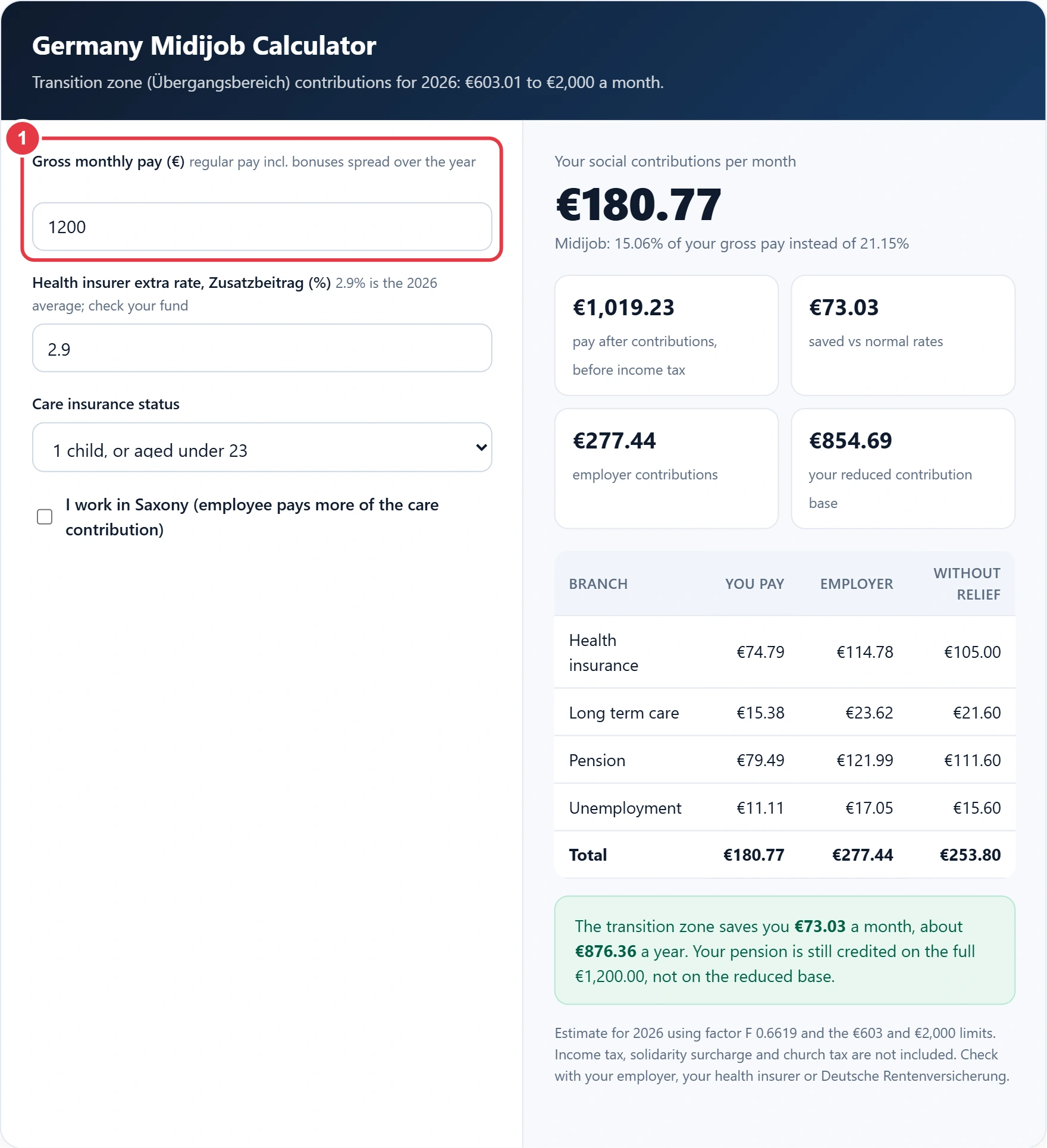
Step 1: Enter Your Gross Monthly Pay
Type your regular gross pay in euros. If you receive a one off bonus, the law looks at your expected average over the year, so spread regular extras across 12 months. Below €603.01 the tool tells you the job counts as a Minijob instead.
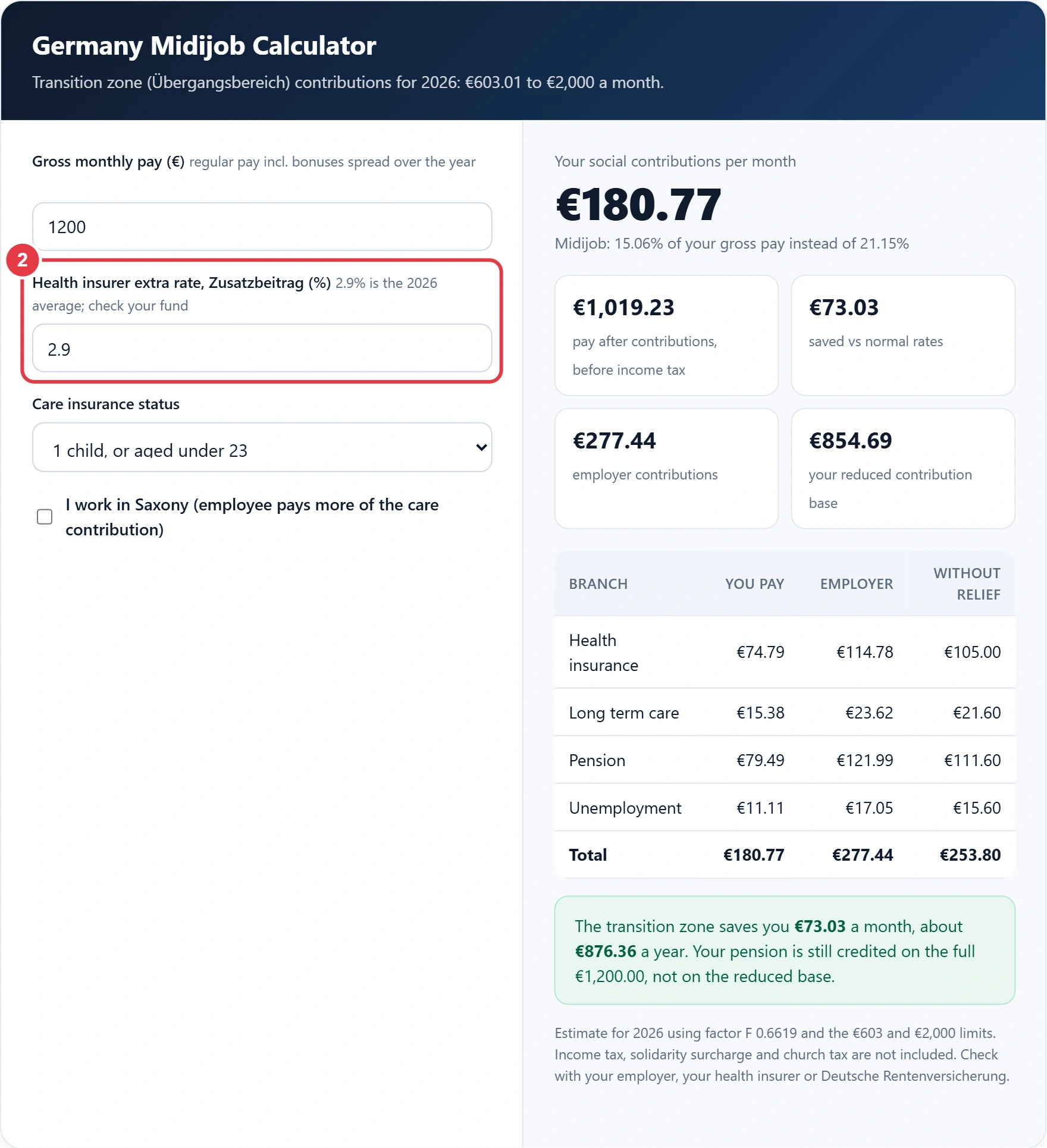
Step 2: Enter Your Health Insurer's Extra Rate
Every Krankenkasse charges a Zusatzbeitrag on top of the general 14.6% rate. The default of 2.9% is the official 2026 average used to set factor F, but your own fund may charge more or less, so copy the figure from your membership letter.
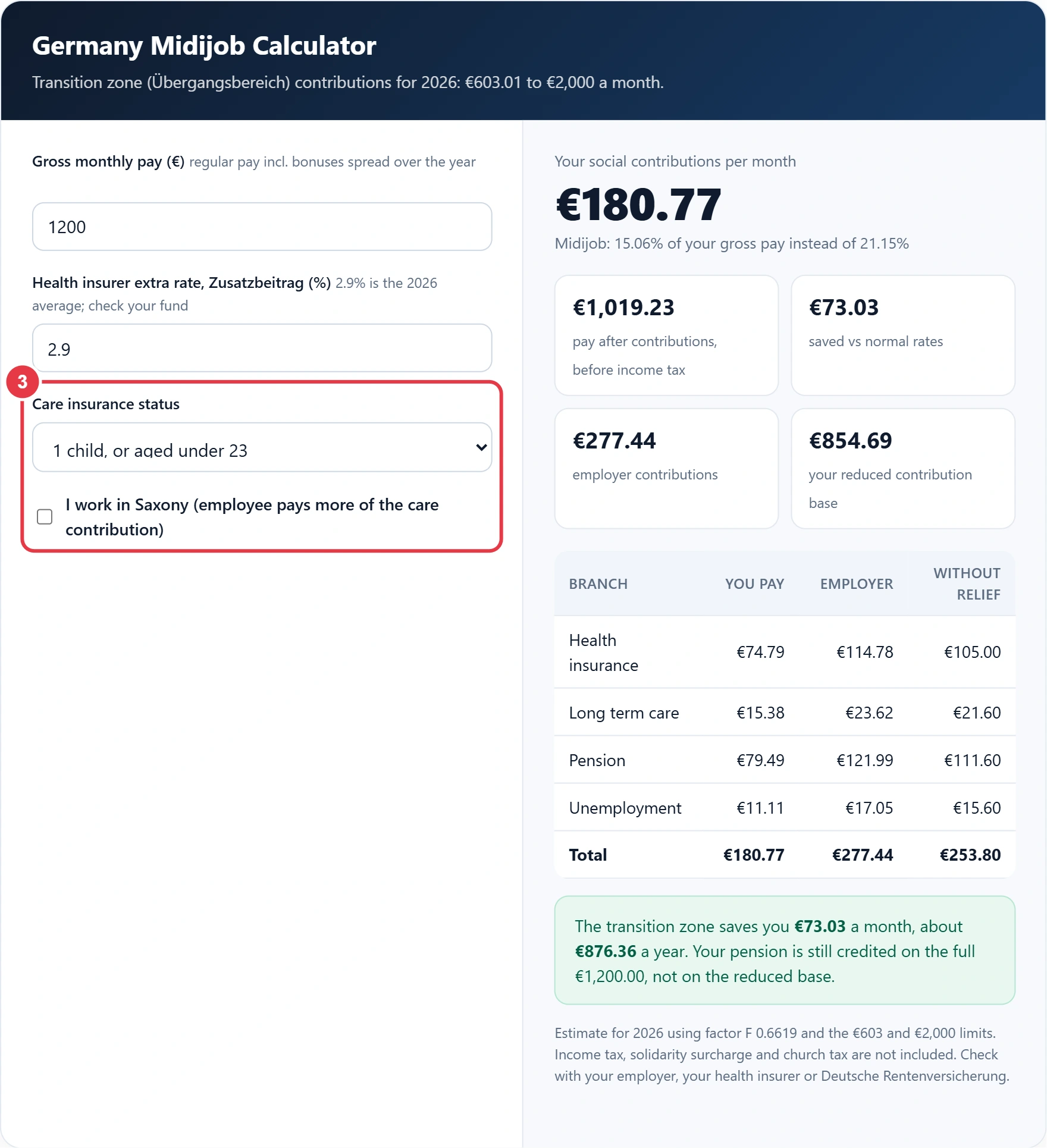
Step 3: Choose Your Care Insurance Status
Long term care costs 3.6% in total for 2026. Employees aged 23 or over without children pay an extra 0.6%, and parents of two to five children under 25 pay 0.25 points less per child from the second. Tick Saxony if you work there, because the employee pays 2.3% of the care rate in that state instead of 1.8%.
Step 4: Read Your Results
The headline shows your monthly contributions, with your pay after contributions, your saving and the employer's share underneath. The table splits each branch, so you can match it line by line against your payslip. If you are weighing up extra hours, the pro rata salary calculator shows what a change in hours does to gross pay before you test it here.
Midijob Contributions at Different Pay Levels in 2026
The table below uses the 2.9% average extra health rate, one child and a workplace outside Saxony. It shows how quickly the relief fades as pay rises towards €2,000.
| Gross pay a month | Your base | You pay | Normal rate | Monthly saving | Employer pays |
|---|---|---|---|---|---|
| €700 | €138.87 | €29.37 | €148.05 | €118.68 | €186.48 |
| €1,000 | €568.36 | €120.21 | €211.50 | €91.29 | €241.07 |
| €1,200 | €854.69 | €180.77 | €253.80 | €73.03 | €277.44 |
| €1,500 | €1,284.18 | €271.61 | €317.25 | €45.64 | €332.02 |
| €1,800 | €1,713.67 | €362.45 | €380.70 | €18.25 | €386.60 |
| €2,000 | €2,000.00 | €423.00 | €423.00 | €0.00 | €423.00 |
Notice that the employer pays more than half near the bottom of the zone. At €700 the employer covers €186.48 while you pay €29.37, because the law shifts the cost of the relief onto the employer side rather than onto the insurance funds.
Your health fund's extra rate moves the figures only a little. At €1,000 a month with a 3.0% Zusatzbeitrag instead of 2.9%, your share rises from €120.21 to €120.50 and the employer's share from €241.07 to €241.64, so it is worth entering your own fund's rate for a payslip match.
Does a Midijob Reduce My Pension?
No, a Midijob does not reduce your state pension, because since 1 July 2019 your pension points are worked out on your actual gross pay, not on the reduced base. Lena pays pension contributions on €854.69 but builds her record as if she paid on the full €1,200, which is one of the main reasons the transition zone exists. If you have more than one job, the pay from all of them is added together to decide whether you fall inside the zone.
Do You Pay Income Tax on a Midijob?
Yes, Midijob pay is taxed like any other wage under your tax class, so the transition zone only lowers social contributions and not income tax. In tax class I, a single person on €1,200 a month usually has little or no wage tax deducted, but class V or VI can take tax from the first euro. That is why this tool stops at pay after contributions and labels it before income tax.
British readers moving to Germany will find the UK government guide to living in Germany useful for the registration, tax ID and healthcare steps that come before your first payslip, and your employer needs your tax ID to apply the right tax class.
Midijob Rules Worth Knowing
- The limits are monthly: €603.01 to €2,000 in 2026, and both follow the Minijob limit, which is tied to the statutory minimum wage.
- Trainees (Auszubildende) are excluded and pay normal contributions from the first euro.
- The childless surcharge is calculated on your reduced base and paid by you alone.
- Your employer reports the job as a Midijob through normal payroll, so you do not need to apply.
- Factor F changes every January with the average Zusatzbeitrag, so a 2025 payslip used 0.6683 and will not match 2026 figures.
Midijob workers changing roles often ask about notice next. The Germany notice period calculator works out the statutory notice you or your employer must give under the German Civil Code.
Key Germany Midijob Calculator Terms Explained
These German social insurance terms explain the reduced contributions the Germany midijob calculator shows, branch by branch, for pay in the transition zone.
- Übergangsbereich
- The German transition zone for monthly pay between the Minijob limit and an upper threshold, formerly called the Gleitzone. Within it, employee social contributions are charged on a reduced base, rising smoothly to the full rate at the top of the band.
- Minijob
- Marginal employment in Germany with pay at or below a monthly limit. Employees are largely free of their own social contributions apart from pension, while employers pay flat rate levies, and earning above the limit moves the job into the transition zone.
- Factor F
- A yearly coefficient set by the German authorities and used in the transition zone formula to calculate the total contribution base. It ensures that combined employer and employee contributions are spread fairly across pay levels within the zone.
- Zusatzbeitrag
- The additional contribution rate each German statutory health insurer charges on top of the general health insurance rate. It varies between funds, is shared between employer and employee, and changes the final contribution figure.
- Pflegeversicherung
- German long-term care insurance, a compulsory branch of social insurance funding care for people who need help with daily living. Childless employees above a set age pay a surcharge, while parents of several young children pay less.
- Deutsche Rentenversicherung
- The German statutory pension insurance body that collects pension contributions and pays retirement, disability and survivor benefits. Midijob workers are fully insured with it and earn pension entitlements based on their actual pay.
</>Embed this calculator on your website
Add the free Germany Midijob Calculator to your own site or blog. Copy the code below and paste it into an HTML block. It resizes itself and works on phones.
How we checked this tool: the Tools Veria Editorial Team built this tool by hand, checked it against the official rules or published standards where they apply, and tested it against worked examples. Results are estimates for planning, not personal financial or tax advice. Read our editorial policy and disclaimer, or report an error.
Frequently Asked Questions
What is the Midijob limit in 2026?
The Midijob transition zone runs from €603.01 to €2,000 gross a month in 2026. Pay of €603 or less is a Minijob, and pay above €2,000 follows normal contribution rules with no reduction.
What is factor F for 2026?
Factor F for 2026 is 0.6619, published in the Bundesanzeiger on 18 December 2025. It is used in the total base formula that sets how much the employer pays inside the Midijob transition zone.
How much does a Midijob save in contributions?
The saving is largest just above €603 and falls to zero at €2,000. On €1,200 a month with the average 2.9% extra health rate and one child, you pay €180.77 instead of €253.80, saving €73.03.
Do I get full pension credit on a Midijob?
Yes. Since 1 July 2019 your pension entitlement is based on your actual gross pay, not the reduced contribution base, so a €1,200 Midijob builds the same pension record as any €1,200 job.
Is the childless surcharge reduced in a Midijob?
The 0.6% surcharge for childless employees aged 23 or over is charged on your reduced contribution base, so it is lower in euros. On €1,200 gross it adds €5.13 a month rather than €7.20.
Can I have two Midijobs at once?
Yes, but the pay from both jobs is added together. If the combined total is between €603.01 and €2,000 a month the transition zone applies, and each employer uses its share of the total.