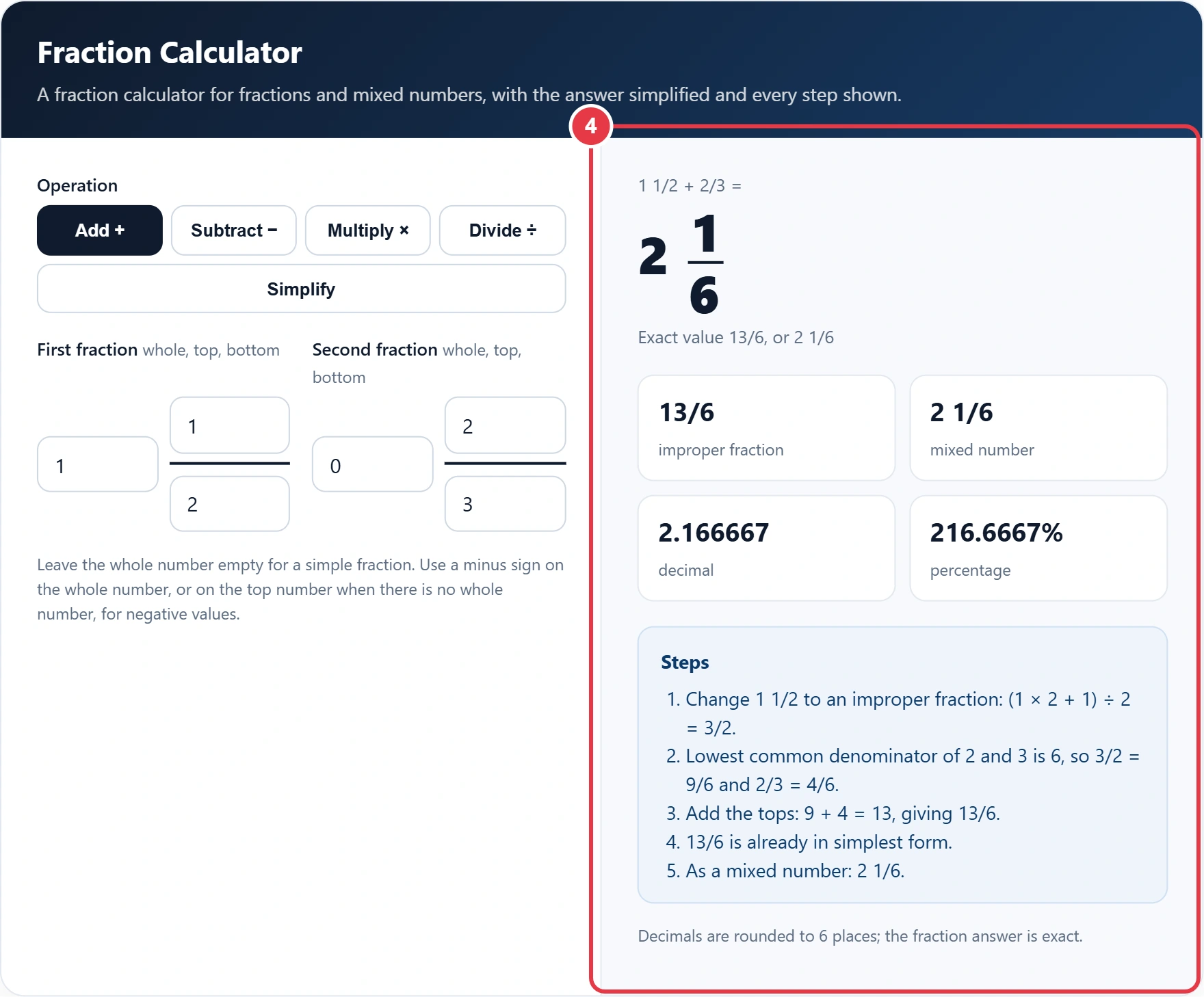
A fraction calculator for fractions and mixed numbers, with the answer simplified and every step shown.
Leave the whole number empty for a simple fraction. Use a minus sign on the whole number, or on the top number when there is no whole number, for negative values.
Decimals are rounded to 6 places; the fraction answer is exact.
This free fraction calculator adds, subtracts, multiplies and divides fractions and mixed numbers, and it can also simplify a single fraction. It is made for pupils, parents helping with homework, cooks scaling recipes and anyone measuring in inches, and it shows each step using the standard rules for fractions taught in schools in the UK, US and worldwide, so you can learn the method as well as check the answer.
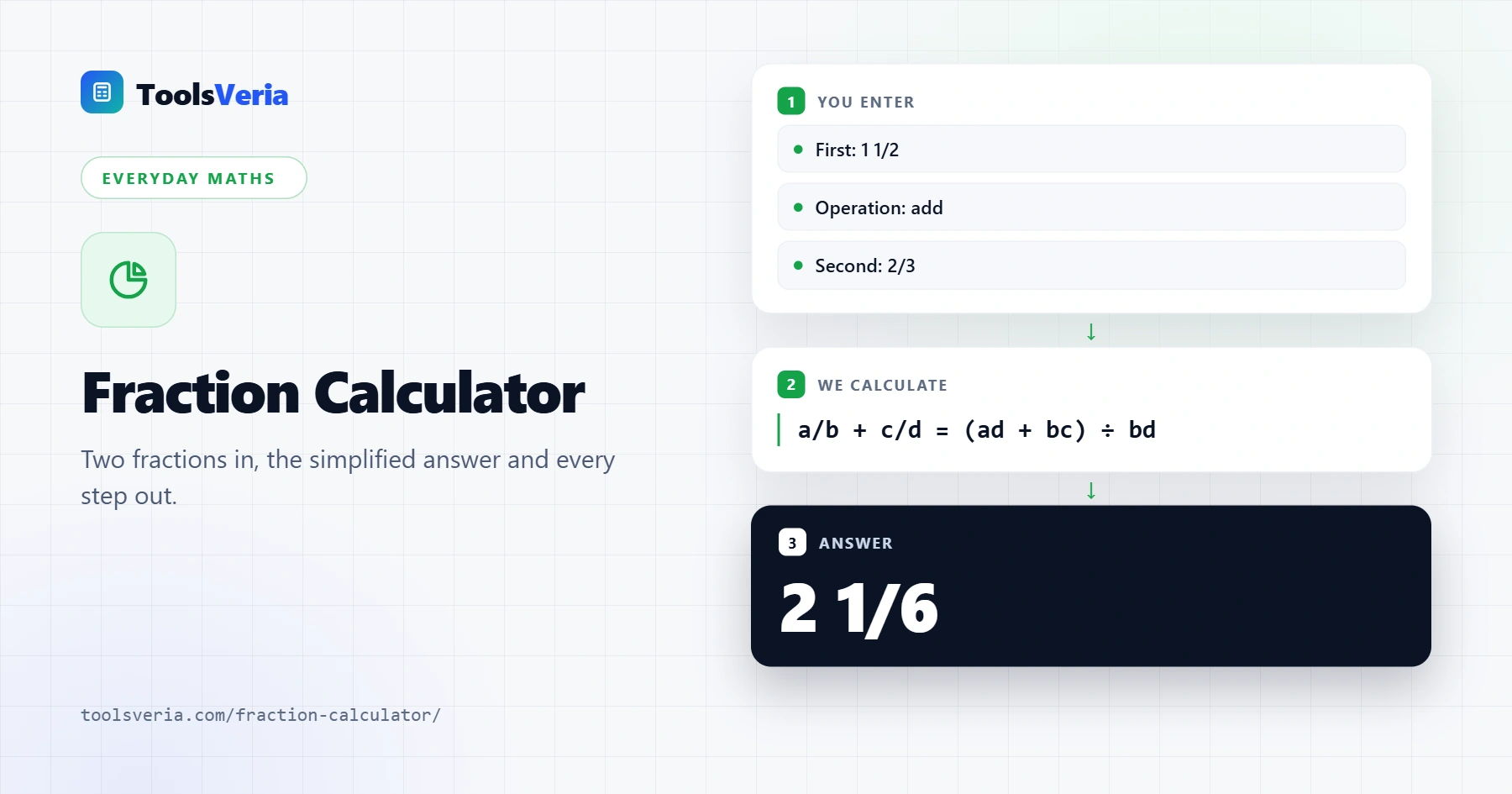
Quick answer: To add or subtract fractions, give them a common denominator, then add or subtract the top numbers. To multiply, multiply tops and bottoms. To divide, flip the second fraction and multiply. A fraction calculator then simplifies: 1 1/2 + 2/3 = 9/6 + 4/6 = 13/6 = 2 1/6.
In This Guide
What Is a Fraction Calculator?
A fraction calculator is a tool that does arithmetic with fractions and gives an exact answer as a fraction, not just a rounded decimal. It handles mixed numbers such as 2 3/4 by changing them to improper fractions such as 11/4 first.
The formulas in plain words are: a/b + c/d = (a × d + c × b) ÷ (b × d), subtraction is the same with a minus sign, a/b × c/d = (a × c) ÷ (b × d), and a/b ÷ c/d = a/b × d/c. The tool uses the lowest common denominator rather than b × d, which keeps the numbers small, and it reduces every result by the greatest common divisor.
How to Use the Fraction Calculator
Step 1: Choose the Operation
Pick add, subtract, multiply or divide, or choose Simplify to reduce one fraction to its lowest terms. The answer and steps change straight away when you switch.

Step 2: Enter the First Fraction
Type the whole number on the left, then the top number (numerator) and the bottom number (denominator) on the right. For 3/8, leave the whole number empty. For a negative mixed number such as -1 1/4, put the minus sign on the whole number.

Step 3: Enter the Second Fraction
Enter the second value the same way. Whole numbers work too: type 3 as the whole number with 0 over 1, or simply 3 over 1. The second box is hidden in Simplify mode because only one fraction is needed.

Step 4: Read the Answer and Steps
The large figure is the simplified answer. The boxes give the improper fraction, mixed number, decimal and percentage, and the numbered steps show the common denominator, the sum and the simplification. If you only need the decimal form of a fraction, the fraction to decimal converter focuses on that single job and suits long lists of conversions.
How Do You Add Fractions With Different Denominators?
To add fractions with different denominators, rewrite both over their lowest common denominator, add the numerators and keep the denominator. For 3/4 + 5/6, the lowest common denominator of 4 and 6 is 12, so 9/12 + 10/12 = 19/12, which is 1 7/12.
The common mistake is to add tops and bottoms separately, which turns 1/2 + 1/3 into 2/5. That answer is smaller than 1/2 on its own, so it cannot be right. The correct sum is 3/6 + 2/6 = 5/6. Used as an adding fractions calculator, this tool always shows the common denominator step so the error is easy to spot.
| Operation | Rule | Example | Answer |
|---|---|---|---|
| Add | Common denominator, add tops | 3/4 + 5/6 | 19/12 = 1 7/12 |
| Subtract | Common denominator, subtract tops | 3 3/4 − 1 5/8 | 17/8 = 2 1/8 |
| Multiply | Tops × tops, bottoms × bottoms | 2/3 × 3/2 | 6/6 = 1 |
| Divide | Flip the second, then multiply | 3/4 ÷ 1/8 | 24/4 = 6 |
| Simplify | Divide by the greatest common divisor | 18/24 | 3/4 |
How Do You Simplify Fractions?
To simplify fractions, divide the top and bottom by their greatest common divisor, the largest number that divides both exactly. For 18/24 the greatest common divisor is 6, so 18 ÷ 6 = 3 and 24 ÷ 6 = 4, giving 3/4.
Large numbers are no problem, because the tool finds the divisor with the Euclidean algorithm, which repeatedly divides and keeps the remainder, so even fractions such as 1071/462 reduce instantly to 51/22. A fraction is in simplest form when the only number that divides both parts is 1.
Where Are Fractions Used in Everyday Life?
Fractions turn up whenever something is split or scaled, most often in cooking, DIY measurements in inches and sharing costs. Worked example: Ben is fitting a shelf into an alcove that measures 3 3/4 inches deeper than the bracket, and he trims 1 5/8 inches off the board. The fraction calculator gives 15/4 − 13/8 = 30/8 − 13/8 = 17/8, so 2 1/8 inches remain.
Later he makes 1 1/2 times a cake recipe that needs 2/3 of a cup of sugar. Multiplying 2/3 × 3/2 gives exactly 1 cup. When a recipe is written as a ratio instead, the ratio calculator scales every ingredient at once, and the percentage calculator helps when a fraction needs to become a percentage, such as 3/8 = 37.5%. Method checked October 2026.
Key Fraction Terms Explained
These terms name the parts and rules a fraction calculator works with, so each step in the working makes sense when you check it by hand.
- Numerator
- The top number of a fraction, showing how many equal parts are counted. In 3/4 the numerator is 3, and when fractions share a denominator you add or subtract only the numerators.
- Denominator
- The bottom number of a fraction, showing how many equal parts make one whole. It can never be 0. In 3/4 the denominator is 4, meaning the whole is split into four parts.
- Lowest common denominator
- The smallest number that two or more denominators divide into exactly, the least common multiple. For 4 and 6 it is 12, so 3/4 becomes 9/12 and 5/6 becomes 10/12 before adding.
- Greatest common divisor
- The largest whole number that divides both parts of a fraction with no remainder. For 18 and 24 it is 6, so 18/24 simplifies to 3/4. The Euclidean algorithm finds it quickly.
- Mixed number
- A whole number and a proper fraction written together, such as 2 1/6. It equals the improper fraction 13/6, found by multiplying 2 by 6 and adding 1 on top.
- Reciprocal
- A fraction turned upside down, so the reciprocal of 1/8 is 8/1. Dividing by a fraction is the same as multiplying by its reciprocal, which is why 3/4 divided by 1/8 equals 6.
</>Embed this calculator on your website
Add the free Fraction Calculator to your own site or blog. Copy the code below and paste it into an HTML block. It resizes itself and works on phones.
How we checked this tool: the Tools Veria Editorial Team built this tool by hand, checked it against the official rules or published standards where they apply, and tested it against worked examples. Results are estimates for planning, not personal financial or tax advice. Read our editorial policy and disclaimer, or report an error.
Frequently Asked Questions
How do you divide fractions?
Keep the first fraction, flip the second one upside down to get its reciprocal, then multiply. So 3/4 ÷ 1/8 becomes 3/4 × 8/1 = 24/4, which simplifies to 6. This works because dividing by a number is the same as multiplying by its reciprocal.
How do I turn a mixed number into an improper fraction?
Multiply the whole number by the denominator, add the numerator, and put the result over the same denominator. For 2 3/4, 2 × 4 + 3 = 11, so the improper fraction is 11/4. The calculator does this step for you and shows it.
What is the lowest common denominator?
It is the smallest number that both denominators divide into exactly, also called the least common multiple. For 4 and 6 it is 12. Using it keeps numbers small, so less simplifying is needed at the end.
Can the calculator handle negative fractions?
Yes. Put a minus sign on the whole number for a negative mixed number, or on the numerator for a simple fraction. For example, -1 1/2 + 2/3 = -5/6, and the steps show how the signs are combined.
Why is my answer an improper fraction?
An improper fraction has a top number at least as big as the bottom, such as 13/6. It is exact and often preferred in algebra. The calculator also shows the mixed number form, 2 1/6, which is easier to picture.
How do I convert a fraction to a percentage?
Divide the top by the bottom and multiply by 100. For 3/8, 3 ÷ 8 = 0.375, and 0.375 × 100 = 37.5%. The percentage box in the calculator shows this for every answer, rounded to 4 decimal places.