Midpoint, missing endpoint or ratio point of a line segment in 2D or 3D, with the working.
Order: x, y.
| Point on AB | Coordinates |
|---|
The midpoint is the average of the coordinates. For a missing endpoint, the calculator doubles the midpoint and subtracts the known end.
This midpoint and endpoint calculator finds the exact middle of a line segment, recovers a missing endpoint from a midpoint, and locates the point that splits a segment in any ratio, in two or three dimensions. It is built for GCSE, A level and SAT students as well as designers and engineers working with coordinates, and it uses the standard midpoint formula from coordinate geometry with every line of working shown so you can copy the method, not just the answer.
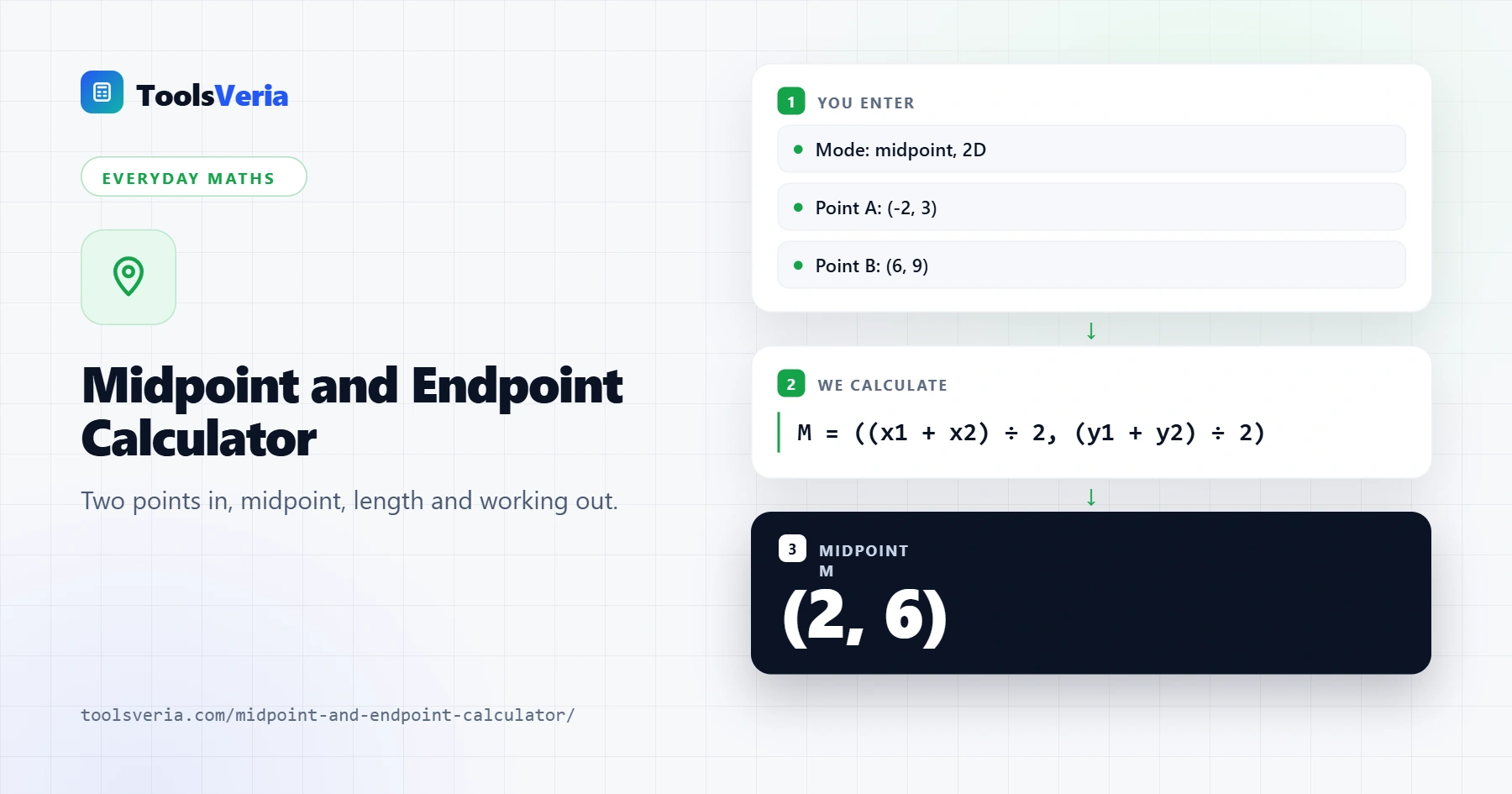
Quick answer: the midpoint is the average of the coordinates, M = ((x₁ + x₂) ÷ 2, (y₁ + y₂) ÷ 2). The missing endpoint is B = (2xₘ minus x₁, 2yₘ minus y₁). For A(minus 2, 3) and B(6, 9), the midpoint and endpoint calculator gives M = (2, 6) and a segment length of 10 units.
In This Guide
What Are a Midpoint and an Endpoint?
A midpoint is the point exactly halfway along a line segment, the same distance from both ends, and the endpoints are the two points where the segment starts and stops. If you know any two of the three points, you can always find the third.
The formulas in plain words: to find the midpoint, add the two x values and halve the total, then do the same for the y values (and the z values in 3D). To find a missing endpoint, double each midpoint coordinate and subtract the matching coordinate of the endpoint you already know. This works because the midpoint sits the same step away from each end, so the unknown end is the known end plus two of those steps.
How to Use the Midpoint and Endpoint Calculator
Step 1: Choose What to Find and the Dimension
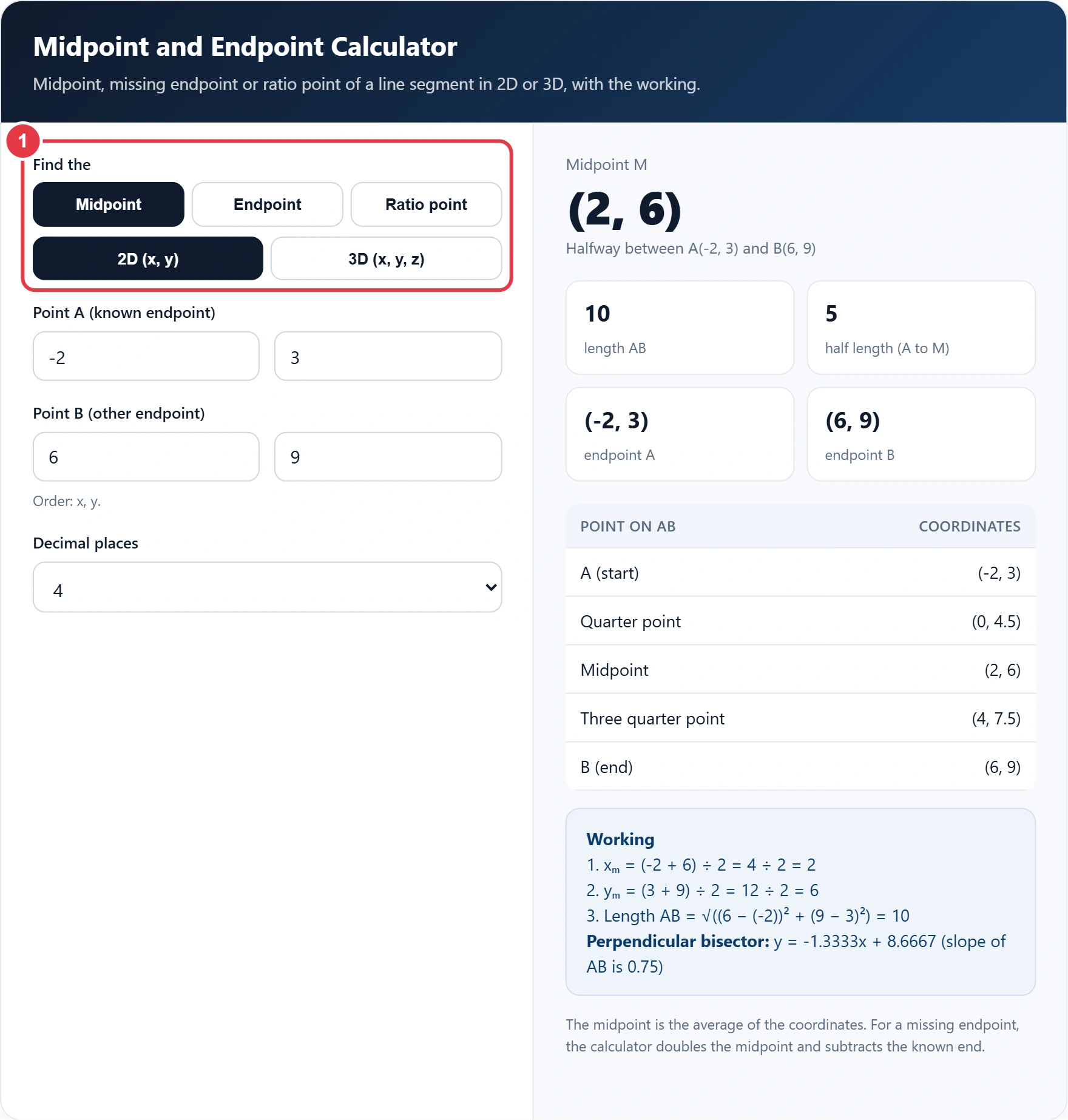
Open the midpoint and endpoint calculator and pick Midpoint, Endpoint or Ratio point, then choose 2D for flat graphs and maps or 3D for points in space. Switching between midpoint and endpoint carries your numbers across, so you can check one answer with the other.
Step 2: Enter Point A
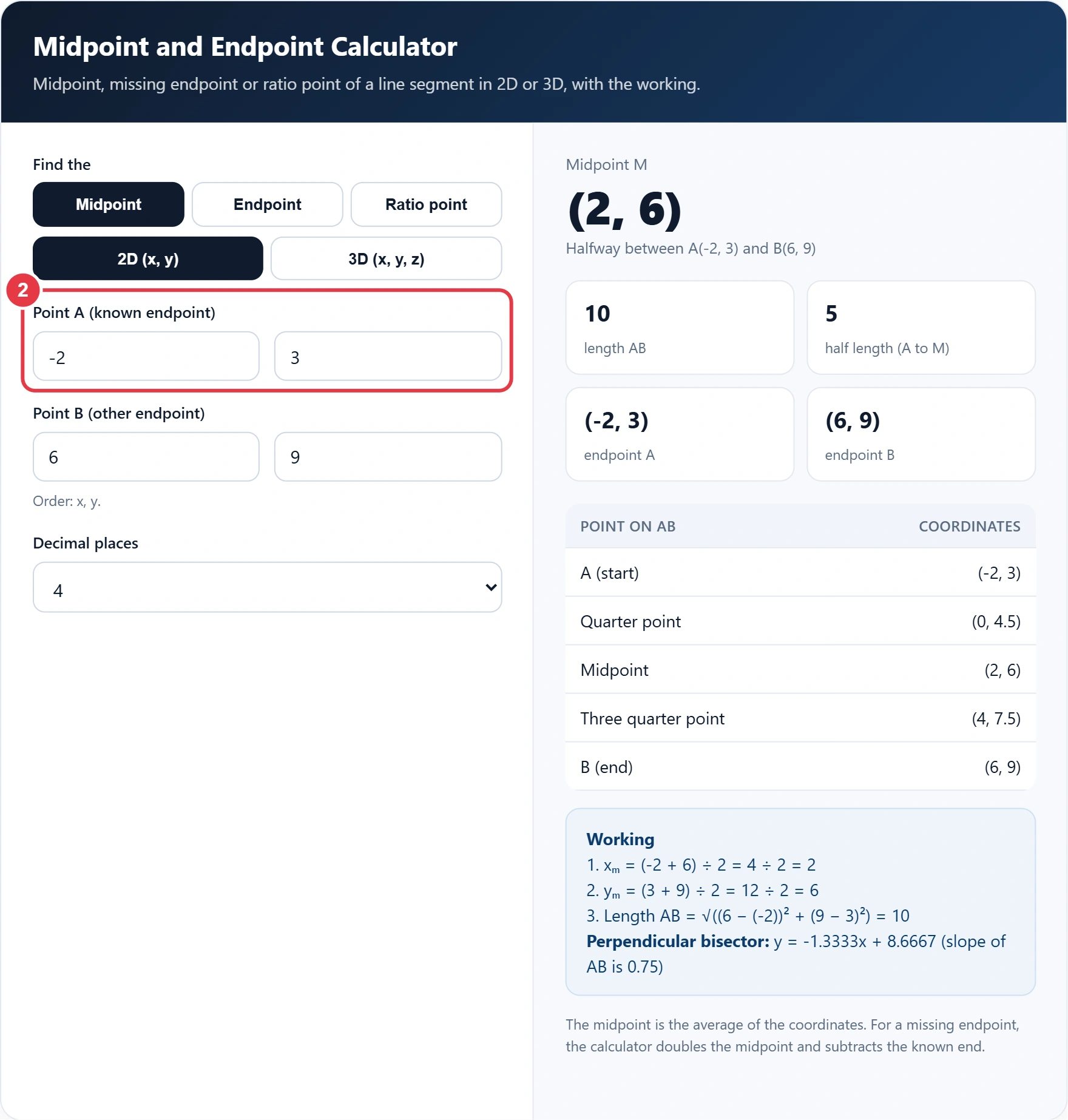
Type the x and y coordinates (and z in 3D) of the endpoint you know. Negative numbers and decimals are accepted, so points in any quadrant work.
Step 3: Enter the Second Point
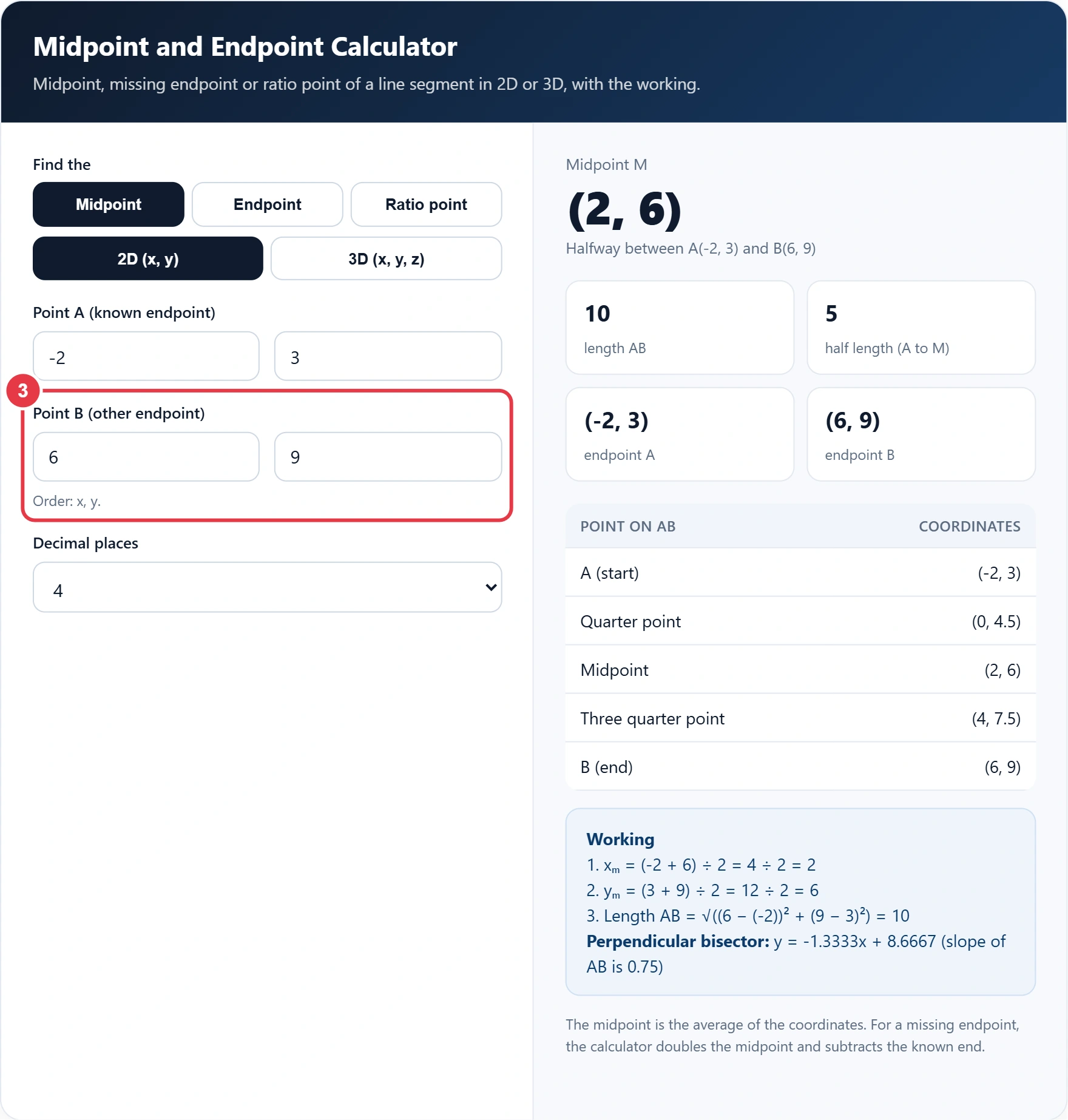
In midpoint and ratio modes this is the other endpoint, B. In endpoint mode the label changes to Midpoint M, because you are working backwards from the middle to the missing end. For a ratio point, also enter the two parts of the ratio, such as 1 and 3.
Step 4: Read the Result and Working
The main result is the point you asked for. Below it you get the segment length, the half length, the quarter points along the segment and, in 2D, the equation of the perpendicular bisector. The slope calculator takes the same two points further if you also need the gradient and the equation of the line itself.
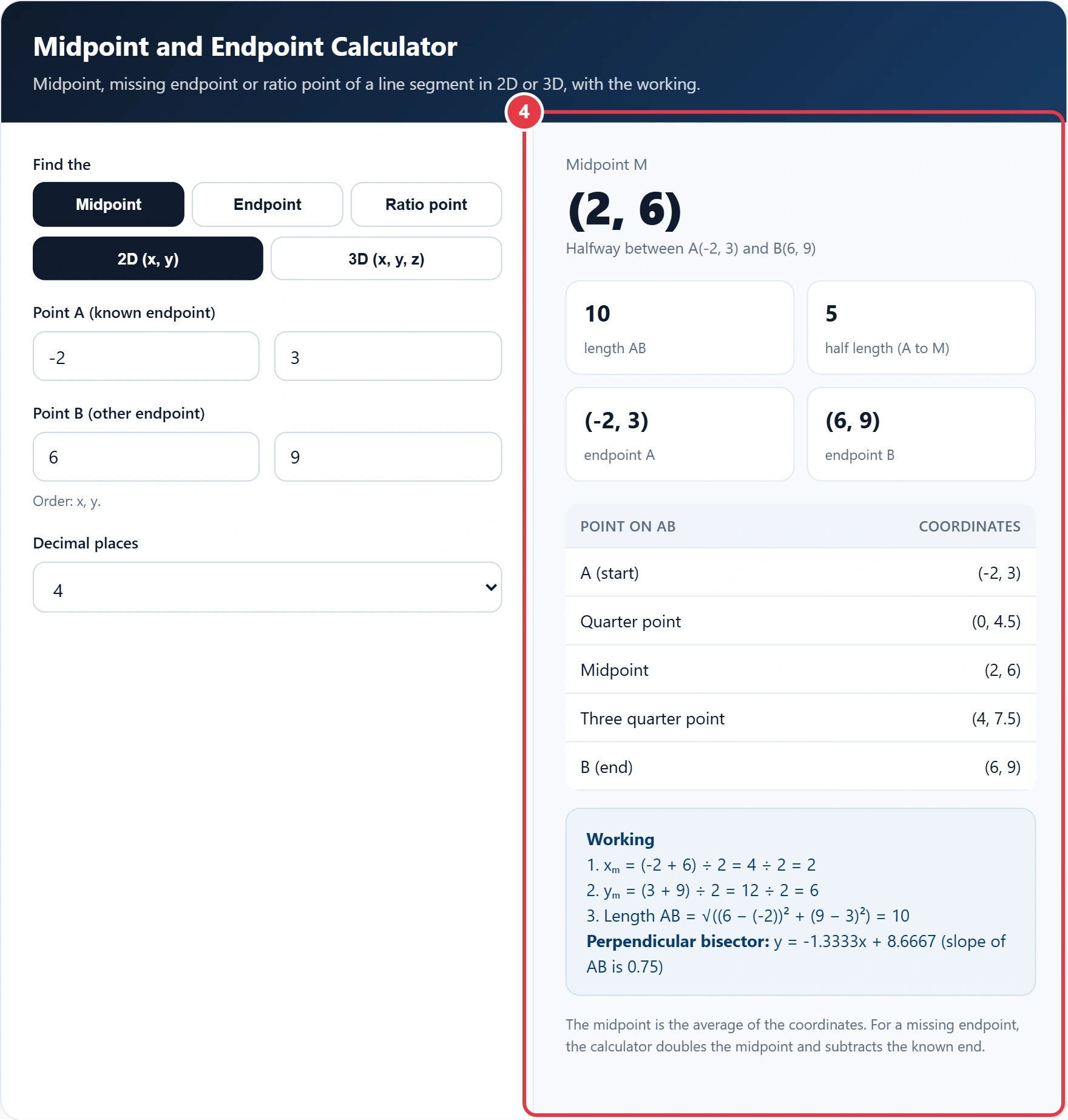
How Do You Find the Midpoint of Two Points?
Add the x coordinates and divide by 2, then add the y coordinates and divide by 2. The midpoint is simply the mean of each coordinate, which is why the average calculator gives the same numbers if you feed it each pair of values in turn.
Worked example: Maya, a garden designer in Bath, wants a bird bath exactly halfway between two apple trees. Measured from the corner of the plot, one tree stands at (1.5, 2) metres and the other at (9.5, 8) metres. The midpoint is ((1.5 + 9.5) ÷ 2, (2 + 8) ÷ 2) = (5.5, 5). The trees are √(8² + 6²) = 10 metres apart, so the bird bath sits 5 metres from each trunk, and the quarter points at (3.5, 3.5) and (7.5, 6.5) mark good spots for a pair of matching shrubs.
How Do You Find a Missing Endpoint?
Double the midpoint and subtract the known endpoint: x₂ = 2xₘ minus x₁ and y₂ = 2yₘ minus y₁. Always check by finding the midpoint of your answer, which the midpoint and endpoint calculator does when you switch modes, and the known end: it should match the midpoint you started with.
Worked example: Jas is revising for GCSE maths and gets the question "M(4, minus 1) is the midpoint of AB, and A is (1, 3). Find B." Using the formula, x = 2 × 4 minus 1 = 7 and y = 2 × (minus 1) minus 3 = minus 5, so B is (7, minus 5). The check confirms it: (1 + 7) ÷ 2 = 4 and (3 + minus 5) ÷ 2 = minus 1. The most common slip is halving instead of doubling, which gives (2.5, 1), a point that sits between A and M rather than beyond M.
How Do You Divide a Line Segment in a Ratio?
Move a fraction t = m ÷ (m + n) of the way from A to B: P = A + t × (B minus A), applied to each coordinate. This is the internal section formula, and the midpoint is just the special case where the ratio is 1:1 and t is one half.
For A(minus 2, 3), B(6, 9) and a ratio of 1:3, t = 1 ÷ 4 = 0.25. The point is (minus 2 + 0.25 × 8, 3 + 0.25 × 6) = (0, 4.5). It lies 2.5 units from A and 7.5 units from B, which is the 1:3 split you asked for.
| You want | 2D formula | 3D formula adds |
|---|---|---|
| Midpoint M | ((x₁ + x₂) ÷ 2, (y₁ + y₂) ÷ 2) | (z₁ + z₂) ÷ 2 |
| Missing endpoint B | (2xₘ minus x₁, 2yₘ minus y₁) | 2zₘ minus z₁ |
| Ratio point m:n | A + m ÷ (m + n) × (B minus A) | same rule for z |
| Length AB | √((x₂ minus x₁)² + (y₂ minus y₁)²) | + (z₂ minus z₁)² inside the root |
Does the Midpoint Formula Work in 3D?
Yes: in three dimensions you average the z coordinates as well, so the midpoint of (1, 2, 3) and (5, 8, 9) is (3, 5, 6). The endpoint and ratio formulas extend in the same way, one coordinate at a time, which is why the midpoint and endpoint calculator offers a 3D switch for CAD models, game levels and physics problems.
- Add the coordinates for a midpoint; subtract them only when finding lengths or endpoints.
- Keep negative signs inside brackets: 2 × (minus 1) minus 3 is minus 5, not minus 1.
- Pair x with x and y with y; never add an x value to a y value.
- In a ratio m:n, the first number belongs to the A side, so 1:3 puts the point closer to A.
Ratio questions often start from words rather than numbers, and the ratio calculator simplifies and scales them before you bring them here. For the angle a segment makes with the axis, the trigonometry calculator turns rise and run into degrees. Formulas checked October 2026.
Key Midpoint and Endpoint Terms Explained
These coordinate geometry terms explain the methods behind the midpoint and endpoint calculator, helping you follow the working and check answers in two or three dimensions.
- Line segment
- The part of a straight line between two fixed endpoints, with a definite, measurable length. Unlike a full line, which continues forever in both directions, a segment has exactly one midpoint and can be divided in any chosen ratio.
- Midpoint formula
- The rule that finds the centre of a segment by averaging the matching coordinates of its two ends. It extends naturally to three dimensions by averaging the z values as well, and reversing it recovers a missing endpoint.
- Section formula
- A method for finding the point that divides a segment internally in a given ratio. Each coordinate is a weighted average of the endpoints, with the weights taken from the ratio parts, so equal parts give the midpoint.
- Perpendicular bisector
- The line that passes through the midpoint of a segment at right angles to it. Every point on it is the same distance from both endpoints, a property used in constructions, circle problems and locus questions.
- Euclidean distance
- The straight line length between two points, found by applying Pythagoras' theorem to the differences in their coordinates. In three dimensions the square of the z difference is added before taking the square root.
- Cartesian coordinates
- A system that fixes any point by its signed distances from perpendicular axes, written as an ordered pair or triple. It turns geometric questions about points and lines into arithmetic and algebra that can be calculated exactly.
</>Embed this calculator on your website
Add the free Midpoint and Endpoint Calculator to your own site or blog. Copy the code below and paste it into an HTML block. It resizes itself and works on phones.
How we checked this tool: the Tools Veria Editorial Team built this tool by hand, checked it against the official rules or published standards where they apply, and tested it against worked examples. Results are estimates for planning, not personal financial or tax advice. Read our editorial policy and disclaimer, or report an error.
Frequently Asked Questions
What is the midpoint formula?
The midpoint formula is M = ((x₁ + x₂) ÷ 2, (y₁ + y₂) ÷ 2). Add the two x values and halve them, then do the same for the y values. For (minus 2, 3) and (6, 9) the midpoint is (2, 6).
How do I find an endpoint from the midpoint?
Double the midpoint and subtract the known endpoint, one coordinate at a time: x₂ = 2xₘ minus x₁ and y₂ = 2yₘ minus y₁. With M(4, minus 1) and A(1, 3), the other endpoint is (7, minus 5).
Can a midpoint have decimal coordinates?
Yes. If the two x values add to an odd number, the midpoint has a .5 coordinate. The midpoint of (1, 2) and (4, 7) is (2.5, 4.5), which is a perfectly valid point.
Is the midpoint the same as the average?
Yes, each midpoint coordinate is the mean of the two matching endpoint coordinates. That is why the midpoint is sometimes called the average point or centre of a line segment.
How do I find the midpoint in 3D?
Average all three coordinates: ((x₁ + x₂) ÷ 2, (y₁ + y₂) ÷ 2, (z₁ + z₂) ÷ 2). For (1, 2, 3) and (5, 8, 9) the 3D midpoint is (3, 5, 6).
What is the perpendicular bisector of a line segment?
It is the line that passes through the midpoint at right angles to the segment. Its slope is the negative reciprocal of the segment's slope, so for a segment with slope 3/4 the bisector has slope minus 4/3.