Find the sale price, the percentage off, or the real saving from two discounts stacked together.
Enter the full price and the percentage off shown on the label.
Prices are rounded to two decimal places. Check whether a shop applies stacked discounts one after the other, as most do.
Shopping a sale and want to know what you will actually pay? This discount calculator uses the basic rules of percentages to work out the sale price from any percent off, find the percentage discount between two prices, and show the real saving when two discounts are stacked. It handles pounds, euros and dollars, so the maths is always clear.
What Is a Discount Calculation?
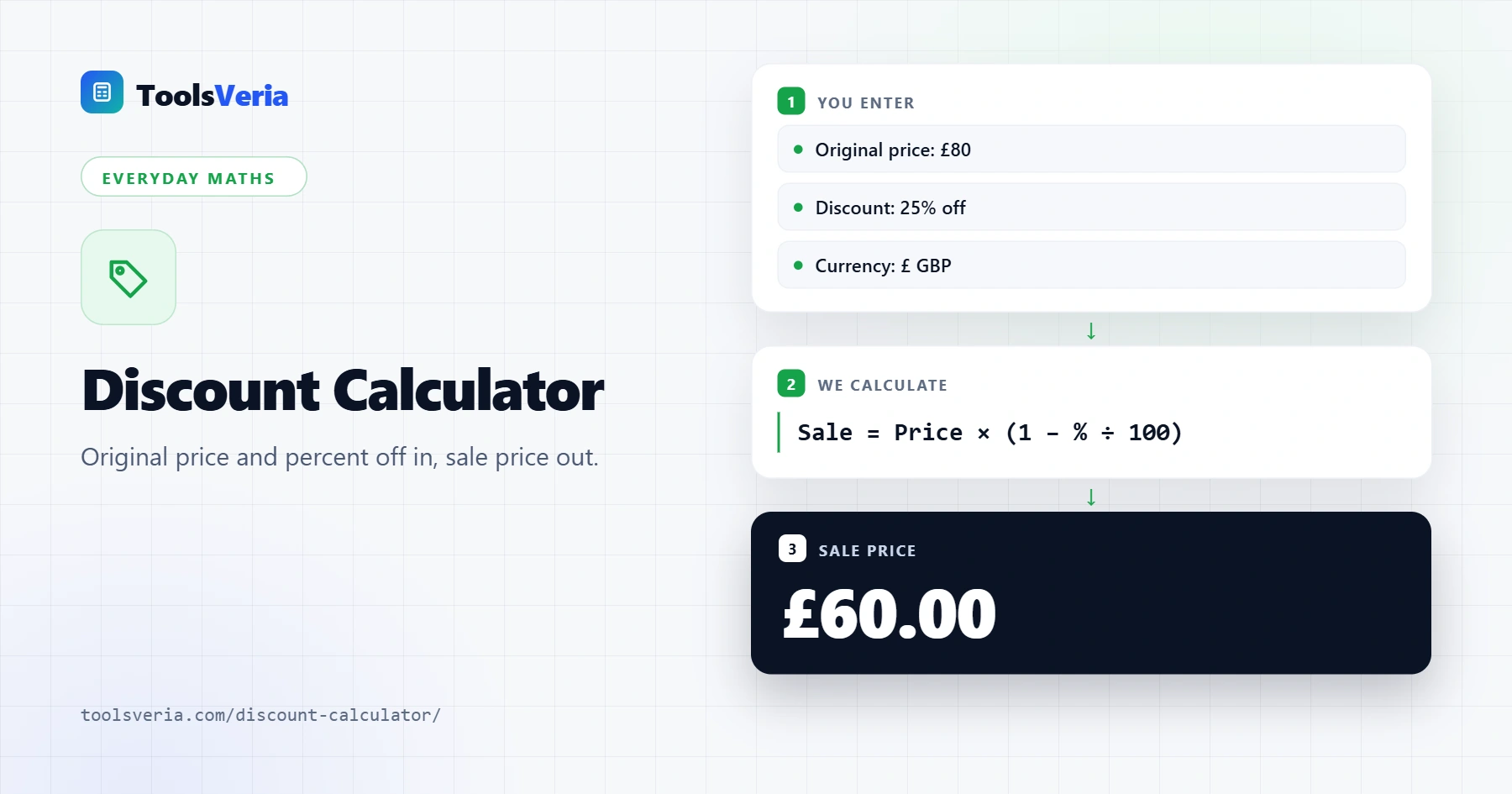
A discount is a reduction from the original price, usually shown as a percentage. To find the sale price, multiply the original price by what is left after the discount: sale price = original price × (1 − discount ÷ 100). So 25% off £80 is £80 × 0.75 = £60, a saving of £20.
To find the percentage off from two prices, use (original − sale) ÷ original × 100. For a general comparison of any two numbers, the percentage difference calculator shows the gap either way. Stacked discounts multiply rather than add: 20% off then an extra 10% off leaves 0.8 × 0.9 = 0.72 of the price, which is 28% off in total, not 30%.
How to Use the Discount Calculator
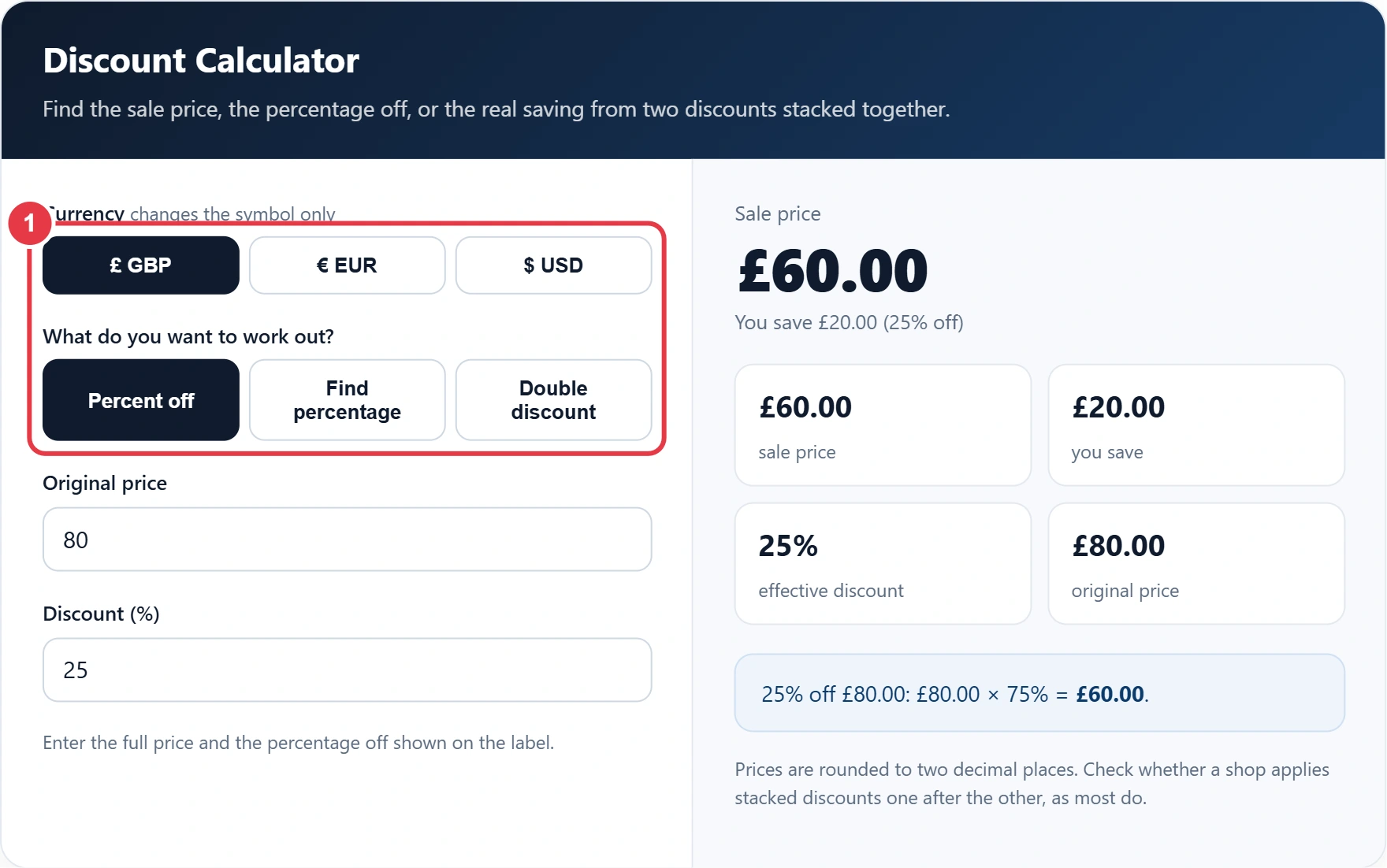
Step 1: Choose Currency and Mode
Pick £, € or $, then choose Percent off, Find percentage or Double discount. The fields change to match what you want to work out.
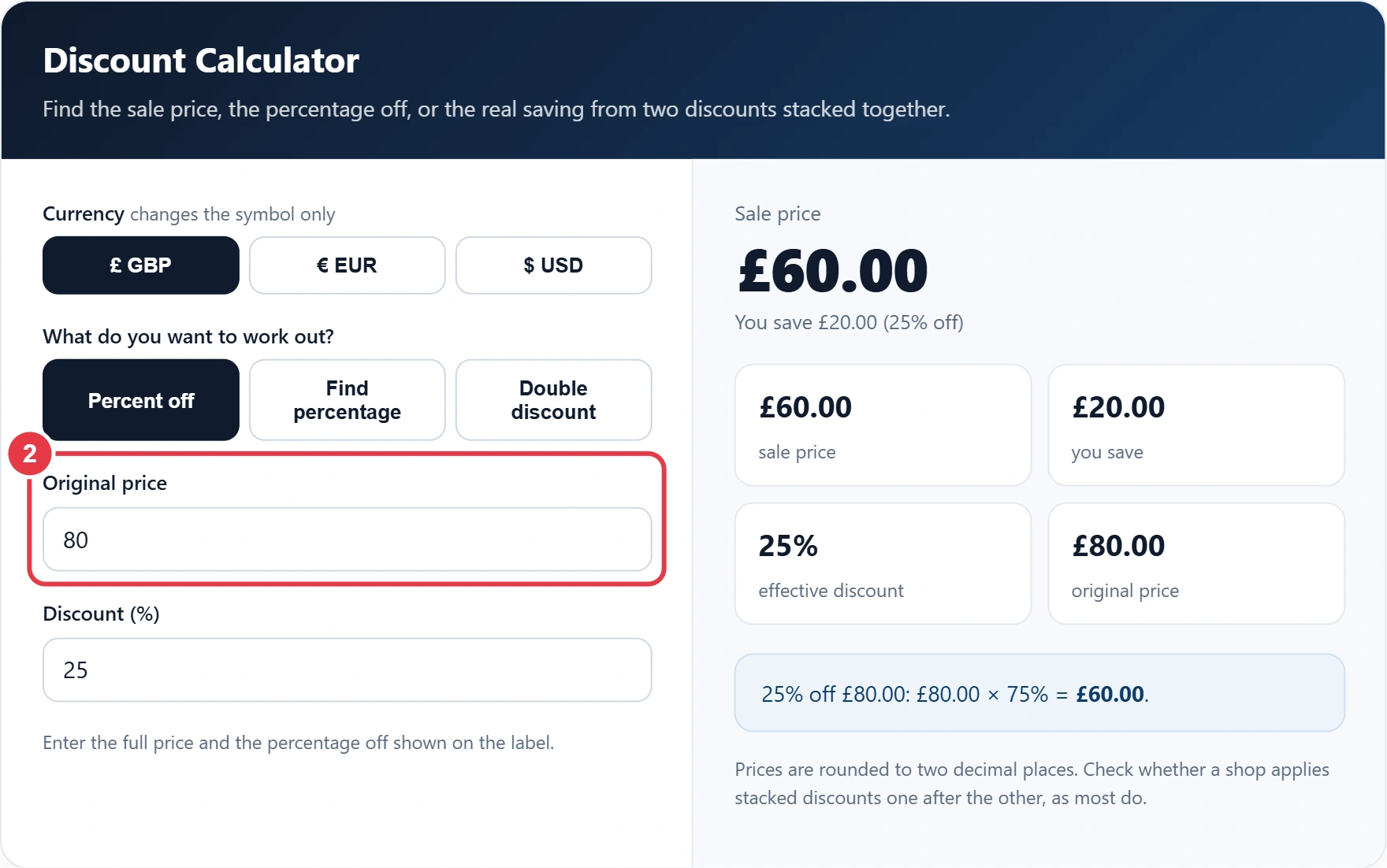
Step 2: Enter the Original Price
Type the full price before any discount. This is often the crossed out "was" price on the label or website.
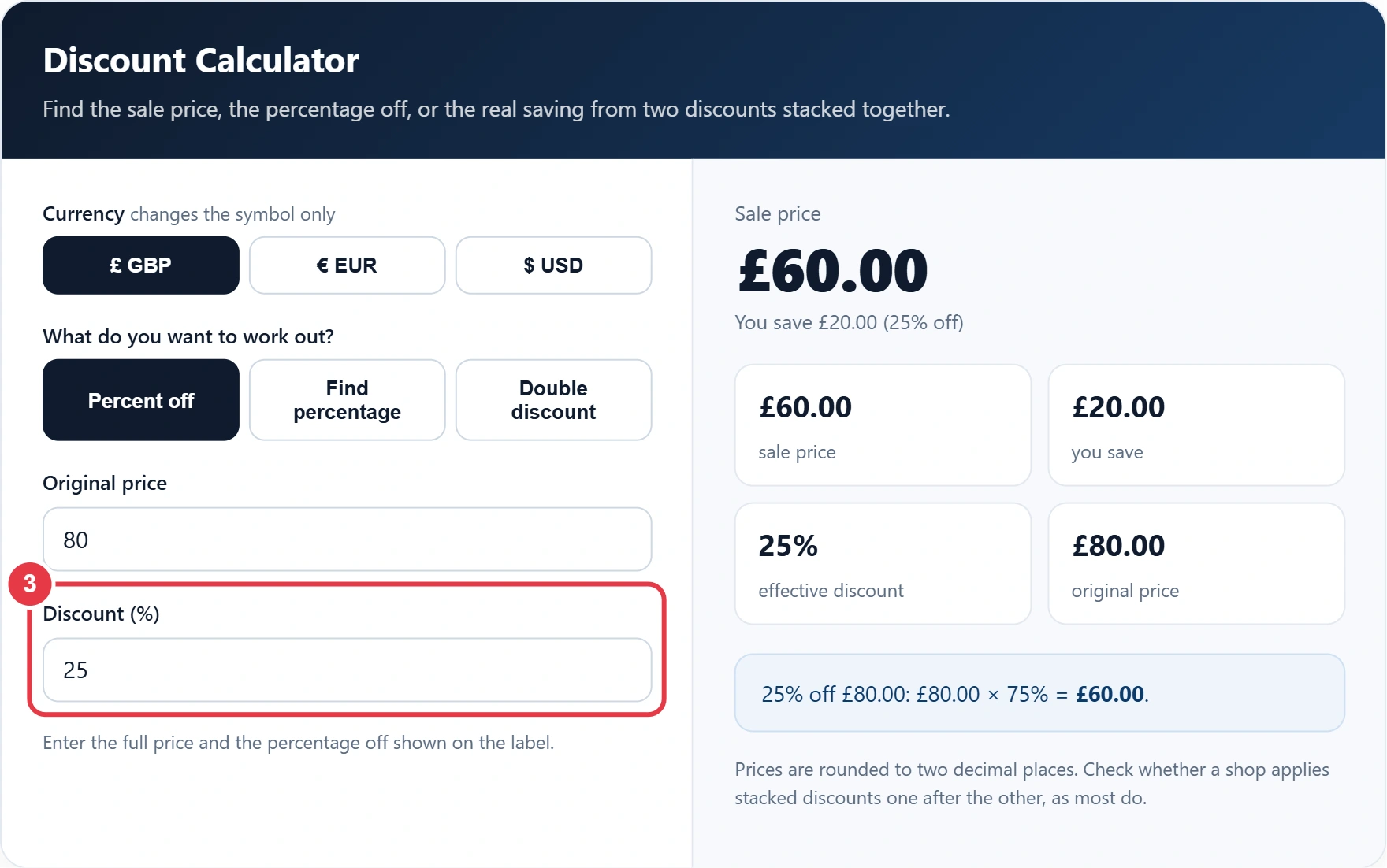
Step 3: Enter the Discount
Enter the percentage off, the sale price you have been offered, or two separate discounts such as a sale price plus a voucher code.
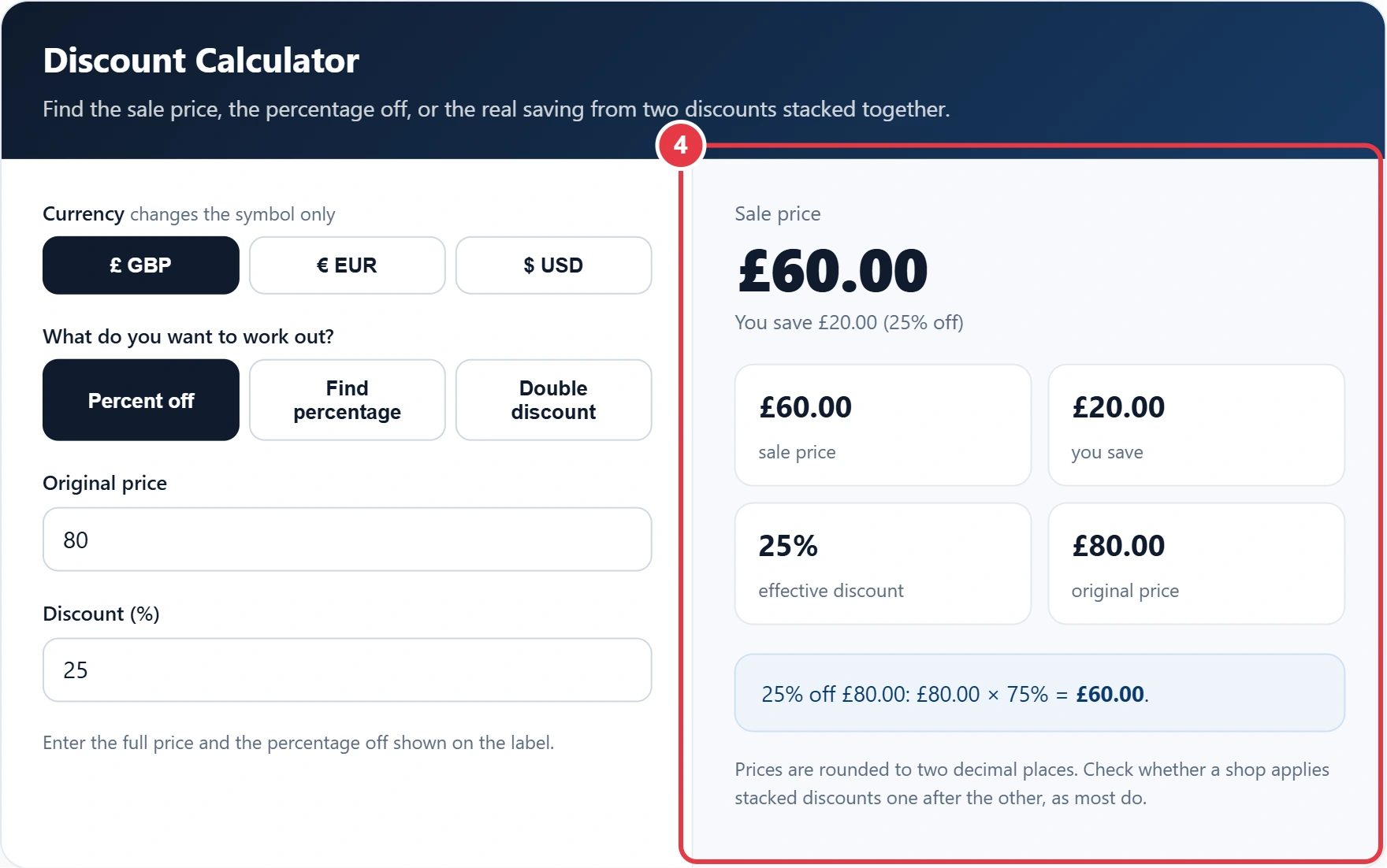
Step 4: Read Your Results
You will see the sale price, how much you save and the effective discount, with the working shown underneath so you can check it. If you sell goods yourself, the profit margin calculator shows how a discount eats into your margin, so you can plan offers that still pay.
Discount Examples
| Original price | Discount | Sale price | You save |
|---|---|---|---|
| £80 | 25% off | £60.00 | £20.00 |
| £49.99 | 30% off | £34.99 | £15.00 |
| £120 | Sale price £90 | £90.00 | £30.00 (25%) |
| £100 | 20% then 10% off | £72.00 | £28.00 (28%) |
A big percentage only matters if the original price was genuine. Under UK rules, traders must not mislead you with fake "was" prices, and you can read more about your rights in the GOV.UK consumer protection guide. Comparing the sale price with other shops is often more useful than the discount itself.
Frequently Asked Questions
How do I calculate a percentage discount?
Multiply the original price by the discount as a decimal to get the saving, then take it off. For 25% off £80, 80 × 0.25 = £20, so you pay £60.
How do I work out the percentage off from two prices?
Subtract the sale price from the original, divide by the original and multiply by 100. £120 down to £90 is 30 ÷ 120 × 100 = 25% off.
Is 20% off plus 10% off the same as 30% off?
No. The second discount comes off the already reduced price, so 20% then 10% is 28% off in total.
How do I find the original price before a discount?
Divide the sale price by what is left after the discount. If £60 is 25% off, the original was £60 ÷ 0.75 = £80.
What is 30% off £50?
30% of £50 is £15, so the sale price is £35.
Does the discount apply before or after VAT?
UK shop prices for consumers include VAT, so a percentage off the shelf price reduces the VAT inclusive price you pay.