Hannah sells handmade oak side tables from a small workshop near Bristol. Each one costs her £60 in timber, finish and delivery, and she lists it at £100. Her accountant calls that a 40% return; her supplier rep, looking at the same table, calls it 67%. Both are right, and that clash sits at the centre of profit margin vs markup: one profit figure, measured against two different starting points.
Quick answer: The difference in profit margin vs markup is the base: margin = profit ÷ selling price × 100, while markup = profit ÷ cost × 100. An item costing £60 and selling for £100 makes £40 profit, which is a 40% margin but a 66.67% markup, so the margin is always the lower figure.
The muddle has a real price. Set a tag using markup when you meant margin and every sale quietly brings in less than you budgeted. Below, Hannah’s tables show how each measure works, how to switch between them, and where the money leaks out.
In This Guide
Profit Margin vs Markup: The Two Formulas
Start with the cash Hannah keeps from one table: £100 taken minus £60 spent leaves £40. Both percentages use that £40. They part company over what goes underneath it.
- Profit margin = profit ÷ selling price × 100. Put £40 over the £100 sale and you get 40%, the slice of each sale she holds on to.
- Markup = profit ÷ cost × 100. Put £40 over the £60 outlay and you get 66.67%, how far she lifted the price above what she paid.
Any sale made at a profit has a price bigger than its cost, so the margin will always be the lower of the pair. If someone quotes you a figure without saying which, ask.
Lenders and accountants lean on margin because it scales straight off turnover: if Hannah’s workshop sells £50,000 of furniture at a 40% gross margin, gross profit is £20,000. Markup is the shop floor favourite, since you can apply it to a cost price in your head. Wikipedia’s article on markup in a business context confirms it is always calculated from cost. Neither number is wrong; trouble starts only when two people in the same business use different ones without saying so.
Converting between margin and markup
Handily, when comparing profit margin vs markup, you can swap one for the other without knowing any prices at all. Write the percentages as decimals first, so 40% becomes 0.40:
- Margin = markup ÷ (1 + markup). A 50% markup gives 0.5 ÷ 1.5 = 33.33% margin.
- Markup = margin ÷ (1 − margin). A 40% margin gives 0.4 ÷ 0.6 = 66.67% markup.
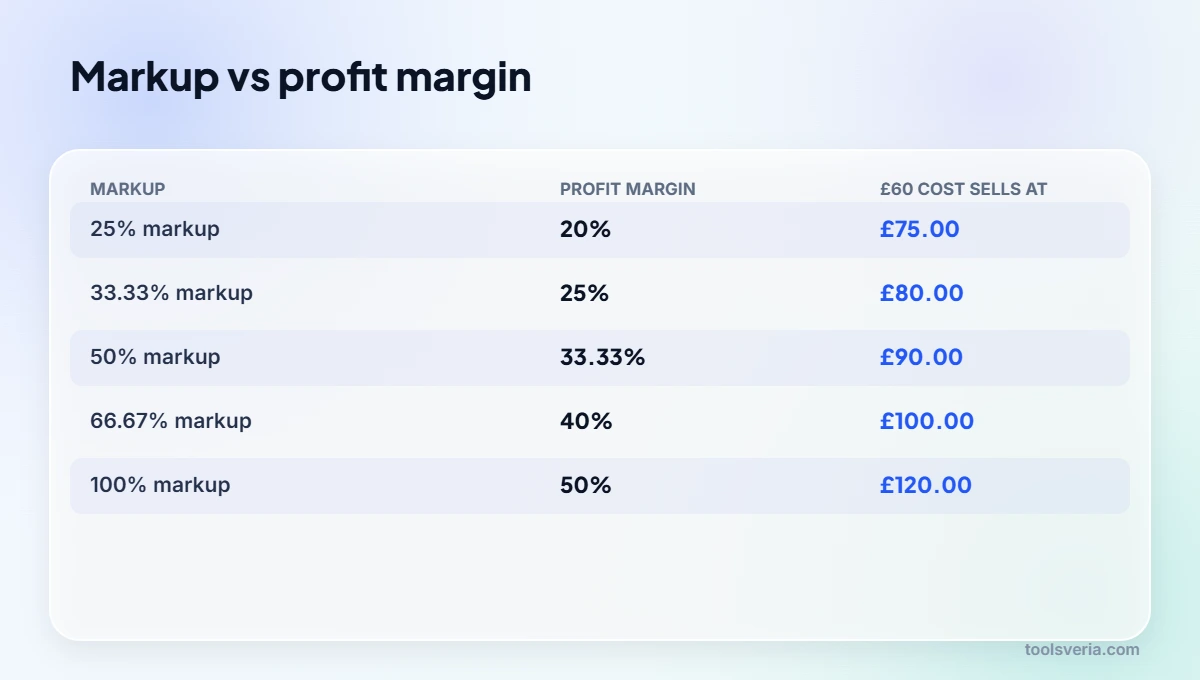
Applied to Hannah’s £60 table, the pairs she meets most often look like this:
| Markup | Profit margin | Cost £60 sells for |
|---|---|---|
| 20% | 16.67% | £72.00 |
| 25% | 20% | £75.00 |
| 33.33% | 25% | £80.00 |
| 50% | 33.33% | £90.00 |
| 66.67% | 40% | £100.00 |
| 100% | 50% | £120.00 |
Two things about profit margin vs markup are worth memorising from the bottom row. Charging twice what the table cost Hannah, a 100% markup, leaves her keeping exactly half of the sale. And margin can never touch 100% however steep the markup, because that would require the table to have cost nothing to make.
What Is the Most Common Pricing Mistake With Margin?
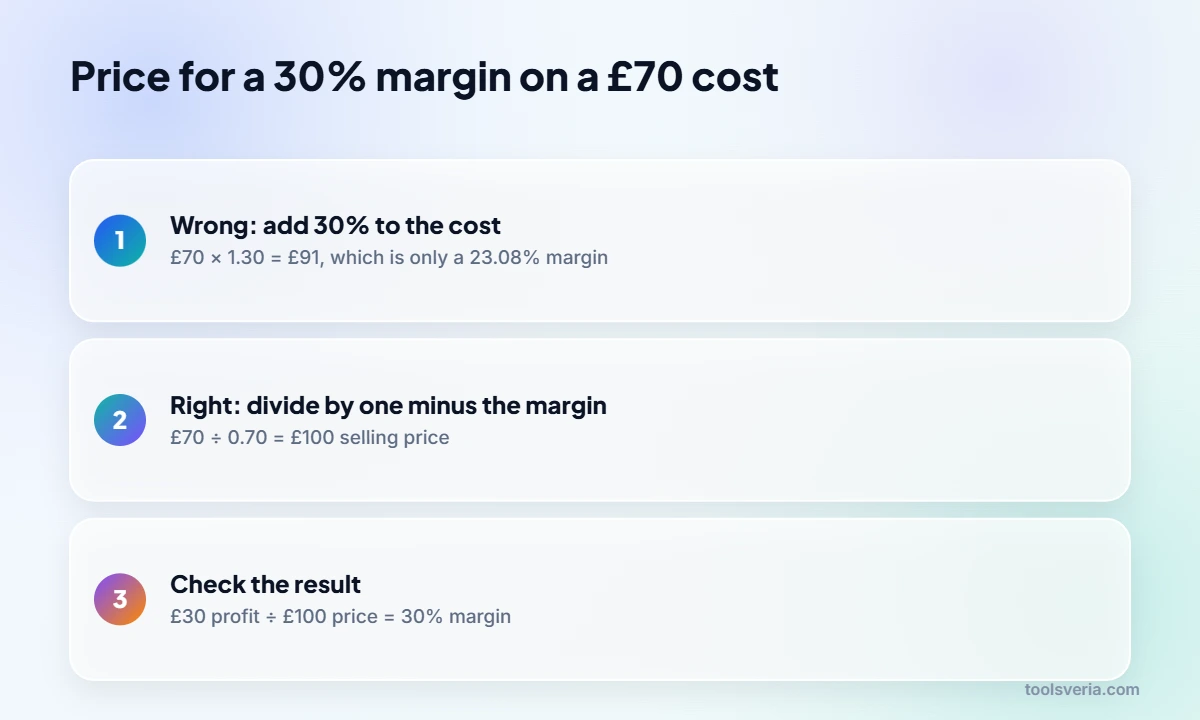
Adding 30% to a £70 cost gives £91, but the £21 profit is only 23.08% of £91, a long way short of a 30% margin. Last spring Hannah added a walnut stool costing £70 and wanted a 30% margin on it. Her first instinct was to add 30% to the cost: £70 plus £21 equals £91. Check it, though. Profit is £21, and £21 out of £91 is just 23.08%, a long way short of her target.
The fix is to divide rather than add: £70 ÷ (1 − 0.30) gives £70 ÷ 0.70, which is £100. At that price the profit is £30, and £30 really is 30% of £100. One stool shows a £9 gap. Sell a thousand over the year and £9,000 of profit has vanished without anyone noticing.
Prefer to start from the cost price? Type it with your chosen percentage into our markup calculator and it returns the selling price alongside the margin that price produces, so a mismatch shows up before the label is printed.
How Do Discounts Affect Profit Margin?
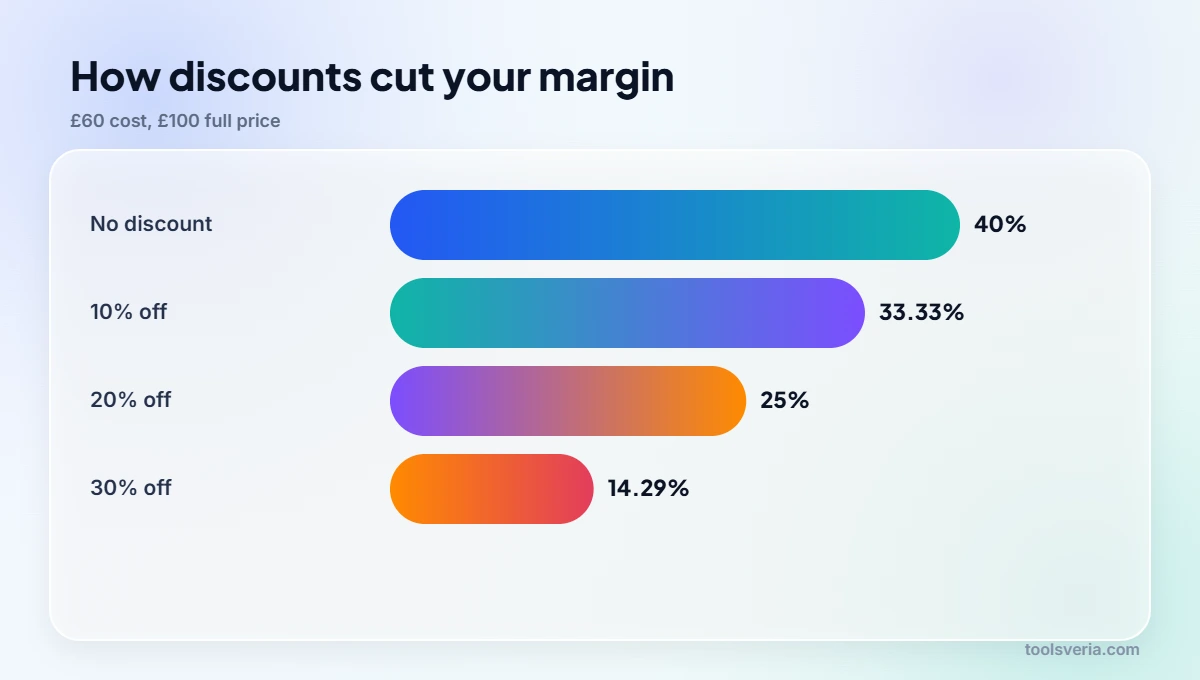
Price cuts come out of the selling price while the cost stays put, so a 20% off weekend on a £100 table drops the margin from 40% to 25%. Price cuts come out of the selling price while the cost stays put, so profit shrinks much faster than the sticker suggests. Say Hannah runs a 20% off weekend on the £100 oak table. Customers pay £80, she still spent £60, and her profit drops from £40 to £20. The margin slips from 40% to 25%.
Put plainly, a fifth off the price cut each table’s profit in half. Ten full price sales used to earn £400 of gross profit; at the sale price she needs twenty to match it. Before any promotion, test the scenario in the discount calculator and be honest about whether footfall will really double.
| Discount on £100 price | New price | Profit (cost £60) | New margin |
|---|---|---|---|
| None | £100 | £40 | 40% |
| 10% | £90 | £30 | 33.33% |
| 20% | £80 | £20 | 25% |
| 30% | £70 | £10 | 14.29% |
Should Profit Margin Be Worked Out Including VAT?
No, margin and markup should always be worked on the net figure, because the extra £20 on a £120 shelf price is collected for HMRC and passed on. Once Hannah registered for VAT, her table moved to a £120 shelf price. Only £100 of that is hers, since the extra £20 is collected for HMRC and passed on. Margin and markup should therefore always be worked on the net figure. To peel the tax off a gross price quickly, our reverse VAT calculator gives you the net amount in a single step.
Watch the rate as well, because some goods are charged at 5% or 0% rather than 20%. Check the current list on the GOV.UK VAT rates page before pricing anything unusual. Strip 20% from a £105 item and you would wrongly get £87.50; at the correct 5% rate the net price is £100, which changes the margin entirely.
Decide, too, what belongs in “cost”. For gross margin Hannah counts only what each table directly needs: materials and inbound delivery. Workshop rent, her apprentice’s wages, website fees and adverts are overheads that the gross profit then has to pay for. A business can show a comfortable 40% gross margin and still lose money if those overheads are bigger, so keep an eye on net profit too.
Key points
- Margin divides profit by price; markup divides it by cost.
- On one sale the margin is always lower, such as 40% against 66.67%.
- For a target margin, price = cost ÷ (1 − margin), never cost plus that percentage.
- A discount takes a bigger bite out of profit than out of price.
- Leave VAT out and work from net prices.
Frequently Asked Questions
My wholesaler suggests a 50% markup. Does that mean I keep half of each sale?
No. On a £60 cost, a 50% markup prices the item at £90, and you keep 33.33% of the sale. Keeping half requires a 100% markup, a £120 price.
My bank manager asked for my margin, but I price by markup. Which should I report?
Give the margin, since that is what lenders compare against turnover. A 66.67% markup converts to a 40% margin, so state that figure clearly.
An item costs me £70 and I want 30% of the price as profit. What should I charge?
Charge £100. Divide £70 by 0.70 rather than adding 30%, which would give £91 and only a 23.08% margin.
A friend claims a 150% margin on resold trainers. Is that possible?
Not as a margin, which tops out below 100%. They almost certainly mean markup: buying at £60 and selling at £150 is a 150% markup but a 60% margin.
Hannah now writes “margin” on every price sheet and runs each new product through both figures before it goes online. Pick one measure for your own business, say so on paper, and check every price against the other before it reaches a customer.