Fill in a genuine sale and print or save a tidy receipt for your customer.
Receipts must reflect real transactions that you made. Use this tool only for your own genuine sales. Nothing you type is saved or sent anywhere; it stays in this browser tab.
This online receipt generator lets sole traders, market stallholders and small business owners create a clean receipt for their own genuine sales, with line items, optional VAT and the payment method. Receipts also form part of the business records HMRC expects you to keep, so a consistent numbered format makes Self Assessment easier at the end of the year.
Quick answer: An online receipt generator works out each line as quantity × unit price, adds the lines together and adds VAT only if you charge it. A useful receipt shows your business name and address, a unique receipt number, the date, each item, the total paid and the payment method. Sole traders must keep records for at least 5 years.
In This Guide
What Is a Sales Receipt?
A sales receipt is a written record, given to a customer after they pay, that confirms what was bought, how much was paid, when and by what method. The total is worked out as quantity × unit price for each line, added together, plus VAT if you charge it.
A receipt is different from an invoice. An invoice asks for payment, while a receipt confirms payment has already been made. Many small traders who take cash or card at the point of sale only ever need receipts, and this generator produces them without any account, app or template download.
How to Use the Online Receipt Generator
Step 1: Add Your Business Details
Choose £, $ or €, then enter your trading name and address. Only add a VAT number if your business is actually VAT registered.

Step 2: Enter the Sale Details
Give each receipt a unique number in sequence, such as R-0042, and set the date of the sale. Add the customer's name if they want it, and pick card, cash, bank transfer or another method.

Step 3: List the Items and VAT
Add one line per product or service with quantity and unit price. Choose Add VAT if your prices are net, or Prices include VAT if they are gross, and the receipt splits out the VAT. The reverse VAT calculator shows the same split if you want to check a single figure.

Step 4: Preview and Print
The preview updates as you type. Press Print or save as PDF and choose "Save as PDF" in the print dialog to email the file, or print it on paper. Nothing is stored on our servers.

What Should a Receipt Include?
A useful receipt shows your business name and address, a unique receipt number, the date, each item with quantity and price, the total paid and the payment method. If you are VAT registered, add your VAT number, the VAT rate and the VAT amount.
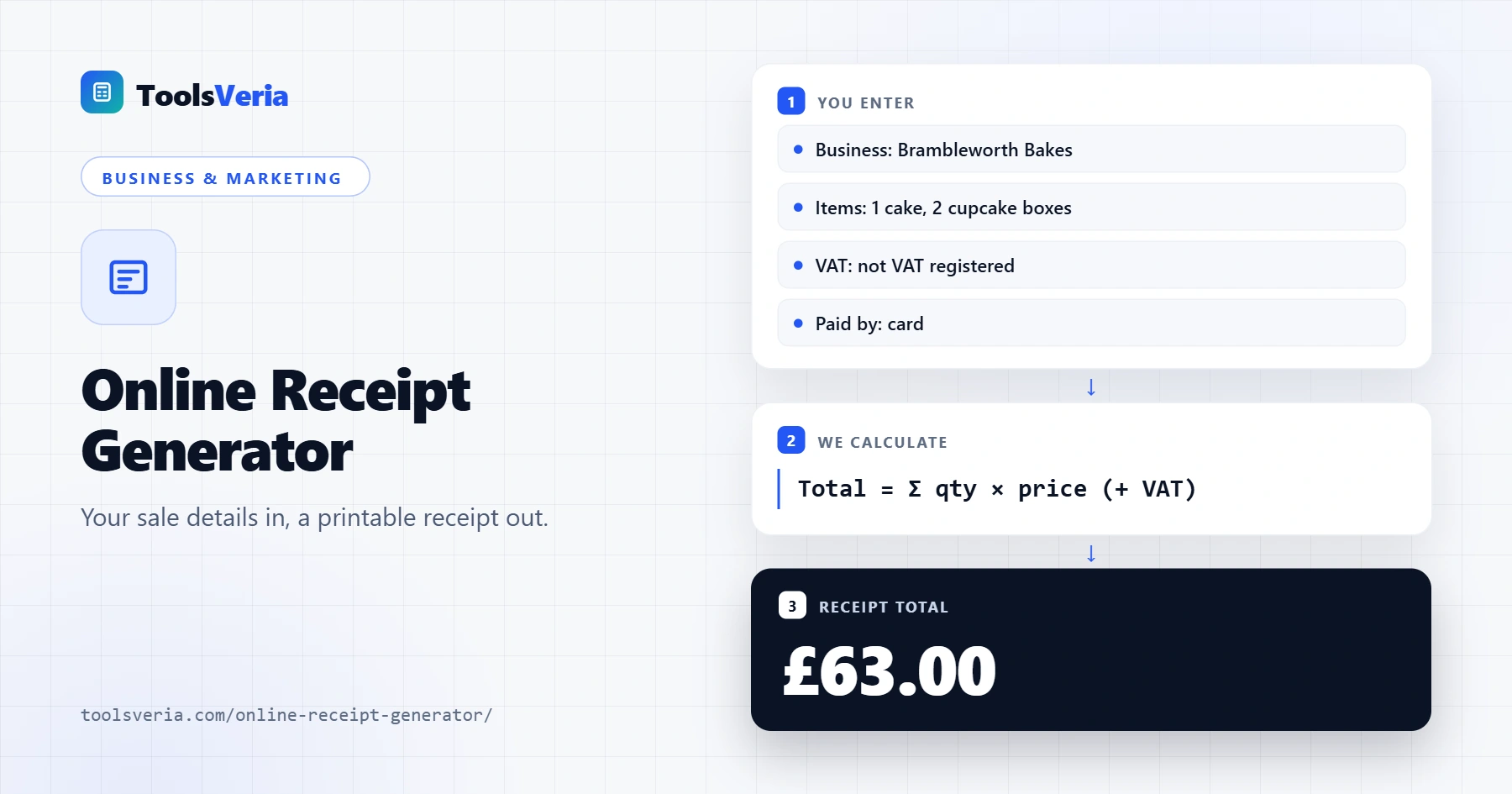
For example, Ellie runs Brambleworth Bakes, a home bakery below the VAT threshold. A customer pays £63.00 by card for one 8 inch celebration cake at £38.00 and two boxes of six cupcakes at £12.50 each, so Ellie issues receipt R-0042 with no VAT line.
She keeps a copy of every receipt in a dated folder, partly for her own bookkeeping and partly because GOV.UK says sole traders must keep records for at least 5 years after the 31 January submission deadline. Once a month she adds up the receipts and checks her profit margin on each product, so she can spot cakes that cost more to make than she thought.
- VAT registered sellers can issue a simplified VAT invoice for sales of £250 or less, as set out in HMRC's VAT Notice 700/21.
- Use one numbering sequence and never reuse a number.
- Only issue a receipt for money you have actually received. A receipt for a sale that did not happen is a false record.
Online Receipt Generator Terms You Should Know
These record keeping terms explain what belongs on a proper receipt, so the online receipt generator helps you document genuine sales accurately and keep tidy business records.
- Sales receipt
- A document handed to a customer after payment that proves a transaction took place, listing what was sold, the amount paid, the date and the payment method. It protects both buyer and seller if a dispute or return arises later.
- Invoice
- A request for payment sent before money changes hands, setting out what is owed and when it is due. Once the invoice is settled, a receipt or paid marking confirms the debt has been cleared.
- Simplified VAT invoice
- A shorter form of VAT invoice that registered businesses may issue for lower value retail sales, as set out by HMRC. It needs fewer details than a full invoice but must still show the supplier's VAT number and the rate charged.
- VAT registration number
- The unique identifier HMRC gives a business when it registers for VAT. It must appear on VAT invoices so that business customers can reclaim input tax, and it should never be shown by a business that is not registered.
- Sequential numbering
- Giving each receipt a unique number that follows on from the last, without gaps or reuse. It makes records easy to audit, helps spot missing documents and lets you find any sale quickly when a customer asks.
- Business records
- The documents a trader keeps to support figures on a tax return, including receipts, invoices, bank statements and expense evidence. HMRC can ask to see them, so they must be kept for the required period after the filing deadline.
</>Embed this calculator on your website
Add the free Online Receipt Generator to your own site or blog. Copy the code below and paste it into an HTML block. It resizes itself and works on phones.
How we checked this tool: the Tools Veria Editorial Team built this tool by hand, checked it against the official rules or published standards where they apply, and tested it against worked examples. Results are estimates for planning, not personal financial or tax advice. Read our editorial policy and disclaimer, or report an error.
Frequently Asked Questions
Is a receipt the same as an invoice?
No. An invoice is a request for payment sent before the customer pays, while a receipt confirms that payment has already been received. Many small shops and market traders only issue receipts because customers pay on the spot.
Do I need to show VAT on a receipt?
Only if you are VAT registered. In the UK, a VAT registered seller must show their VAT number, the VAT rate and the VAT amount, and can use a simplified VAT invoice for sales of £250 or less including VAT.
How long should I keep copies of my receipts?
UK sole traders must keep business records for at least 5 years after the 31 January Self Assessment deadline for that tax year. A receipt for a sale in the 2026/27 tax year should be kept until at least 31 January 2033.
Can I save the receipt as a PDF?
Yes. Press Print or save as PDF, then choose Save as PDF as the printer in your browser's print dialog. The file contains only the receipt, which you can email to your customer.
Is my data stored when I make a receipt?
No. Everything you type stays in your browser tab and is not saved or sent to any server. Closing or refreshing the page clears it, so print or save the receipt first.
Can I make a receipt for a sale that did not happen?
No. A receipt must reflect a real payment you received. Creating receipts for transactions that did not take place, or to claim expenses, is a false record and can be fraud.