Enter up to four products to see which one really costs least.
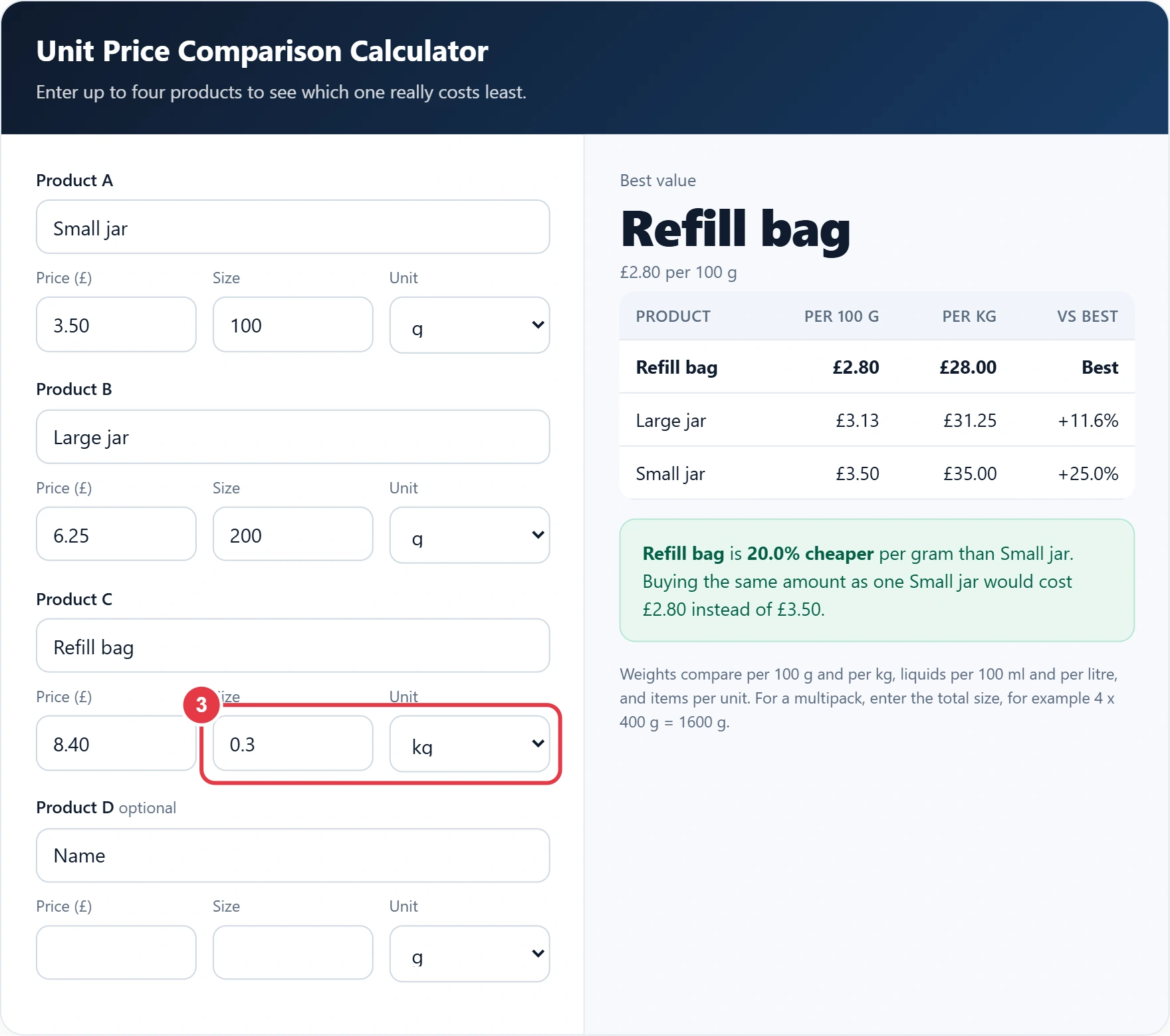
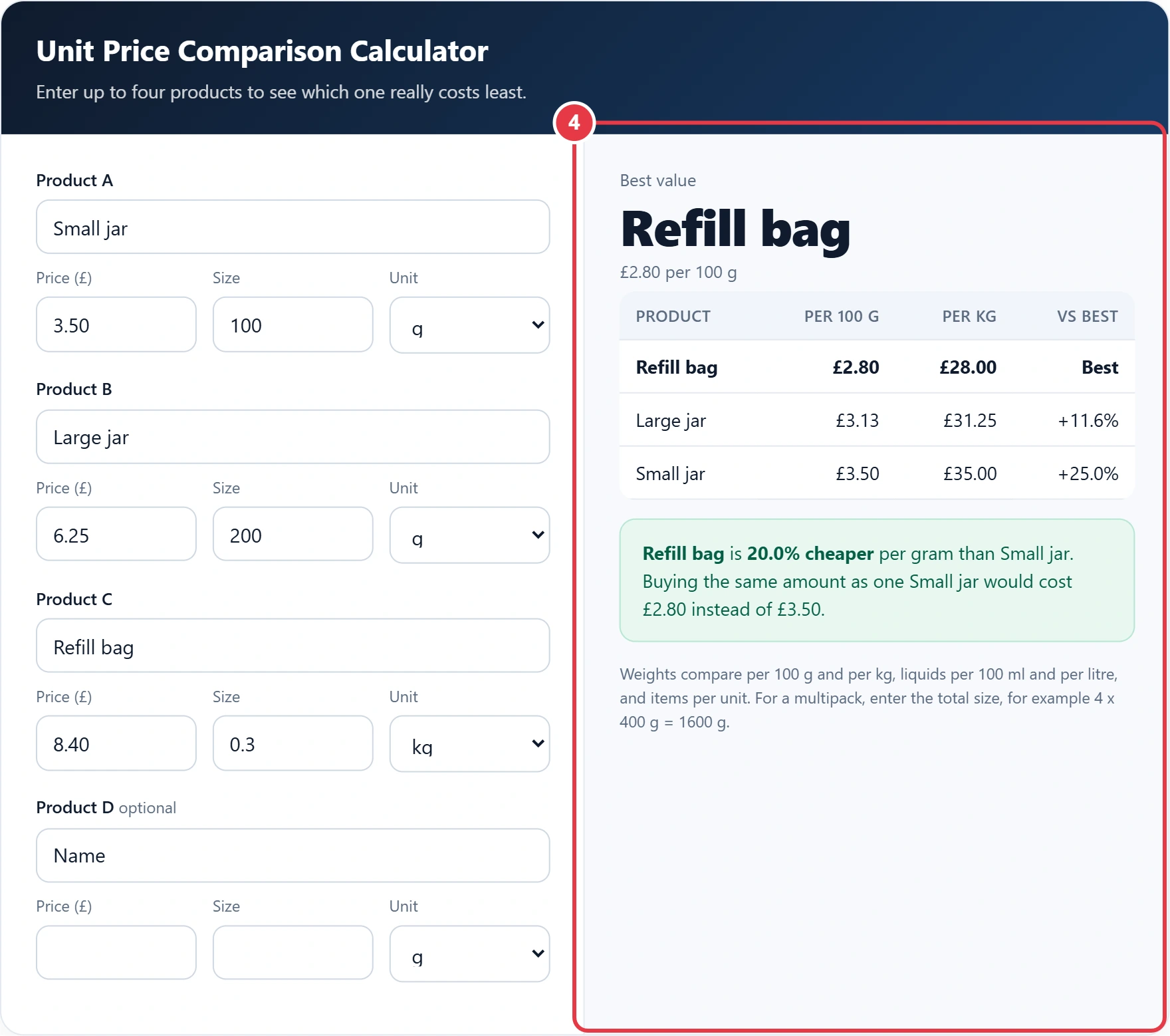
| Product | Per 100 g | Per kg | vs best |
|---|
Weights compare per 100 g and per kg, liquids per 100 ml and per litre, and items per unit. For a multipack, enter the total size, for example 4 x 400 g = 1600 g.
This unit price comparison calculator lets UK shoppers compare up to four products by price per 100 g, per litre or per item, so you can see in seconds which pack is the best value. Shelf labels are meant to show this already under the Price Marking Order guidance, but they mix units, and promotions and online listings often leave them out.
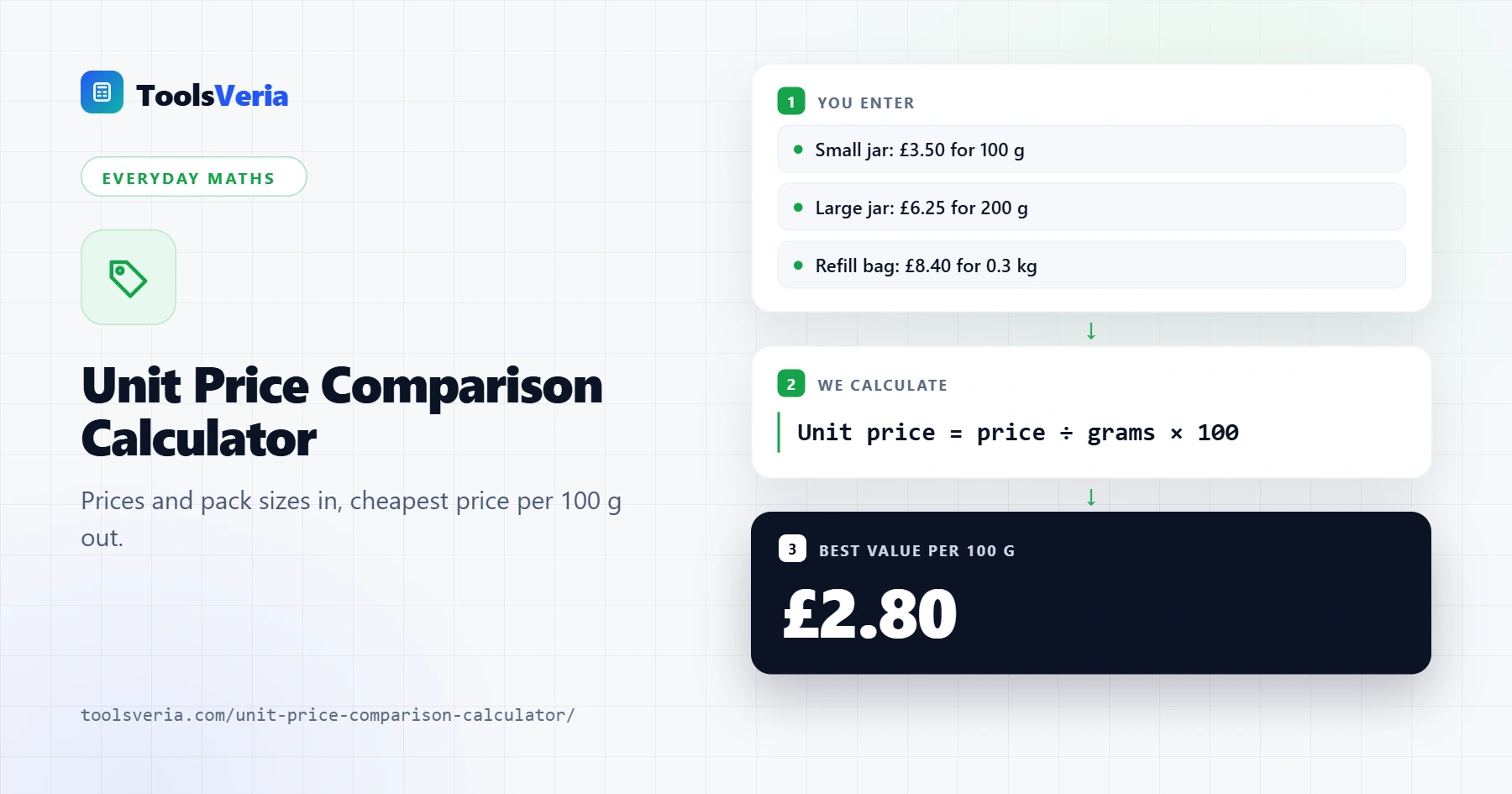
Quick answer: A unit price comparison calculator uses unit price = price ÷ size × base quantity. Divide the price by the weight in grams and multiply by 100, so a £3.50 100 g jar, a £6.25 200 g jar and an £8.40 300 g bag cost £3.50, £3.125 and £2.80 per 100 g.
In This Guide
What Is a Unit Price?
A unit price is the cost of a fixed quantity of a product, such as 100 g, one litre or one item, which lets you compare packs of different sizes fairly. The formula is unit price = price ÷ size × base quantity, after converting kilograms to grams and litres to millilitres.
Bigger is not always cheaper. Supermarkets often price a mid size pack or a multipack on promotion below the family size, and a "2 for £5" offer can beat a single large bottle. Working out the price per 100 g removes the guesswork.
How to Use the Unit Price Comparison Calculator
Step 1: Enter the First Product
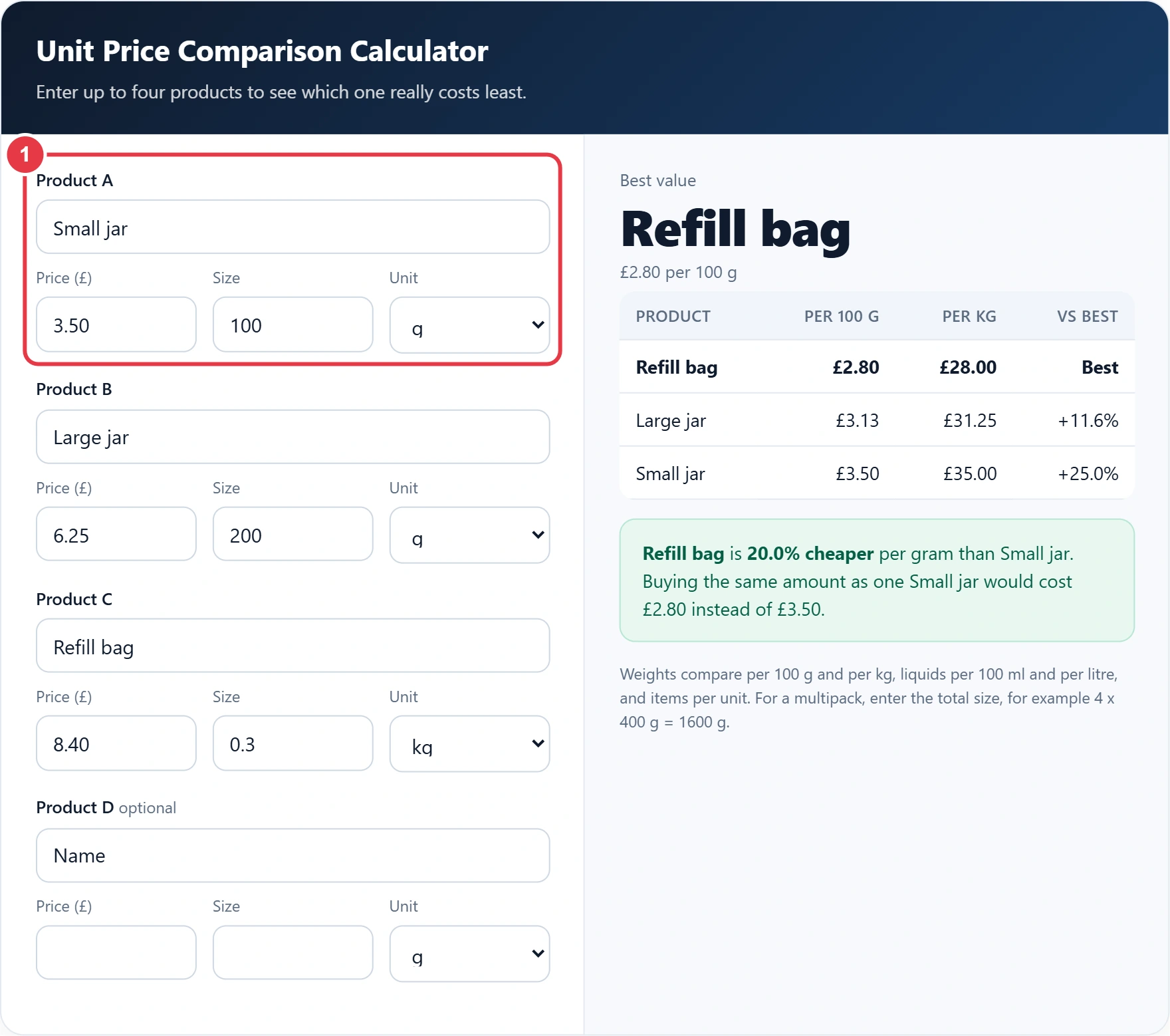
Give it a short name you will recognise, then type the shelf price in pounds and the pack size printed on the label.
Step 2: Add the Products You Are Comparing
Fill in up to three more products. If one is on offer, enter the offer price, and for a "2 for £5" deal enter £5 with double the size. The discount calculator is handy for working out a percentage off price before you type it in.
Step 3: Choose the Right Unit
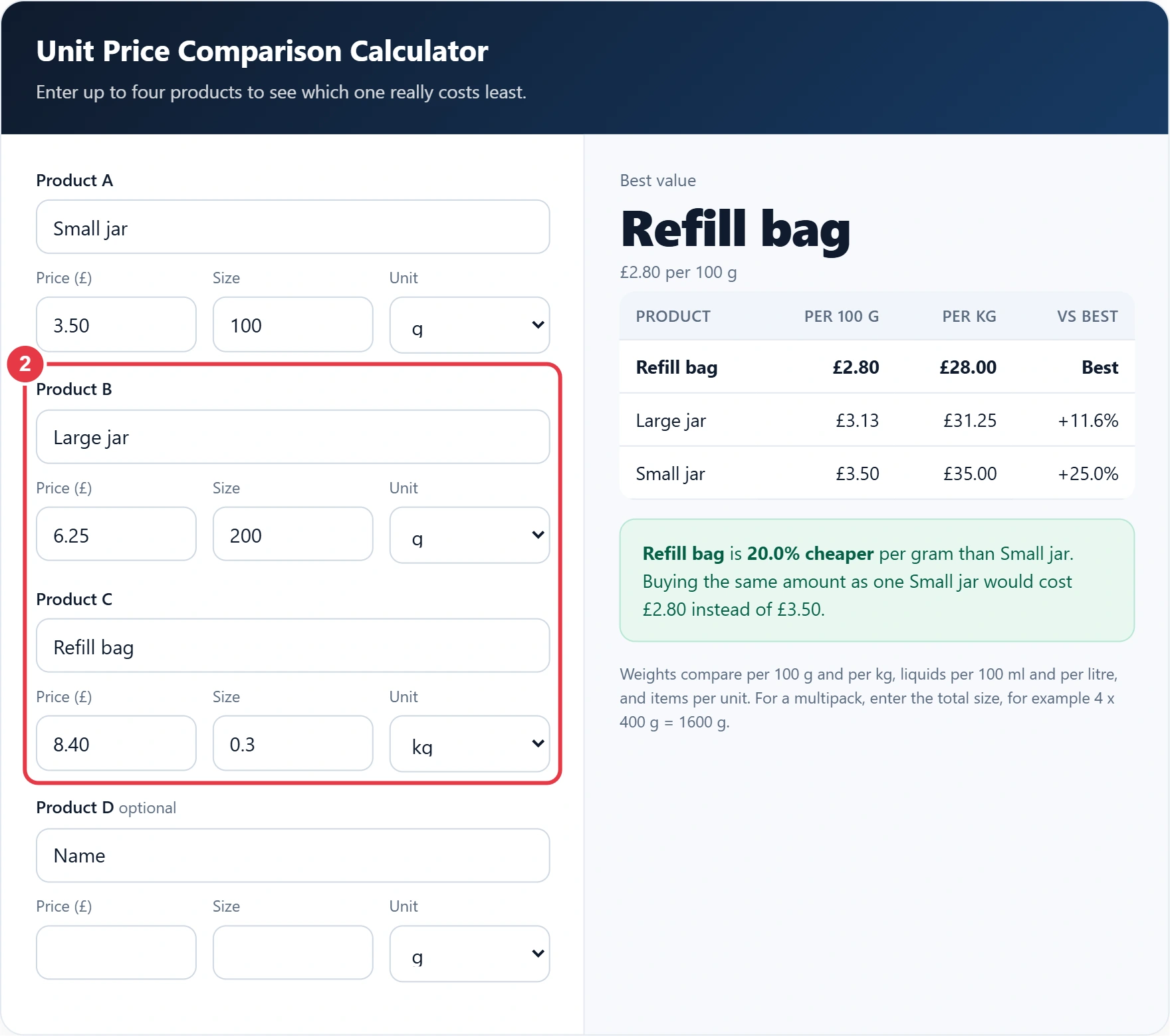
Pick g or kg for food sold by weight, ml or l for drinks and liquids, and units for items such as nappies, dishwasher tablets or eggs. Products in different kinds of unit are left out so you never compare grams with millilitres.
Step 4: Read the Best Value
The table ranks every product from cheapest to dearest per 100 g and per kg, with the gap to the best buy as a percentage. That figure works like the percentage difference calculator, so you can judge whether a well known brand is worth the extra.
How Do You Work Out the Price per 100g?
Divide the price by the weight in grams, then multiply by 100. Hannah is choosing instant coffee: a 100 g jar costs £3.50, a 200 g jar costs £6.25 and a 300 g refill bag costs £8.40. That gives £3.50, £3.125 and £2.80 per 100 g, so the refill bag is 20% cheaper per gram than the small jar.
| Product | Price and size | Unit price |
|---|---|---|
| Small coffee jar | £3.50 for 100 g | £3.50 per 100 g |
| Large coffee jar | £6.25 for 200 g | £3.13 per 100 g |
| Coffee refill bag | £8.40 for 0.3 kg | £2.80 per 100 g |
| Orange juice | £1.95 for 1.5 l | £1.30 per litre |
| Dishwasher tablets | £6.00 for 40 | £0.15 per tablet |
Shelf labels sometimes show one pack per 100 g and another per kg, a problem flagged in the Which? research on unit pricing, so recalculating on one basis is the quickest way to catch a false bargain.
Comparing Prices for Best Value: Worked Examples
A fair comparison of cost means converting every pack to the same unit before you look at the price. The unit price comparison calculator does that for up to 4 products, and the examples below show the arithmetic it uses.
| Pack | Price | Price per 100 g |
|---|---|---|
| 500 g bag | £2.40 | 48p |
| 1.2 kg bag | £5.40 | 45p |
| 3 × 400 g for £5 | £5.00 | 41.7p |
Tiered Pricing and Bulk Discounts
Tiered pricing charges a lower rate once you buy past a set quantity, for example 50p each for the first 100 labels and 40p each after that. To compare it with a flat price, work out the total for the quantity you actually need and divide by that quantity: 150 labels cost £50 plus £20, or £70, which is 46.7p each.
Price Measurements That Trip People Up
Shelf labels mix units, so one product may show a price per kg and its neighbour a price per 100 g, and drinks may show per litre or per 100 ml. Multiply a price per 100 g by 10 to get the price per kg. For conversions between grams, ounces and pounds, the unit converters cover every common kitchen measurement.
Key Unit Price Comparison Calculator Terms
These definitions explain the pricing ideas behind the unit price comparison calculator, helping you compare packs, multipacks and offers on a fair basis.
- Unit price
- The cost of a standard quantity of a product, such as 100 g, a litre or one item. Expressing every pack on the same basis removes the effect of different sizes, so the cheapest option is clear.
- Base quantity
- The fixed amount a unit price is expressed against, chosen to suit the product. Food sold by weight is usually compared per 100 g or per kg, drinks per 100 ml or per litre, and countable goods per item.
- Price Marking Order
- The UK legislation that requires most retailers to display the selling price and, for many goods sold by quantity, the unit price. It aims to let shoppers compare products, although labels may still use different units.
- Multipack
- Several identical items sold together for one price, such as four tins. To compare it fairly, the total size is the single item size multiplied by the number of items in the pack.
- Multi-buy offer
- A promotion that lowers the price when you buy more than one, such as two items for a set price. Entering the offer price against the combined size shows whether the deal truly beats a larger single pack.
</>Embed this calculator on your website
Add the free Unit Price Comparison Calculator to your own site or blog. Copy the code below and paste it into an HTML block. It resizes itself and works on phones.
How we checked this tool: the Tools Veria Editorial Team built this tool by hand, checked it against the official rules or published standards where they apply, and tested it against worked examples. Results are estimates for planning, not personal financial or tax advice. Read our editorial policy and disclaimer, or report an error.
Frequently Asked Questions
How do I compare prices of different pack sizes?
Convert each price to the same base, such as price per 100 g or per litre, by dividing the price by the size. A £6.25 jar of 200 g works out at £3.13 per 100 g, which you can compare with any other size.
Is the bigger pack always cheaper per 100 g?
No. Promotions often make a smaller pack or multipack cheaper per 100 g than the largest size. Always compare unit prices, because a 200 g jar on offer can beat a 400 g jar at full price.
How do I work out price per litre?
Divide the price by the volume in litres. A 1.5 litre bottle at £1.95 costs £1.30 per litre, and a 500 ml bottle at £0.85 costs £1.70 per litre, so the bigger bottle is cheaper.
Can I compare grams with millilitres?
Not directly, because a gram measures weight and a millilitre measures volume. The calculator only compares products in the same kind of unit and leaves out any product that does not match.
How should I enter a multipack?
Enter the total size of the multipack. Four 400 g tins for £2.40 is 1600 g at £2.40, which is £0.15 per 100 g, so you can compare it fairly with a single tin.
How do I compare a 2 for £5 offer?
Enter £5 as the price and the combined size of both items. Two 500 ml bottles for £5 is 1 litre for £5, which is £5.00 per litre, ready to compare against a single larger bottle.