This break even calculator shows how many units or how much in sales you need before your business starts making a profit.
| If price changes | Price | Break even |
|---|
Assumes a constant price and variable cost per unit, fixed costs that do not change within the period and a single product or an average sales mix. Use prices without VAT or sales tax. Nothing is sent anywhere.
This break even calculator shows small business owners, start ups, freelancers and students how many units or how much in sales they need before costs are covered, in pounds, dollars or euros. It works from your fixed costs, selling price and variable cost per unit, then adds the sales needed for a profit target, your margin of safety, a chart and a price sensitivity table.
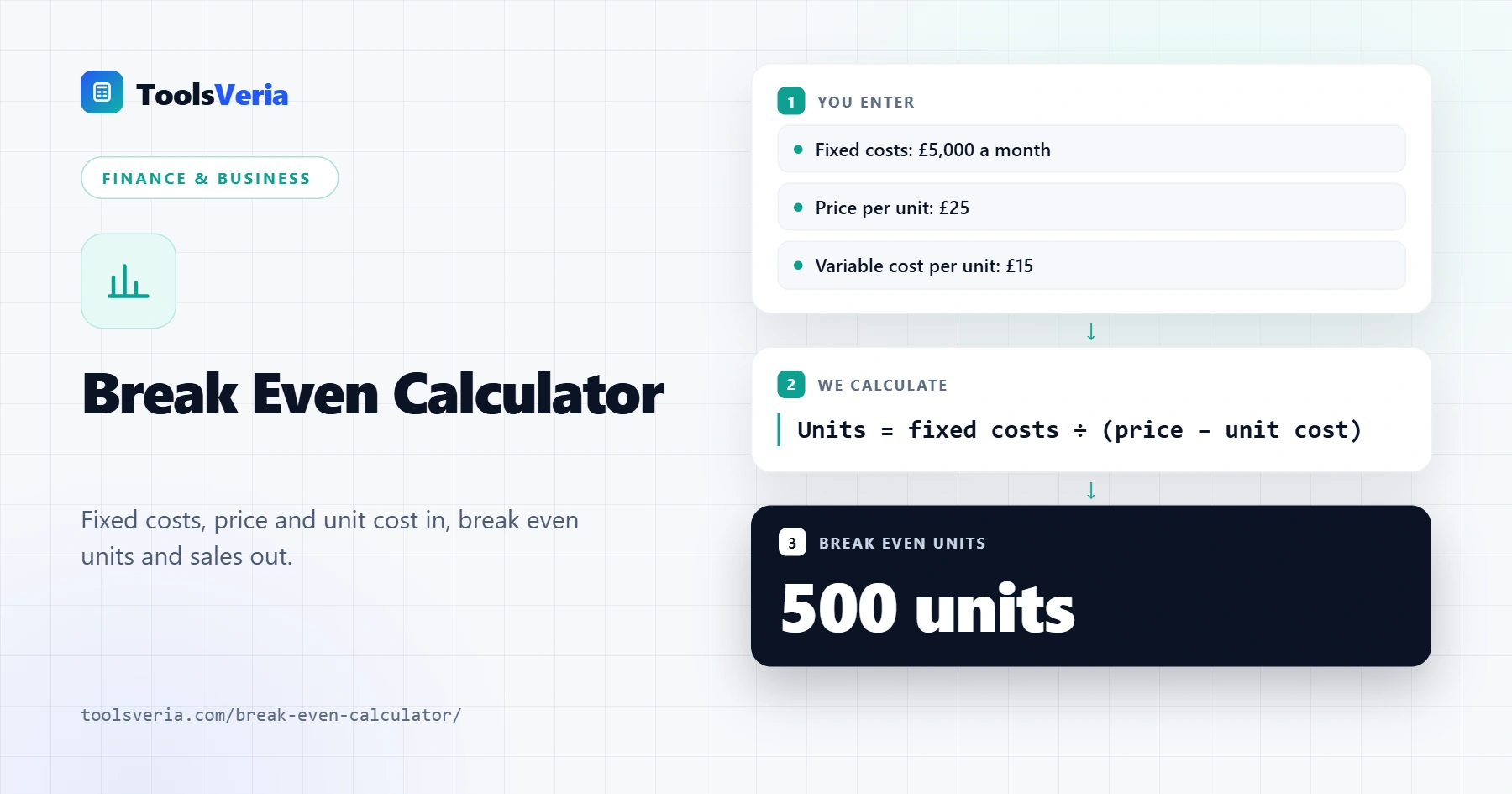
Quick answer: Break even units = fixed costs ÷ (selling price minus variable cost per unit). With £5,000 of monthly fixed costs, a £25 price and a £15 unit cost, each sale contributes £10, so this break even calculator shows you need 500 units, or £12,500 of sales, a month before you make any profit.
In This Guide
What Is a Break Even Calculator?
A break even calculator is a planning tool that finds the sales level at which total revenue exactly equals total costs, so profit is zero. Below that point every period makes a loss; above it, each extra sale adds its contribution straight to profit.
The key figure is the contribution margin: selling price minus variable cost per unit. Fixed costs ÷ contribution margin gives break even units, and break even units × price gives break even revenue. For businesses that do not sell units, fixed costs ÷ gross margin percentage gives the break even sales value directly.
How to Use the Break Even Calculator
Step 1: Choose a Method and Currency
Use units, price and unit cost if you sell products. Choose sales and gross margin if you run a service, a shop with many lines or an agency, where an average margin is easier to know than a cost per unit.

Step 2: Enter Your Fixed Costs
Add up costs that stay the same whatever you sell in the period: rent, salaries, insurance, loan repayments, software and accountancy fees. Use a month or a year, but keep every figure in the same period.

Step 3: Enter Price, Unit Cost and Targets
Enter the price you receive per unit, excluding VAT or sales tax, and the variable cost of each unit: materials, packaging, delivery, card fees and sales commission. Add a target profit and your expected sales if you want them tested.

Step 4: Read the Break Even Point
The break even calculator shows break even units and sales, the contribution per unit, the units needed for your profit target and your margin of safety. The chart marks where revenue crosses total costs, and the table shows how a 5% or 10% price change moves the result.

How Do You Calculate the Break Even Point?
In a break even analysis, you find the break even point by dividing fixed costs by the contribution each sale makes. Units needed for a target profit follow the same logic: (fixed costs + target profit) ÷ contribution per unit. Always round units up, because you cannot sell part of a product.
Worked example: Maya makes candles. Her fixed costs are £1,800 a month for her unit, insurance and website. Each candle sells for £24 and costs £9 in wax, jars, packaging and card fees, so each contributes £15. Her break even point is £1,800 ÷ £15 = 120 candles, or £2,880 of sales. To earn £1,200 profit she needs (£1,800 + £1,200) ÷ £15 = 200 candles.
If Maya expects to sell 250 candles, her margin of safety is (250 minus 120) ÷ 250 = 52%, so sales could fall by about half before she makes a loss. A profit margin calculator then shows what percentage of each sale she keeps once all costs are paid.
How Does Price Change Your Break Even Point?
Price changes your break even point sharply, because a price rise goes straight into contribution. The table uses £5,000 of fixed costs to compare scenarios a break even point calculator would test.
| Price | Variable cost | Contribution | Contribution ratio | Break even units | Break even sales |
|---|---|---|---|---|---|
| £20 | £15 | £5 | 25% | 1,000 | £20,000 |
| £22.50 | £15 | £7.50 | 33.3% | 667 | £15,000 |
| £25 | £15 | £10 | 40% | 500 | £12,500 |
| £25 | £12 | £13 | 52% | 385 | £9,615 |
| £30 | £15 | £15 | 50% | 334 | £10,000 |
A 10% price cut from £25 to £22.50 raises the units needed by a third, from 500 to 667. Before discounting, check how a price change affects your margin with the markup calculator, and test whether buyers would accept a higher price instead.
What Are the Limits of Break Even Analysis?
Break even analysis assumes a constant price, a constant cost per unit and fixed costs that do not move, which is rarely true at every sales level. Bulk discounts, overtime, a new hire or a second unit all change the lines on the chart.
It also ignores timing: you can be above break even on paper and still run short of cash if customers pay late. Use the result of any break even point calculator as a planning target alongside a cash flow forecast. The GOV.UK business plan templates include a cash flow forecast you can pair with these figures before you approach a lender. Figures on this page were checked October 2026.
Key Break Even Terms Explained
These terms explain the costs and margins the break even calculator uses, so you can check the units and sales figures it gives.
- Fixed costs
- Fixed costs stay the same within a period whatever you sell, such as rent, salaries, insurance and software. In Maya's candle business they are £1,800 a month, the amount her sales must cover before any profit.
- Variable cost
- A variable cost rises with each unit sold, such as materials, packaging, delivery and card fees. Each of Maya's candles has a variable cost of £9, which the calculator subtracts from her £24 price.
- Contribution margin
- Contribution margin is selling price minus variable cost per unit, the amount each sale adds towards fixed costs and then profit. A £25 price and a £15 unit cost give a £10 contribution and a 40% ratio.
- Break even point
- The break even point is the sales level where revenue equals total costs and profit is zero. With £5,000 of fixed costs and a £10 contribution, it is 500 units or £12,500 of sales.
- Margin of safety
- Margin of safety is the share of expected sales you could lose before reaching break even. Maya expects 250 candles against a break even point of 120, which gives a margin of safety of 52%.
</>Embed this calculator on your website
Add the free Break Even Calculator to your own site or blog. Copy the code below and paste it into an HTML block. It resizes itself and works on phones.
How we checked this tool: the Tools Veria Editorial Team built this tool by hand, checked it against the official rules or published standards where they apply, and tested it against worked examples. Results are estimates for planning, not personal financial or tax advice. Read our editorial policy and disclaimer, or report an error.
Frequently Asked Questions
What is the break even formula?
Break even units equal fixed costs divided by contribution per unit, which is selling price minus variable cost per unit. For £5,000 fixed costs, a £25 price and £15 unit cost, that is £5,000 ÷ £10 = 500 units.
What is the difference between fixed and variable costs?
Fixed costs, such as rent, salaries and insurance, stay the same whatever you sell in a period. Variable costs, such as materials, packaging and card fees, rise with every unit you sell.
How do I calculate break even in sales value?
Divide fixed costs by the contribution margin ratio, which is contribution per unit divided by price. With £5,000 of fixed costs and a 40% ratio, break even sales are £5,000 ÷ 0.40 = £12,500.
What is margin of safety?
Margin of safety is how far sales can fall before you reach break even, shown as a percentage of expected sales. Expecting 700 units with a 500 unit break even point gives a margin of safety of 28.6%.
Should I include VAT in the selling price?
No. Use prices excluding VAT or sales tax, because that tax is collected for the government and does not help cover your costs. In the UK, a £30 price including 20% VAT is £25 to the business.
Can service businesses use a break even calculator?
Yes. Choose the sales and gross margin method, enter your fixed costs and the share of each sale left after direct costs. A consultancy with £8,000 fixed costs and a 60% margin breaks even at £13,333 of sales.