
Grace has washed her own tunic and trousers after every shift as a healthcare assistant at a Leicester nursing home since 2021, and nobody has ever mentioned that HMRC gives tax back for it. The uniform tax rebate is that refund: a fixed yearly amount, set by job, that reduces the pay you are taxed on to cover cleaning, repairing and replacing a uniform, protective clothing or small tools.
Sums are usually modest each year, yet they stack up across the five tax years you can claim, and the process takes minutes on GOV.UK. Grace and three other workers are followed below so you can see what your own job is worth.
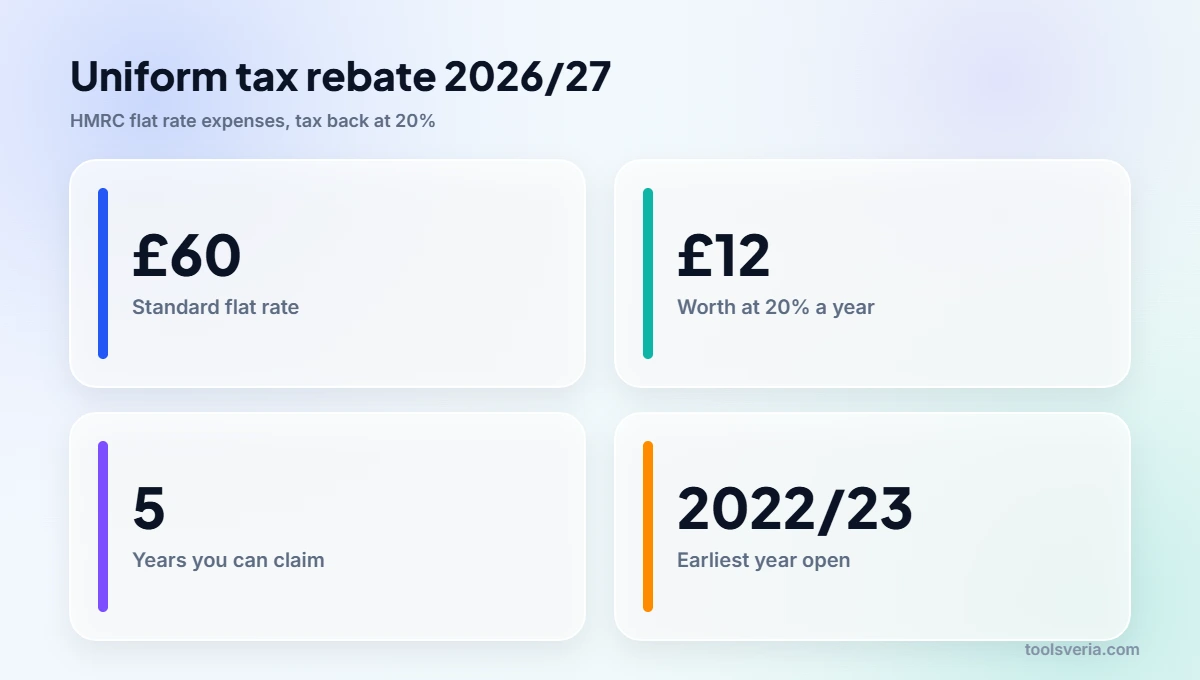
Quick answer: For 2026/27, HMRC’s flat rate for uniforms is £60 a year unless your job has a higher agreed amount, such as £125 for nurses and care workers or £140 for police officers. You get tax relief at your own rate, so £60 is worth £12 at 20%, and you can claim back to 2022/23.
In This Guide
Who can claim a uniform tax rebate?
You can claim a uniform tax rebate if you are an employee who must wear a uniform or specialist clothing for work, you pay to clean, repair or replace it yourself, your employer does not repay those costs in full, and you paid Income Tax in the year you are claiming for.
A uniform means something that marks you out as doing that job. A polo shirt with the supermarket’s logo counts, as do scrubs, a police tunic or a chef’s whites. Plain black trousers do not, even if the dress code demands them, because you could wear them anywhere. The GOV.UK rules on uniforms, work clothing and tools also exclude the cost of buying the clothing in the first place and any protective equipment your employer should supply free.
Two groups miss out. If your employer launders your uniform for free, you cannot claim for cleaning it. If your income sat below the £12,570 Personal Allowance in a year, you paid no tax that year and the relief has nothing to reduce. Self-employed workers use business expense rules instead, which is a separate route.
How much is the uniform tax rebate for my job?
The uniform tax rebate is your job’s flat rate amount multiplied by your tax rate, so most workers get between £12 and £56 a year, and anyone whose job is not on HMRC’s list uses the standard £60, which is worth £12 a year to a basic rate taxpayer.
Each agreed amount, set out job by job and industry by industry, is published in the HMRC list of industries and jobs on GOV.UK, which runs from agriculture to wood and furniture. The amounts below cover some of the most common claims, with the yearly value at the two main rates and the total for a full five year claim at 20%.
| Job | Flat rate a year | Tax back a year at 20% | Tax back a year at 40% | 5 years at 20% |
|---|---|---|---|---|
| Any job not on the list | £60 | £12.00 | £24.00 | £60.00 |
| Uniformed fire fighters and prison officers | £80 | £16.00 | £32.00 | £80.00 |
| Nurses, healthcare assistants, care workers | £125 | £25.00 | £50.00 | £125.00 |
| Police officers up to chief inspector | £140 | £28.00 | £56.00 | £140.00 |
| Joiners and carpenters | £140 | £28.00 | £56.00 | £140.00 |
| Ambulance staff on active service | £185 | £37.00 | £74.00 | £185.00 |
| Airline cabin crew | £720 | £144.00 | £288.00 | £720.00 |
| Airline pilots and flight deck crew | £1,022 | £204.40 | £408.80 | £1,022.00 |
One page that ranks for this search quotes a £90 minimum, which is wrong: £60 is the floor. Scottish taxpayers receive relief at their own Scottish rate on the top slice of income, so the figure differs slightly from the table, and the finder lets you pick that rate.

How is the rebate worked out? Four examples
The rebate is worked out in three steps: take the flat rate for your job, subtract anything your employer pays towards the same costs, then multiply what is left by the rate of tax you pay on the top slice of your income.
Grace, healthcare assistant, basic rate
Grace’s employer insists on black shoes and black tights in one style, so she can add £12 for shoes and £6 for tights to the £125 health and care rate. Her total of £143 at 20% gives £28.60 a year, and five years from 2022/23 to 2026/27 come to £143.
Kieran, garage mechanic with a laundry allowance
Kieran’s rate as a motor mechanic in a garage repair shop is £120, but his employer pays him £50 a year towards overalls. Only £70 is left to claim, which saves him £14 a year at 20%. If the garage covered the full £120, he would have nothing to claim at all.
Owen, pilot paying 40%
Owen flies for a regional airline and pays higher rate tax. His £1,022 allowance is worth £408.80 a year, or £2,044 across five years, which makes him one of the few workers for whom the rebate is a serious sum.
Sasha, supermarket assistant on low hours
Sasha works 14 hours a week and earned under £12,570 in 2023/24, so she paid no tax that year and cannot get relief for it. Her hours rose in 2024/25, so that year and the two after it each give her £12, which is £36 in total. Working out which tax year each payslip falls in is easier with the UK tax week calculator, since every tax year runs from 6 April to 5 April.

How far back can you claim a uniform tax rebate?
You can claim a uniform tax rebate for the current tax year and the four tax years before it, so in 2026/27 the earliest year you can still claim is 2022/23, which ends on 5 April 2023.
Each April, the oldest year drops off. Grace has worn her uniform since 2021, yet 2021/22 is already out of reach. If she waits until after 5 April 2027, 2022/23 goes too and her five year total shrinks by £28.60. Claiming now locks in every year still open.
How do you get the money back?
You get the money back by claiming directly through HMRC, either online on GOV.UK, by post on form P87, or on the employment pages of your Self Assessment return if you already file one, and no receipts are needed for a flat rate claim.
For the current year, HMRC usually raises your tax code so a little less tax comes off each payslip. Grace’s £143 lifts her allowance from £12,570 to £12,713, so her code moves from 1257L to 1271L, and the tax code calculator shows how that changes her monthly pay. Earlier years usually arrive as a refund. If you also use your own car for work, business miles are a separate claim that the mileage allowance calculator values at 55p a mile for the first 10,000 miles.
Refund companies will make the same claim for you but keep a share of the money. Claiming yourself costs nothing, and the whole refund reaches your account. Checking your take home pay afterwards in the UK salary calculator confirms the code change has gone through.
Key points
- The standard uniform flat rate is £60 a year, worth £12 at 20% and £24 at 40%.
- Many jobs have higher agreed amounts, such as £125 for nurses and care workers and £1,022 for pilots.
- In 2026/27 you can claim for every year back to 2022/23, five tax years in total.
- Anything your employer pays towards the same costs is deducted before relief is given.
- You need to have paid tax in a year to get relief for that year, and no receipts are needed for a flat rate claim.
Uniform Tax Rebate Terms Explained
These terms explain who qualifies for a uniform tax rebate, how the yearly value is worked out and why some workers receive nothing back.
- Qualifying uniform
- Clothing that identifies the wearer as doing a particular job, such as branded workwear, scrubs or a police tunic. Ordinary items that could be worn anywhere, even when required by a dress code, fall outside the definition.
- Personal Allowance
- The amount of income a person can receive each tax year before any Income Tax is due, set at £12,570. Someone earning below it pays no tax, so a uniform deduction has no tax to reduce and produces no rebate.
- Basic rate taxpayer
- A person whose highest slice of income is taxed at the 20% basic rate. For them, every pound of flat rate expense saves 20 pence, so the standard £60 amount produces £12 of tax back a year.
- Tax code adjustment
- The way HMRC usually gives ongoing relief for the current year, by raising the employee’s tax code so that more pay is tax free. Relief for earlier years is normally paid as a refund rather than through the code.
- Personal protective equipment
- Safety items such as gloves, hard hats or high visibility clothing that protect a worker from hazards. Employers must generally provide it free of charge, so its cost cannot form part of a uniform claim.
- Business expense rules
- The separate framework self-employed people use to deduct allowable costs from their trading profits. Because it works through Self Assessment, the employee flat rate scheme does not apply to them.
Frequently Asked Questions
I have worn a supermarket uniform since 2019. How much can I get?
You can claim the £60 standard amount for each year from 2022/23 to 2026/27, provided you paid tax in each one. At 20% that is £12 a year, so £60 in total, and the years before 2022/23 can no longer be claimed.
My hospital washes our scrubs on site. Can I still claim?
Not for cleaning, because GOV.UK rules out laundering costs when your employer provides free laundry. If you still pay for shoes or tights your employer requires in a set style, speak to HMRC about those items rather than claiming the full £125.
Do I have to send receipts with my claim?
No receipts are needed when you claim the flat rate for your job, such as £60 or £125. You only send evidence if you claim the actual amount you spent instead, which is worth doing only when your real costs are well above the flat rate.
Will I get cash or a change to my tax code?
Usually both. HMRC adjusts your tax code for the current year, so a £125 allowance raises a 1257L code to 1269L, and it repays the earlier years you claim for, typically as a refund to your bank account.
Grace will collect £143 for five years of washing her own tunic, Kieran £14 a year and Owen over £2,000. Search your own job in the finder, claim on GOV.UK and keep the whole amount. Figures checked October 2026 against HMRC’s flat rate list on GOV.UK.