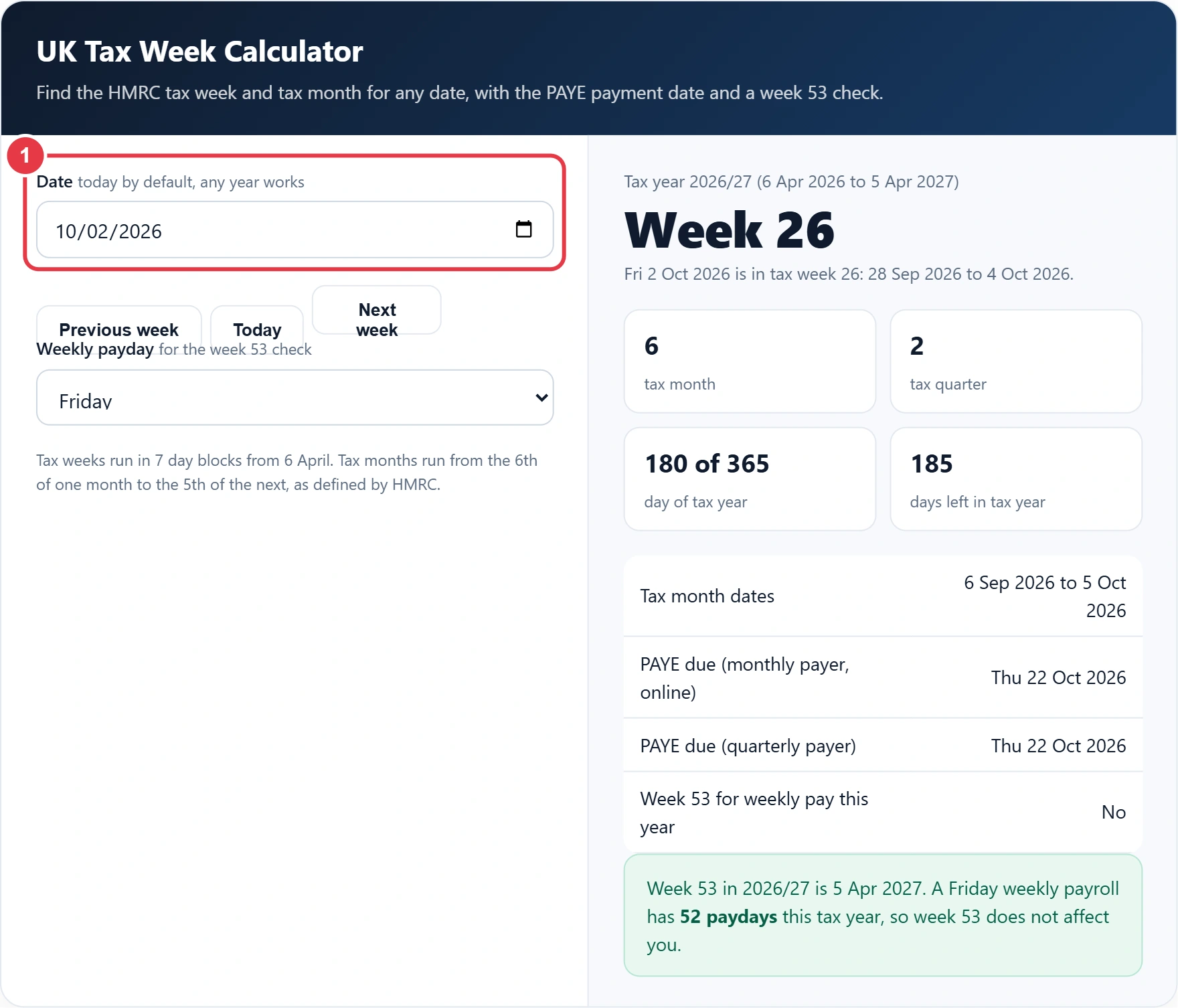
Find the HMRC tax week and tax month for any date, with the PAYE payment date and a week 53 check.
Tax weeks run in 7 day blocks from 6 April. Tax months run from the 6th of one month to the 5th of the next, as defined by HMRC.
| Tax month dates | |
| PAYE due (monthly payer, online) | |
| PAYE due (quarterly payer) | |
| Week 53 for weekly pay this year |
This UK tax week calculator gives payroll staff, employers and employees the HMRC tax week, tax month and quarter for any date in the 2026/27 tax year or any other year, along with the PAYE payment date for that period. It also checks whether your weekly payday creates a week 53 this year, which is the question that catches most small payrolls out in March.
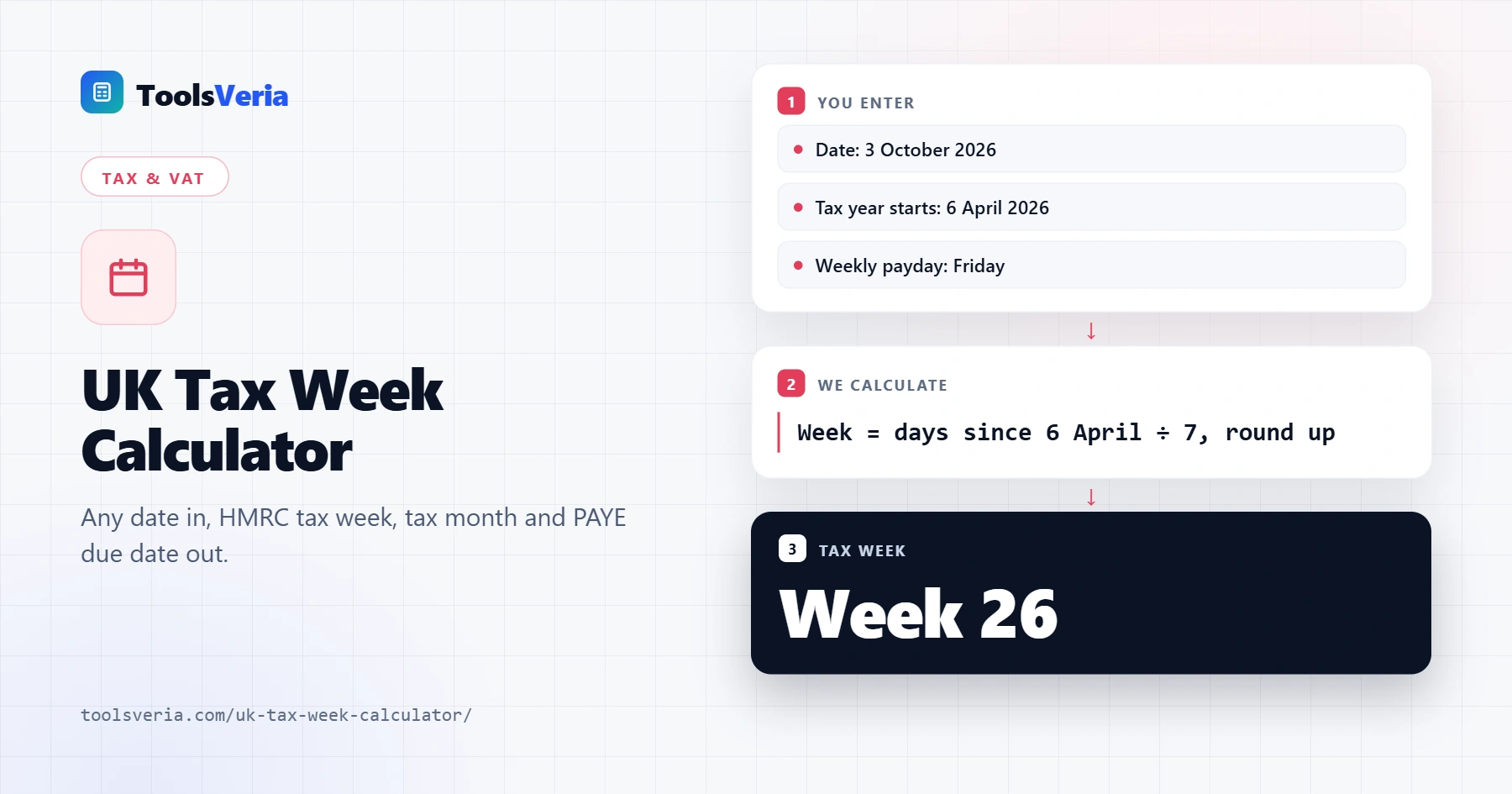
Quick answer: the UK tax year starts on 6 April, so tax week 1 is 6 to 12 April and each week is a 7 day block after that. Tax month 1 is 6 April to 5 May. On 3 October 2026 it is tax week 26 and tax month 6. The UK tax week calculator works out any date.
In This Guide
What Is a UK Tax Week Calculator?
A UK tax week calculator is a tool that converts a calendar date into the week and month numbers HMRC uses for PAYE. The formula in plain words: count the days from 6 April up to your date, divide by 7 and round up to get the tax week; for the tax month, count how many 6ths of the month have passed since 6 April.
Every Full Payment Submission your payroll software sends carries a tax week or month number, and the official definitions are short: the HMRC National Insurance manual on GOV.UK defines tax weeks as successive 7 day periods beginning with 6 April, and tax months as running from the 6th of one month to the 5th of the next. Getting the number right keeps cumulative tax codes accurate.
How to Use the UK Tax Week Calculator
Step 1: Pick the Date
The date starts as today. Change it to a payday, a start date or a leaving date. PAYE follows the date the employee is paid, not the period the work covers, so enter the payday if you are running payroll.
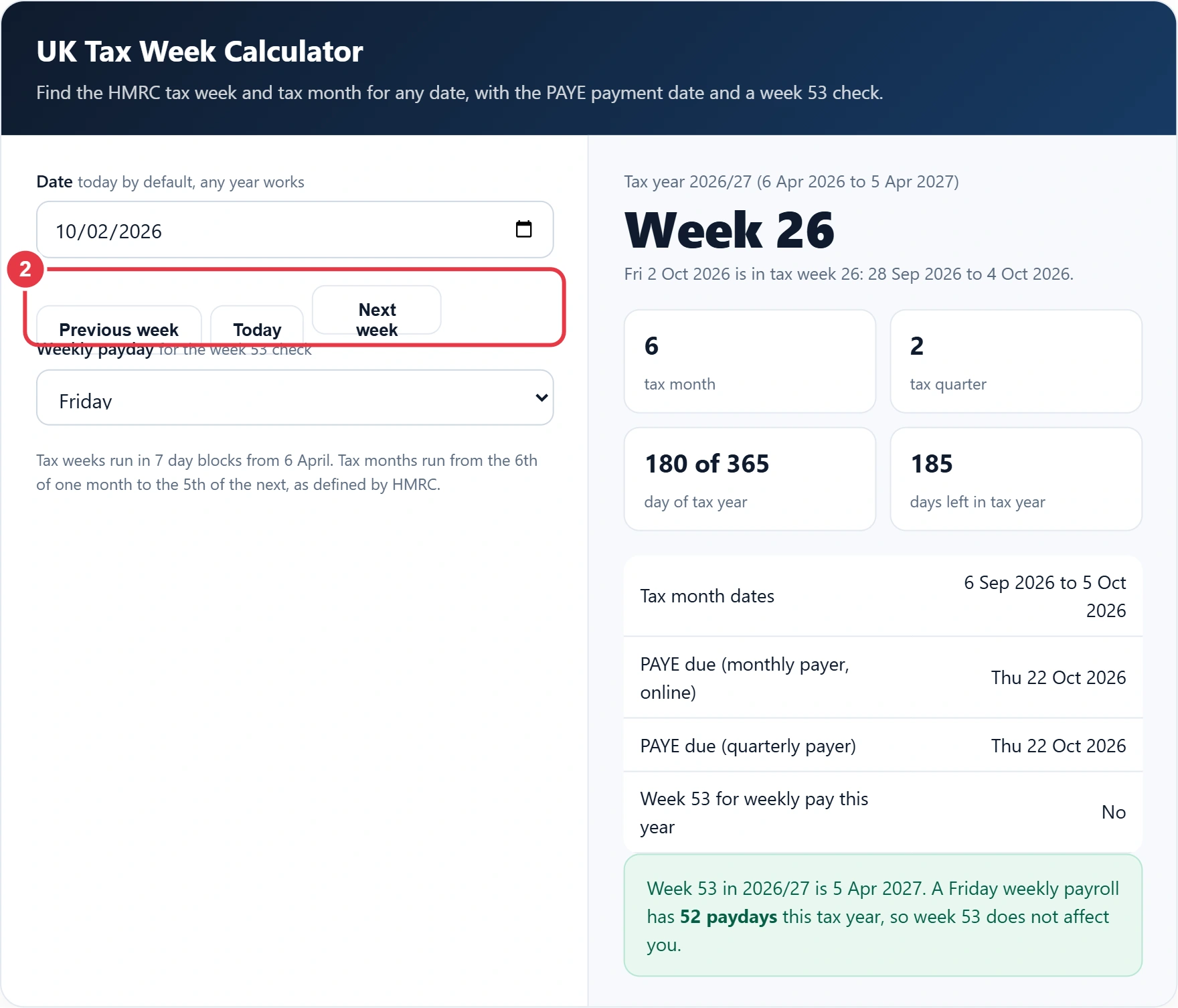
Step 2: Move a Week at a Time
Use Previous week and Next week to step through a run of weekly paydays, or Today to jump back. This is handy when you are checking a backlog of timesheets or planning holiday cover across several pay periods.
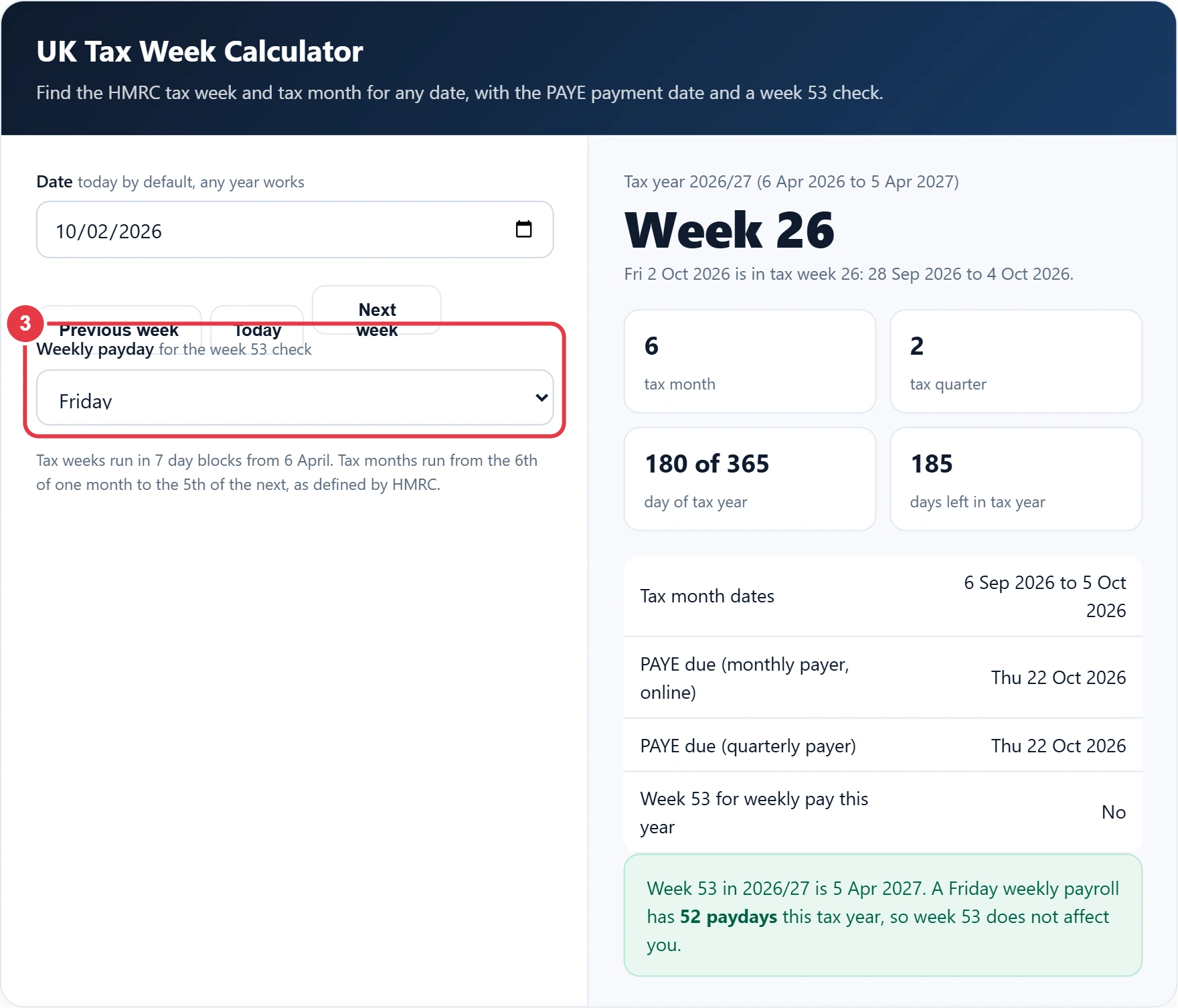
Step 3: Choose Your Weekly Payday
Pick the day of the week your weekly paid staff receive their wages. The UK tax week calculator compares it with the odd days left at the end of the tax year to tell you whether you will have a week 53 payday.
Step 4: Read the Results
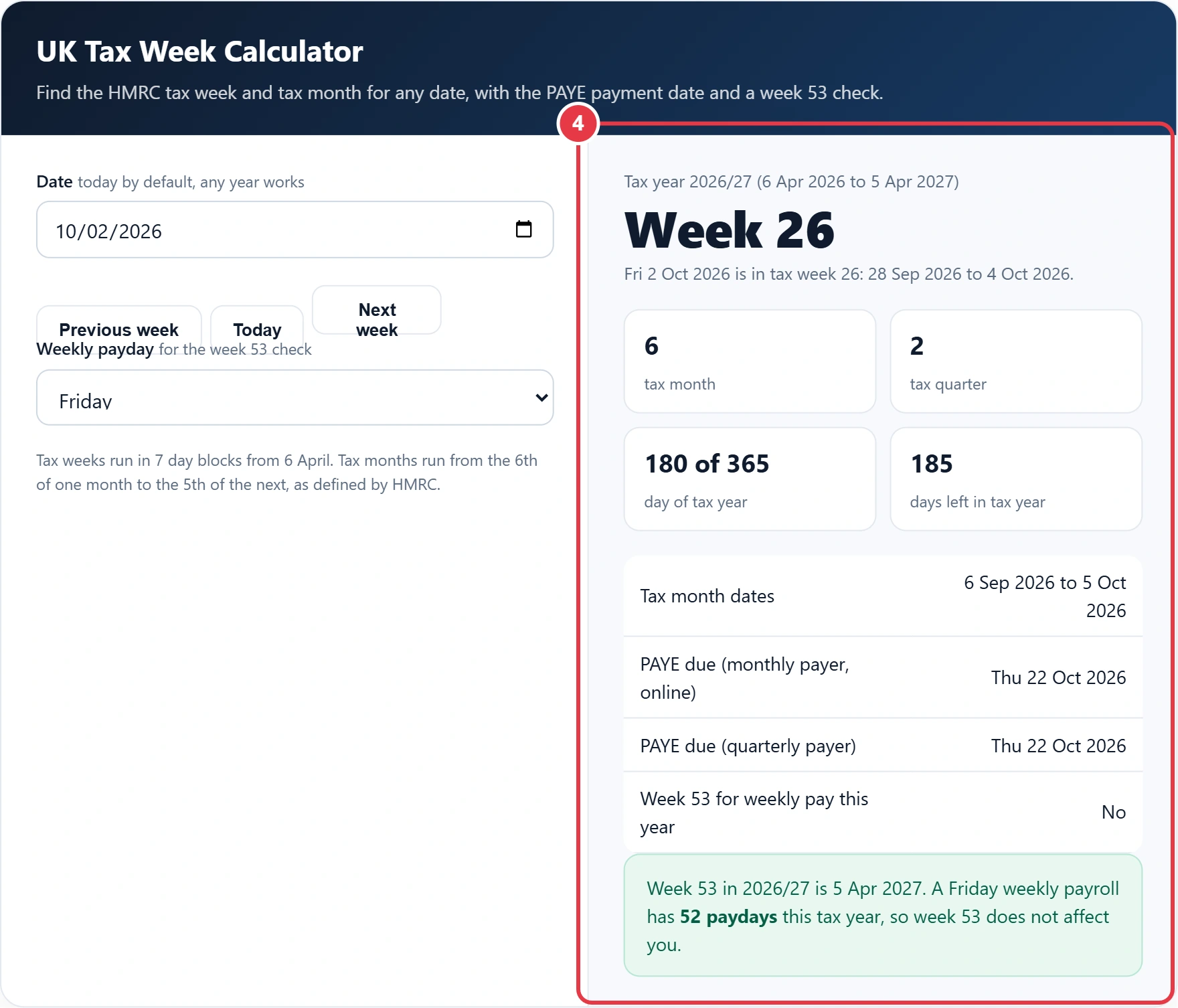
You see the tax week with its start and end dates, the tax month and quarter, the day of the tax year and how many days are left. The table gives the tax month dates and the PAYE payment deadlines, with a flag when a deadline falls on a weekend.
What Tax Week Is It?
To find what tax week it is, count the days since the last 6 April, divide by 7 and round up. Worked example: Gemma runs payroll for a café in Bristol and pays staff on Friday 2 October 2026. That is day 180 of the 2026/27 tax year; 180 divided by 7 is 25.7, which rounds up to tax week 26 (28 September to 4 October 2026). The same date falls in tax month 6 (6 September to 5 October), so a monthly paid manager paid that day is in month 6 too.
When Is PAYE Due for Each Tax Month?
PAYE is due by the 22nd of the next tax month if you pay electronically, or the 19th if you post a cheque, according to the GOV.UK guide to paying employers' PAYE, which also sets 22 July as the date for the first quarter if you pay quarterly. This table covers 2026/27.
| Tax month | Dates | Tax weeks (mostly) | PAYE due online |
|---|---|---|---|
| 1 | 6 Apr to 5 May 2026 | 1 to 5 | Fri 22 May 2026 |
| 2 | 6 May to 5 Jun 2026 | 5 to 9 | Mon 22 Jun 2026 |
| 3 | 6 Jun to 5 Jul 2026 | 9 to 13 | Wed 22 Jul 2026 |
| 4 | 6 Jul to 5 Aug 2026 | 14 to 18 | Sat 22 Aug 2026 |
| 5 | 6 Aug to 5 Sep 2026 | 18 to 22 | Tue 22 Sep 2026 |
| 6 | 6 Sep to 5 Oct 2026 | 22 to 27 | Thu 22 Oct 2026 |
| 7 | 6 Oct to 5 Nov 2026 | 27 to 31 | Sun 22 Nov 2026 |
| 8 | 6 Nov to 5 Dec 2026 | 31 to 35 | Tue 22 Dec 2026 |
| 9 | 6 Dec 2026 to 5 Jan 2027 | 35 to 40 | Fri 22 Jan 2027 |
| 10 | 6 Jan to 5 Feb 2027 | 40 to 44 | Mon 22 Feb 2027 |
| 11 | 6 Feb to 5 Mar 2027 | 44 to 48 | Mon 22 Mar 2027 |
| 12 | 6 Mar to 5 Apr 2027 | 48 to 53 | Thu 22 Apr 2027 |
Two deadlines in 2026/27 fall at a weekend (22 August and 22 November), so allow for bank processing times and pay before the weekend. Quarterly payers pay by 22 July, 22 October, 22 January and 22 April, one quarter at a time.
What Is Tax Week 53?
Tax week 53 is the one or two odd days left after 52 full tax weeks: 5 April in a normal year, or 4 and 5 April when the tax year contains 29 February. In 2026/27 week 53 is Monday 5 April 2027, so only employers with a Monday weekly payday get a 53rd payday. In 2027/28 it covers Tuesday 4 and Wednesday 5 April 2028. HMRC's employer guidance says fortnightly payrolls with 27 paydays use week 54 and four weekly payrolls with 14 paydays use week 56.
HMRC's guidance says that for employees on a week 1 or month 1 code the extra payday is simply another week 1 payment, while cumulative codes use a special calculation based on the week 1 tax tables, which payroll software applies for you. If you also need to count paid days for the period, the working days calculator handles bank holidays, and the holiday pay calculator helps when a week 53 payday includes leave. Figures checked October 2026.
</>Embed this calculator on your website
Add the free UK Tax Week Calculator to your own site or blog. Copy the code below and paste it into an HTML block. It resizes itself and works on phones.
How we checked this tool: the Tools Veria Editorial Team built this tool by hand, checked it against the official rules or published standards where they apply, and tested it against worked examples. Results are estimates for planning, not personal financial or tax advice. Read our editorial policy and disclaimer, or report an error.
Frequently Asked Questions
When does the UK tax year start and end?
The UK tax year starts on 6 April and ends on 5 April the following year. The 2026/27 tax year runs from Monday 6 April 2026 to Monday 5 April 2027, and the 2027/28 tax year starts on Tuesday 6 April 2027.
What tax week is the first week of April?
Dates from 1 to 5 April belong to the end of the previous tax year: tax week 52 or week 53. Tax week 1 of the new year always starts on 6 April and ends on 12 April, whatever day of the week that is.
How do I work out the tax month from a date?
Tax month 1 runs from 6 April to 5 May, month 2 from 6 May to 5 June, and so on. If the day of the month is 6 or later, count months from April; if it is 1 to 5, use the previous tax month.
Is there a week 53 in 2026/27?
Yes, tax week 53 in 2026/27 is Monday 5 April 2027. Only employers who pay weekly on a Monday have a 53rd weekly payday that year. Fortnightly and four weekly payrolls can also have an extra payday, reported as week 54 or 56.
What date is PAYE due for tax month 6?
Tax month 6 runs from 6 September to 5 October 2026, so PAYE for that month is due by Thursday 22 October 2026 if you pay electronically, or must reach HMRC by Monday 19 October 2026 if you pay by cheque through the post.
Is the tax week based on the pay date or the work date?
PAYE uses the date the employee is paid, not the dates the work was done. Work done in tax week 25 but paid on 2 October 2026 is reported in tax week 26 and tax month 6.