CO2 malus plus weight malus for a car first registered in France, new or imported used, on the 2026 rules.
| Step | Amount |
|---|
Estimate based on the service-public.fr grids checked October 2026. Excludes the regional horsepower tax and fixed fees on the carte grise, and any large family or disability relief. Check with the official ANTS simulator before you buy.
This France malus calculator is for anyone buying a car to register in France in 2026, whether new from a French dealer or used and imported from the UK or another country. It adds the CO2 malus and the weight malus, applies the age discount for imports and the combined cap, and uses the grids for the WLTP test cycle published by service-public.fr, the French government's official information site. Figures checked October 2026.
Quick answer: In 2026 the French CO2 malus starts at €50 for 108 g/km and reaches €80,000 above 191 g/km, and the weight malus adds €10 to €30 for every kilo from 1,500 kg. Imports use the grid of their first registration year, minus an age discount. This France malus calculator shows a 2023 car at 150 g/km pays €1,007.68.

In This Guide
What Is the French Malus?
The French malus is a one off registration tax on passenger cars with high CO2 emissions or a heavy kerb weight, paid when the car is first registered in France. It has two parts: the malus CO2 (taxe sur les émissions de CO2), set by a gram by gram grid, and the malus masse (taxe sur la masse en ordre de marche), charged per kilo above a threshold. Both are added to the cost of the carte grise, so you pay them once and never again, even when the car is later sold within France.
In plain words: malus due = (CO2 malus + weight malus, capped at the maximum CO2 malus for that grid) × (1 minus the age discount). For a new car the age discount is zero. The weight malus is marginal, like a tax band: on the 2026 grid a 1,950 kg car pays €10 on 200 kg, €15 on 100 kg, €20 on 100 kg and €25 on 51 kg, which is €6,775, exactly the example service-public.fr gives.
How Much Is the Malus on an Imported Used Car?
An imported used car pays the malus from the grid in force in the year it was first registered abroad, reduced by an age discount of 3% after one month up to 100% after 15 years. Take James, who is moving from Kent to the Dordogne and wants to bring his petrol SUV, first registered in the UK on 1 March 2023, rated at 150 g/km WLTP and weighing 1,700 kg.
On the 2023 grid, 150 g/km costs €1,504, and the 2023 weight malus only starts at 1,800 kg, so it adds nothing. Registering it on 2 November 2026 makes the car 44 months old, which carries a 33% discount. James pays €1,504 × 67% = €1,007.68. The same car bought new in France in 2026 would pay €4,279 plus €2,015 of weight malus, or €6,294.
How to Use the France Malus Calculator
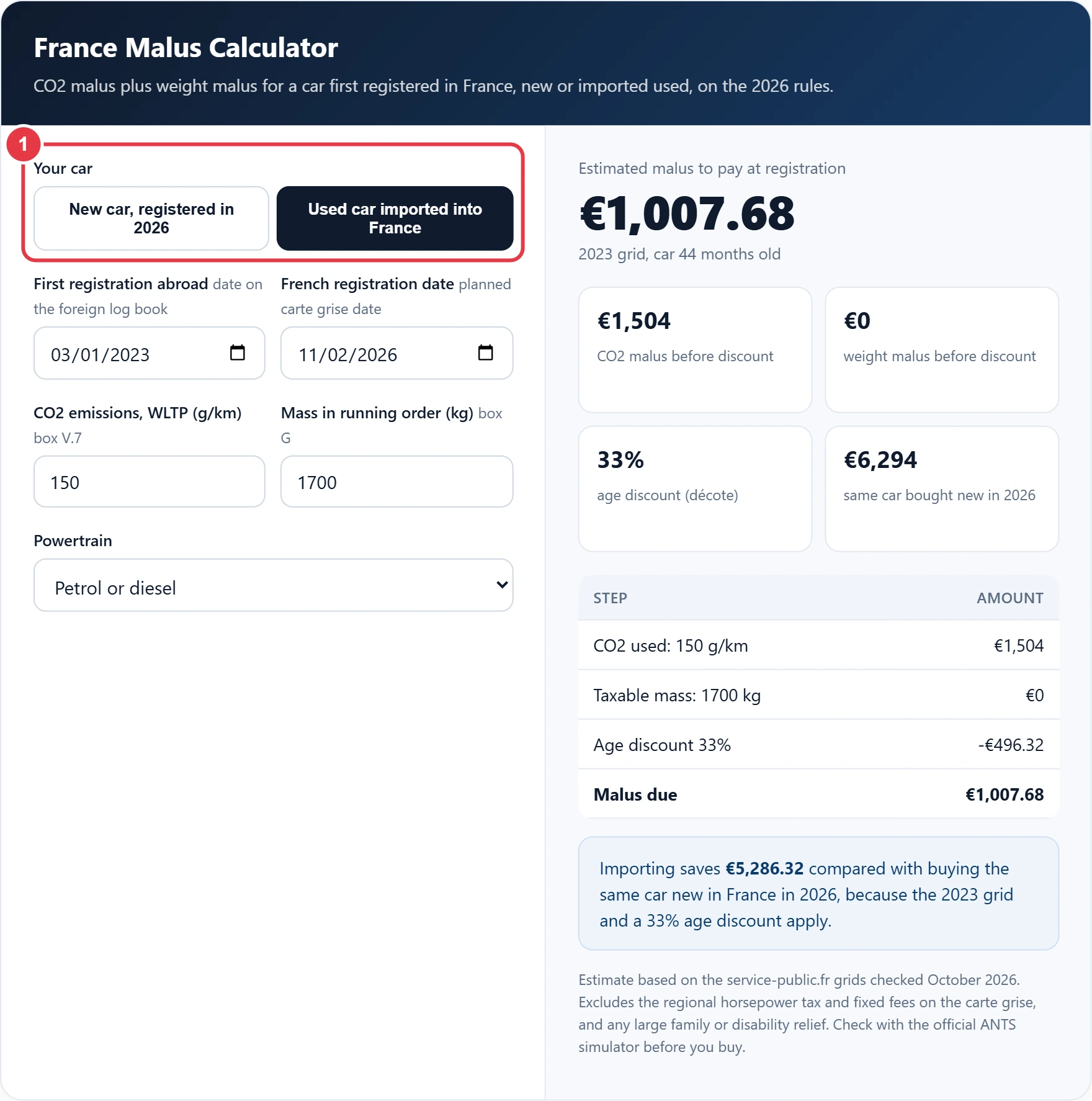
Step 1: Choose New or Imported
Pick "New car" for a car registered for the first time anywhere in 2026, or "Used car imported" for a car that already has a registration in another country. The import mode opens the date fields and the age discount.
Step 2: Enter the Two Registration Dates
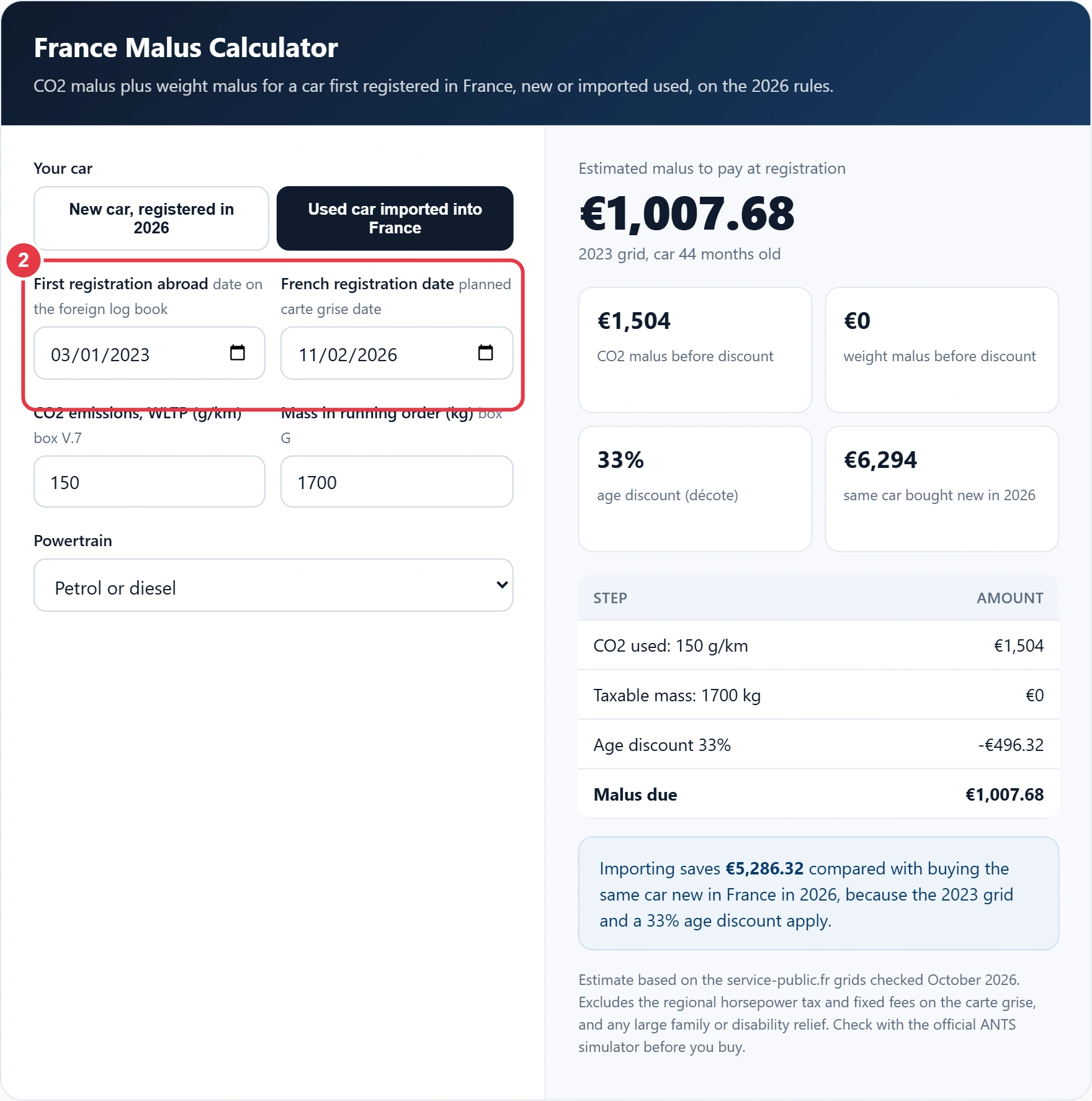
Enter the date of first registration from the foreign log book (on a UK V5C it is in the first registration box), then the date you expect to receive the French carte grise. The first date picks the grid, and the gap between the two sets the discount, counted in completed months.
Step 3: Add CO2, Mass and Powertrain
Use the WLTP CO2 figure in g/km (box V.7 on a French certificate) and the mass in running order in kilograms (box G), which you can usually find on the certificate of conformity. Choose the powertrain: hybrids get a weight reduction, flex fuel E85 cars have their CO2 cut by 40%, and electric or hydrogen cars are exempt from both parts.

Step 4: Read the Breakdown
The headline is the malus you would pay, with the CO2 and weight parts, the discount and the new car comparison below it. If you plan to drive into low emission zones, the Crit'Air sticker checker tells you which sticker the same car needs, which matters as much as the malus in cities such as Paris and Lyon.

France CO2 Malus Grid 2026
These are key points from the 2026 WLTP grid for cars first registered in 2026. The full grid, built into the calculator, rises every gram from 108 g/km.
| CO2 (g/km WLTP) | Malus 2026 | CO2 (g/km WLTP) | Malus 2026 |
|---|---|---|---|
| Under 108 | €0 | 150 | €4,279 |
| 108 | €50 | 160 | €8,770 |
| 120 | €310 | 170 | €22,380 |
| 130 | €983 | 180 | €45,990 |
| 140 | €2,205 | 191 | €79,911 |
| 145 | €3,119 | Over 191 | €80,000 |
Older grids start higher and cap lower. The 2021 grid begins at 133 g/km and caps at €30,000, the 2023 grid begins at 123 g/km with a €50,000 cap, and the grid for 1 March to 31 December 2025 begins at 113 g/km with a €70,000 cap. That is why an imported car is often cheaper to register than the same model bought new.
How Much Is the Weight Malus in 2026?
The 2026 weight malus charges €10 a kilo from 1,500 kg, rising to €30 a kilo from 2,000 kg, on each slice of weight like income tax bands. The bands are shown below, next to the 2024 and 2025 bands that still apply to imports first registered in those years.
| Rate per kg | 2026 grid | 2024 and 2025 grids | 2022 and 2023 grids |
|---|---|---|---|
| €0 | Up to 1,499 kg | Up to 1,599 kg | Up to 1,799 kg |
| €10 | 1,500 to 1,699 kg | 1,600 to 1,799 kg | From 1,800 kg |
| €15 | 1,700 to 1,799 kg | 1,800 to 1,899 kg | None |
| €20 | 1,800 to 1,899 kg | 1,900 to 1,999 kg | None |
| €25 | 1,900 to 1,999 kg | 2,000 to 2,099 kg | None |
| €30 | From 2,000 kg | From 2,100 kg | None |
The CO2 and weight malus together can never exceed the maximum CO2 malus for the same grid, which is €80,000 in 2026. A car already paying €80,000 of CO2 malus pays no weight malus at all.
How Does the Age Discount Work for Imports?
The age discount, or coefficient de décote, cuts both parts of the malus by a fixed percentage based on how many months the car has been registered abroad, reaching 100% after 180 months. Cars first registered abroad before 1 January 2015 pay nothing at all.
| Age in months | Discount | Age in months | Discount |
|---|---|---|---|
| 1 to 3 | 3% | 49 to 60 | 38% |
| 4 to 6 | 6% | 61 to 72 | 43% |
| 7 to 9 | 9% | 73 to 84 | 48% |
| 10 to 12 | 12% | 97 to 108 | 58% |
| 13 to 18 | 16% | 121 to 132 | 70% |
| 19 to 24 | 20% | 145 to 156 | 82% |
| 25 to 36 | 28% | 169 to 180 | 94% |
| 37 to 48 | 33% | From 181 | 100% |
Which Cars Are Exempt From the French Malus?
Fully electric and hydrogen cars are exempt from both the CO2 and the weight malus. Wheelchair accessible vehicles and one car per holder of a mobility inclusion card marked invalidité are also exempt, and households with at least three children can claim a reduction. Hybrids are not exempt but get lighter treatment on weight: 100 kg off for full and mild hybrids, and 200 kg off for plug-in hybrids with more than 50 km of electric range, limited to 15% of the mass.
Before shipping a car from Britain, read the UK government guidance on taking a vehicle out of the UK, because you must tell the DVLA when the car leaves for good, and then budget the malus with this tool. To compare running costs once the car is in France, the L/100km to mpg converter turns French fuel economy figures into UK miles per gallon.
France Malus Terms You Should Know
These terms explain each part of the registration tax the France malus calculator estimates, so you can check the figures before buying or importing a car.
- Malus CO2
- The French registration tax on passenger cars based on carbon dioxide emissions measured in grams per kilometre. Each gram above a threshold falls into a published grid, and higher emitting cars pay sharply rising amounts up to a ceiling.
- Malus masse
- The French tax on heavy cars charged on mass in running order above a threshold. It works in marginal bands, so each additional kilo is taxed at the rate of the band it falls into, much like income tax.
- Carte grise
- The French vehicle registration certificate, officially the certificat d'immatriculation. Registration taxes, including any malus, are paid when it is issued, and its boxes record the figures the calculation uses.
- WLTP
- The Worldwide Harmonised Light Vehicles Test Procedure, a laboratory test cycle used to measure fuel consumption and CO2 emissions of new cars. French malus grids for recent years are based on WLTP values rather than the older NEDC figures.
- Mass in running order
- The weight of a vehicle ready for use, including fluids, a mostly full fuel tank and an allowance for the driver. It is the figure the weight malus is charged on, after any reduction allowed for hybrid or plug-in powertrains.
- Décote
- The age discount France applies to the malus on a used car imported from abroad. It reduces the amount due according to how long ago the car was first registered, reaching full exemption for older vehicles.
</>Embed this calculator on your website
Add the free France Malus Calculator to your own site or blog. Copy the code below and paste it into an HTML block. It resizes itself and works on phones.
How we checked this tool: the Tools Veria Editorial Team built this tool by hand, checked it against the official rules or published standards where they apply, and tested it against worked examples. Results are estimates for planning, not personal financial or tax advice. Read our editorial policy and disclaimer, or report an error.
Frequently Asked Questions
What is the malus threshold in France for 2026?
The CO2 malus starts at 108 g/km WLTP in 2026, costing €50, and the weight malus starts at 1,500 kg. The CO2 malus is capped at €80,000 for cars above 191 g/km, and that cap also limits the two taxes combined.
Do you pay the malus on a used car imported into France?
Yes. A used car registered in France for the first time pays the CO2 and weight malus from the grid of the year it was first registered abroad, reduced by an age discount of 3% to 100%.
Is the French malus paid every year?
No. The malus is a one off tax added to the cost of the carte grise when the car is first registered in France. A car later resold inside France does not pay it again.
Do electric cars pay the malus in France?
No. Fully electric and hydrogen cars are exempt from both the CO2 malus and the weight malus. Plug-in hybrids are not exempt but have 200 kg taken off their mass for the weight malus.
Do cars older than 2015 pay the malus when imported?
No. A car first registered abroad before 1 January 2015 pays no CO2 malus and no weight malus when it is registered in France, whatever its emissions or weight.
Where do I find the mass in running order?
The mass in running order is shown in box G of a French or EU registration certificate. If your foreign log book does not show it, the manufacturer's certificate of conformity lists it in kilograms.