
Daniel is 35, earns £45,000 a year and has £40,000 in workplace pensions. He would like £30,000 a year in today’s money once he stops work at 67. Working out how much to save for retirement means turning that wish into a pot size and then into a monthly amount, and three well known rules of thumb get him most of the way. The maths works the same in dollars or euros; only the state pension figures change.
This guide tests those rules on Daniel’s numbers, shows how the UK State Pension shrinks the target, and puts a price on starting ten years later. It is general guidance, not personal financial advice.
Quick answer: A common guide is to save 12% to 15% of your salary for retirement, counting employer contributions and tax relief, from your early thirties. For a target income, subtract any state pension and multiply the gap by 25. Daniel’s £17,452 gap after the 2026/27 full new State Pension means a pot of about £436,000.
In This Guide
How much income will you need in retirement?
Most people need between two thirds and four fifths of their final working income to keep a similar lifestyle in retirement, because work costs, commuting and pension saving stop, and many have paid off a mortgage. Those who still rent usually need nearer the top of that range.
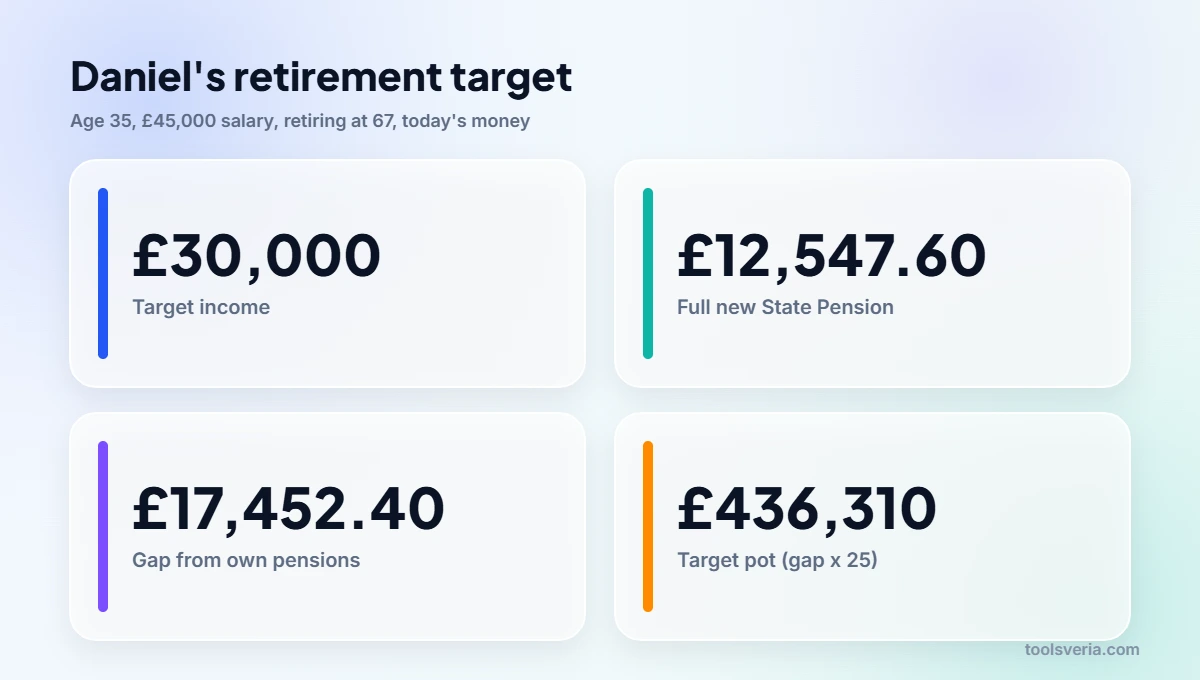
A better approach than any percentage is to list what you actually expect to spend each year: housing, bills, food, transport, holidays, gifts and a buffer for repairs and care. Daniel did this and reached £30,000 a year, two thirds of his current salary. Write the figure in today’s money; inflation is handled later by using a return figure that has already had inflation taken off.
How does the State Pension change the target?
The State Pension reduces the amount your own savings must provide, and for 2026/27 the full new State Pension is £241.30 a week, or £12,547.60 a year. You normally need 35 qualifying years of National Insurance for the full amount and at least 10 to get anything.
State Pension age is 66 and is rising to 67 between 2026 and 2028, so Daniel should assume his starts at 67 at the earliest. The GOV.UK guide to the new State Pension explains how to get a forecast of your own amount. Subtracting £12,547.60 from his £30,000 target leaves a gap of £17,452.40 a year that his own pensions must fill.
Readers in other countries should swap in their own state benefit. In the US, the Social Security Administration gives each worker a personal estimate based on their earnings record, and most European countries offer a similar online forecast. The method that follows does not change.

How to work out how much to save for retirement
To work out how much to save for retirement, multiply your yearly income gap by 25 to get a target pot, then calculate the monthly saving that grows your current pot to that figure by your retirement age. The multiply by 25 step comes from the 4% rule.
The 4% rule says that withdrawing 4% of a pot in the first year, then raising that sum with inflation, has historically lasted about 30 years. It comes from US research in the 1990s, including the Trinity study, and is a rough guide rather than a guarantee. Daniel’s gap of £17,452.40 multiplied by 25 gives a target of £436,310 in today’s money.
Next, assume a growth rate after fees and inflation. Using 3% a year, Daniel’s existing £40,000 should grow to about £103,000 in today’s money by 67. That leaves £333,300 to build from new saving over 32 years, which works out at about £522 a month, roughly 13.9% of his salary. Employer contributions and tax relief count towards that total, so his own share could be well under half. A lower return of 2% would push the figure up, so test both in our retirement calculator.
How much should you have saved by each age?
A widely quoted benchmark from the US investment firm Fidelity suggests having about 1 times your salary saved by 30, 3 times by 40, 6 times by 50, 8 times by 60 and 10 times by 67. It assumes steady saving of around 15% a year and no large state pension, so UK readers can treat it as a cautious ceiling.
| Age | Salary multiple | On a £45,000 salary | On a $60,000 salary |
|---|---|---|---|
| 30 | 1 times | £45,000 | $60,000 |
| 40 | 3 times | £135,000 | $180,000 |
| 50 | 6 times | £270,000 | $360,000 |
| 60 | 8 times | £360,000 | $480,000 |
| 67 | 10 times | £450,000 | $600,000 |
Daniel is behind the age 30 marker of £45,000 and well short of the 3 times mark he would face at 40, yet his own calculation says he is on track if he saves about £522 a month from now. That is the weakness of age benchmarks: they ignore the State Pension, your actual spending target and your current pot. Use them as a nudge, then do your own sums.

What does starting late cost?
Starting late raises the monthly saving needed sharply, because there are fewer years to save and less time for growth to compound. If Daniel waited until 45 to begin, keeping the same £40,000 pot and the same target, he would need about £968 a month, nearly 26% of his salary.
Ten years of delay almost doubles the monthly cost, from £522 to £968. Growth does much of the heavy lifting for early savers: at 3% a year after inflation, £1 saved at 35 is worth about £2.57 in today’s money by 67, while £1 saved at 45 grows to only about £1.92. Our compound interest calculator shows the same effect year by year for any rate.
Late starters still have strong levers. In the UK, pension contributions receive tax relief at your highest rate of Income Tax, and many employers match extra contributions. Our pension tax relief calculator shows how little a £100 contribution can cost a basic or higher rate taxpayer. Working two years longer, or planning for a slightly lower income in your late seventies, also cuts the target noticeably.
Key points
- Many people need two thirds to four fifths of their working income in retirement.
- The full new State Pension for 2026/27 is £241.30 a week, or £12,547.60 a year.
- Multiplying the yearly income gap by 25 gives a target pot under the 4% rule.
- Daniel needs about £522 a month from age 35, or about £968 a month if he starts at 45.
- Saving 12% to 15% of salary, including employer money and tax relief, is a common starting guide.
Key Retirement Saving Terms Explained
These terms appear in every plan for how much to save for retirement, whether you live in the UK, the US or elsewhere.
- Replacement rate
- The share of your final working income you expect to need each year in retirement, commonly two thirds to four fifths. Daniel’s £30,000 target is two thirds of his £45,000 salary.
- New State Pension
- The UK state retirement income for people reaching State Pension age since April 2016. For 2026/27 the full rate is £241.30 a week, normally needing 35 qualifying years of National Insurance.
- 4% rule
- A guideline that withdrawing 4% of a pot in the first year, then rising with inflation, has historically lasted about 30 years. Turned around, it means a target pot of 25 times the yearly income gap.
- Real return
- Investment growth after inflation and fees are taken off, which keeps every figure in today’s money. Daniel’s plan assumes 3% a year, which turns £40,000 now into about £103,000 by age 67.
- Qualifying year
- A tax year in which you paid or were credited with enough National Insurance to count towards the UK State Pension. At least 10 are needed for any payment and 35 for the full amount.
Frequently Asked Questions
Is the 8% auto enrolment minimum enough on its own?
For most people, no. The UK minimum of 8% applies only to earnings within a band, not your whole salary. Daniel’s plan needs about 13.9% of his full £45,000, so the minimum alone would leave a sizeable gap at 67.
Should I include my house in my retirement savings?
Only if you genuinely plan to sell or downsize. A home you live in pays no income, so most plans leave it out and treat any downsizing money as a bonus or a reserve for care costs later in life.
Why use a 3% return rather than the 7% my fund made?
A 3% figure is a cautious return after inflation and fees, so the target stays in today’s money. A fund returning 7% while inflation runs at 3% and fees take 0.5% delivers only about 3.4% of real growth.
I am 55 with very little saved. Is it too late?
It is not too late, but the plan changes. Focus on maximising employer matching and tax relief, check your State Pension forecast and fill any National Insurance gaps, and consider working a little longer. In the UK, the free Pension Wise service offers guidance from age 50.
Daniel raised his contribution so that, with his employer’s share and tax relief, about £522 a month goes in, and he will review it each year. To see how much to save for retirement in your own situation, enter your figures in the retirement calculator and test a cautious and an optimistic return. State Pension figures checked October 2026.