This retirement calculator shows your projected pot in today's money and how much you need to retire on your target income.
Returns are yearly averages after fees. Monthly saving is assumed to rise with inflation. Tax, fees you have not deducted and market swings are not modelled.
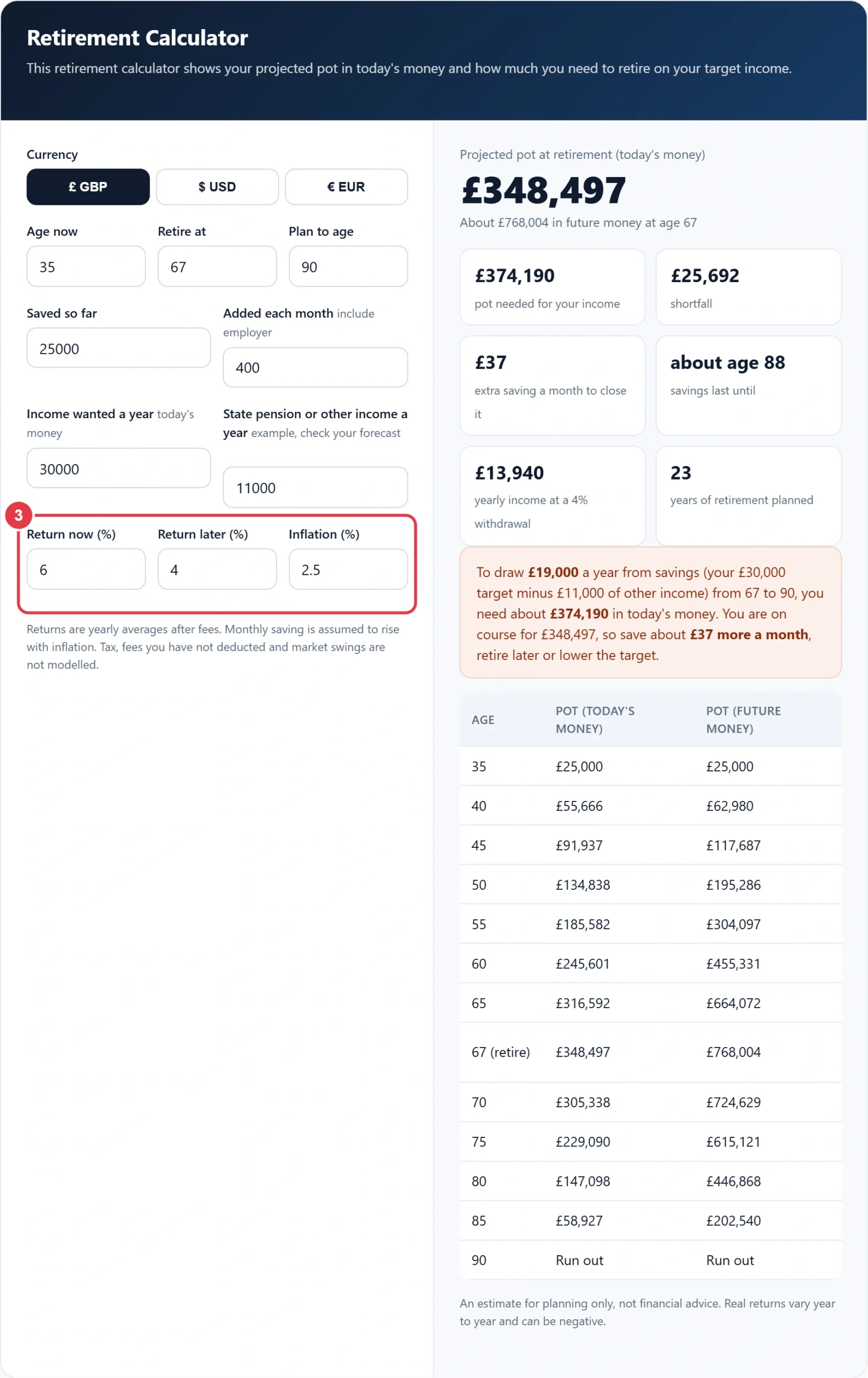
| Age | Pot (today's money) | Pot (future money) |
|---|
An estimate for planning only, not financial advice. Real returns vary year to year and can be negative.
This free retirement calculator shows savers in the UK, US, Europe and elsewhere whether their pension and savings are on track, in pounds, dollars or euros. It projects your pot in today's money, works out the pot you need for your target income after any state pension, and shows the monthly gap. In the UK you can get your real figure from the official State Pension forecast service and enter it as other income, so the result reflects your own record.
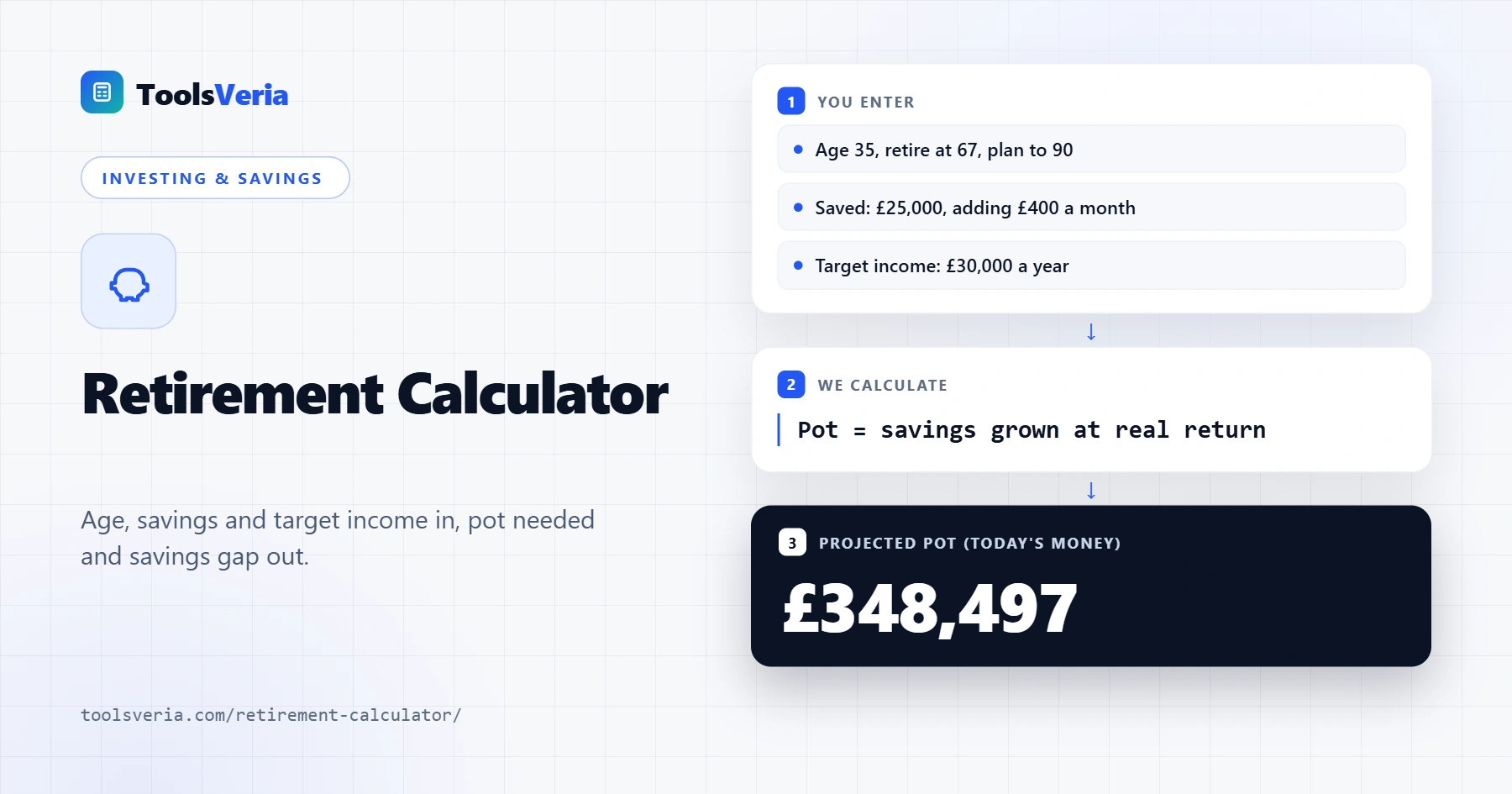
Quick answer: How much to retire depends on the yearly income your savings must provide and how long it must last. A 35 year old with £25,000 saved, adding £400 a month at 6% growth and 2.5% inflation, reaches about £348,000 in today's money by 67. This retirement calculator says £374,000 funds £19,000 a year to 90.
In This Guide
What Is a Retirement Calculator?
A retirement calculator, sometimes called a retirement savings calculator, is a planning tool that compares the money you are likely to have when you stop work with the money you will need to fund the income you want for the rest of your life. Because prices rise over decades, this one shows everything in today's money, so £30,000 means what £30,000 buys now.
The method in plain words: your current savings and monthly additions grow at the real return, which is your investment return after inflation. At retirement, the pot needed is the present value of the yearly shortfall between your target income and other income, such as a state pension, paid each year until your planning age and still earning a lower real return.
How to Use the Retirement Calculator
Step 1: Choose a Currency and Enter Your Ages
Pick pounds, dollars or euros, then enter your age now, the age you hope to retire and the age to plan to. Planning to 90 or beyond is sensible, because many people live longer than the average life expectancy for their age.

Step 2: Enter Savings and Income
Add the value of your pensions and long term savings, and the total paid in each month, including any employer contribution and tax relief. Then enter the yearly income you want and any guaranteed income, such as a state pension or defined benefit pension.

Step 3: Set Returns and Inflation
Set an average yearly return after fees for the saving years and a lower one for retirement, when most people hold less in shares. Then set inflation. Try a cautious and an optimistic case in the retirement calculator to see the range.
Step 4: Read Your Results
The retirement calculator shows your projected pot, the pot needed, any shortfall or surplus, the extra monthly saving that closes the gap, the age your savings could last to and a yearly table in both today's and future money.

How Much Do I Need to Retire?
You need roughly 25 times the yearly income you will draw from savings, using the popular 4% rule, so £19,000 a year needs about £475,000. That rule comes from studies of US market history, such as the Trinity study, and assumes a 30 year retirement. This retirement savings calculator uses your own ages, returns and inflation instead, which is why its answer can be higher or lower.
A common rule of thumb is to aim for 70% to 80% of your pre retirement income, because commuting and mortgage costs often fall. Your own budget is a better guide to how much to retire on. Remember that guaranteed income cuts the pot you need: in the UK, State Pension age is 66 and is rising to 67 between 2026 and 2028.
Worked example: Daniel is 35, has £25,000 in his workplace pension and pays in £400 a month including his employer's share. He wants £30,000 a year from 67 to 90 and expects £11,000 a year of State Pension, leaving £19,000 to draw. At 6% before retirement, 4% after and 2.5% inflation, the retirement calculator projects £348,497 against £374,190 needed. The £25,692 shortfall closes if he saves about £37 more a month.
How Much Should I Save Each Month?
The earlier you start, the less you need to save each month, because growth has longer to compound. The table shows the monthly saving needed to build a pot worth £300,000 in today's money by 67, starting from nothing, at 6% growth and 2.5% inflation, with the payments rising each year in line with inflation.
| Starting age | Years to 67 | Monthly saving needed |
|---|---|---|
| 25 | 42 | £271 |
| 30 | 37 | £341 |
| 35 | 32 | £436 |
| 40 | 27 | £570 |
| 45 | 22 | £769 |
| 50 | 17 | £1,092 |
| 55 | 12 | £1,694 |
Starting at 25 instead of 45 cuts the monthly cost by almost two thirds. To see how compounding builds a lump sum in more detail, the compound interest calculator shows growth year by year. UK savers can check how much basic and higher rate relief adds with the pension tax relief calculator, then enter the gross monthly figure in this retirement savings calculator.
Why Does Inflation Matter So Much?
Inflation matters because it shrinks what each pound, dollar or euro buys, and over a 30 year horizon even 2.5% a year roughly halves purchasing power. In Daniel's example the pot is about £768,000 in future money, but only £348,497 in today's money. Judging a pot in future money makes it look far bigger than it really is.
When Can I Claim a State Pension or Social Security?
In the UK you can claim the State Pension from State Pension age, currently 66, while in the US full retirement age is 67 for anyone born in 1960 or later. US benefits can start from 62 at a reduced rate, and the Social Security retirement benefits pages explain how to get your own estimate. Other European countries set their own ages, so use your national forecast.
Results are estimates for planning, not financial advice, and real returns vary from year to year. UK savers over 50 with a defined contribution pension can book free guidance through Pension Wise from MoneyHelper, and anyone can speak to a regulated financial adviser before making big decisions. Rules and ages checked October 2026.
Key Retirement Planning Terms Explained
These terms explain the numbers behind this retirement calculator, from real returns to the 4% rule, so you can test your own plan with confidence.
- Real return
- Your investment return after inflation, worked out as (1 + return) ÷ (1 + inflation) minus 1. A 6% return with 2.5% inflation gives a real return of about 3.4% a year.
- Today's money
- A way of showing future amounts in current prices by removing inflation. A pot of about £768,000 in 32 years equals about £348,497 in today's money at 2.5% inflation.
- 4% rule
- A guideline that a retiree can draw 4% of the starting pot in year one and raise it with inflation, with a high chance of lasting 30 years. It implies a pot of 25 times the yearly withdrawal.
- State Pension
- The regular payment from the UK government from State Pension age, currently 66 and rising to 67 between 2026 and 2028. A full amount needs 35 qualifying years of National Insurance.
- Drawdown
- Taking an income directly from an invested pension pot while the rest stays invested. The pot needed depends on how much you draw each year and the real return the remaining money earns.
</>Embed this calculator on your website
Add the free Retirement Calculator to your own site or blog. Copy the code below and paste it into an HTML block. It resizes itself and works on phones.
How we checked this tool: the Tools Veria Editorial Team built this tool by hand, checked it against the official rules or published standards where they apply, and tested it against worked examples. Results are estimates for planning, not personal financial or tax advice. Read our editorial policy and disclaimer, or report an error.
Frequently Asked Questions
How much do I need to retire in the UK?
It depends on the income you want and your State Pension. Using the 4% rule, each £1,000 a year drawn from savings needs about £25,000, so £19,000 a year needs roughly £475,000. A retirement calculator with your own ages gives a closer figure.
What is the 4% rule?
The 4% rule says you can withdraw 4% of your pot in the first year of retirement, then raise the amount with inflation, with a high chance of the money lasting 30 years. It is based on US market history.
What return should I use in a retirement calculator?
Use a realistic average after fees: many people test 4% to 6% a year for a mixed portfolio while saving, and a lower rate after retiring. Running a cautious and an optimistic case shows the range of outcomes.
Why does the calculator use today's money?
Showing results in today's money removes inflation, so £348,497 means what that sum buys now. In future money the same pot would be about £768,000 after 32 years of 2.5% inflation, which can be misleading.
Should I include the State Pension?
Yes, if you expect to qualify. Enter your forecast as yearly other income, because it reduces how much your own savings must provide. A full UK State Pension needs 35 qualifying years of National Insurance.
What if my savings run out too early?
You can save more each month, retire a little later, plan a lower income, or aim for a higher return with more risk. Even retiring two years later helps, because the pot grows longer and pays out for fewer years.