Chloe, a 29 year old nurse, keeps seeing “BMR” on her fitness app and wants to know where its number comes from before she trusts it. Learning how to calculate BMR takes one line of arithmetic and a calculator, and once she has done it by hand she can tell whether an app or a meal plan is giving her sensible figures.
Think of basal metabolic rate as the running cost of staying alive while you lie perfectly still: breathing, pumping blood and holding a steady temperature. Below, Chloe works through the sum in metric, her colleague James does it from stone and feet, and the three most used formulas are compared on the same person.
Quick answer: To calculate BMR with the Mifflin St Jeor equation, multiply your weight in kg by 10, add 6.25 times your height in cm, subtract 5 times your age, then add 5 for men or subtract 161 for women. A 29 year old woman weighing 64 kg at 168 cm has a BMR of 1,384 kcal a day.
In This Guide
How do you calculate BMR?
You calculate BMR by putting your weight, height, age and sex into a prediction equation, and the Mifflin St Jeor equation is the one most dietitians and calculators use today. It was developed from measurements of 498 healthy adults aged 19 to 78, published in the original 1990 Mifflin St Jeor study, which also found the older Harris Benedict equations overestimated measured energy use by about 5%.
- Men: BMR = (10 × weight in kg) + (6.25 × height in cm) minus (5 × age in years) + 5
- Women: BMR = (10 × weight in kg) + (6.25 × height in cm) minus (5 × age in years) minus 161
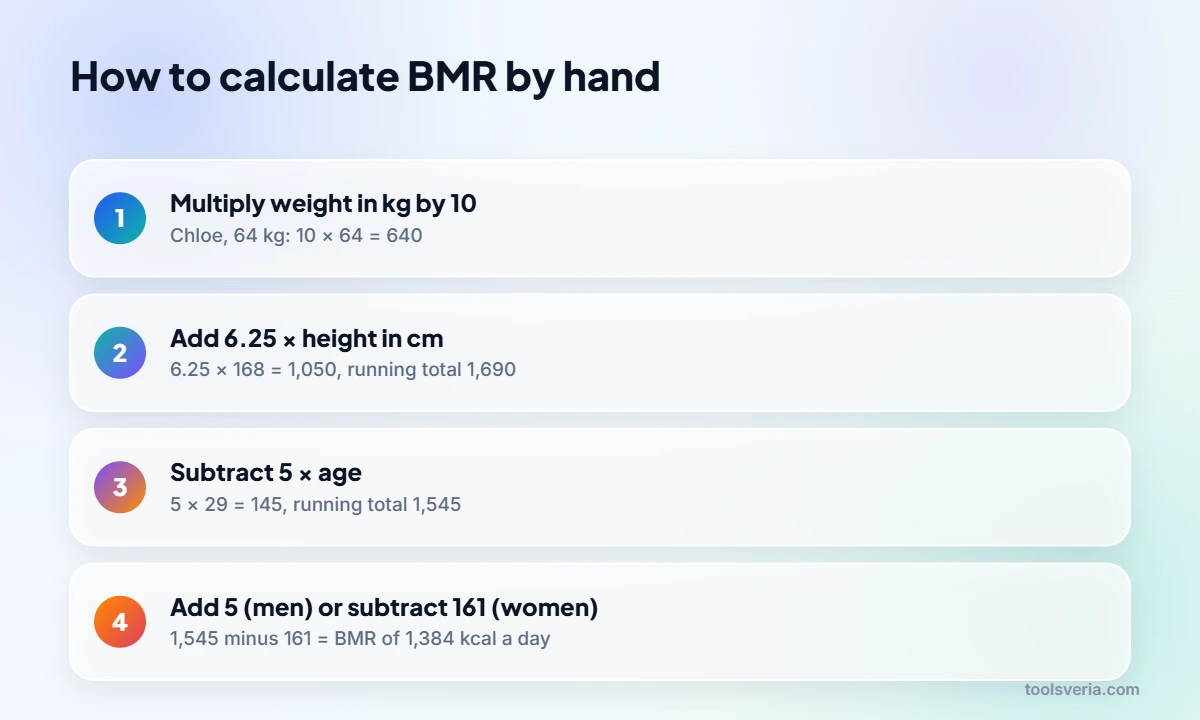
Chloe weighs 64 kg and is 168 cm tall. Working through it one piece at a time:
- Weight: 10 × 64 = 640
- Height: 6.25 × 168 = 1,050
- Age: 5 × 29 = 145, which is taken away
- Sex adjustment for women: take away 161
- Total: 640 + 1,050 minus 145 minus 161 = 1,384 kcal a day
The most common slip is mixing units, such as entering pounds where kilograms belong, which can inflate the answer by several hundred calories. Write each part down before adding them, and the total is easy to check.
How do I calculate BMR if I know my weight in stone?
To calculate BMR from stone and feet, convert your weight to kilograms and your height to centimetres first, then use the usual Mifflin St Jeor equation. One stone is 14 lb, one pound is 0.4536 kg and one inch is 2.54 cm.
James is 41, weighs 13 st 8 lb and stands 5 ft 11 in. His weight is 13 × 14 + 8 = 190 lb, which is about 86.18 kg, and his height is 71 inches, or 180.34 cm. Our stone to kg converter does that first step instantly. His BMR is then 861.8 + 1,127.1 minus 205 plus 5, which comes to about 1,789 kcal a day.
Which BMR formula is most accurate?
For most healthy adults, Mifflin St Jeor is the most reliable everyday BMR formula, and a 2005 systematic review of resting metabolic rate equations found it predicted within 10% of measured values for more people than the alternatives it tested. Even so, every equation is an estimate, and some people sit well outside that 10% range.
Two other formulas are worth knowing. The revised Harris Benedict equation from 1984 uses different weightings: for men 88.362 + 13.397 × weight + 4.799 × height minus 5.677 × age, and for women 447.593 + 9.247 × weight + 3.098 × height minus 4.330 × age. The Katch McArdle formula ignores age and sex and uses lean body mass instead: 370 + 21.6 × lean mass in kg, which suits people who know their body fat percentage.
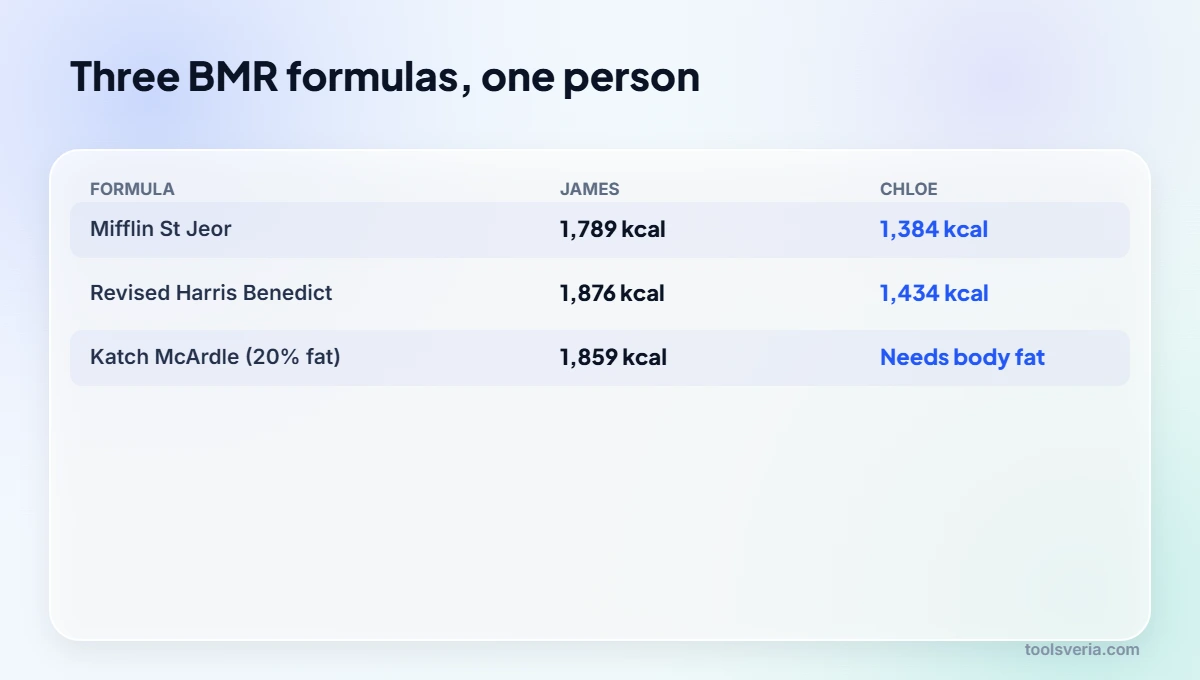
| Formula | What it needs | James (41, 86.2 kg, 180.3 cm) | Chloe (29, 64 kg, 168 cm) |
|---|---|---|---|
| Mifflin St Jeor (1990) | Weight, height, age, sex | 1,789 kcal | 1,384 kcal |
| Revised Harris Benedict (1984) | Weight, height, age, sex | 1,876 kcal | 1,434 kcal |
| Katch McArdle | Lean body mass | 1,859 kcal at 20% body fat | Needs body fat figure |
James’s three answers span 87 calories, which is typical. A sensible approach is to use Mifflin St Jeor as your main figure, treat the others as a range, and then let a few weeks of real weight data tell you which end you are nearer.

How do I turn my BMR into daily calories?
To turn BMR into daily calories, multiply it by an activity factor between 1.2 and 1.9, which gives your total daily energy expenditure, often called TDEE or maintenance calories. BMR alone is what you would burn lying still all day, so it is always lower than what you actually need.
| Activity level | Multiply BMR by | Chloe’s daily calories |
|---|---|---|
| Sedentary: desk based, little exercise | 1.2 | 1,661 |
| Lightly active: exercise 1 to 3 days a week | 1.375 | 1,903 |
| Moderately active: 3 to 5 days a week | 1.55 | 2,145 |
| Very active: 6 to 7 days a week | 1.725 | 2,387 |
| Extra active: physical job plus training | 1.9 | 2,630 |
Chloe’s twelve hour ward shifts keep her on her feet, so she picks moderately active and lands on about 2,145 kcal. If you would rather skip the multiplication, the TDEE calculator applies the factor for you, and the calorie deficit calculator takes the next step if your aim is weight loss. James, who cycles to work and plays five a side, also counts as moderate at 1.55, giving him about 2,773 kcal a day.
The NHS uses rounder averages of 2,000 kcal a day for women and 2,500 for men, and its guidance on counting calories suggests trimming about 600 a day to lose weight. Your BMR is not a target to eat down to; it is the starting point for the larger maintenance figure.
What changes your BMR over time?
Your BMR changes mainly with your weight, muscle mass and age, so the same person can see their figure move by hundreds of calories over a decade. Height and sex matter too, but those rarely change in adult life.
Age has a fixed effect in the Mifflin St Jeor equation: 5 calories off for every year. If Chloe stays at 64 kg until she is 49, her BMR drops from 1,384 to 1,284 kcal, exactly 100 less. Muscle works the other way, which is why strength training while losing weight helps protect the number. Food labels in the UK also show kilojoules, and one kcal equals 4.184 kJ, so Chloe’s 1,384 kcal is about 5,791 kJ a day.
When should you speak to a GP about your BMR?
Speak to a GP if your weight is changing without an obvious reason, if you have a thyroid condition, or if you are pregnant, breastfeeding or have a history of an eating disorder. BMR formulas are estimates for healthy adults and are not medical advice, and they can be well off for people with conditions that affect metabolism.
A GP can arrange blood tests or refer you to a dietitian, who can measure energy needs more precisely than any equation. If you simply want a starting point, the macro calculator turns daily calories into protein, carbohydrate and fat amounts once your BMR and activity level are set.
Key points
- The Mifflin St Jeor BMR is 10 × kg plus 6.25 × cm minus 5 × age, plus 5 for men or minus 161 for women.
- A 29 year old woman at 64 kg and 168 cm has a BMR of 1,384 kcal a day.
- Convert stone to kg (1 stone is 14 lb, 1 lb is 0.4536 kg) and inches to cm (× 2.54) before using the formula.
- Daily calorie needs equal BMR multiplied by an activity factor from 1.2 to 1.9.
- Mifflin St Jeor removes 5 kcal for each year of age, so BMR falls 100 kcal over 20 years at the same weight.
Key BMR Calculation Terms Explained
These terms explain what each part of the formula measures when you learn how to calculate BMR, and why different equations give slightly different answers.
- Basal metabolic rate (BMR)
- The energy the body burns at complete rest to keep vital systems running, such as breathing, circulation and temperature control. It is usually given in kilocalories per day and forms the largest single part of total daily energy use.
- Mifflin St Jeor equation
- A prediction formula from 1990 that estimates BMR from weight in kilograms, height in centimetres, age and sex. It differs between men and women only in its final constant, plus 5 or minus 161, and is the default in most modern calculators.
- Revised Harris Benedict equation
- A 1984 update of an older BMR formula that gives separate weightings for weight, height and age in men and women. It tends to return a slightly higher figure than Mifflin St Jeor for the same person, as the James and Chloe comparison shows.
- Katch McArdle formula
- A BMR equation built on lean body mass instead of total weight, age and sex. Because it needs a body fat percentage to work out lean mass, it suits people who have had their body composition measured.
- Lean body mass
- Everything in the body that is not fat, including muscle, bone, organs and water. Found by subtracting fat mass from total weight, it drives energy use more directly than weight alone, which is why some formulas use it.
- Kilocalorie (kcal)
- The unit of food energy used on nutrition labels and in BMR results, equal to 1,000 small calories. In everyday speech it is usually just called a calorie, so a BMR of 1,384 means 1,384 kcal a day.
Frequently Asked Questions
My app says my BMR is 1,250. Should I eat 1,250 calories to lose weight?
No, BMR is what you burn at complete rest, so eating only that amount ignores all your daily movement. Multiply 1,250 by your activity factor, for example 1.375 gives about 1,719, and take a modest deficit from that figure instead.
I am 5 ft 4 in and 10 stone. What is my BMR as a 35 year old woman?
Your BMR is about 1,315 kcal a day using Mifflin St Jeor. Ten stone is about 63.5 kg and 5 ft 4 in is 162.56 cm, so the sum is 635 plus 1,016 minus 175 minus 161.
Why does my smart scale show a different BMR from the formula?
Smart scales usually estimate body fat and feed it into a formula similar to Katch McArdle, while most calculators use Mifflin St Jeor. Differences of 50 to 150 kcal are normal, and neither number is a direct measurement of your metabolism.
Is BMR the same as resting metabolic rate?
Close, but not quite: BMR is measured under strict fasting, fully rested conditions, while resting metabolic rate is measured under looser conditions and usually comes out slightly higher. For home calculations the two are used almost interchangeably.
Chloe now knows her app’s figure of about 1,384 kcal is right, and that her real daily need on shift is closer to 2,145. James has his answer from stone and feet, and a range from three formulas to test against the scales. Run your own numbers, recheck them as your weight changes and speak to a GP if anything above applies. Figures checked October 2026.