Turn a weight in stone and pounds into kilograms, total pounds and grams.
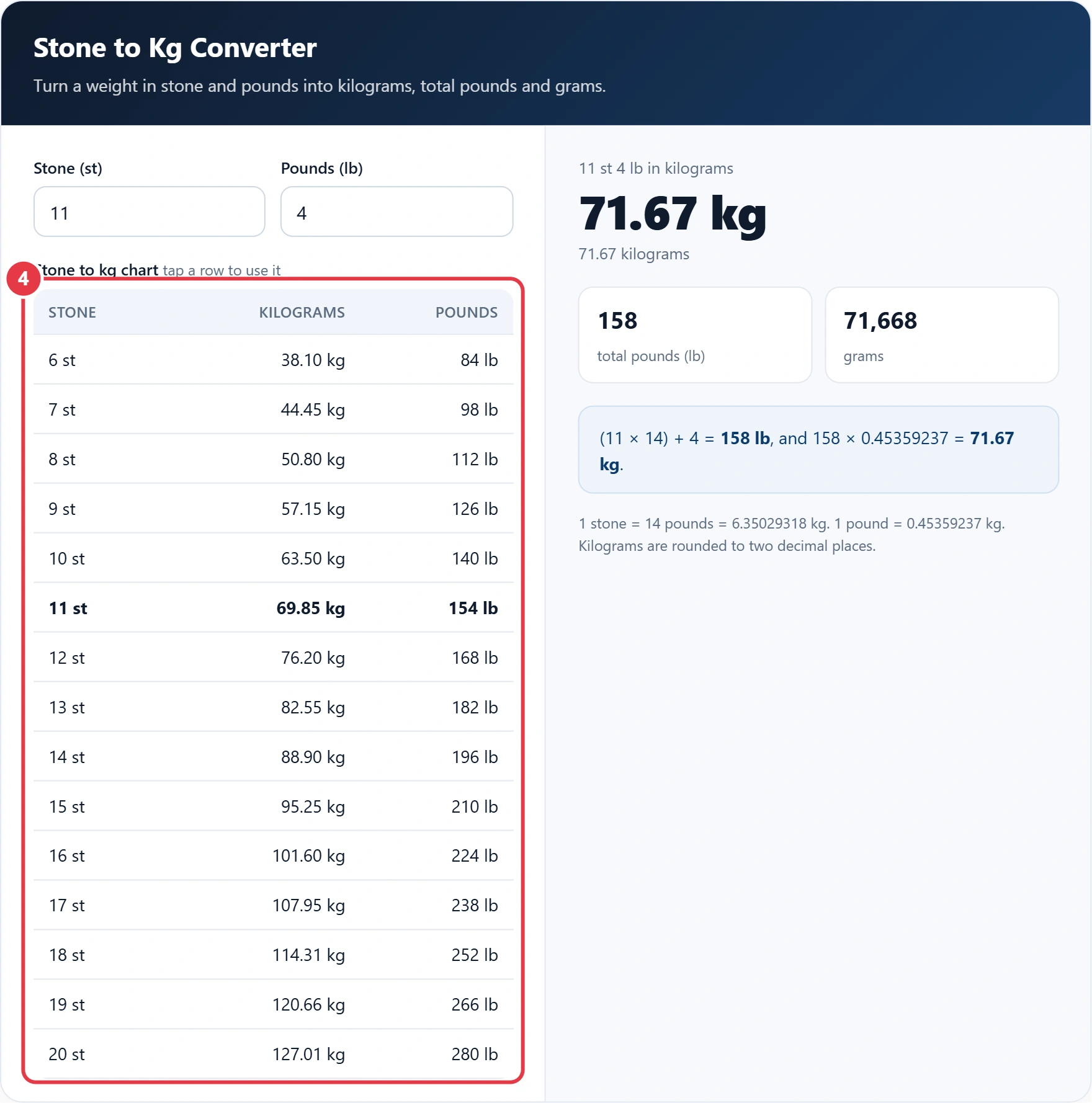
| Stone | Kilograms | Pounds |
|---|
1 stone = 14 pounds = 6.35029318 kg. 1 pound = 0.45359237 kg. Kilograms are rounded to two decimal places.
Doctors, gyms and fitness apps often ask for your weight in kilograms, while most of us in the UK know it in stone and pounds. This stone to kg converter uses the exact definition of the international avoirdupois pound to turn stone and pounds into kilograms to two decimal places, along with total pounds and grams.
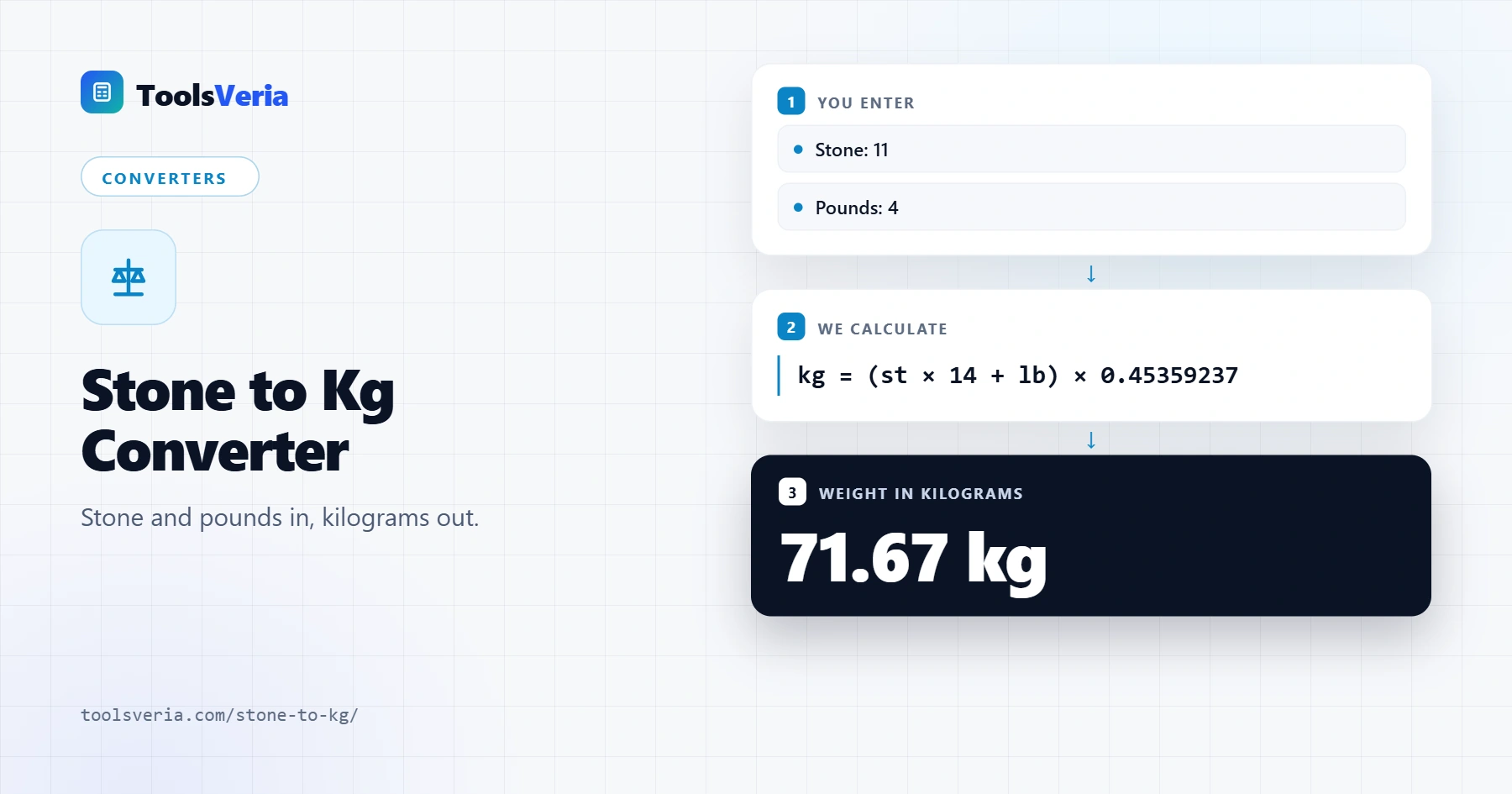
Quick answer: To convert stone to kg, change your weight to pounds with (stone × 14) + pounds, then multiply by 0.45359237. One stone is 6.35029318 kg, so 12 stone is 76.20 kg, and 11 st 4 lb is 158 lb, which is 71.67 kg. For a rough figure, multiply the stones by 6.35.
In This Guide
How Do You Convert Stone to Kg?
One stone is 14 pounds and one pound is exactly 0.45359237 kg, so one stone is 6.35029318 kg. For a whole number of stones, just multiply by 6.35029318. For example, 12 stone is 76.20 kg.
When your weight is in stone and pounds, convert it all to pounds first: (stone × 14) + pounds. Then multiply by 0.45359237. So 11 st 4 lb is 154 + 4 = 158 lb, and 158 × 0.45359237 = 71.67 kg. Need to go the other way? Our kg to stone converter turns kilograms back into stone and pounds.
How Do You Use the Stone to Kg Converter?
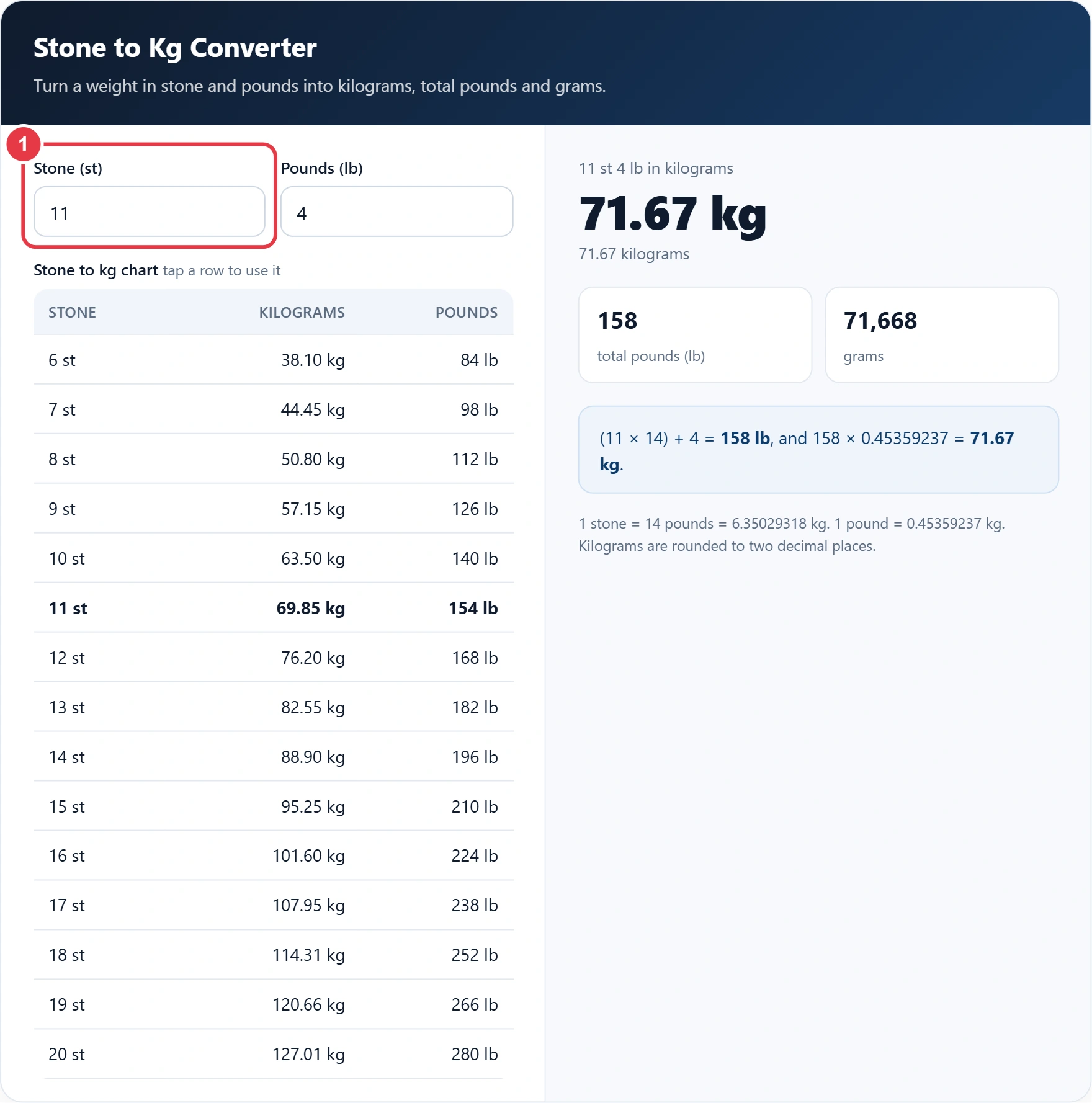
Step 1: Enter the Stones
Type the whole number of stones, for example 11 if you weigh 11 stone 4 pounds, or enter decimal stone such as 11.5 and leave the pounds at 0. Type the whole number of stones, for example 11 if you weigh 11 stone 4 pounds. You can also enter decimal stone, such as 11.5, and leave the pounds at 0.
Step 2: Enter the Pounds
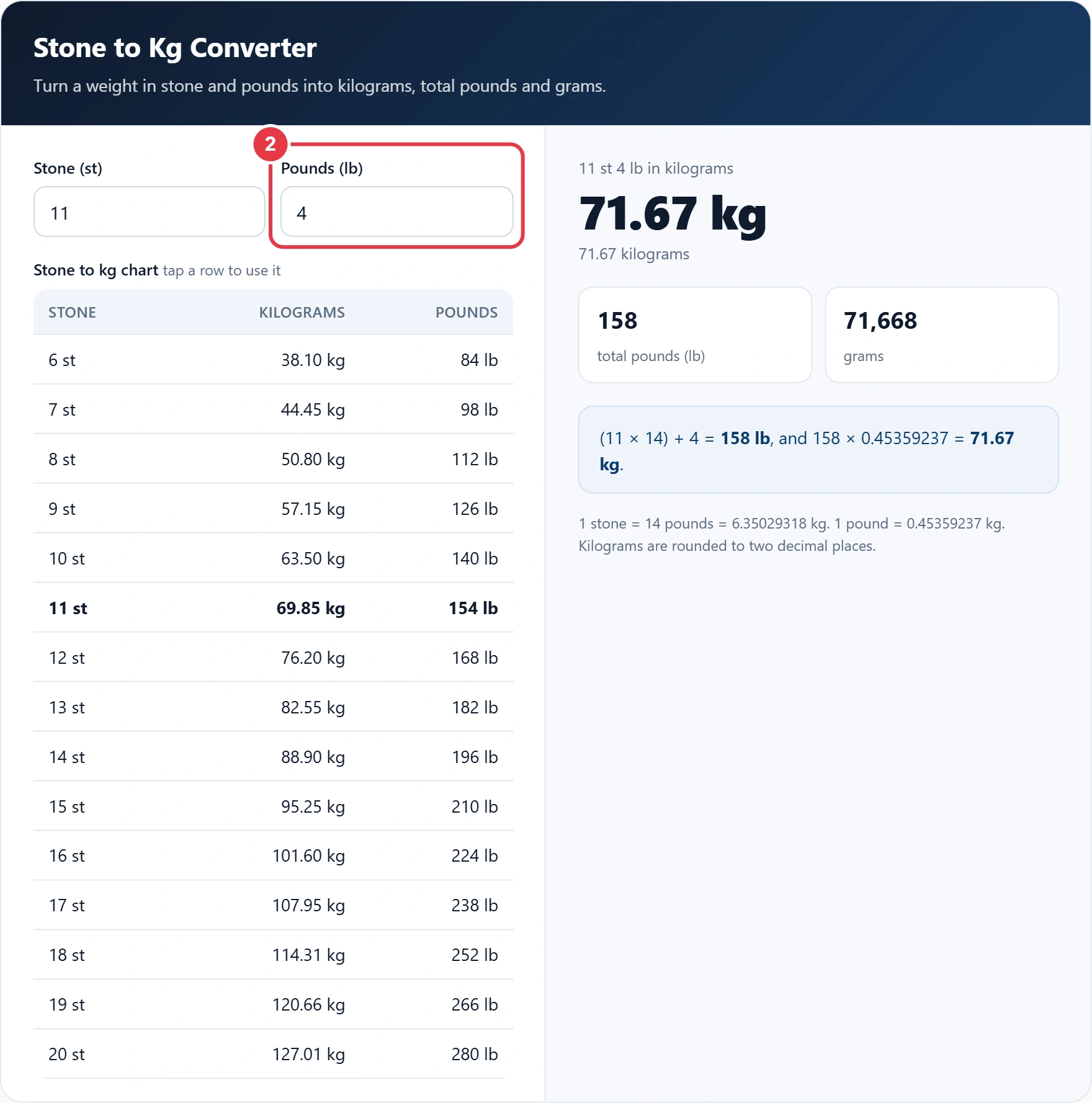
Add the extra pounds, from 0 to 13. Decimals such as 4.5 are fine if your scales show half pounds.
Step 3: Read Your Weight in Kg
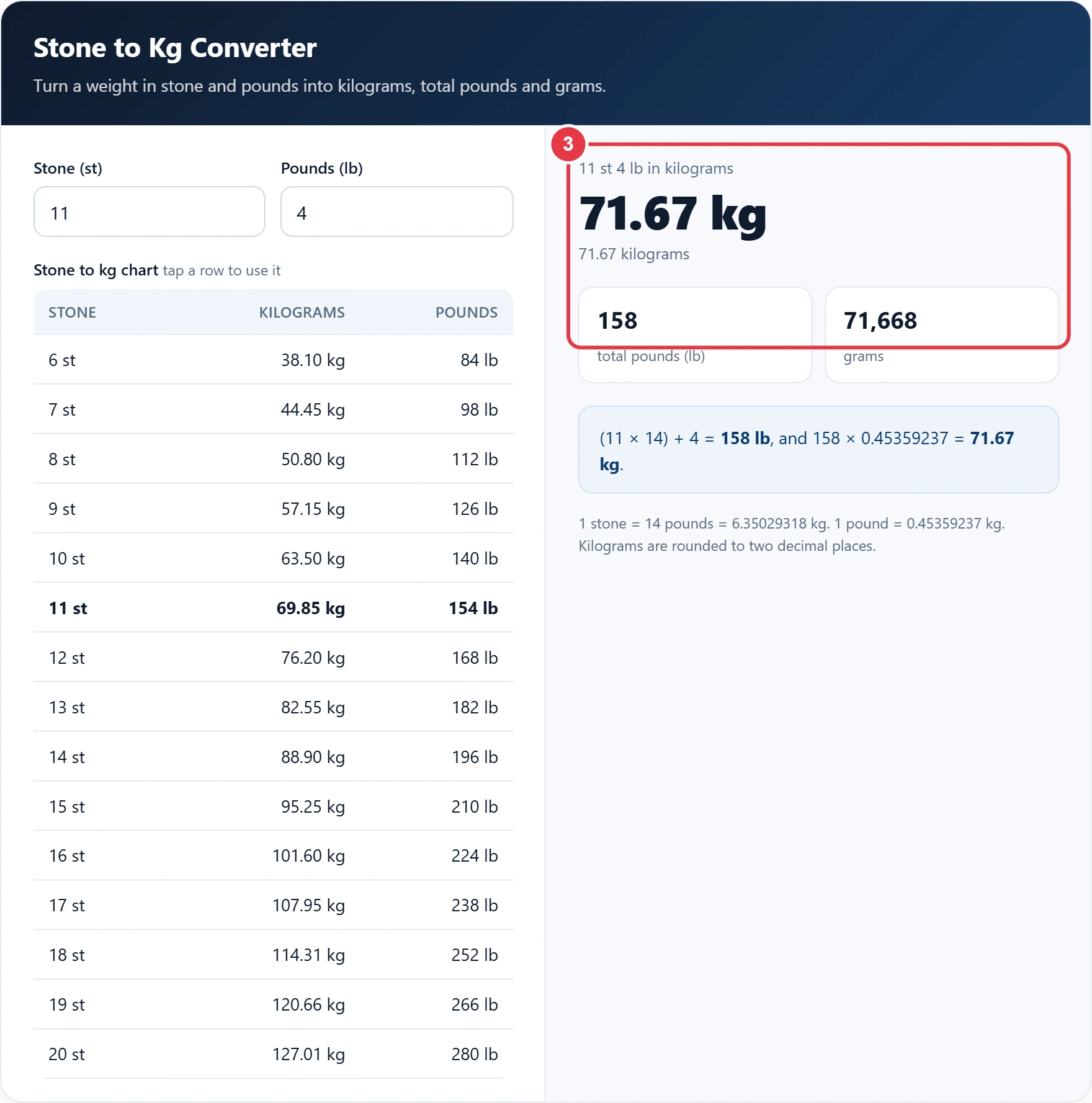
The result shows your weight in kilograms to two decimal places, plus total pounds and grams, and a worked line underneath shows exactly how the figure was calculated. If you are tracking weight loss, the percentage difference calculator compares two readings so you can see the change in percentage terms.
Step 4: Use the Conversion Chart
The chart covers 6 stone to 20 stone. The row nearest your weight is highlighted, and you can tap any row to load it.
What Is Stone in Kg for Common Body Weights?
| Stone and pounds | Total pounds | Kilograms |
|---|---|---|
| 8 st 7 lb | 119 lb | 53.98 kg |
| 10 st 0 lb | 140 lb | 63.50 kg |
| 11 st 4 lb | 158 lb | 71.67 kg |
| 12 st 10 lb | 178 lb | 80.74 kg |
| 14 st 0 lb | 196 lb | 88.90 kg |
| 16 st 7 lb | 231 lb | 104.78 kg |
For example, 10 st 0 lb is 63.50 kg, 12 st 10 lb is 80.74 kg and 14 st 0 lb is 88.90 kg, with roughly 6.35 kg in each stone. For a rough figure in your head, multiply the stones by 6.35 and add about 0.45 kg for each extra pound. Metric units are the standard for trade in the UK, as set out in the GOV.UK weights and measures guidance, which is why medical and fitness records usually use kilograms.
Stone to Kg Conversion Terms Explained
These definitions explain the imperial and metric units behind the stone to kg converter so you can read and share body weight figures accurately.
- Stone (st)
- A unit of weight equal to 14 pounds, still widely used in the UK and Ireland for body weight. It is not an SI unit, so medical records and fitness apps usually store weight in kilograms instead.
- Kilogram (kg)
- The SI base unit of mass, now defined by fixing the numerical value of the Planck constant. One kilogram equals 1,000 grams, and it is the standard unit for clinical weight records and medicine dosage calculations.
- Avoirdupois pound (lb)
- The pound used for everyday weights in the UK and US, defined by international agreement as exactly 0.45359237 kilograms. Sixteen ounces make one pound, and fourteen pounds make one stone.
- Imperial units
- The system of weights and measures formalised in Britain, including the stone, pound, ounce, mile and pint. Metric units are now official for most purposes, yet imperial units remain common in everyday conversation about body weight.
- Body mass index (BMI)
- A screening measure that divides weight in kilograms by the square of height in metres. Because the formula needs kilograms, converting from stone and pounds is often the first step before checking a BMI result.
- Gram (g)
- A metric unit of mass equal to one thousandth of a kilogram. Expressing weight in grams helps with precise tracking, such as monitoring small changes in a baby's weight or logging food and nutrition data.
</>Embed this calculator on your website
Add the free Stone to Kg Converter to your own site or blog. Copy the code below and paste it into an HTML block. It resizes itself and works on phones.
How we checked this tool: the Tools Veria Editorial Team built this tool by hand, checked it against the official rules or published standards where they apply, and tested it against worked examples. Results are estimates for planning, not personal financial or tax advice. Read our editorial policy and disclaimer, or report an error.
Frequently Asked Questions
How many kg is a stone?
One stone is exactly 6.35029318 kg, usually rounded to 6.35 kg.
How do I convert stone and pounds to kg?
Multiply the stones by 14 and add the pounds to get total pounds. Then multiply by 0.45359237 to get kilograms.
What is 10 stone in kg?
10 stone is 63.50 kg, which is 140 pounds.
What is 12 stone in kg?
12 stone is 76.20 kg, which is 168 pounds.
What is 15 stone in kg?
15 stone is 95.25 kg, which is 210 pounds.
Why do people in the UK use stone?
Stone is a traditional British unit that is still widely used for body weight, even though metric units are used for trade and in most medical records.