Daily calories plus grams of protein, fat and carbs, per day and per meal.
| Macro | g | kcal | % | Meal |
|---|
An estimate for healthy adults, not medical advice. If you have kidney disease, diabetes, are pregnant or breastfeeding, check protein and carbohydrate targets with your GP or a registered dietitian.
This macro calculator turns your body stats and goal into a daily calorie target and exact grams of protein, fat and carbohydrate, for adults in the UK and elsewhere who track food in an app or want a clear plan for losing fat, maintaining or building muscle. Protein is set per kilogram of body weight, in line with the International Society of Sports Nutrition guidance for active people, and fat and carbs fill the rest. It works in kg, stone and pounds, or pounds.
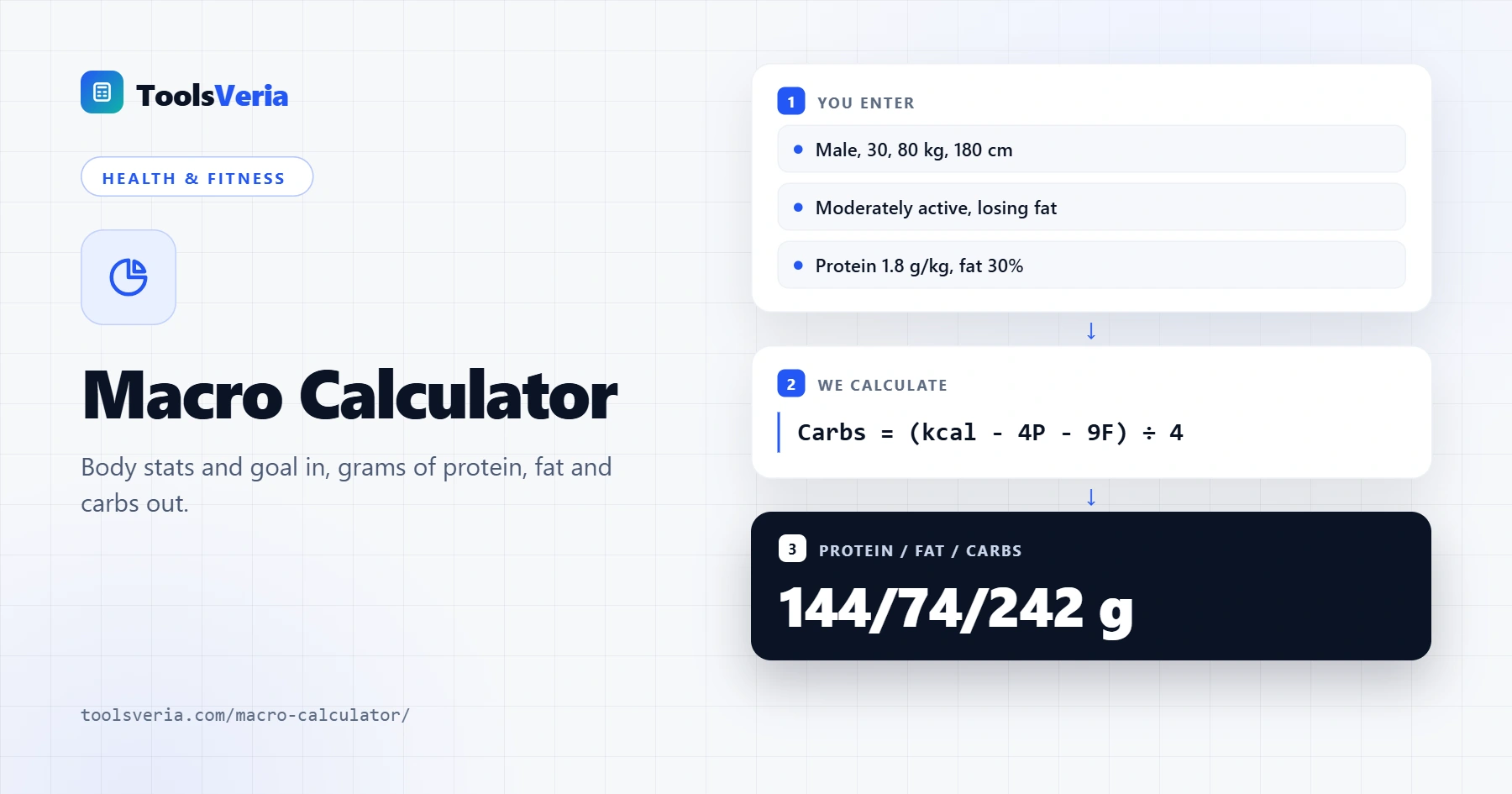
Quick answer: A macro calculator adjusts your maintenance calories for your goal, then splits them: protein at 1.4 to 2.0 g per kg, fat at 25 to 35% of calories and carbs from what is left. An 80 kg moderately active man losing fat would eat about 2,207 kcal: 144 g protein, 74 g fat and 242 g carbs.
In This Guide
What Are Macros?
Macros, short for macronutrients, are the three nutrients that supply almost all of the calories in food: protein, fat and carbohydrate. Protein and carbohydrate each provide 4 kcal per gram, while fat provides 9 kcal per gram, which is why a small amount of oil or butter adds up quickly. Alcohol also supplies 7 kcal per gram but is not counted as a macro target.
The calculator works in four steps. It finds your basal metabolic rate with the Mifflin-St Jeor equation and multiplies it by your activity level to get maintenance calories, exactly as the TDEE calculator does. It then takes off 20% to lose fat or adds 10% to build muscle. Protein is your weight in kg multiplied by your chosen grams per kg. Fat is your chosen percentage of calories divided by 9. Carbohydrate is whatever remains: carbs = (calories minus protein × 4 minus fat calories) ÷ 4.
| Macro | kcal per gram | Main jobs | Good UK sources |
|---|---|---|---|
| Protein | 4 | Builds and repairs muscle, keeps you full | Chicken, fish, eggs, Greek yoghurt, lentils, tofu |
| Fat | 9 | Hormones, vitamin absorption, essential fatty acids | Olive oil, nuts, seeds, oily fish, avocado |
| Carbohydrate | 4 | Main fuel for training and the brain | Oats, potatoes, rice, wholemeal bread, fruit |
How to Use the Macro Calculator
Step 1: Enter Your Sex, Age, Weight and Height
Choose female or male, then type your age, weight and height in the units you prefer. Weight converts automatically between kg, stone and pounds, and pounds, so 12 st 8 lb shows as 79.8 kg. These details set your resting calorie burn.

Step 2: Choose Your Activity Level
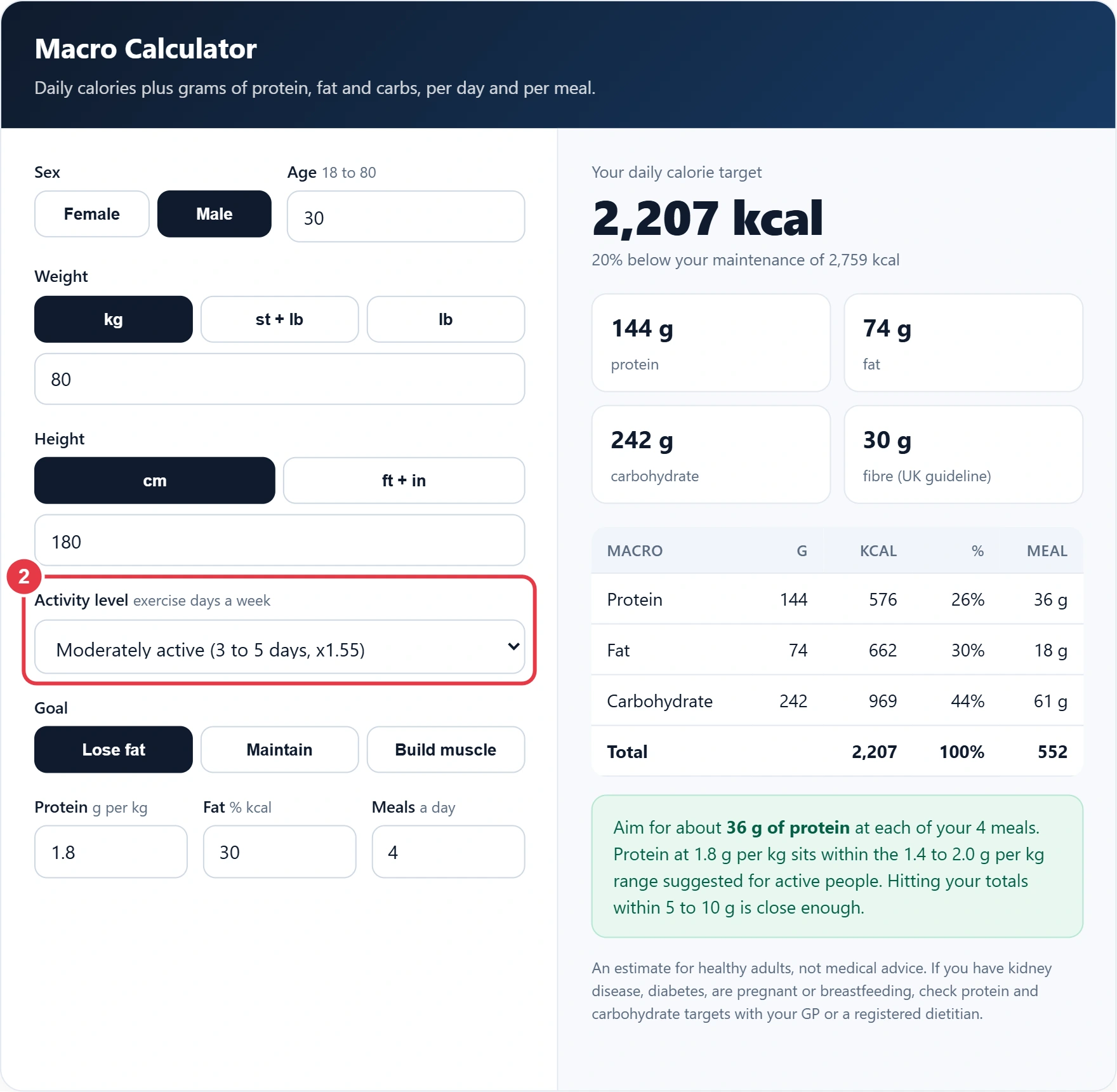
Pick the option that matches an ordinary week. Someone with an office job who trains three or four times a week is moderately active. If your week varies a lot, choose the lower level and adjust after a fortnight of real results.
Step 3: Pick a Goal and Fine Tune the Split
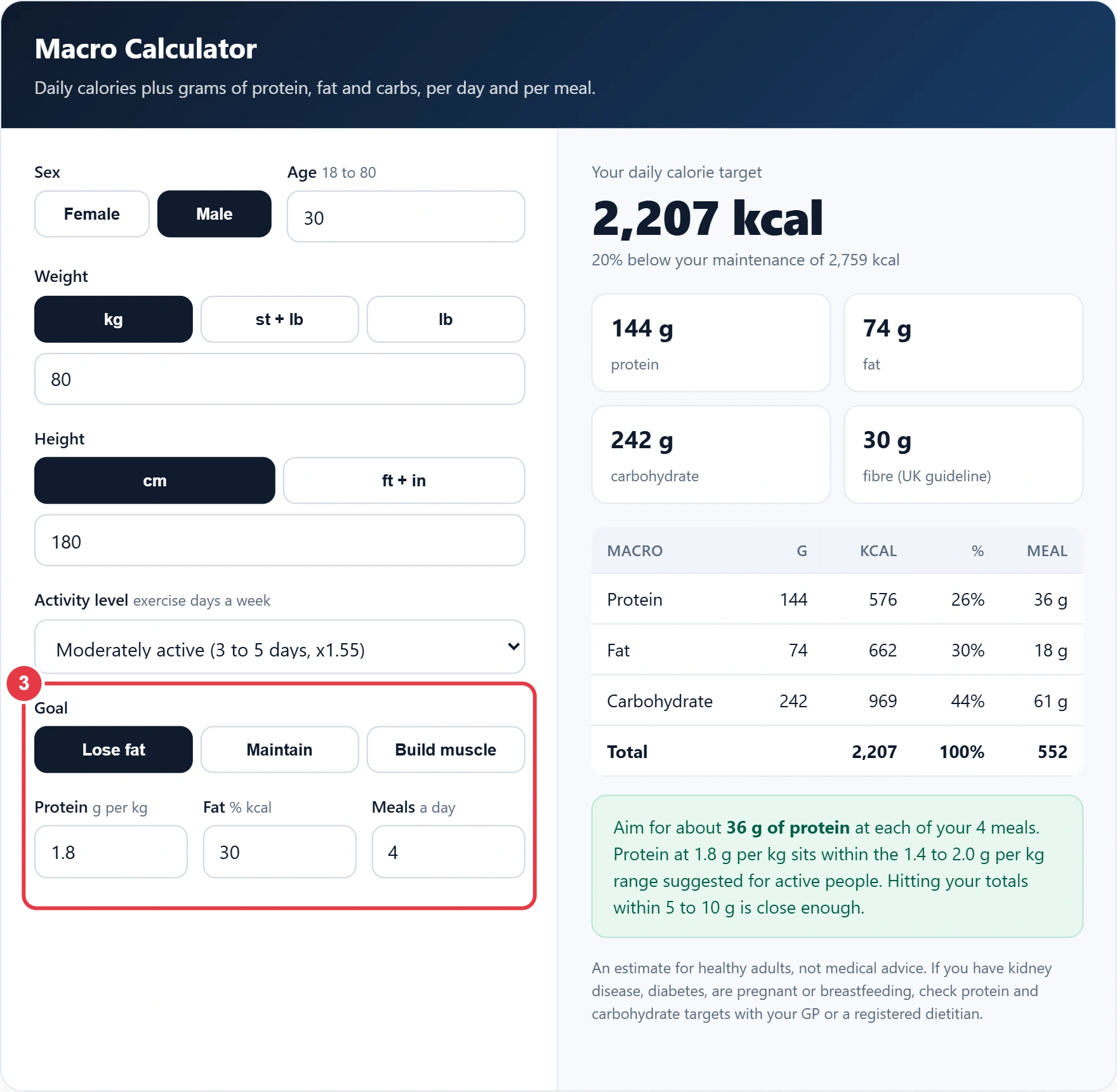
Choose lose fat, maintain or build muscle. The protein box updates to a sensible default for that goal (1.8, 1.4 or 1.7 g per kg), but you can change it. Set fat as a percentage of calories, 30% being a balanced choice, and enter how many meals or snacks you eat so the calculator can share the totals out.
Step 4: Read Your Macros
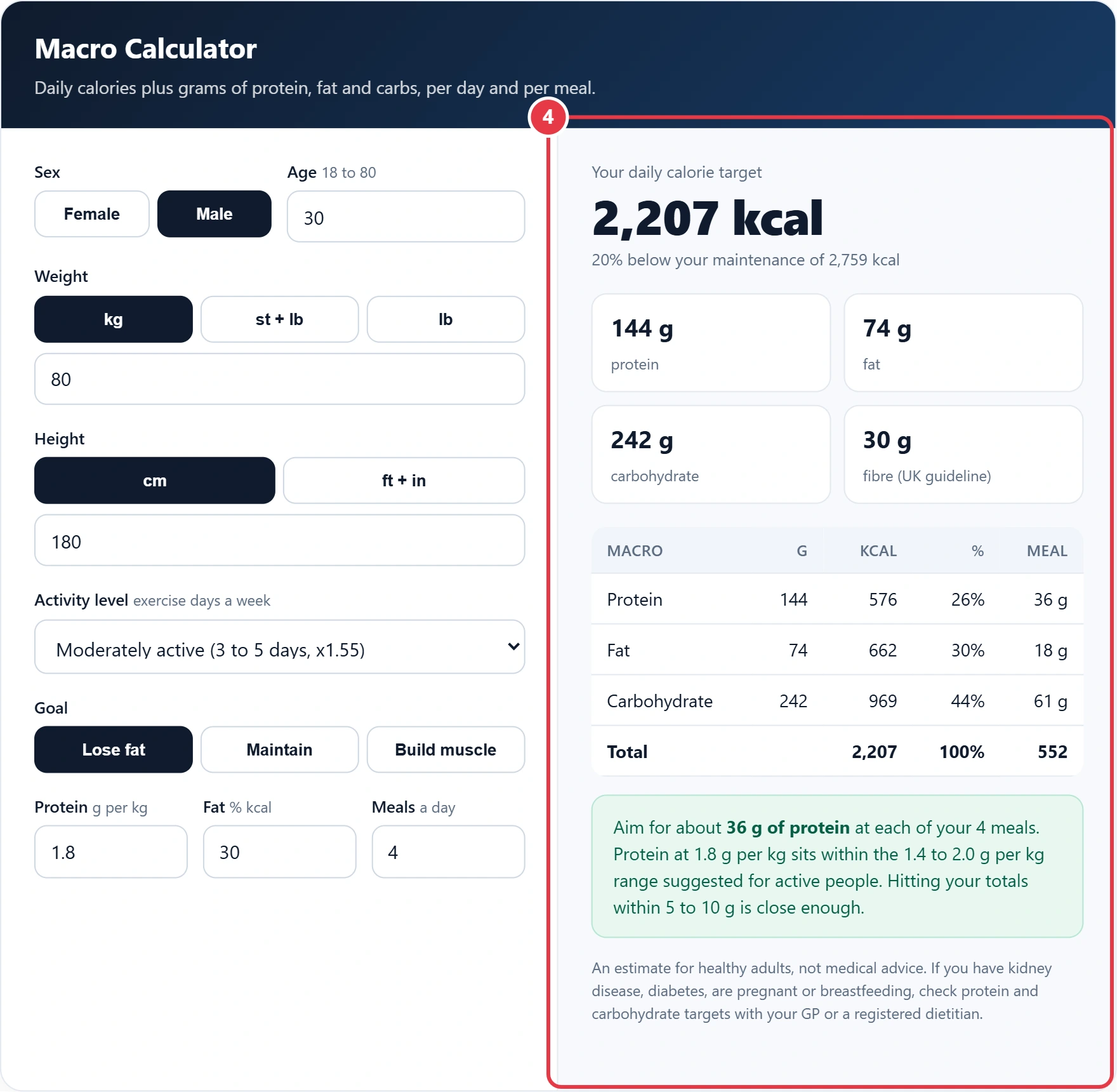
The large figure is your calorie target. The cards show your daily grams of protein, fat and carbohydrate alongside the UK fibre guideline. The table gives grams, calories, percentage of the total and grams per meal, which makes it easy to plan a plate or set targets in a tracking app.
How Many Macros Should I Eat a Day?
Most active adults do well with about 1.4 to 2.0 g of protein per kg of body weight, 25 to 35% of calories from fat and the rest from carbohydrate, plus 30 g of fibre. The calories themselves depend on your goal: around 20% below maintenance to lose fat, at maintenance to hold steady and about 10% above to build muscle.
Take Tom, a 30 year old electrician from Cardiff. He is 180 cm tall, weighs 80 kg and lifts weights three times a week on top of a physical job that he rates as moderately active. His BMR is 1,780 kcal and his maintenance is 2,759 kcal. To lose fat he eats 20% less, which is 2,207 kcal. His protein is 1.8 × 80 = 144 g, or 576 kcal. Fat at 30% is 662 kcal, which is 74 g. That leaves 969 kcal for carbohydrate, or 242 g. Over four meals he aims for about 36 g protein, 18 g fat and 61 g carbs at each.
| Tom's goal | Calories | Protein | Fat | Carbs |
|---|---|---|---|---|
| Lose fat (minus 20%) | 2,207 kcal | 144 g (1.8 g/kg) | 74 g | 242 g |
| Maintain | 2,759 kcal | 112 g (1.4 g/kg) | 92 g | 371 g |
| Build muscle (plus 10%) | 3,035 kcal | 136 g (1.7 g/kg) | 101 g | 395 g |
Notice that protein goes up when Tom is in a deficit, even though his calories fall. Higher protein helps keep muscle while fat is lost and makes a lower calorie diet less hungry. In a surplus, carbohydrate does more of the work, fuelling harder training sessions.
How to Hit Your Macros Without Obsessing
- Build each meal around protein: a palm sized portion of chicken, fish, eggs, tofu or beans covers 25 to 40 g, then add carbs and fats around it.
- Weigh for a fortnight: a cheap kitchen scale teaches you what 60 g of oats or 150 g of rice really looks like, and the cups to grams converter helps when a recipe uses American cup measures.
- Be accurate on fats: a tablespoon of oil is about 120 kcal, so pour it with a spoon rather than straight from the bottle.
- Allow a margin: landing within 5 to 10 g of each target and close on calories is plenty. Weekly averages matter more than any single day.
- Keep fibre up: vegetables, fruit, oats, beans and wholegrains help you reach 30 g a day, which most UK adults miss.
How Accurate Is a Macro Calculator?
A macro calculator is only as accurate as the calorie estimate underneath it. The Mifflin-St Jeor equation is usually within about 10% of a measured value, and the activity multiplier adds more uncertainty, so treat your first targets as a two to three week experiment. Weigh yourself each morning, compare weekly averages and adjust calories by 100 to 200 kcal if the trend is not moving the way you want. Change carbohydrate or fat to make that adjustment and keep protein steady.
The numbers also say nothing about food quality. A plan that hits every target with sweets and protein bars will feel worse than one built on whole foods, and the NHS Eatwell Guide is a simple way to check the balance, with plenty of fruit and vegetables and starchy foods making up just over a third of what you eat. Use the macro calculator for the amounts and the Eatwell Guide for the choices.
Some people only care about the calorie side and want to know when they will reach a target weight. For that job, the calorie deficit calculator adds a goal date and a weekly pace, and you can bring the calorie figure back here to split it into macros.
This tool gives estimates for healthy adults and is not medical advice. Speak to your GP or a registered dietitian before raising protein if you have kidney disease, before cutting carbohydrate if you take insulin or other diabetes medicine, and before any weight loss diet if you are pregnant, breastfeeding, under 18 or have had an eating disorder.
What the Key Macro Calculator Terms Mean
These nutrition terms explain how the macro calculator turns your body stats into targets, so you can adjust protein, fat and carbohydrate with understanding.
- Basal metabolic rate
- The energy your body uses at complete rest to keep vital organs working, such as breathing, circulation and temperature control. It accounts for the largest share of daily calorie burn in most people and is the starting point for any calorie estimate.
- Mifflin-St Jeor equation
- A formula that predicts resting energy expenditure from weight, height, age and sex. Published in 1990, it is widely preferred over older equations because studies found it estimates the resting needs of modern adults more accurately.
- Total daily energy expenditure
- The total calories you burn across a full day, combining resting metabolism, the energy used digesting food and all movement and exercise. Eating at this level keeps body weight stable, so it acts as the maintenance figure.
- Activity multiplier
- A factor applied to basal metabolic rate to reflect how much you move in a typical week, rising from the lowest value for desk based lifestyles to the highest for heavy physical work. Choosing too high a level overstates your calorie needs.
- Protein per kilogram
- A way of setting protein intake in proportion to body weight rather than as a share of calories. It keeps protein steady when calories fall during fat loss, which helps preserve lean muscle while you eat less overall.
- Dietary fibre
- The part of plant foods, such as oats, beans, vegetables and wholegrains, that the small intestine cannot digest. Although it supplies little usable energy, it supports gut health and fullness, so it is tracked alongside macros rather than as one.
</>Embed this calculator on your website
Add the free Macro Calculator to your own site or blog. Copy the code below and paste it into an HTML block. It resizes itself and works on phones.
How we checked this tool: the Tools Veria Editorial Team built this tool by hand, checked it against the official rules or published standards where they apply, and tested it against worked examples. Results are estimates for planning, not personal financial or tax advice. Read our editorial policy and disclaimer, or report an error.
Frequently Asked Questions
How much protein do I need a day?
The UK reference for adults is 0.75 g of protein per kg of body weight, which covers basic needs. People who train regularly often benefit from 1.4 to 2.0 g per kg, which is 112 to 160 g a day for someone weighing 80 kg.
What is a good macro split for fat loss?
There is no single best split. A practical starting point is about 1.8 g of protein per kg, 25 to 30% of calories from fat and the rest from carbs, with calories around 20% below maintenance.
Do I have to hit my macros exactly every day?
No. Being within 5 to 10 g of each target and close to your calorie total is enough. What matters is your average over a week, so one high or low day makes little difference.
Should I count net carbs or total carbs?
For a normal balanced diet, count total carbohydrate as shown on UK labels. UK labels already list fibre separately from carbohydrate, unlike US labels, so you do not need to subtract it yourself.
How often should I recalculate my macros?
Recalculate after every 4 to 5 kg of weight change or when your training changes. If your weekly average weight has not moved in the expected direction for three weeks, adjust calories by about 100 to 200 kcal.
Is it safe to eat a high protein diet?
For healthy adults, intakes up to about 2 g per kg are considered safe. If you have kidney disease or reduced kidney function, speak to your GP or a renal dietitian before increasing protein.