
Ben is 34, plays five a side twice a week and lifts weights, yet his BMI of 25.9 labels him overweight. He wanted a better sense of how much of his 82 kg is fat. Learning how to calculate body fat percentage with a tape measure gave him an answer in five minutes, and it told a very different story from his BMI.
This guide is for healthy adults who want to track body composition at home. It explains the US Navy tape method step by step, works through examples for a man and a woman, compares the tape with BMI based formulas, smart scales and DEXA scans, and sets out what the common ranges mean. The results are estimates, not a diagnosis, so speak to your GP if you have concerns about your weight or health.
Quick answer: The best home method is the US Navy formula, using height, neck and waist measurements (plus hips for women). For a man 178 cm tall with an 86 cm waist and 39 cm neck, it estimates about 16.4% body fat. Typical American Council on Exercise ranges are 14 to 24% for men and 21 to 31% for women.
In This Guide
What does body fat percentage tell you?
Body fat percentage is the share of your total weight that is fat, with the rest being lean mass such as muscle, bone, organs and water. It adds detail that weight and BMI cannot, because two people of the same height and weight can carry very different amounts of fat. The Wikipedia article on body fat percentage outlines the main measurement methods.
Some fat is essential. Men need roughly 2 to 5% and women roughly 10 to 13% for hormone production, nerve function and reproduction, which is why healthy ranges for women sit higher. Where fat is stored matters too: fat around the waist is linked with a greater risk of type 2 diabetes and heart disease than fat on the hips.
How to calculate body fat percentage with a tape measure
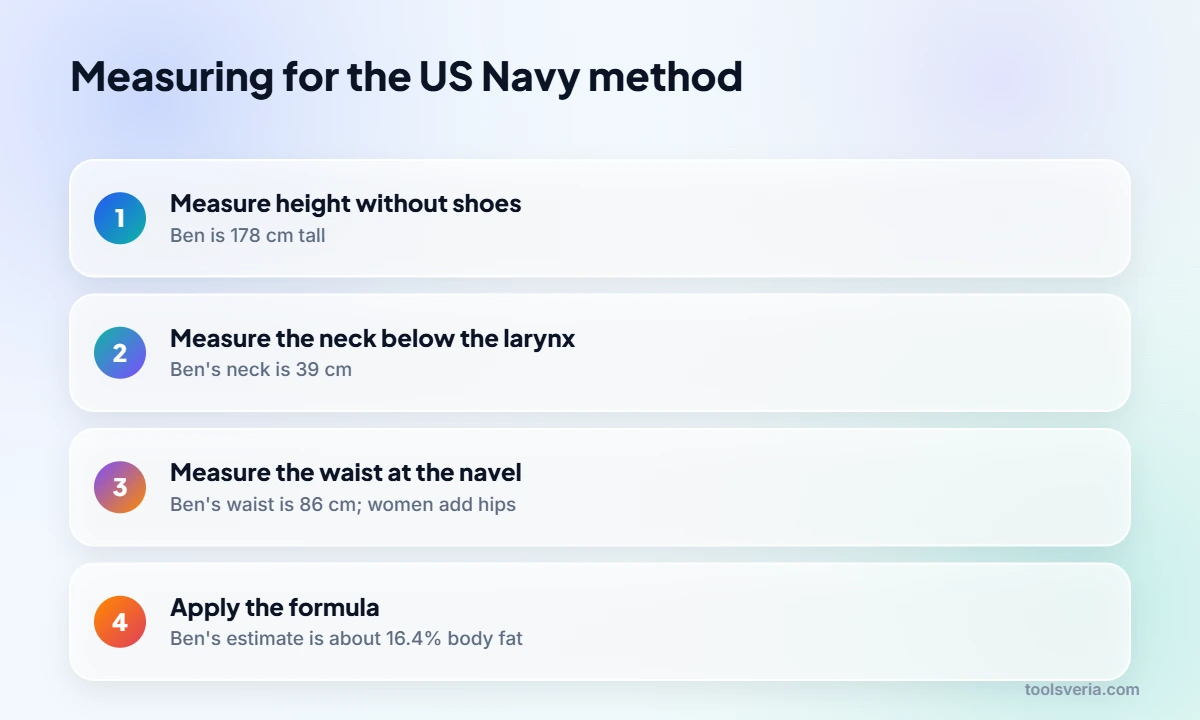
To calculate body fat percentage at home, measure your height, neck and waist (and hips if you are a woman) in centimetres, then put the figures into the US Navy formula or a calculator that uses it. Take each measurement on bare skin, standing relaxed, with the tape snug but not pressing in.
- Height: stand against a wall without shoes and mark the top of your head.
- Neck: measure just below the Adam’s apple, with the tape sloping slightly down at the front.
- Waist: men measure horizontally at the navel; women measure at the narrowest point, usually just above the navel. Breathe out normally first.
- Hips (women only): measure around the widest part of the buttocks.
- Repeat each measurement three times and use the average.
The metric formula for men is 495 divided by (1.0324 minus 0.19077 × log10 of waist minus neck, plus 0.15456 × log10 of height), then minus 450. For women it is 495 divided by (1.29579 minus 0.35004 × log10 of waist plus hips minus neck, plus 0.22100 × log10 of height), then minus 450. The logarithms are why most people use the body fat calculator rather than a pocket calculator.
Worked examples for a man and a woman
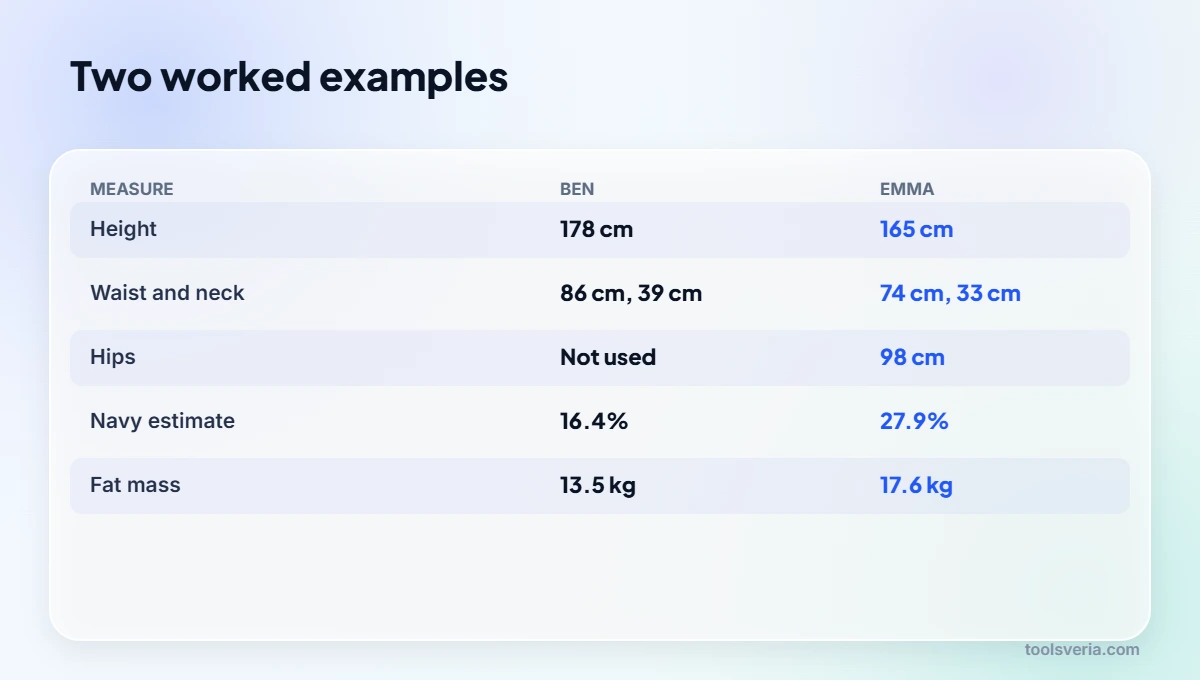
Ben is 178 cm tall with an 86 cm waist and a 39 cm neck. Waist minus neck is 47 cm. Putting those values through the men’s formula gives about 16.4% body fat. At 82 kg, that is roughly 13.5 kg of fat and 68.5 kg of lean mass, which fits his active lifestyle far better than his BMI label suggests.
Emma is 29, 165 cm tall and weighs 63 kg, with a 74 cm waist, 98 cm hips and a 33 cm neck. Waist plus hips minus neck is 139 cm. The women’s formula gives about 27.9%, or roughly 17.6 kg of fat and 45.4 kg of lean mass. That sits within the typical range for women.
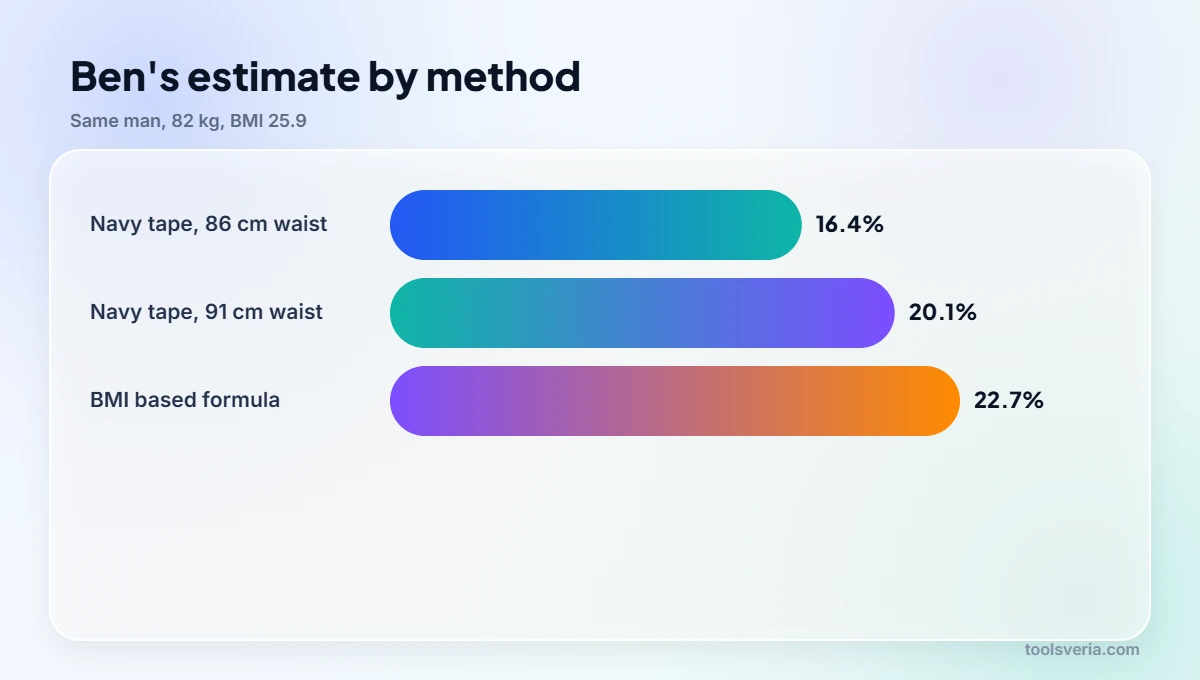
The tape method is sensitive to the waist figure. If Ben’s waist had measured 91 cm instead of 86 cm, his estimate would jump to about 20.1%. A 5 cm difference can come from measuring at the wrong height or pulling the tape tight, which is why the three measurement average matters more than any single reading.
What is a healthy body fat percentage?
There is no single official cut off, but the ranges published by the American Council on Exercise are widely used: about 14 to 24% for typical healthy men and 21 to 31% for typical healthy women. The NHS does not set body fat targets; it uses BMI and waist size instead.
| Category (ACE) | Men | Women |
|---|---|---|
| Essential fat | 2 to 5% | 10 to 13% |
| Athletes | 6 to 13% | 14 to 20% |
| Fitness | 14 to 17% | 21 to 24% |
| Average | 18 to 24% | 25 to 31% |
| Obese | 25% and above | 32% and above |
On that scale Ben’s 16.4% falls in the fitness band and Emma’s 27.9% in the average band. These categories do not adjust for age, and body fat tends to rise gradually through adulthood, so treat them as a rough guide rather than a target. Very low body fat is not healthier; dropping toward essential levels can disrupt hormones and, in women, periods.
How does the tape method compare with BMI and other methods?
The tape method is cheaper than lab tests and usually more informative than BMI for active people, but it is still an estimate. BMI based formulas, such as the Deurenberg equation (1.20 × BMI plus 0.23 × age, minus 10.8 for men, minus 5.4), cannot tell muscle from fat. For Ben, that equation gives about 22.7%, six points higher than the tape, because his extra weight is mostly muscle.
| Method | What it needs | Strengths | Limits |
|---|---|---|---|
| US Navy tape | Tape measure | Free, repeatable at home | Sensitive to measuring technique |
| BMI based formula | Height, weight, age | No measuring needed | Overestimates fat in muscular people |
| Smart scales (bioimpedance) | Scale with metal pads | Quick daily readings | Changes with hydration and meals |
| Skinfold callipers | Callipers and a trained tester | Cheap and portable | Depends heavily on tester skill |
| DEXA scan | Clinic or research scanner | Detailed regional breakdown | Cost and a small X ray dose |
Whichever method you choose, stick with it. Trends from the same method under the same conditions are more useful than comparing a tape figure with a smart scale reading taken after a glass of water. If you want to check your BMI alongside the tape result, the BMI calculator takes either metric or imperial units.
Using your result to plan changes
Your lean mass figure is useful for planning. Because muscle drives most of your resting energy use, knowing it helps when you estimate daily calories with a TDEE calculator and set protein targets. If you want to lose fat, a moderate calorie deficit combined with strength training helps protect lean mass while fat comes down.
Waist size is worth tracking on its own too. The NHS guidance on obesity notes that men with a waist of 94 cm or more and women with 80 cm or more are more likely to develop obesity related health problems. Measure every two to four weeks rather than daily, since small changes are hidden by measuring error. If your result is very high or very low, or you are pregnant, under 18 or managing a medical condition, talk to your GP before making changes.
Key points
- The US Navy formula uses height, neck and waist, plus hips for women.
- Ben, 178 cm with an 86 cm waist and 39 cm neck, comes out at about 16.4%.
- ACE ranges put typical healthy men at 14 to 24% and women at 21 to 31%.
- BMI based formulas overestimate fat in muscular people, by six points for Ben.
- A 5 cm waist measuring error can shift a tape estimate by nearly four points.
Key Body Fat Percentage Terms Explained
These terms explain the measurements, formulas and categories behind any answer when you learn how to calculate body fat percentage at home or in a clinic.
- US Navy method
- A tape measure formula using height, neck and waist, plus hips for women, with logarithms of those values. For Ben, 178 cm tall with an 86 cm waist, it gives about 16.4%.
- Lean body mass
- Everything in the body that is not fat, including muscle, bone, organs and water. Ben weighs 82 kg at 16.4% fat, so his lean mass is roughly 68.5 kg.
- Essential fat
- The minimum fat needed for normal body function such as hormone production. ACE puts it at roughly 2 to 5% for men and 10 to 13% for women.
- Body mass index
- Weight in kilograms divided by height in metres squared. It ignores body composition, so Ben’s BMI of 25.9 reads as overweight even though his tape estimate sits in the fitness band.
- Dual energy X ray absorptiometry
- A DEXA scan that measures fat, lean tissue and bone separately, region by region. It is more detailed than a tape measure but costs money and involves a small X ray dose.
Frequently Asked Questions
How accurate is the tape measure method?
It is a reasonable estimate for most healthy adults but not a precise measurement. Results depend heavily on technique, and very muscular or very lean people may get less reliable figures. For a detailed reading, a DEXA scan is the more thorough option.
My smart scale says 22% but the tape says 17%. Which is right?
Neither is exact, as both are estimates using different assumptions. Smart scales vary with hydration, meals and exercise. Pick one method, measure under the same conditions each time, and follow the trend rather than the single number.
Why do women need a higher body fat percentage than men?
Women carry more essential fat, roughly 10 to 13% compared with 2 to 5% for men, which supports hormone production and reproductive health. That is why every range for women sits several points higher.
Can I use inches instead of centimetres?
Yes. The Navy method has an imperial version with different constants, and it gives the same answer when used correctly. Ben’s measurements entered in inches also produce about 16.5%. Never mix units within one calculation.
How often should I measure my body fat?
Every two to four weeks is enough. Measure at the same time of day, ideally in the morning before eating, and take three readings each time, because small day to day changes are smaller than normal measuring error.
Is BMI or body fat percentage better for checking my health?
They answer different questions. BMI is a quick screening tool used by the NHS, while body fat percentage shows composition. Using both, along with waist size, gives a fuller picture than either one alone, especially for active people like Ben.
Ben now knows his 16.4% body fat puts him in the fitness band despite a BMI of 25.9, and Emma’s 27.9% sits within the typical range. Knowing how to calculate body fat percentage with a tape gives you a free, repeatable check, but it is an estimate for healthy adults, not medical advice. Figures checked October 2026.