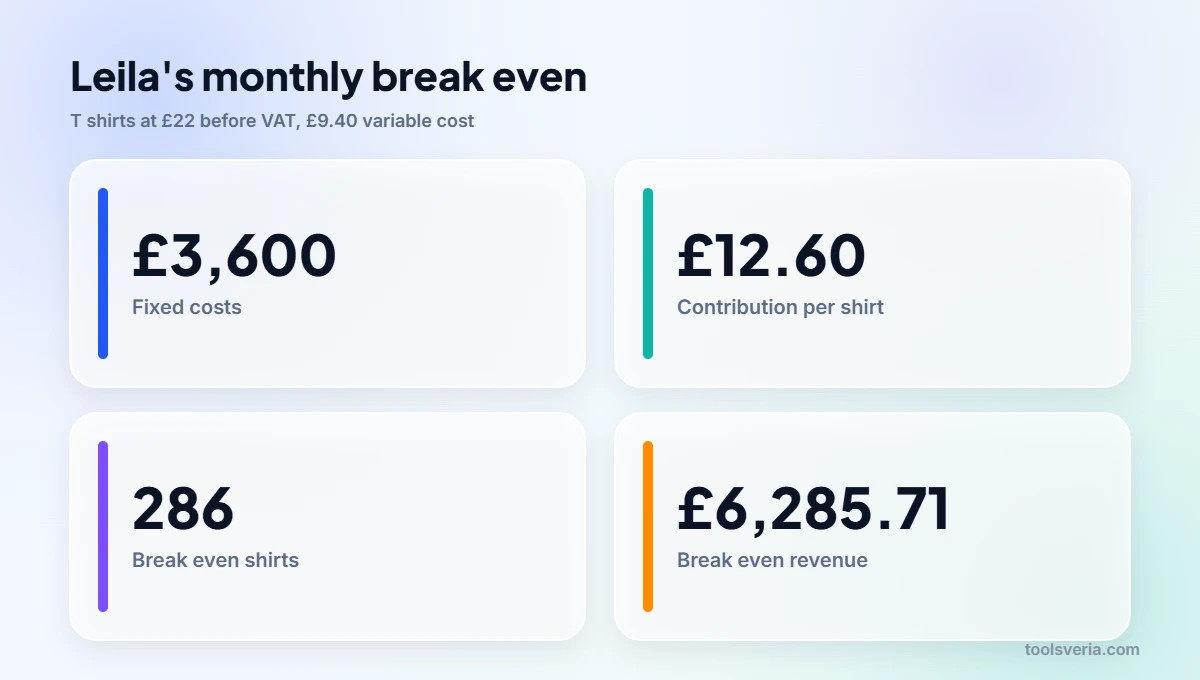
Leila runs a small T shirt printing business from a rented unit. Her overheads come to £3,600 a month whether she prints one shirt or a thousand, and each shirt sells for £22 before VAT. Knowing how to calculate break even point tells her exactly how many shirts she must sell each month before she earns a penny of profit. The same method works for a café in Dublin, a consultant in Texas or an online shop anywhere.
This guide covers break even in units and in sales revenue, then uses Leila’s numbers to test a price rise, a cost cut, a profit target and a mixed product range.
Quick answer: To calculate the break even point, divide your fixed costs by the contribution margin per unit, which is the selling price minus the variable cost per unit. Leila’s £3,600 of monthly fixed costs divided by £12.60 (£22 minus £9.40) is 285.7, so she must sell 286 shirts a month to break even. Checked October 2026.
In This Guide
What is the break even point?
The break even point is the level of sales at which total revenue exactly equals total costs, so the business makes neither a profit nor a loss. Every sale beyond it adds profit; every sale short of it leaves a loss.
Two kinds of cost drive the answer. Fixed costs stay the same each month regardless of sales: Leila’s unit rent, insurance, software subscriptions and equipment finance total £3,600. Variable costs rise with every item sold: her blank shirt (£4.20), ink (£1.10), packaging (£0.90) and postage with card fees (£3.20) add up to £9.40 a shirt. The Wikipedia article on the break even point shows the classic chart where the total cost and revenue lines cross.
How to calculate break even point in units
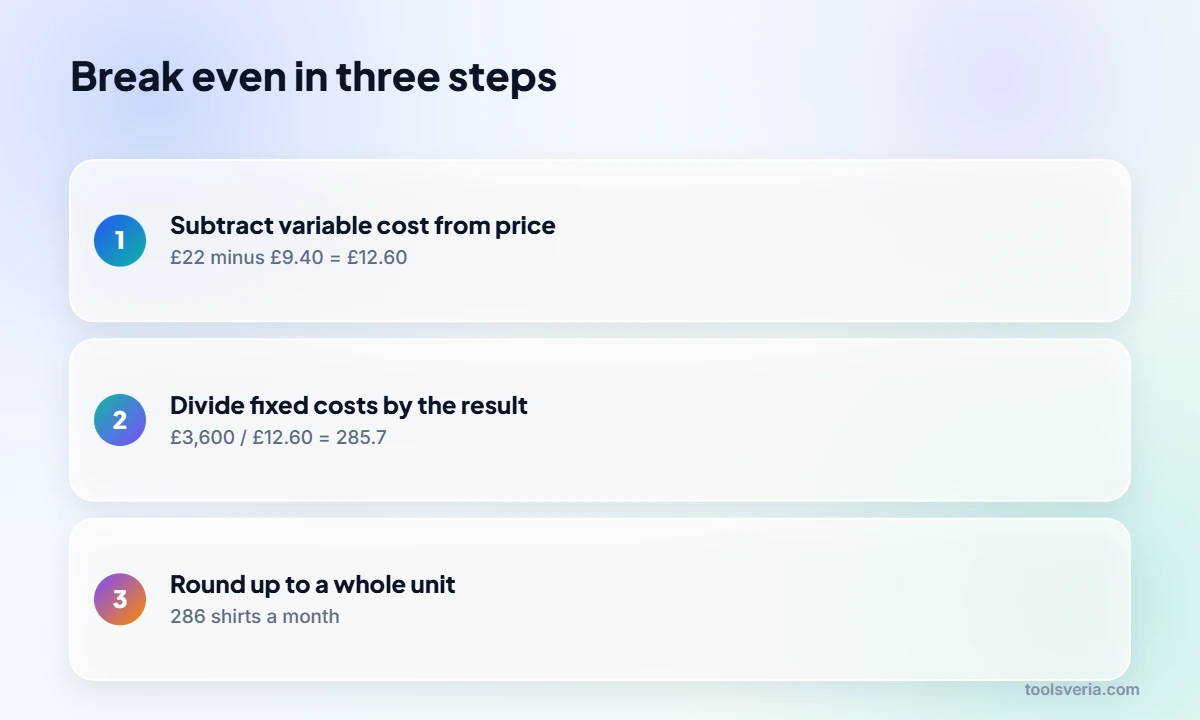
Break even in units equals fixed costs divided by the contribution margin per unit, and you always round the answer up to the next whole unit. The contribution margin is what each sale leaves over, after its own variable costs, to pay towards the fixed costs.
- Find the contribution margin: £22 minus £9.40 is £12.60 per shirt.
- Divide fixed costs by it: £3,600 divided by £12.60 is 285.7.
- Round up: Leila needs 286 shirts a month, because 285 would leave her a few pounds short.
Check the result by building a mini profit and loss. 286 shirts bring in £6,292. Variable costs are 286 × £9.40, which is £2,688.40. Add the £3,600 of fixed costs and total costs reach £6,288.40, leaving a profit of £3.60. That is break even, give or take one shirt. Our break even calculator runs the same check for any figures you enter.
How do you calculate break even in sales revenue?
Break even in sales revenue equals fixed costs divided by the contribution margin ratio, which is the contribution margin per unit divided by the selling price. This version suits businesses that sell many different items or think in turnover rather than units.
Leila’s contribution margin ratio is £12.60 divided by £22, or 57.3%. In other words, 57.3p of every pound of sales goes towards fixed costs and profit. Her break even revenue is £3,600 divided by 0.5727, which is £6,285.71 a month. A café owner who knows food and drink costs average 35% of sales can do the same in one line: a 65% margin ratio against £9,750 of monthly overheads gives a break even turnover of £15,000.
Use prices without VAT or sales tax, because that money belongs to the government, not the business. In the UK the standard rate is 20%, listed on the GOV.UK VAT rates page, so Leila’s £22 shirt sells for £26.40 including VAT. Plugging £26.40 into the formula would understate her true break even point badly. Our VAT calculator strips the tax out of a gross price in one step.

How do price and cost changes move the break even point?
Raising prices or cutting variable costs lowers the break even point by widening the contribution margin, while higher fixed costs raise it. Small changes have a surprisingly large effect, which makes break even analysis a quick way to test decisions before making them.
| Scenario | Contribution per shirt | Break even shirts a month | Change from today |
|---|---|---|---|
| Today: £22 price, £9.40 variable, £3,600 fixed | £12.60 | 286 | None |
| Price rises to £24 | £14.60 | 247 | 39 fewer |
| Variable cost falls £1 to £8.40 | £13.60 | 265 | 21 fewer |
| Fixed costs rise £600 to £4,200 | £12.60 | 334 | 48 more |
| Target profit of £2,000 a month | £12.60 | 445 | 159 more |
The profit target row uses the same formula with the target added to fixed costs: £3,600 plus £2,000, divided by £12.60, is 444.4, so 445 shirts. A £2 price rise cuts the break even point by about 14%, which is why pricing deserves as much attention as cost cutting. Before raising prices, compare your markup and margin with our profit margin calculator so you know what customers are already paying for.
What is the margin of safety?
The margin of safety is the gap between actual or expected sales and break even sales, usually shown as a percentage of actual sales. It tells you how far sales could fall before the business starts losing money.
Leila sold 400 shirts last month. Her margin of safety is 400 minus 285.7, about 114 shirts, which is 28.6% of her sales. Sales could drop by more than a quarter before she slips into a loss. A business with a margin of safety under 10% has very little room for a slow month, a supplier price rise or a lost customer.
How do you find break even with several products or services?
With several products, use a weighted average contribution margin based on your typical sales mix, then divide fixed costs by it. Service businesses use hours or projects as their unit instead of items.
Suppose 70% of Leila’s orders are T shirts (£12.60 margin) and 30% are hoodies (£18 margin). The weighted margin is 0.7 × £12.60 plus 0.3 × £18, which is £14.22. Break even is £3,600 divided by £14.22, or 254 items a month, about 178 shirts and 76 hoodies. If the mix shifts towards shirts, the break even number rises again. A freelance designer in the US with $4,000 of monthly fixed costs, an $85 hourly rate and $10 of variable cost per hour needs 54 billable hours a month to break even.
Key points
- Break even units equal fixed costs divided by the selling price minus variable cost per unit.
- Leila needs 286 shirts a month to cover £3,600 of fixed costs at a £12.60 margin.
- Break even revenue equals fixed costs divided by the contribution margin ratio, £6,285.71 for Leila.
- Always use prices excluding VAT or sales tax in break even calculations.
- A £2 price rise lowers Leila’s break even point from 286 to 247 shirts.
Key Break Even Terms Explained
These are the figures you need once you know how to calculate break even point for a product, a service or a mixed range.
- Fixed costs
- Costs that stay the same each month whatever the sales volume, such as rent, insurance and software. Leila’s total £3,600, and they are the amount the contribution margin must cover before profit begins.
- Variable costs
- Costs that rise with every unit sold, such as materials, packaging, postage and card fees. Leila’s come to £9.40 a shirt, made up of the blank shirt, ink, packaging and delivery.
- Contribution margin
- The selling price minus the variable cost per unit, showing what each sale adds towards fixed costs and profit. At £22 less £9.40, every shirt Leila sells contributes £12.60.
- Contribution margin ratio
- The contribution margin divided by the selling price, expressed as a percentage. Leila’s is 57.3%, and dividing fixed costs by it gives her break even revenue of £6,285.71 a month.
- Margin of safety
- The amount by which actual sales exceed break even sales, usually as a percentage of actual sales. With 400 shirts sold against a break even of 285.7, Leila’s margin of safety is 28.6%.
Frequently Asked Questions
Should I include my own salary in fixed costs?
Yes, if you need to draw a regular income, include it in fixed costs. Otherwise your break even point only covers the business’s bills, and you could be breaking even while earning nothing yourself for your time.
Is break even the same as payback period?
No. Break even is the monthly sales level where profit is zero, while payback period is how long it takes to recover a one off investment. Leila’s new £6,000 printer pays back in about 21 months if it adds £290 of monthly profit.
What if my price is lower than my variable cost?
Then there is no break even point, because every sale loses money and selling more only deepens the loss. Raise the price, cut the variable cost, or drop the product before worrying about fixed costs.
How often should a small business recalculate break even?
Recalculate whenever prices, supplier costs or overheads change, and at least once a quarter. Energy bills, rent reviews and postage increases can all push the break even point up quietly over a year.
Leila now checks her break even figure every quarter and knows that 286 shirts is her floor, not her goal. Now that you know how to calculate break even point in units and revenue, enter your own costs in the calculator and test a price change before you make it. Examples checked October 2026.