Sophie’s last period started on Tuesday 3 November 2026 and her cycles run like clockwork at 28 days. Her sister Amara has longer, 33 day cycles, and their friend Leah never knows whether hers will be 26 days or 34. All three want to know how to calculate ovulation, and the same simple sum gives each of them a different answer.
Ovulation is not fixed to “day 14”. It depends on when your next period is due, and the gap before that period is the steadier half of the cycle. Below are the sum, real dates for each of the three, a table for cycle lengths from 24 to 35 days, and an honest look at what the calendar can and cannot tell you.
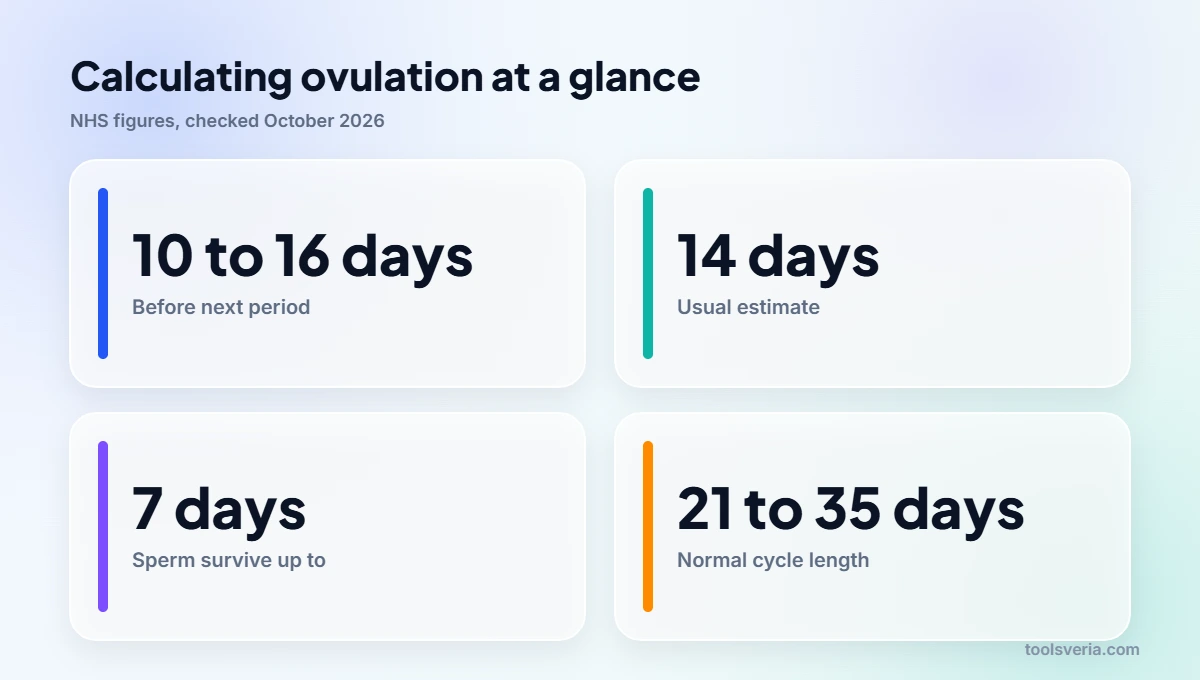
Quick answer: To calculate ovulation, take the date your next period is due and count back 14 days. With a 28 day cycle that falls about 14 days after your period starts. The NHS says ovulation usually happens 10 to 16 days before the next period, and your most fertile days are the 5 days before ovulation plus the day itself.
In This Guide
How do you calculate ovulation from your cycle length?
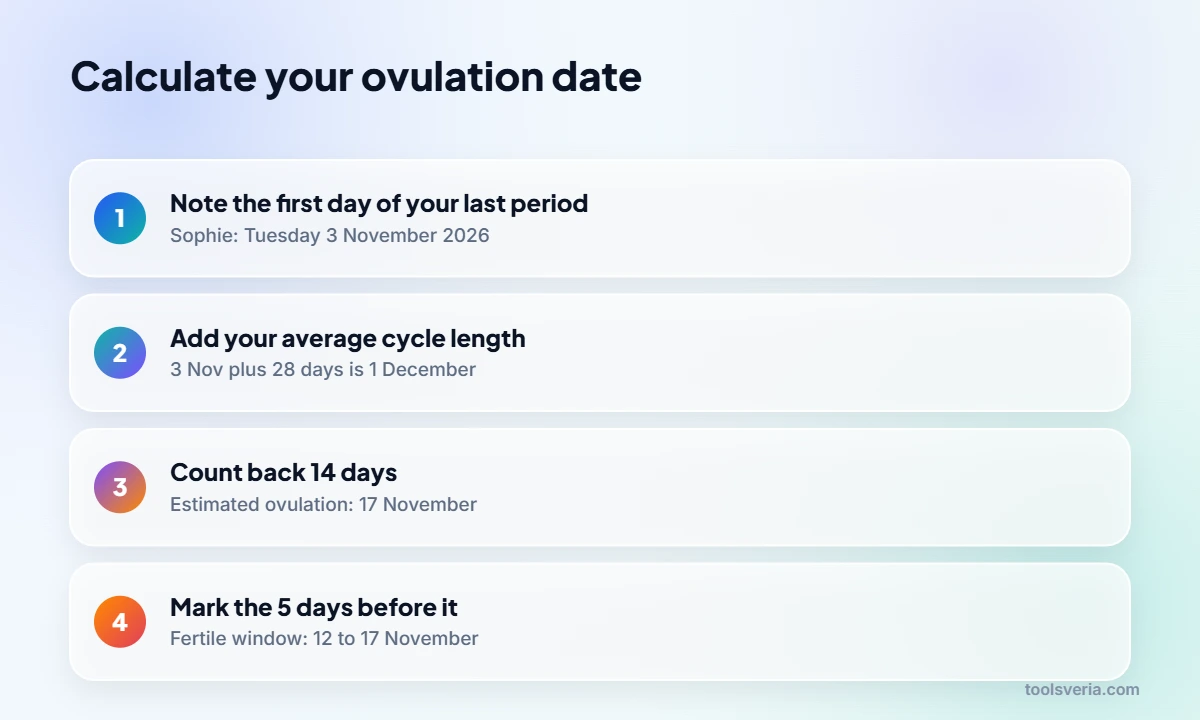
You calculate ovulation by adding your cycle length to the first day of your last period, which gives the date your next period is due, and then subtracting 14 days. In plain words: ovulation date equals first day of last period, plus cycle length, minus 14.
The 14 comes from the luteal phase, the stretch between releasing an egg and the next bleed, which stays fairly constant from month to month. The NHS page on fertility in the menstrual cycle puts ovulation at around 10 to 16 days before the next period for most women, so 14 is the midpoint rather than a guarantee.
Sophie’s period started on 3 November. Adding 28 days brings her next period to Tuesday 1 December, and counting back 14 days lands on Tuesday 17 November. Using the NHS range, her ovulation could fall anywhere from 15 to 21 November, which is why the days around the estimate matter as much as the date itself.
Amara’s 33 day cycle shows why “day 14” misleads. Her period began on 5 November, so her next is due on 8 December and her estimated ovulation is 24 November, a full 19 days after her period started. If she had relied on the day 14 rule, she would have aimed five days too early. Counting days by hand is fiddly, so our days between dates calculator is handy for checking the gaps between periods before you trust any estimate.
| Cycle length | Estimated ovulation (days after period starts) | Most fertile days (days after period starts) | NHS range (days after period starts) |
|---|---|---|---|
| 24 days | 10 | 5 to 10 | 8 to 14 |
| 26 days | 12 | 7 to 12 | 10 to 16 |
| 28 days | 14 | 9 to 14 | 12 to 18 |
| 30 days | 16 | 11 to 16 | 14 to 20 |
| 32 days | 18 | 13 to 18 | 16 to 22 |
| 35 days | 21 | 16 to 21 | 19 to 25 |
How do you work out your average cycle length?
Your cycle length is the number of days from the first day of one period to the day before the next one starts, and your average is the total of several cycles divided by how many you counted. Three months is the minimum for a useful average; six is better.
Amara logged cycles of 32, 34 and 33 days over the summer. Those add up to 99, and 99 divided by 3 gives an average of 33 days, the figure she uses above. Had she guessed 28, every estimate would have landed five days early. The NHS describes cycles anywhere from 21 to 35 days as normal, with 28 as the average, so a cycle that is not 28 days is nothing unusual.
Keeping a record makes every later step more accurate. Our online period tracker stores start dates and works out your average and shortest and longest cycles for you, which you need for the irregular cycle method further down.

When is your fertile window?
Your fertile window covers six days: the five that lead up to ovulation and ovulation day itself. It starts so early because the NHS notes that sperm can survive for up to 7 days inside the body, while the egg itself lives only for roughly 12 to 24 hours after release.
For Sophie that means 12 to 17 November, with the two or three days just before 17 November the most likely to lead to pregnancy. Amara’s window is 19 to 24 November. Because ovulation can drift by a day or two either side, many couples simply aim for sex every 2 or 3 days throughout the cycle rather than timing one particular day.
The same sum tells you when a test is worth taking. The NHS says most pregnancy tests work from the first day of a missed period, so Sophie could test from 1 December, or 21 days after unprotected sex if her period timing is unclear.
How to calculate ovulation with irregular periods
With irregular periods, you calculate a wider fertile window using your shortest and longest recent cycles: subtract 18 from the shortest cycle to find the first fertile day, and subtract 11 from the longest to find the last. Day 1 is the first day of bleeding.
This is the classic calendar rule used for decades and set out in the overview of calendar based methods. Leah’s last six cycles ranged from 26 to 34 days. Her first likely fertile day is day 8 (26 minus 18) and her last is day 23 (34 minus 11). With a period starting on Monday 2 November, that covers 9 to 24 November, a 16 day stretch.
A window that long is honest but not very precise, so Leah adds body signs to narrow it down. Very irregular cycles, periods more than 35 days apart, or months with no period at all can point to conditions such as polycystic ovary syndrome or thyroid problems, and are worth raising with a GP rather than trying to calculate around.
How can you tell if you have ovulated?
You can tell ovulation is close or has happened from three body signs: clearer, wetter and stretchy cervical mucus before it, a positive result on an LH urine test a day or so before it, and a small, sustained rise in resting body temperature after it.
- Cervical mucus: becomes slippery, like raw egg white, in the days before ovulation.
- Ovulation test kits: detect the surge in luteinising hormone (LH) that comes shortly before the egg is released.
- Basal body temperature: rises slightly after ovulation, so it confirms ovulation has passed rather than predicting it.
Combining the calendar estimate with one of these signs works best. Sophie starts LH tests on 13 November, four days before her estimated date, rather than testing all month. Calendar estimates and these signs are not a reliable form of contraception on their own; speak to a GP, practice nurse or sexual health clinic if you want to avoid pregnancy.
When should you see a GP about ovulation or fertility?
You should see a GP if you have not conceived after a year of trying, or sooner if you are 36 or over or already suspect a fertility problem. The NHS guidance on infertility also notes that more than 8 in 10 couples where the woman is under 40 conceive within a year with regular sex every 2 or 3 days.
Book an earlier appointment if your periods are very irregular, have stopped, are extremely painful or heavy, or if you have had pelvic infections or surgery. This guide explains the general calculation for healthy adults and is not medical advice; a GP can arrange blood tests that confirm whether you are ovulating at all.
Key points
- Ovulation is usually about 14 days before your next period, so it equals first day of last period plus cycle length minus 14.
- The NHS says ovulation happens around 10 to 16 days before the next period in most women.
- The fertile window is the 5 days before ovulation plus ovulation day, because sperm can survive up to 7 days.
- With irregular cycles, subtract 18 from your shortest cycle and 11 from your longest to find a wider fertile window.
- The NHS advises seeing a GP after a year of trying, or sooner if you are 36 or over.
What the Key Ovulation Terms Mean
These terms explain the cycle stages behind how to calculate ovulation, so you can see why the estimate counts back from your next period date.
- Ovulation
- The release of a mature egg from an ovary partway through the menstrual cycle. After release the egg can be fertilised for only a short time, so knowing its likely date is the basis of every fertility calendar.
- Luteal phase
- The part of the cycle from ovulation to the start of the next period, during which the emptied follicle produces hormones that prepare the womb lining. Its length is fairly steady, which is why the sum counts back 14 days.
- Follicular phase
- The first part of the cycle, running from the first day of bleeding until ovulation, while an egg matures inside its follicle. Its length varies more than the luteal phase, so longer cycles push ovulation later.
- Menstrual cycle length
- The count of days from the first day of one period up to the day before the next begins. Averaging at least three cycles gives a steadier figure, since a single month can be shorter or longer than usual.
- Fertile window
- The six day stretch in each cycle when intercourse can lead to pregnancy, made up of the five days before ovulation and ovulation day. It is shaped by how long sperm survive compared with the short life of the egg.
Frequently Asked Questions
My cycle is 35 days. Do I still ovulate on day 14?
No, with a 35 day cycle ovulation is more likely around 21 days after your period starts, because it usually happens about 14 days before the next period. Your most fertile days would be roughly days 16 to 21 after your period begins.
I came off the pill last month. Can I calculate ovulation yet?
You can, but treat the first estimates loosely, because cycles can take a few months to settle after stopping hormonal contraception. Record at least three natural cycles, then use their average length; until then, LH tests give a better guide than the calendar alone.
Is the day after ovulation still fertile?
Only briefly, because the egg survives for roughly 12 to 24 hours after release. Chances fall sharply after ovulation day, which is why sex in the 2 or 3 days before ovulation gives the best odds, with sperm already waiting.
When should I take a pregnancy test if I ovulated on 17 November?
Test from the first day of your missed period, which for a 14 day luteal phase is around 1 December. The NHS says most tests are reliable from then; if your periods are unpredictable, test 21 days after the unprotected sex instead.
Sophie now has 17 November circled, Amara knows to look a week later than she thought, and Leah has a realistic window plus test strips to narrow it. Put your own dates into the calculator, keep logging your cycles and talk to a GP if anything about your periods worries you. Figures checked October 2026.