Priya is lining a round garden pond that measures 2.4 metres across, and the liner is sold by the square metre. Her friend in Ohio is pricing a circular patio in square feet. Both need the area of a circle, and both can get it from a single tape measurement in under a minute. Whether you start from the radius, the diameter or the distance around the edge, one formula does the work.
This guide covers all three starting points, metric and imperial units, part circles and rings, and a quick check on how much rounding pi really matters.
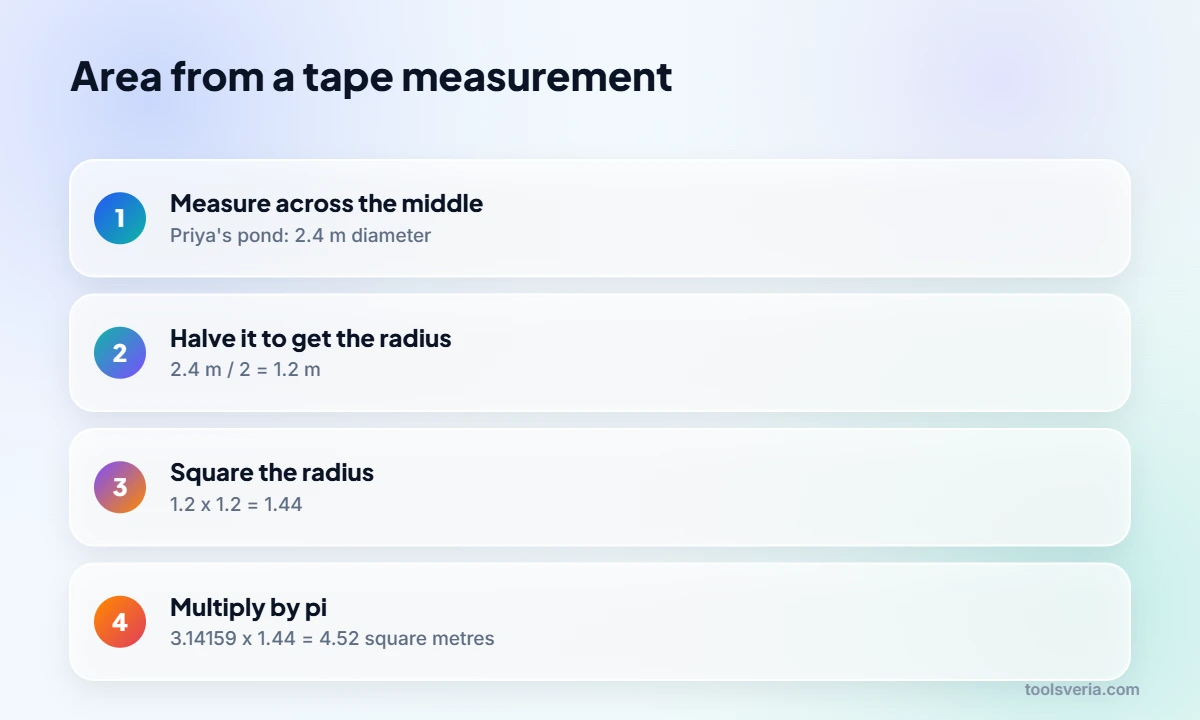
Quick answer: The area of a circle is pi multiplied by the radius squared, written A = πr². Pi is about 3.14159. Priya’s pond is 2.4 m across, so the radius is 1.2 m, the radius squared is 1.44, and the area is 3.14159 × 1.44 = 4.52 square metres, or about 48.7 square feet. Checked October 2026.
In This Guide
What is the formula for the area of a circle?
The formula for a circle’s area is A = πr², meaning pi multiplied by the radius multiplied by itself. The radius is the distance from the centre to the edge, which is half of the diameter.
Why does pi appear? Imagine cutting the circle into many thin slices, like a pizza, and laying them alternately point up and point down. They form a shape close to a rectangle whose height is the radius and whose length is half the circumference, which is π times r. Multiply length by height and you get π times r times r. The more slices you cut, the closer the shape gets to a perfect rectangle. The Wikipedia article on the area of a circle shows this and other proofs, including one by Archimedes.
How to find the area of a circle from the diameter
To work out a circle’s area from the diameter, halve the diameter to get the radius and then use πr², or use the equivalent formula A = πd² divided by 4 in one step. Both give exactly the same answer.
Pizza is the classic test. Is one 12 inch pizza more food than two 8 inch pizzas? The 12 inch pizza has a radius of 6 inches, so its area is π × 36, about 113.1 square inches. Each 8 inch pizza has a radius of 4 inches and an area of π × 16, about 50.3 square inches, so the pair comes to 100.5 square inches. The single large pizza wins by about 12.6 square inches, even though 8 plus 8 looks bigger than 12.
The pizza result reveals the key rule: area grows with the square of the size. Double the diameter and the area becomes four times larger, not twice. That is why a 12 inch pizza holds 2.25 times as much as an 8 inch one.

How do you find the area from the circumference?
To find the area from the circumference, square the circumference and divide by 4π, which is about 12.566. This is useful when you can wrap a tape around something, such as a tree trunk or a round table, but cannot reach across its middle.
A circular rug has a circumference of 6 metres. Six squared is 36, and 36 divided by 12.566 is 2.86 square metres, or about 30.8 square feet. You can also go the long way: the radius is the circumference divided by 2π, which is 0.955 m, and π times 0.955 squared gives the same 2.86 m². Our circle calculator accepts the circumference directly and fills in the radius and diameter too.
The formula also runs backwards. If you know the area and need the radius, divide the area by π and take the square root. If you want a circular lawn of 50 m², the radius needs to be about 3.99 m, so a 4 metre rope pegged at the centre marks out its edge.
Area of a circle chart in metric and imperial units
Area is always given in square units, so a radius in metres gives square metres and a radius in inches gives square inches. To convert, 1 square metre equals 10.764 square feet, and 1 square foot equals 144 square inches.
| Radius | Diameter | Area | Area in other units |
|---|---|---|---|
| 15 cm | 30 cm | 707 cm² | 0.07 m² (about 110 sq in) |
| 1 m | 2 m | 3.14 m² | 33.8 sq ft |
| 1.2 m | 2.4 m | 4.52 m² | 48.7 sq ft |
| 5 m | 10 m | 78.5 m² | 845 sq ft |
| 4 in | 8 in | 50.3 sq in | 324 cm² |
| 6 in | 12 in | 113.1 sq in | 730 cm² |
| 10 ft | 20 ft | 314.2 sq ft | 29.2 m² |
Mixing units is the commonest error. Measure the radius in the unit you want the answer in, or convert the length first with our length converter. Converting an area afterwards needs the squared factor: 4.52 m² is 4.52 × 10.764, not 4.52 × 3.281.
How do you find the area of part of a circle?
To find the area of a semicircle, sector or other part circle, work out the area of the full circle and multiply it by the fraction you need: one half for a semicircle, one quarter for a quadrant, or the angle divided by 360 for a sector. A ring uses the difference between two circles.
- Semicircle: a half moon flower bed with a 3 m radius covers π × 9 ÷ 2, about 14.1 m².
- Sector: a 60 degree slice of a circle with a 4 m radius covers 60/360 × π × 16, about 8.4 m².
- Ring (annulus): a gravel path between circles of radius 5 m and 4 m covers π × (25 minus 16), about 28.3 m².
Garden and DIY jobs often combine shapes, such as a rectangle with a semicircle on one end. Split the shape, find each part separately and add them up; our guide on how to calculate area covers rectangles, triangles and other common shapes.

Does it matter if you use 3.14 or 22/7 for pi?
Using 3.14 or 22/7 for pi changes the answer by less than 0.1%, which is fine for homework, gardening and DIY. For a circle with a 10 m radius, 3.14 gives 314.0 m², 22/7 gives 314.3 m² and the full value of pi gives 314.2 m².
Pi itself never ends and never repeats, as the Wikipedia article on pi explains, but engineering rarely needs more than a handful of digits. Exams often ask for answers “in terms of π”, which means leaving π as a symbol: a radius of 3 cm gives 9π cm². Follow the question’s instruction, and round only at the final step.
Key points
- The area of a circle is pi multiplied by the radius squared, A = πr².
- From the diameter, use π times the diameter squared divided by 4.
- From the circumference, square it and divide by 4π, about 12.566.
- A 2.4 m wide pond covers 4.52 m², which is about 48.7 square feet.
- Doubling the radius makes the area four times larger.
Key Area of a Circle Terms Explained
These terms appear whenever you work out the area of a circle, a semicircle, a sector or a ring in any unit.
- Radius
- The distance from the centre of a circle to its edge, equal to half the diameter. It is squared in the area formula, so Priya’s 1.2 m radius becomes 1.44 before it is multiplied by pi.
- Diameter
- The width of a circle measured straight through its centre, twice the radius. Using it directly, the area equals pi times the diameter squared divided by 4, which gives 113.1 square inches for a 12 inch pizza.
- Circumference
- The distance around the edge of a circle, equal to 2 times pi times the radius. Squaring it and dividing by about 12.566 gives the area, so a 6 m circumference encloses about 2.86 square metres.
- Pi
- The fixed ratio of any circle’s circumference to its diameter, about 3.14159. Rounding it to 3.14 or 22/7 changes a circle’s area by less than 0.1%, so either is fine for most practical work.
- Sector
- A slice of a circle bounded by two radii and the arc between them. Its area is the angle divided by 360, multiplied by the full circle’s area, so a 60 degree slice of a 4 m circle covers about 8.4 m².
Frequently Asked Questions
My pond liner needs an overlap. How much extra should I add?
A liner covers the depth as well as the surface, so area alone is not enough. Add twice the depth plus an overlap to the diameter before buying. For a 2.4 m pond 0.5 m deep with 0.3 m edging, buy a liner at least 4 m across.
Is area the same as circumference?
No, circumference is the length around the edge, measured in metres or feet, while area is the space inside, measured in square metres or square feet. A circle with a 1 m radius has a circumference of 6.28 m but an area of 3.14 m².
How many bags of grass seed do I need for a round lawn?
Find the lawn’s area first, then divide by the coverage printed on the bag. A lawn 10 m across has an area of 78.5 m², so seed sold to cover 25 m² per bag needs 4 bags, rounding up.
How do I find the volume of a round paddling pool?
Multiply the circle’s area by the water depth. A pool 3 m across filled to 0.3 m holds 7.07 m² × 0.3, which is 2.12 cubic metres or about 2,120 litres. Our volume calculator handles cylinders directly.
Priya bought liner for her 4.52 m² pond with a generous overlap, and the pizza question is settled for good. Measure once, halve the diameter, square it and multiply by pi, and the area of a circle is yours in either metric or imperial units. Formulas and examples checked October 2026.