A volume calculator for seven shapes, giving cubic metres, cubic feet, litres and gallons together.
1 m³ = 1,000 litres = 35.315 ft³ = 1.308 yd³. Use inside measurements for tanks and containers. For loose materials such as soil or gravel, order 5% to 10% extra for settling.
This volume calculator works out how much space a box, cube, cylinder, sphere, hemisphere, cone or pyramid holds, in metric and imperial units at once. It suits everyday jobs such as filling a raised bed, sizing a water tank, ordering concrete or checking a removal van, and it uses the standard volume formulas from geometry with every conversion to litres and gallons done for you.
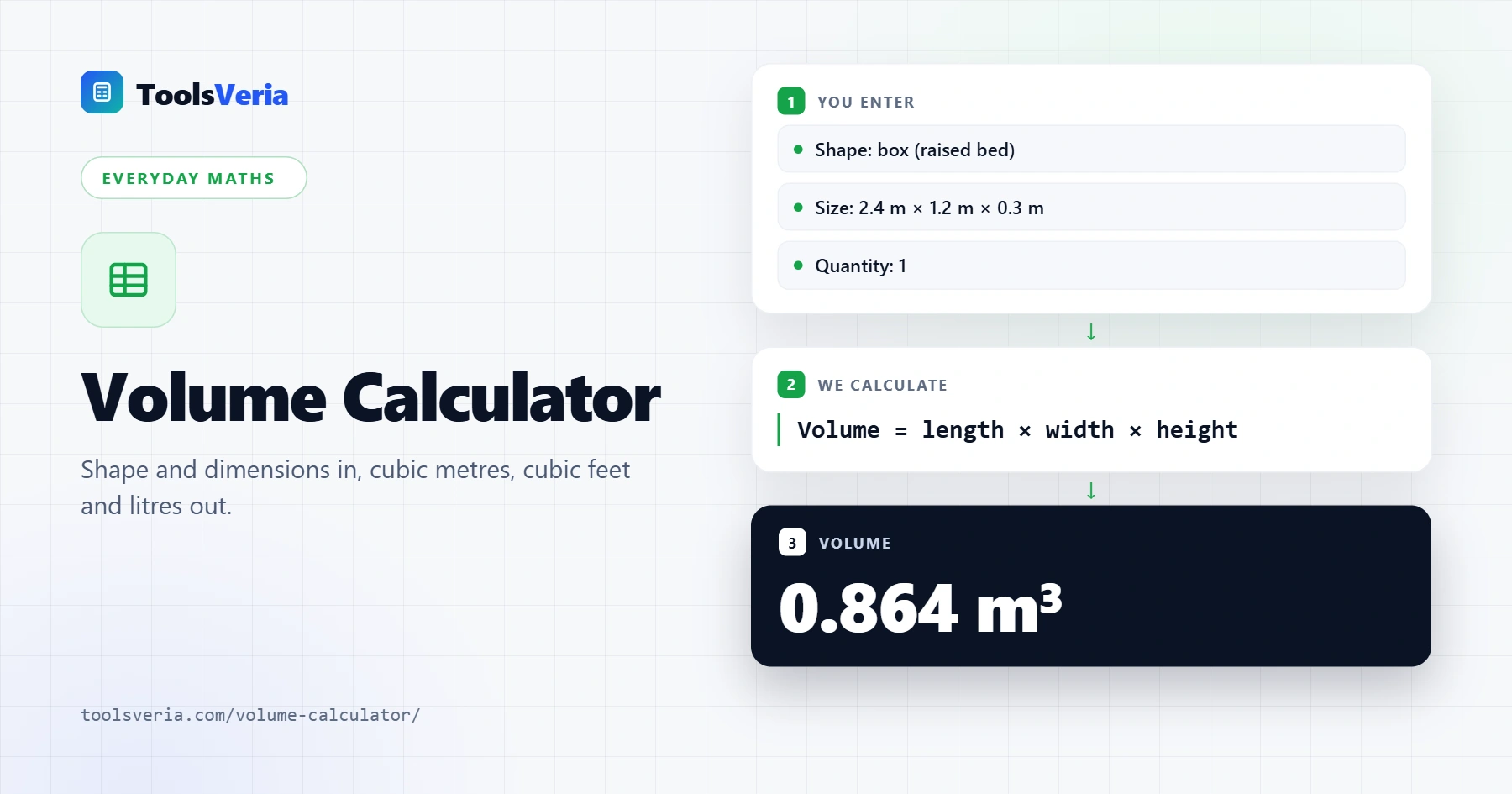
Quick answer: For a box or room, a volume calculator multiplies length × width × height. A raised bed 2.4 m long, 1.2 m wide and 0.3 m deep holds 0.864 m³, which is 864 litres or 30.5 cubic feet. A cylinder is π × radius² × height, and 1 m³ equals 1,000 litres.
In This Guide
What Is a Volume Calculator?
A volume calculator is a tool that measures how much three dimensional space a shape takes up, or how much it can hold, from a few lengths. Volume is measured in cubic units such as cubic metres (m³) and cubic feet (ft³), or in capacity units such as litres and gallons.
Every formula is an area times a height. A box is length × width × height, a cylinder is π × r² × h, a sphere is 4/3 × π × r³, and cones and pyramids are exactly one third of the matching cylinder or box. Because each length is multiplied three times, a small measuring error grows: 10% too long on every side gives a volume 33% too big.
How to Use the Volume Calculator
Step 1: Choose the Shape
In the volume calculator, pick box for rooms, planters, skips and tanks with flat sides, cylinder for water butts and pipes, sphere or hemisphere for balls and domes, and cone or pyramid for heaps and hoppers.
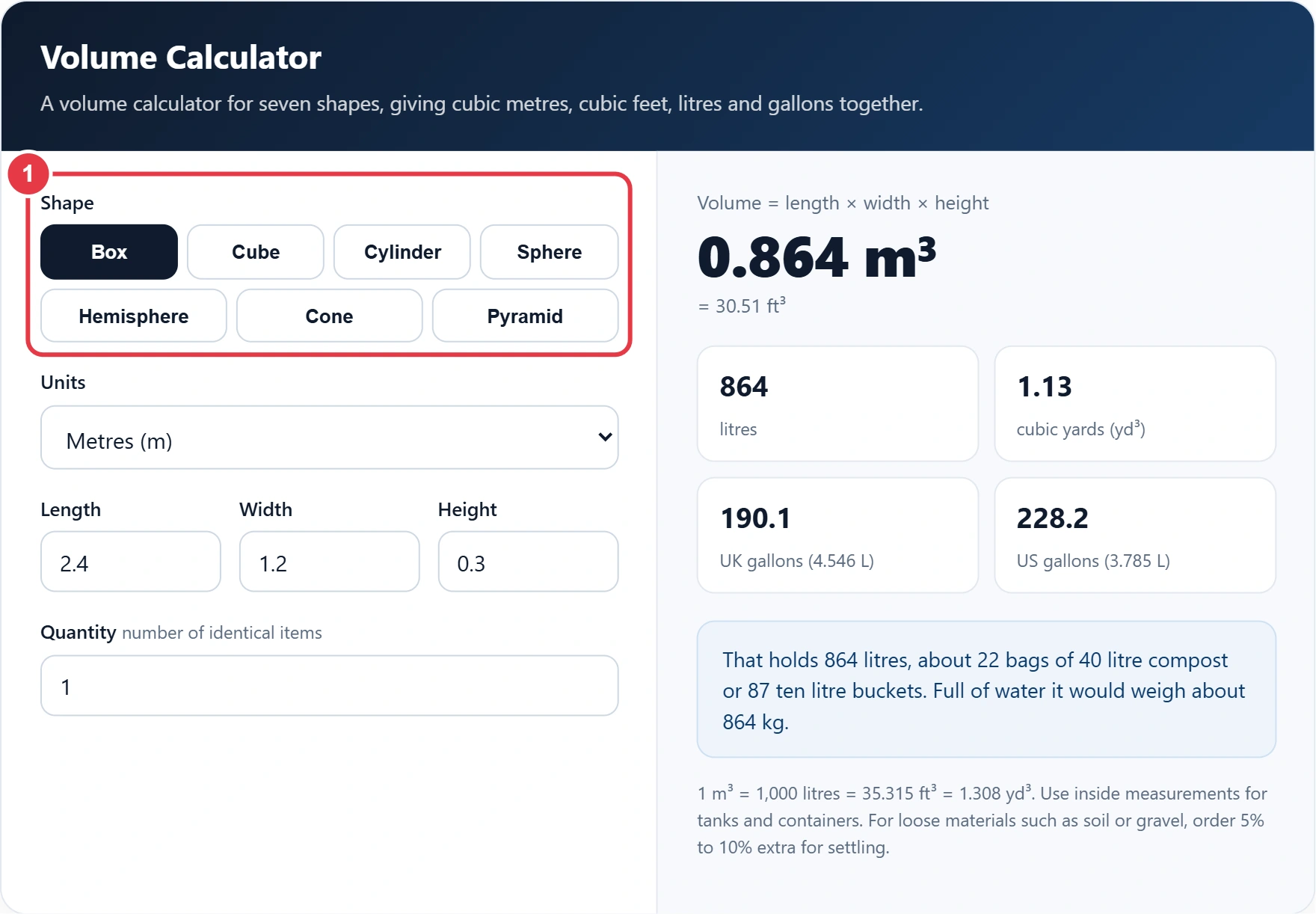
Step 2: Pick Units and Enter the Dimensions
Choose metres, centimetres, millimetres, feet, inches or yards, and use the same unit for every measurement. For round shapes enter the radius, which is half the diameter. If you need to convert a tape reading first, the length converter switches between feet, inches and metres.

Step 3: Set the Quantity
If you are filling several identical containers, such as four planters or six fence post holes, enter the number and the total is multiplied for you.
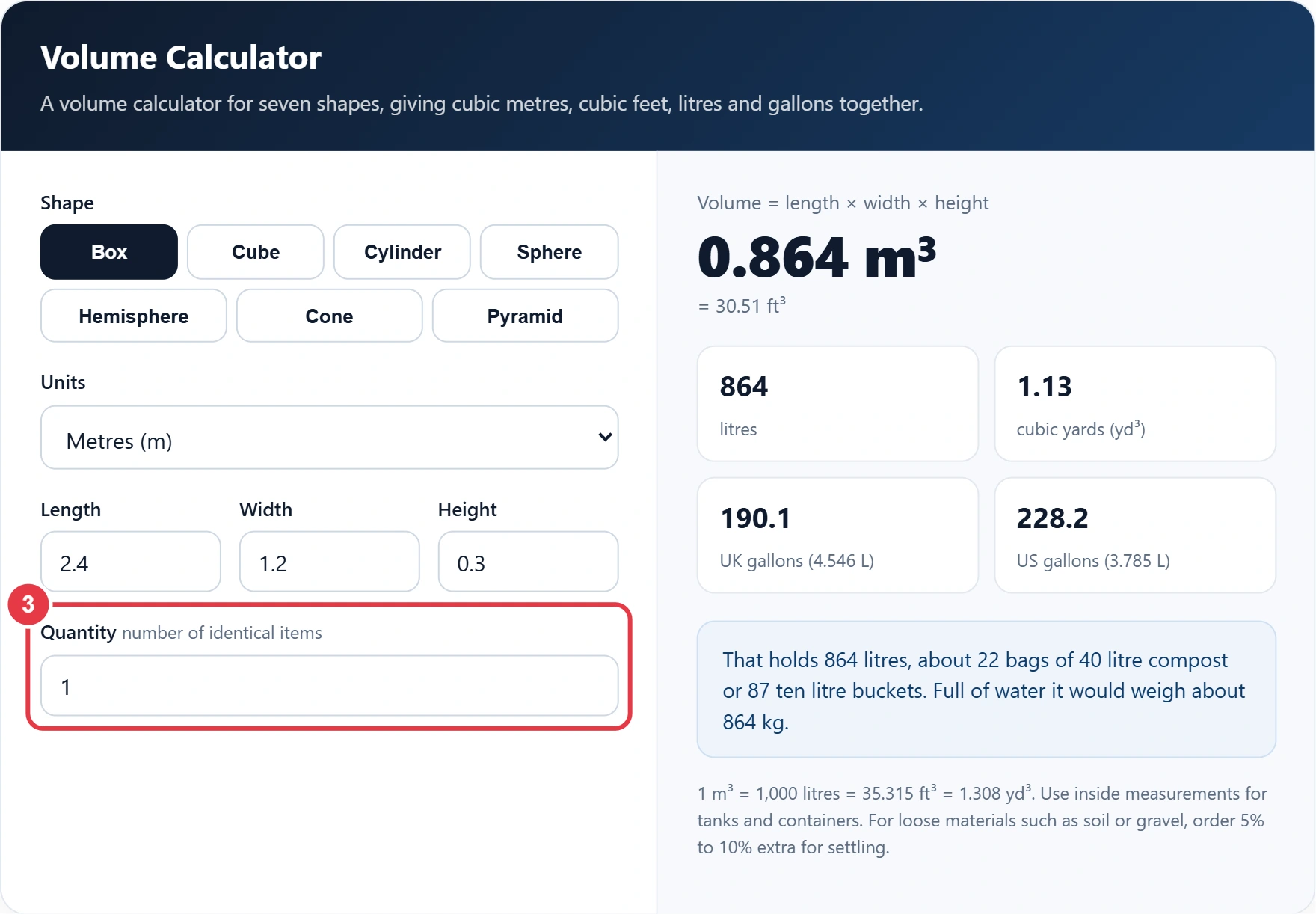
Step 4: Read the Results
The volume calculator shows cubic metres and cubic feet together, plus litres, cubic yards and UK and US gallons. The message box turns the answer into bags of compost, buckets and the weight of water, which helps with real orders.

How Do I Calculate Cubic Feet?
To calculate cubic feet, measure length, width and height in feet and multiply them; a box 4 ft by 2 ft by 2 ft is 16 cubic feet. If you measured in inches, multiply and divide by 1,728, and if you measured in metres, multiply cubic metres by 35.315. Used as a cubic feet calculator, the tool does this automatically.
Worked example: Raj is filling a raised bed 8 ft long, 4 ft wide and 1 ft deep. That is 8 × 4 × 1 = 32 ft³, which is 0.906 m³, 906 litres or 1.19 cubic yards. Compost sold in 40 litre bags means 906 ÷ 40 = 22.7, so he buys 23 bags, or 25 to allow for settling. The area calculator gives the bed's surface of 32 sq ft if he also needs weed membrane.
| Shape | Formula | Example | Volume |
|---|---|---|---|
| Box (cuboid) | l × w × h | 2.4 × 1.2 × 0.3 m | 0.864 m³ (864 L) |
| Cube | side³ | side 1 m | 1 m³ (1,000 L) |
| Cylinder | π × r² × h | r 0.3 m, h 0.9 m | 0.254 m³ (254 L) |
| Sphere | 4/3 × π × r³ | r 1 m | 4.19 m³ |
| Hemisphere | 2/3 × π × r³ | r 1 m | 2.09 m³ |
| Cone | 1/3 × π × r² × h | r 1 m, h 3 m | 3.14 m³ |
| Pyramid | 1/3 × l × w × h | 1 × 1 m base, h 3 m | 1 m³ |
How Many Litres Are in a Cubic Metre?
There are exactly 1,000 litres in one cubic metre, and one litre of water weighs about 1 kg, so a cubic metre of water weighs about a tonne. One cubic foot holds 28.32 litres, which is 6.23 UK gallons or 7.48 US gallons.
These links make the cubic metre calculator useful for tanks and ponds. A water butt with a 0.3 m radius and 0.9 m height holds 254 litres, about 56 UK gallons, and the cubic metre is the SI unit that ties litres, gallons and cubic feet together. For bigger capacity conversions the litre to gallon converter handles both gallon sizes, so you can compare a UK tank with a US product listing.
How Much Concrete, Soil or Gravel Do I Need?
Work out the volume of the hole, slab or bed in cubic metres, then add 5% to 10% for waste, uneven ground and settling. A shed base 3 m by 2 m and 0.1 m deep needs 0.6 m³ of concrete, so order about 0.65 m³. UK suppliers sell in cubic metres or tonne bags, while US suppliers quote cubic yards.
Loose materials weigh different amounts per cubic metre, so check the supplier's figure before ordering by weight. This volume calculator gives the cubic yards needed for US quotes, and the litres figure helps when materials come in bags.
Key Volume Calculation Terms Explained
These terms explain the units and formulas behind every volume calculator result, from cubic metres and cubic feet to litres and gallons.
- Cubic metre
- The SI unit of volume, the space inside a cube 1 metre on each side. It holds exactly 1,000 litres and equals 35.315 cubic feet or 1.308 cubic yards.
- Cubic foot
- An imperial and US unit of volume, a cube 1 foot on each side. It holds 28.32 litres, and a raised bed 8 ft by 4 ft by 1 ft contains 32 cubic feet.
- Litre
- A metric unit of capacity equal to one thousandth of a cubic metre. One litre of water weighs about 1 kg, and 4.546 litres make a UK gallon while 3.785 make a US gallon.
- Cubic yard
- A cube 3 feet on each side, equal to 27 cubic feet or 0.7646 cubic metres. US suppliers use it for concrete, soil and gravel, so 2 m³ is 2.62 cubic yards.
- Cuboid
- A box shaped solid with six rectangular faces, such as a room, a planter or a shipping carton. Its volume is length × width × height, the most common volume sum.
</>Embed this calculator on your website
Add the free Volume Calculator to your own site or blog. Copy the code below and paste it into an HTML block. It resizes itself and works on phones.
How we checked this tool: the Tools Veria Editorial Team built this tool by hand, checked it against the official rules or published standards where they apply, and tested it against worked examples. Results are estimates for planning, not personal financial or tax advice. Read our editorial policy and disclaimer, or report an error.
Frequently Asked Questions
How do I calculate the volume of a room?
Multiply the length, width and height in the same unit. A room 4 m by 3.5 m with a 2.4 m ceiling holds 33.6 m³, which is 1,187 cubic feet. Room volume is used to size heaters, dehumidifiers and air purifiers.
How many cubic feet are in a cubic metre?
One cubic metre equals 35.315 cubic feet, and one cubic foot equals 0.0283 cubic metres or 28.32 litres. So 2 m³ is 70.6 ft³, and 100 ft³ is 2.83 m³.
How do I find the volume of a cylinder?
Multiply pi (about 3.1416) by the radius squared and then by the height. A tank with a 0.5 m radius and 1.2 m height holds 3.1416 × 0.25 × 1.2 = 0.942 m³, or 942 litres.
What is the difference between volume and capacity?
Volume is the space a shape takes up, and capacity is how much it can hold inside. For a thin walled tank they are almost the same, but always measure inside dimensions when working out capacity.
How many litres are in a cubic foot?
One cubic foot holds 28.32 litres. That is 6.23 UK gallons or 7.48 US gallons, so a 10 cubic foot chest freezer has a capacity of about 283 litres.
How do I convert cubic metres to cubic yards?
Multiply cubic metres by 1.308, or divide by 0.7646. A 2 m³ concrete order is 2.62 cubic yards, which matters when comparing UK quotes in cubic metres with US prices in cubic yards.