Litres to US, UK and US dry gallons at once, or back again, with exact factors.
| Litres | US gallons | UK gallons |
|---|
Exact definitions: 1 US gallon = 3.785411784 litres (231 cubic inches), 1 UK gallon = 4.54609 litres, 1 US dry gallon = 4.40488377086 litres.
This liter to gallon converter turns litres into US liquid, UK imperial and US dry gallons at the same time, for drivers, home brewers, aquarium keepers and anyone following a recipe or spec sheet from another country. The UK gallon it uses is the legal one set out in the Weights and Measures Act 1985, and the US gallon follows the NIST definition, so every figure is exact. Factors checked October 2026.
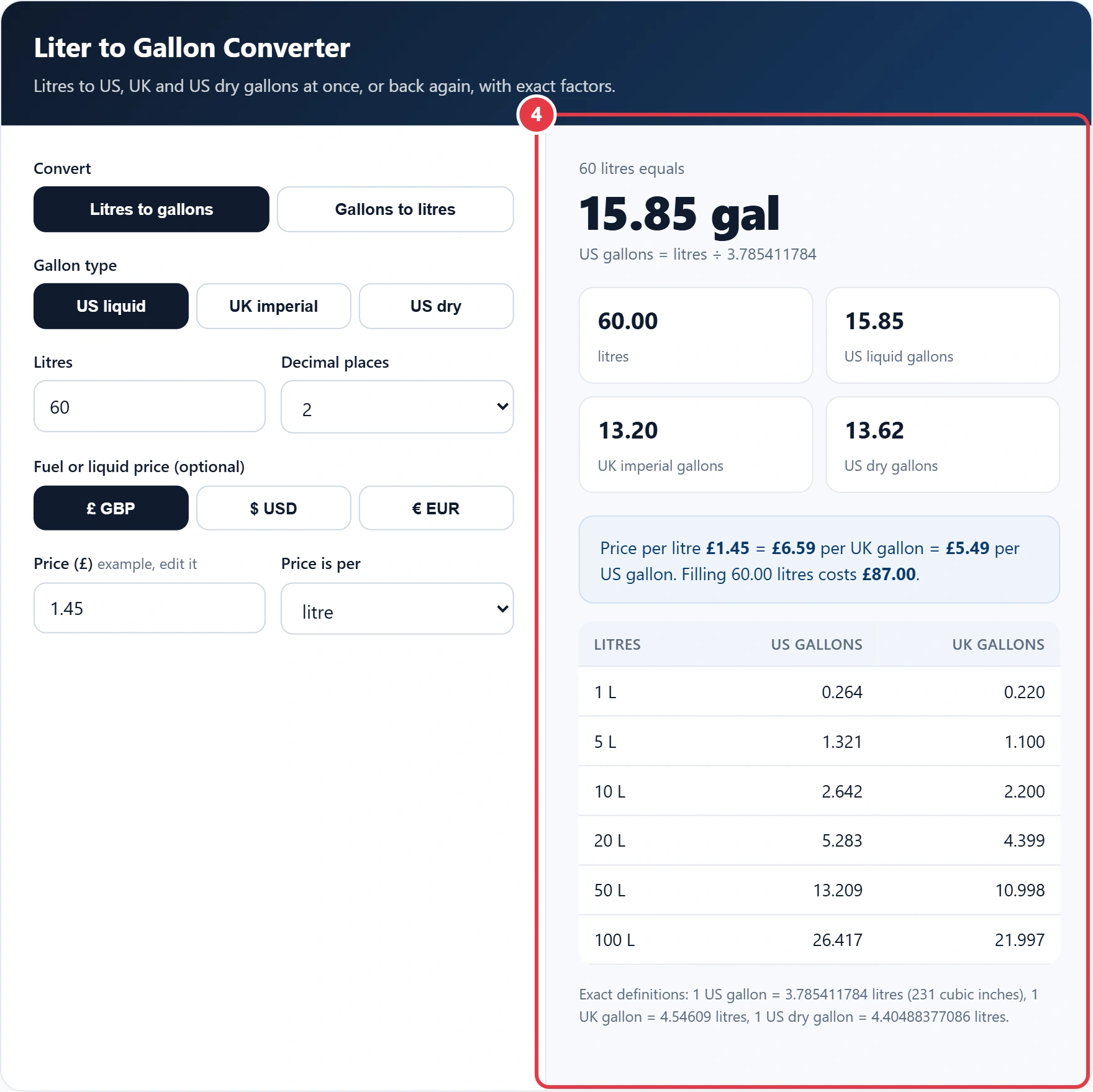
Quick answer: 1 litre is 0.264172 US gallons or 0.219969 UK gallons. To convert, divide litres by 3.785411784 for US gallons or by 4.54609 for imperial gallons. This liter to gallon converter shows 60 litres as 15.85 US gallons and 13.20 UK gallons, because the imperial gallon is about 20% bigger.
In This Guide
What Is a Liter to Gallon Conversion?
A liter to gallon conversion expresses a metric volume in gallons by dividing the number of litres by the number of litres in one gallon. Liter is the American spelling of litre; the unit is identical, exactly one cubic decimetre. The tricky part is the gallon, because three different ones are still in use.
The formula in words: gallons = litres ÷ litres per gallon. Use 3.785411784 for the US liquid gallon, 4.54609 for the UK imperial gallon and 4.40488377086 for the rarely used US dry gallon. To go the other way, multiply gallons by the same number. NIST, the US standards body, defines the US gallon as exactly 231 cubic inches, which is where the long 3.785411784 figure comes from.
How to Use the Liter to Gallon Converter
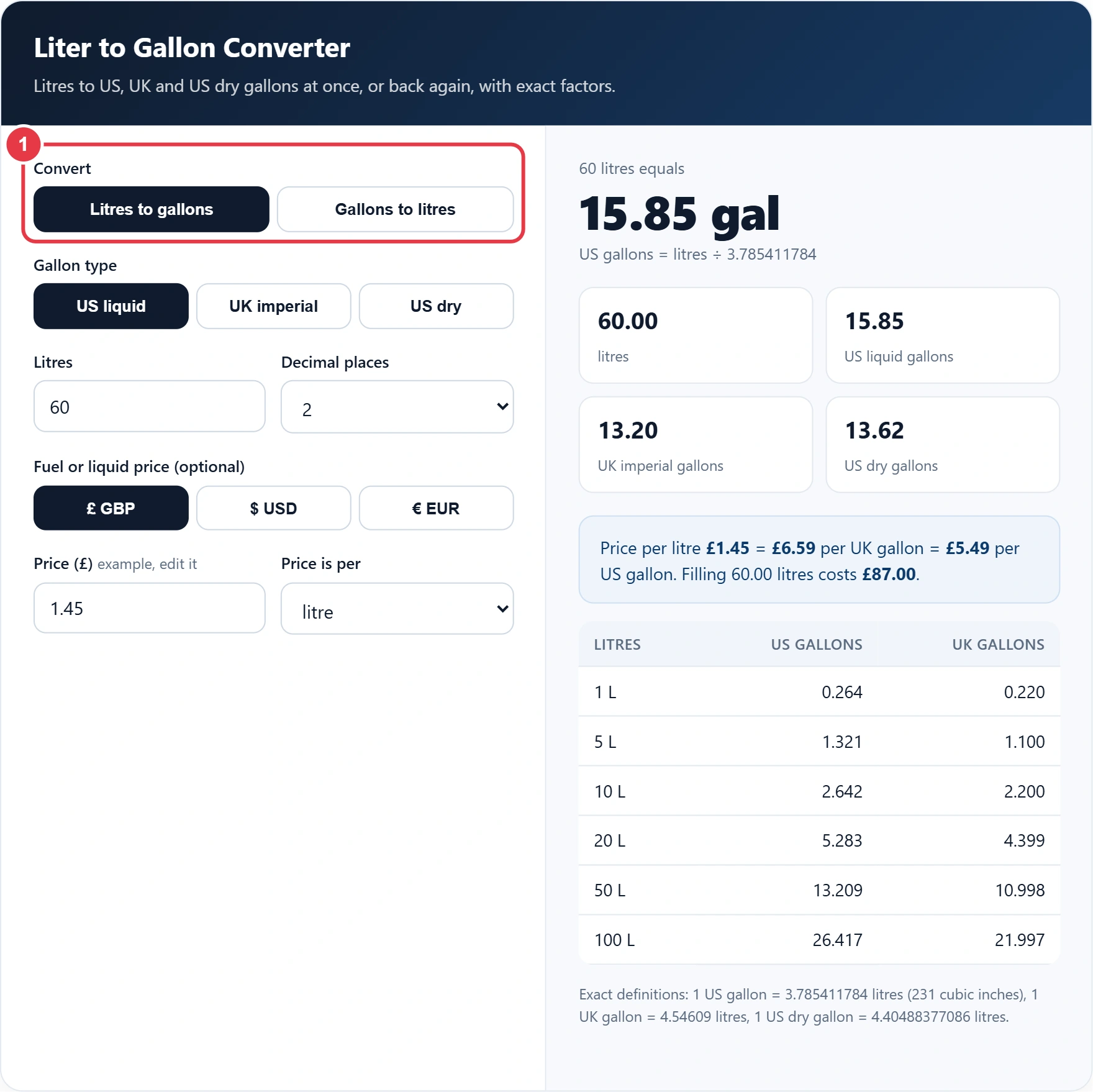
Step 1: Choose the Direction
Select Litres to gallons for metric to gallons, or Gallons to litres when you start with a gallon figure, such as a US recipe or an American tank size. The input label changes to match.
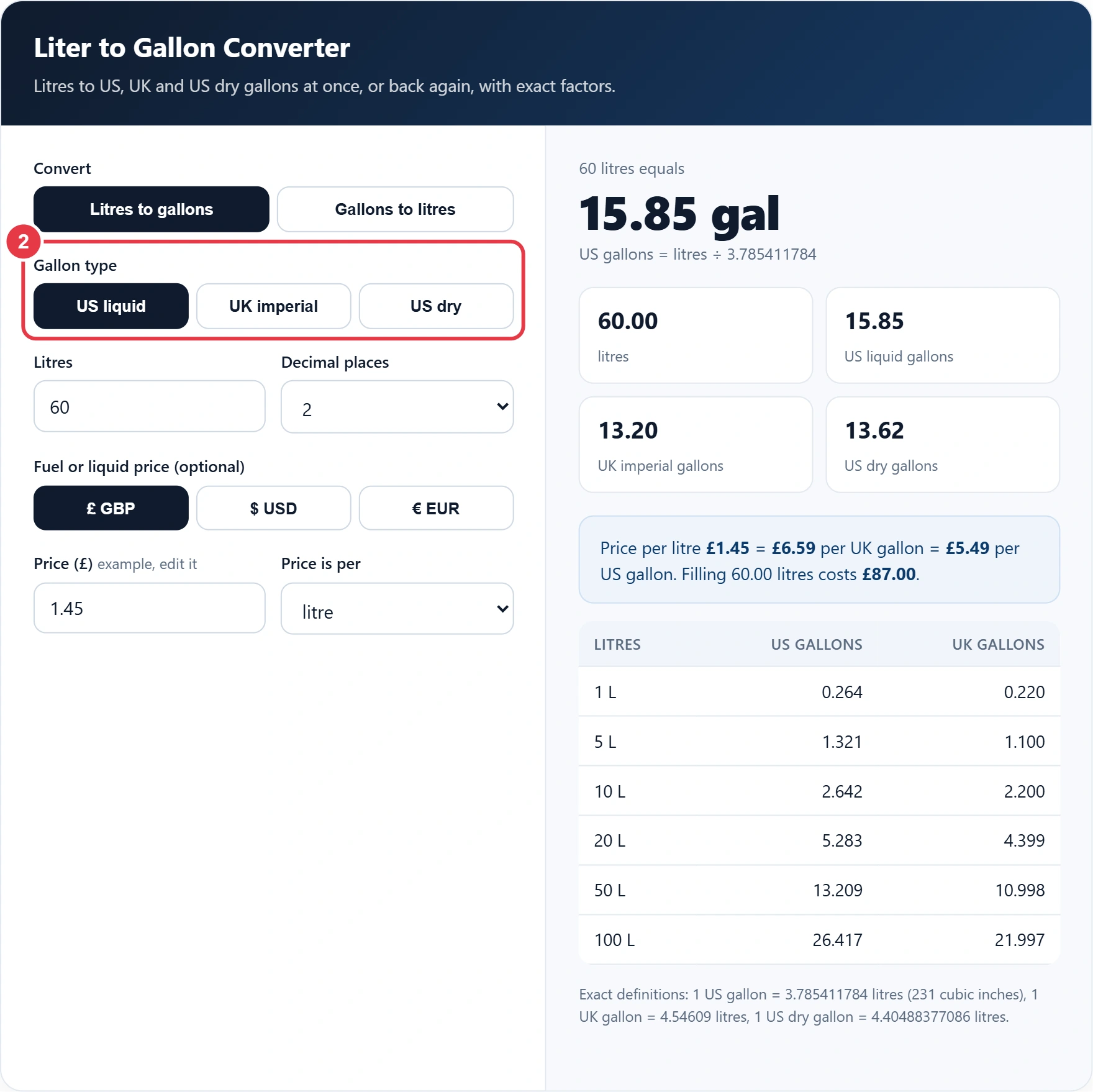
Step 2: Pick the Gallon Type
Choose US liquid for anything American, UK imperial for older British sources and fuel economy in miles per gallon, or US dry for historic dry goods. The big result uses your choice, but the grid always shows all three, so you can spot a mix up at a glance.
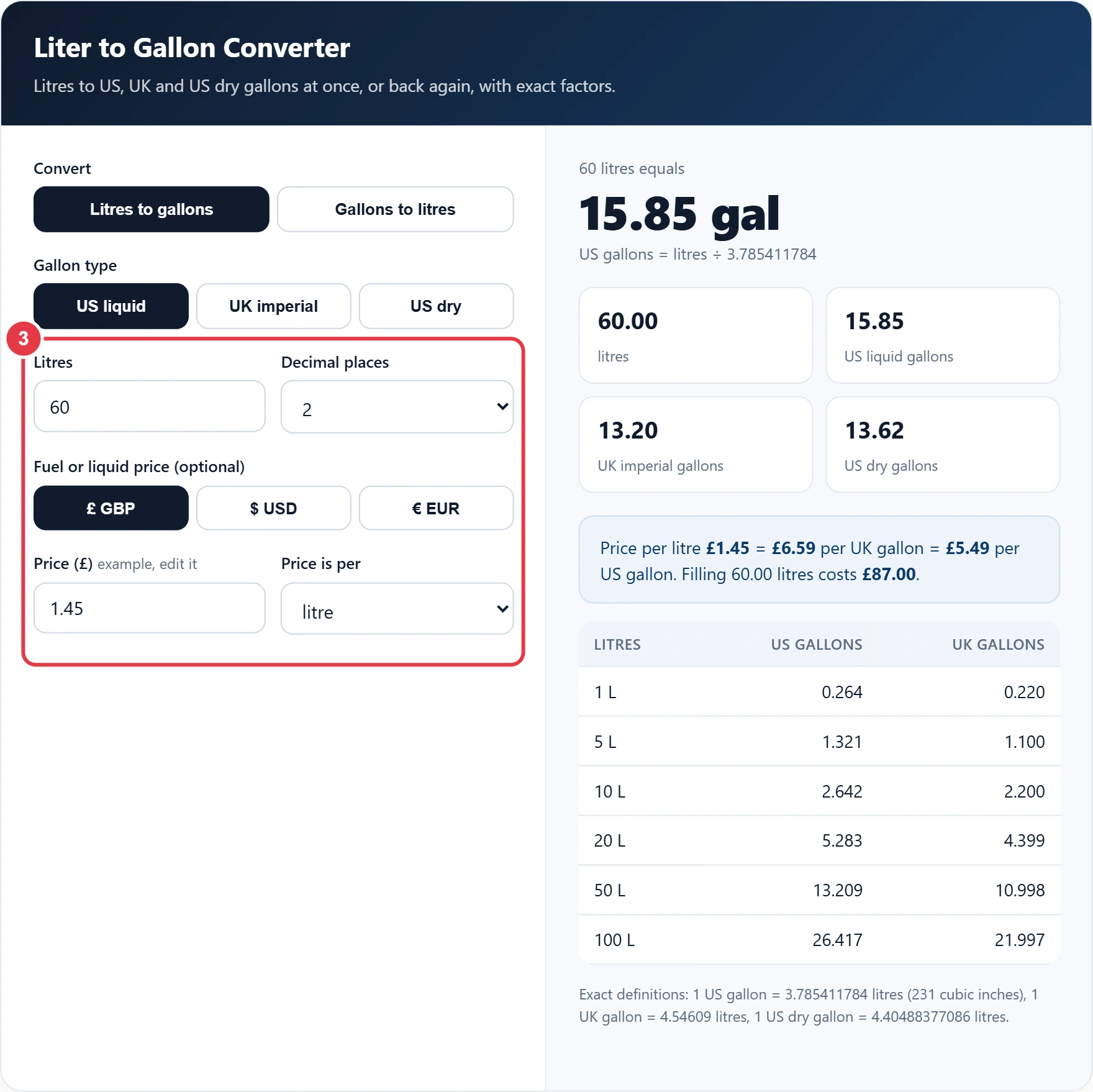
Step 3: Enter the Amount and an Optional Price
Type the volume and pick 2 to 6 decimal places. If you are comparing fuel or liquid prices, choose £, $ or € and enter a price per litre, per US gallon or per UK gallon. The 1.45 default is only an example, so replace it with the price on your receipt or pump.
Step 4: Read the Results
The liter to gallon converter shows the answer in large type, the exact formula used, all three gallon types, the price converted into every unit and the cost of your volume. The quick table underneath covers common amounts from 1 to 100 litres.
How Many Gallons Are in a Liter?
There are 0.264172 US gallons or 0.219969 UK gallons in one liter. Put the other way, a US gallon holds 3.785 litres and an imperial gallon holds 4.546 litres. This table covers the amounts people convert most often.
| Litres | US liquid gallons | UK imperial gallons | US dry gallons |
|---|---|---|---|
| 1 | 0.2642 | 0.2200 | 0.2270 |
| 5 | 1.3209 | 1.0998 | 1.1351 |
| 10 | 2.6417 | 2.1997 | 2.2702 |
| 20 | 5.2834 | 4.3994 | 4.5404 |
| 50 | 13.2086 | 10.9985 | 11.3510 |
| 60 | 15.8503 | 13.1982 | 13.6212 |
| 100 | 26.4172 | 21.9969 | 22.7021 |
Some everyday containers make the difference easy to picture. A 120 litre aquarium is 31.70 US gallons but 26.40 UK gallons. A 200 litre garden water butt holds 52.83 US gallons or 43.99 UK gallons. Going the other way, an American 55 gallon oil drum holds 208.2 litres, which is only 45.80 imperial gallons, and a 5 gallon water cooler bottle holds 18.93 litres. If a product listing gives a size in gallons without saying which kind, the litre figure on the label is the safest number to trust, and the liter to gallon converter turns it into whichever gallon you need.
Why Are US and UK Gallons Different?
They come from different historical gallons: the US kept the old English wine gallon of 231 cubic inches, while Britain replaced its gallons in 1824 with the imperial gallon, based on 10 pounds of water. Today the UK gallon is exactly 4.54609 litres, which makes it 1.20095 US gallons, roughly a fifth larger.
That gap matters more than people expect. A car that does 50 miles per imperial gallon only does about 41.6 miles per US gallon, with no change in efficiency at all. The MPG calculator works out your real fuel economy from a fill up, and the L/100km to MPG converter handles European figures, giving both UK and US mpg so you can compare fairly.
How Do I Convert a Fuel Price per Litre to per Gallon?
Multiply the price per litre by 4.54609 for a price per UK gallon, or by 3.785411784 for a price per US gallon. To go back, divide a price per gallon by the same figure.
Worked example: Dan in Leeds pays an example price of £1.45 a litre and fills a 60 litre tank for £87.00. His uncle in Ohio says he pays $3.20 a gallon. With the liter to gallon converter set to $ and per US gallon, $3.20 becomes $0.85 a litre, while Dan's £1.45 a litre works out at £6.59 per UK gallon or £5.49 per US gallon. Now they can compare like for like once the exchange rate is applied. Pump prices change weekly, so always enter the price you actually see.
For a whole trip rather than one fill up, the fuel cost calculator combines distance, fuel economy and pump price into a journey cost and a cost per mile, which is handy for splitting costs with passengers.
How Can I Convert Litres to Gallons in My Head?
For US gallons, divide litres by 4 and add 5%; for UK gallons, multiply litres by 0.22. Both shortcuts are close enough for a shopping list or a quick estimate.
Take 60 litres. Divided by 4 that is 15, plus 5% gives 15.75 US gallons, against an exact 15.85, an error of about 0.6%. For imperial, 60 × 0.22 = 13.2 UK gallons, almost exactly the true 13.198. The common habit of dividing by 4 for every gallon is fine in the US but gives 15 imperial gallons instead of 13.2, an overestimate of nearly 14%, so it is worth using the right shortcut or the liter to gallon converter.
Which Gallon Should I Use?
Use the US liquid gallon for anything written in the United States and the UK imperial gallon for British mpg figures, older UK recipes and some boating and agricultural kit. If a source does not say which, check where it was written: a US website, product label or car manual will mean US gallons. Fuel in the UK has been sold by the litre for decades, but mpg is still quoted per imperial gallon.
The US dry gallon, one eighth of a bushel, has almost disappeared from everyday use, and you are unlikely to meet it outside historic grain or produce measures. Canada and Ireland officially use litres but older sources there follow the imperial gallon. The history of the gallon explains the many regional versions that existed before these three were standardised, and why the names still cause confusion today.
Liter to Gallon Terms You Should Know
Use these terms to understand which gallon your source means before you rely on the liter to gallon converter for fuel, recipes, aquariums or tank sizes.
- Litre
- The metric unit of volume equal to one cubic decimetre, or 1,000 cubic centimetres. It is accepted for use with the International System of Units, and liter is simply the American spelling of the same unit, with no difference in size.
- US liquid gallon
- The gallon used for fuel, milk and most liquids in the United States, defined as exactly 231 cubic inches. Because one inch is exactly 2.54 cm, this works out to exactly 3.785411784 litres, smaller than the British gallon.
- Imperial gallon
- The British gallon, fixed in law at exactly 4.54609 litres. It is larger than its American namesake and is still quoted in UK miles per gallon figures, which is why British and American fuel economy numbers differ for the same car.
- US dry gallon
- A historic American unit for measuring dry goods such as grain, equal to one eighth of a US bushel, or 4.40488377086 litres. It is rarely used today, and most dry produce is now sold by weight or in bushels instead.
- Weights and Measures Act 1985
- The UK statute that sets the legal definitions of units used for trade in Great Britain, including the imperial gallon. Its schedules fix the gallon as a metric multiple, so every UK conversion figure traces back to an exact legal value.
- NIST
- The National Institute of Standards and Technology, the United States federal agency responsible for measurement standards. Its handbooks publish the official definitions of US customary units, including the liquid and dry gallons used by American traders and regulators.
</>Embed this calculator on your website
Add the free Liter to Gallon Converter to your own site or blog. Copy the code below and paste it into an HTML block. It resizes itself and works on phones.
How we checked this tool: the Tools Veria Editorial Team built this tool by hand, checked it against the official rules or published standards where they apply, and tested it against worked examples. Results are estimates for planning, not personal financial or tax advice. Read our editorial policy and disclaimer, or report an error.
Frequently Asked Questions
How many litres are in a gallon?
A US liquid gallon holds exactly 3.785411784 litres, and a UK imperial gallon holds exactly 4.54609 litres. A US dry gallon, now rarely used, holds 4.40488377086 litres. Always check which gallon a source means before converting.
Is a UK gallon bigger than a US gallon?
Yes. A UK imperial gallon is 4.54609 litres and a US gallon is 3.785411784 litres, so the UK gallon is about 20% larger. One imperial gallon equals 1.20095 US gallons.
How many gallons is 20 litres?
20 litres is 5.28 US gallons or 4.40 UK gallons. Divide 20 by 3.785411784 for US gallons and by 4.54609 for imperial gallons. A 20 litre jerry can therefore holds a little over 4.4 imperial gallons.
How many gallons is a 60 litre fuel tank?
A 60 litre tank holds 15.85 US gallons or 13.20 UK gallons. The difference comes entirely from the size of the gallon, not the tank, so quote the gallon type when comparing cars.
What is the formula to convert liters to gallons?
Divide the number of liters by 3.785411784 to get US gallons, or by 4.54609 to get UK gallons. For example, 10 liters ÷ 3.785411784 = 2.642 US gallons.
Why is liter spelled differently from litre?
Liter is the American spelling and litre is the British and international spelling of the same metric unit, one cubic decimetre or 1,000 millilitres. The conversion factors are identical whichever spelling you use.