
Callum is viewing a used Volkswagen Golf in Swindon, and the seller has propped the logbook on the dashboard. A long string of letters and numbers sits under the windscreen and again on the V5C. Knowing how to read a VIN number lets him check, in a couple of minutes, that the car in front of him is the car on the paperwork.
The vehicle identification number is not a random serial. Each block of characters records something specific, from the country of manufacture to the factory. We decode two real format examples, show the year code and run the check digit sum by hand.
Quick answer: A VIN has 17 characters read in sections. Characters 1 to 3 identify the manufacturer and country, 4 to 8 describe the model and engine, 9 is a check digit, 10 is the model year, 11 is the factory and 12 to 17 are the serial number. Letters I, O and Q are never used.
In This Guide
Where do you find the VIN on a UK car?
On most cars sold in the UK, the VIN is visible through the bottom corner of the windscreen and printed on a label on the driver’s door pillar or under the bonnet. It is also stamped into the body, often on the floor beside a front seat or on the bulkhead, and it appears on paperwork.
- The V5C logbook, in the field for the VIN or chassis number.
- MOT certificates and the online MOT history.
- Insurance schedules, finance agreements and service invoices.
Callum’s tip is to photograph the windscreen plate and the door label, then compare both photos with the logbook at home. Three matching copies are reassuring; one that differs is a reason to walk away.

What do the 17 characters of a VIN mean?
The 17 characters of a VIN split into three blocks: a three character manufacturer code, a six character vehicle description that includes the check digit, and an eight character identifier holding the year, the factory and the serial number. The format follows the international standard ISO 3779, and North American vehicles also follow the US federal rule 49 CFR Part 565.
| Positions | Name | What it tells you |
|---|---|---|
| 1 to 3 | World manufacturer identifier (WMI) | Country or region and manufacturer |
| 4 to 8 | Vehicle descriptor section | Model, body, engine, restraints, set by the maker |
| 9 | Check digit | A calculated character that catches typos (mandatory in North America) |
| 10 | Model year | A letter or number for the year (required in North America) |
| 11 | Plant code | The factory that built the vehicle |
| 12 to 17 | Serial number | The individual vehicle’s production number |
The easiest place to start when learning how to read a VIN number is the first character, which hints at where the car was built. A 1, 4 or 5 means the United States, 2 Canada, 3 Mexico, J Japan, K South Korea, L China, S the United Kingdom, V France or Spain, W Germany, Y Sweden or Finland and Z Italy. A Range Rover built in Solihull therefore starts with S, while Callum’s Golf starts with W.
Example 1: a European hatchback
Take the illustrative Golf VIN WVWZZZ1KZ8W123456. WVW is Volkswagen passenger cars from Germany. ZZZ is filler, which European makers often use where North American rules would demand detail. 1K is Volkswagen’s internal code for that generation of Golf, and the Z in position 9 shows the maker has not used a check digit, which is legal for cars built for Europe. The 8 in position 10 points to 2008, W marks the Wolfsburg plant and 123456 is the serial number.
Example 2: an American import
Priya is pricing a pickup imported from the US with VIN 1FTFW1E51PFA12345. The 1 means United States and 1FT is a Ford truck code. Positions 4 to 8 (FW1E5) describe the cab, drive and engine, 1 is the check digit, P is the model year, F is the plant and A12345 is the serial. Unlike the Golf, every North American character is regulated, so this VIN can be tested mathematically.

How do you read the model year from a VIN?
You read the model year from the 10th character of the VIN, which uses the letters A to Y (skipping I, O, Q, U and Z) and then the digits 1 to 9, giving 30 codes that repeat every 30 years. On North American cars and light trucks, a number in position 7 means the earlier year and a letter means the later year.
Priya’s pickup has P in position 10, which could mean 1993 or 2023. Position 7 is E, a letter, so it is a 2023 model. That 7th character rule is set by US federal VIN regulations for vehicles up to 10,000 lb, so for motorcycles, heavy trucks and most European cars you judge between the two years from the age and design of the vehicle instead.
| 10th character | Earlier cycle | Later cycle |
|---|---|---|
| A | 1980 | 2010 |
| B | 1981 | 2011 |
| C | 1982 | 2012 |
| D | 1983 | 2013 |
| E | 1984 | 2014 |
| F | 1985 | 2015 |
| G | 1986 | 2016 |
| H | 1987 | 2017 |
| J | 1988 | 2018 |
| K | 1989 | 2019 |
| L | 1990 | 2020 |
| M | 1991 | 2021 |
| N | 1992 | 2022 |
| P | 1993 | 2023 |
| R | 1994 | 2024 |
| S | 1995 | 2025 |
| T | 1996 | 2026 |
| V | 1997 | 2027 |
| 1 to 9 | 2001 to 2009 | 2031 to 2039 |
Model year is not the build date or the registration date. A car can be built in the autumn as the following model year and then registered in the UK months later, which is why the date of first registration on the V5C is what decides MOT timing. Our first MOT due date calculator uses that registration date, so enter it rather than the year from the VIN.
How does the VIN check digit work?
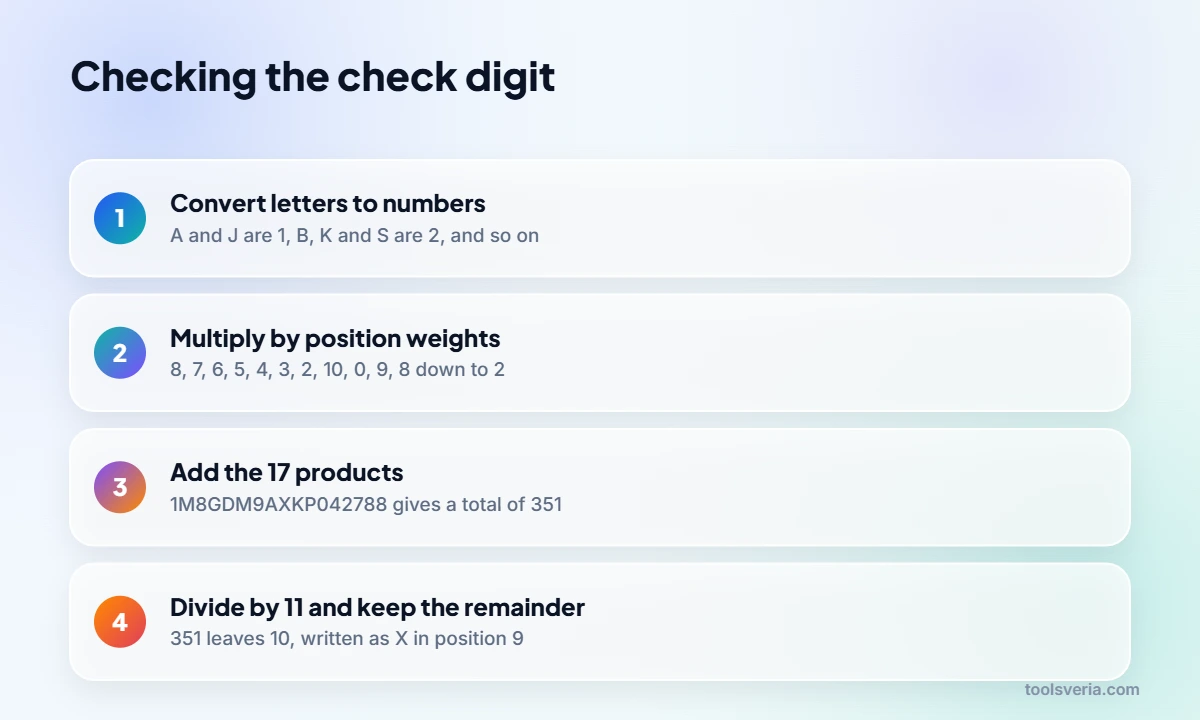
The VIN check digit works by converting every character to a number, multiplying each by a fixed weight for its position, adding the results and dividing by 11. The remainder is the check digit, and a remainder of 10 is written as X. If position 9 does not match, the VIN has been mistyped or altered.
Letters convert like this: A and J are 1, B, K and S are 2, C, L and T are 3, D, M and U are 4, E, N and V are 5, F and W are 6, G, P and X are 7, H and Y are 8, R and Z are 9. Digits keep their own value. The weights for positions 1 to 17 run 8, 7, 6, 5, 4, 3, 2, 10, 0, 9, 8, 7, 6, 5, 4, 3, 2, so position 9 itself carries a weight of 0.
Most explanations of the check digit maths, in print and online, use the same test number, 1M8GDM9AXKP042788, and the Wikipedia article on vehicle identification numbers sets out the full working, so you can compare your own. Converting and weighting each character gives products of 8, 28, 48, 35, 16, 12, 18, 10, 0, 18, 56, 0, 24, 10, 28, 24 and 16, which total 351. Dividing 351 by 11 leaves 10, so the check digit is X, exactly what sits in position 9.
Priya’s pickup gives a total of 353, and 353 divided by 11 leaves 1, which matches its check digit. The 10th character K on the textbook VIN, alongside the number 9 in position 7, also tells you it is a 1989 model, not 2019. Doing the sum by hand is slow, which is why our VIN model year decoder shows the weighted total and remainder for any VIN you paste in.
How can a VIN help you check a used car in the UK?
A VIN helps you check a used car in the UK by proving the vehicle matches its V5C logbook, because a cloned car usually carries another vehicle’s number plate but cannot easily change every stamped and printed VIN. The GOV.UK guide to checking a used vehicle tells buyers to match the VIN and engine number to the logbook and to look for the DVL watermark.
Callum’s Golf passed: windscreen, door label and V5C all read the same. A friend viewing a hatchback the week before was less lucky, because the windscreen plate ended in 4471 while the logbook ended in 4417. Two transposed digits might be a clerical slip, yet the seller could not explain it, so she left.
The VIN does not reveal finance, write off status or mileage on its own, so pair it with a history check, and if you are buying on finance, our PCP calculator shows the monthly cost before you sign. Tyres tell their own story too: our tyre age DOT code calculator reads the four digit date on the sidewall, which should look sensible for the car’s age.
Key points
- A VIN has 17 characters and never uses the letters I, O or Q.
- Characters 1 to 3 identify the maker and country, with S for the United Kingdom and W for Germany.
- The 10th character is the model year code, and each code repeats every 30 years.
- The check digit in position 9 is the weighted total of the other characters divided by 11, with 10 written as X.
- Many European cars use Z fillers and skip the check digit, which is allowed outside North America.
- The VIN on the windscreen, door label and V5C logbook should match exactly.
What the Key VIN Terms Mean
These terms label each block of characters, so learning how to read a VIN number becomes a quick check that a car matches its paperwork.
- Vehicle identification number (VIN)
- A unique 17 character code assigned to a road vehicle at manufacture, recorded on the body and on official documents. Matching it across the windscreen plate, door label and logbook confirms a car’s identity before purchase.
- World manufacturer identifier (WMI)
- The first three characters of a VIN, naming the country or region of manufacture and the maker. Its first character alone gives the region, so a car built in Germany starts with W and one built in Britain with S.
- Vehicle descriptor section
- Positions 4 to 8 of the VIN, which the manufacturer uses to encode model, body style, engine and restraint systems. European makers may fill unused places with Z, while North American rules require every position to carry detail.
- Check digit
- The character in position 9 that results from a weighted sum of the other characters, allowing a computer to spot mistyped VINs. It is compulsory for North American vehicles but often left as a filler on cars built for Europe.
- Model year code
- The 10th character, a letter or digit that stands for the vehicle’s model year on a repeating cycle. Because the cycle repeats, the same character can point to two different years, so it should be read alongside the car’s other details.
- Vehicle identifier section
- The final eight characters of the VIN, covering the model year, the assembly plant code and a six character production serial number. Together they single out one vehicle from every other car of the same model.
Frequently Asked Questions
My German hatchback has a Z in position 9. Is the VIN fake?
No, a Z or other filler in position 9 is normal on many cars built for the European market. The check digit is only mandatory in North America, so compare the full 17 characters with your V5C logbook instead of relying on the sum.
The 10th character is G. Is my car from 1986 or 2016?
G stands for 1986 or 2016, so look at position 7 on a North American car: a letter means 2016. On a European car, the design and the first registration date on the V5C make the answer obvious.
Can I find out who owns a car from its VIN?
No, the VIN describes the vehicle, not the keeper, so it holds no names or addresses. DVLA releases keeper details only to people with a reasonable cause, and the 17 characters tell you the maker, model details, year code, factory and serial number.
Why does my old classic car have a VIN shorter than 17 characters?
The 17 character format arrived with the 1981 model year, so older vehicles carry chassis numbers in each maker’s own style. Those numbers cannot be decoded with the standard year chart or check digit, so use the manufacturer’s records or an owners’ club.
Callum bought the Golf after the three VIN copies matched and the logbook passed the GOV.UK checks. Now that you know how to read a VIN number, paste any VIN into the decoder before a viewing, and you will arrive knowing the year, the factory and whether the number adds up. Figures checked October 2026.