A free ROI calculator that turns money in and money back into ROI, annualised return and profit.
| Same annual rate held for | Value | ROI |
|---|
ROI ignores inflation and the timing of cash flows in between. Results are estimates, not financial advice.
This ROI calculator shows how much an investment really earned, for savers, small business owners and marketers in the UK, the US, Europe or anywhere else. Enter what you put in, what you got back, any fees and how long you held it, and the tool applies the standard return on investment ratio alongside a yearly compounded rate, so a five year project and a five month one can be compared fairly.
Quick answer: ROI equals net profit divided by total cost, multiplied by 100. If you invest £10,000 and get back £14,500, your net profit is £4,500 and your ROI is 45%. Held for 3 years, this ROI calculator shows an annualised return of 13.19% a year, because growth compounds rather than adding up evenly.

In This Guide
What Is a Return on Investment Calculator?
A return on investment calculator, or ROI calculator, measures the profit or loss on money you spent, expressed as a percentage of what it cost you. It works for shares, property, equipment, training courses and advertising campaigns, because the only inputs it needs are money in, money out and time.
The ROI formula in plain words is: (final value minus total cost) ÷ total cost × 100. Total cost is the amount invested plus extra costs such as platform fees, stamp duty or commission. To compare investments held for different lengths of time, the tool also works out the annualised return, sometimes called CAGR: (final value ÷ total cost) raised to the power of 1 ÷ years, minus 1.
How to Use the ROI Calculator
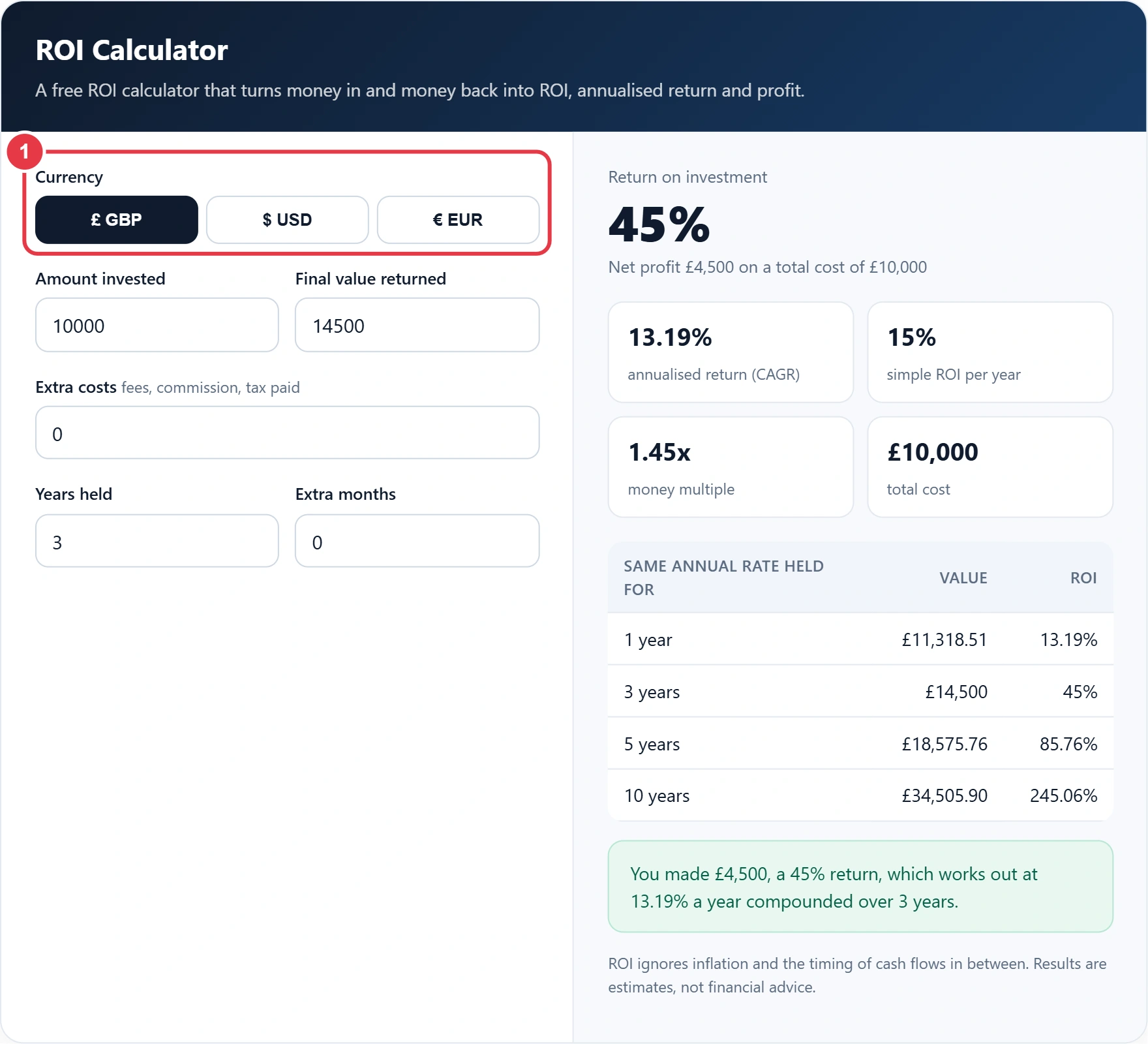
Step 1: Choose Your Currency
Pick pounds, dollars or euros in the ROI calculator. The maths is identical in every currency, so this only changes how the results are labelled.
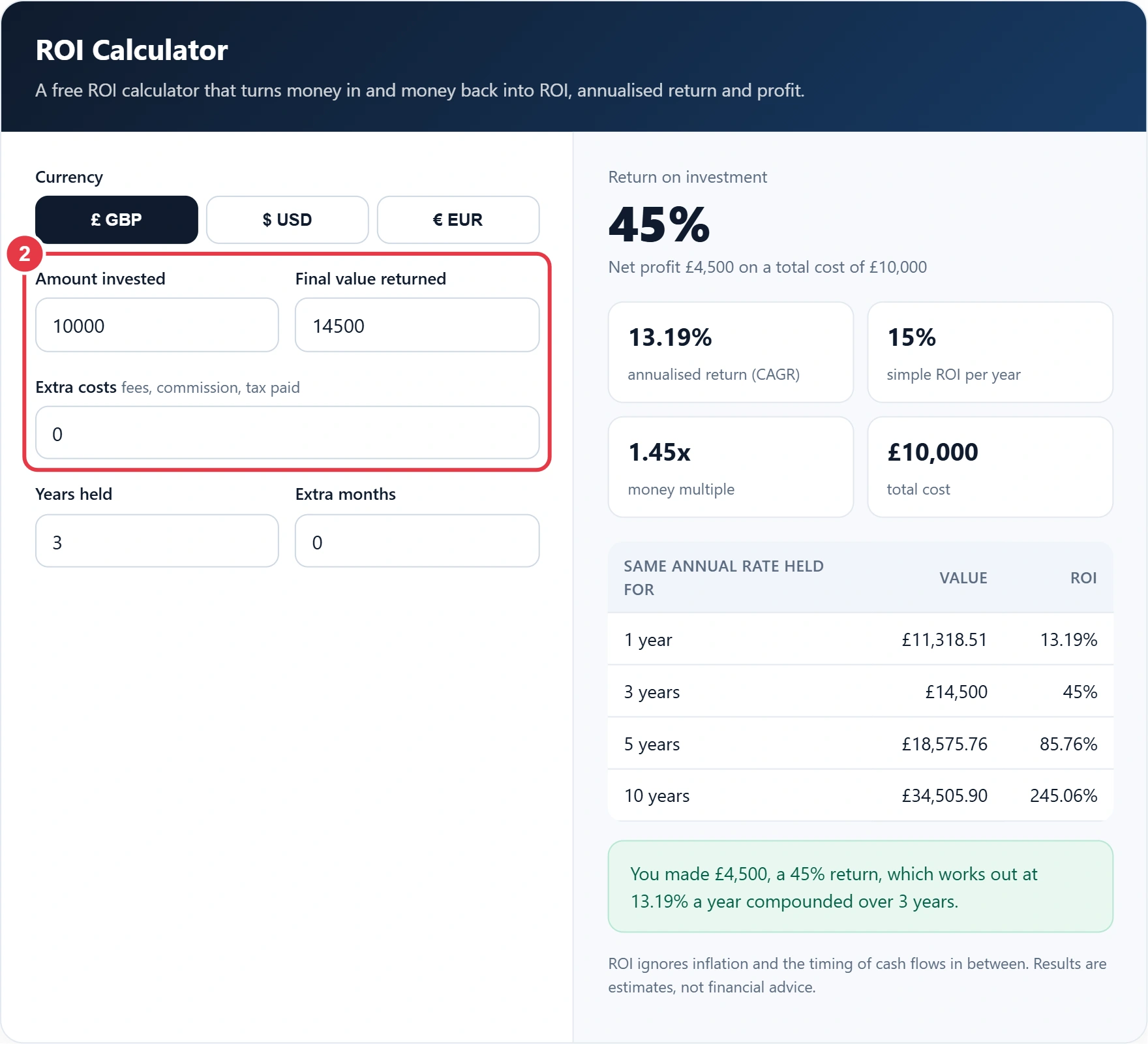
Step 2: Enter Money In and Money Back
Type the amount invested and the final value you received or could sell for today, including any dividends, rent or interest already paid out to you. Add fees, commission and tax in the extra costs box so the result reflects your true outlay.
Step 3: Add the Time Held
Enter the years and any extra months between buying and selling. Without a time period the ROI calculator only gives plain ROI; with it you also get the annualised return and the simple yearly figure.

Step 4: Read Your Results
The results show ROI, net profit, the annualised return, the money multiple and a projection table that keeps the same yearly rate for 1, 3, 5 and 10 years. For a pure growth figure on a cash deposit, the compound interest calculator lets you add monthly contributions on top, which this investment return calculator does not model.

Why Does Annualised ROI Matter More Than Total ROI?
Annualised ROI matters because a total ROI says nothing about how long the money was tied up. A 50% gain sounds strong, but spread over 10 years it is only 4.14% a year, less than many savings accounts have paid. The table shows the same 50% ROI over different periods.
| Total ROI | Years held | Annualised return (CAGR) | Simple ROI per year |
|---|---|---|---|
| 50% | 1 | 50.00% | 50.00% |
| 50% | 2 | 22.47% | 25.00% |
| 50% | 5 | 8.45% | 10.00% |
| 50% | 10 | 4.14% | 5.00% |
Simple ROI per year just divides the total by the number of years, so it always looks better than the compounded figure for periods over one year. Use the annualised number when you compare an investment with a savings rate, a loan rate or another investment. The rule of 72 calculator gives a quick sense check: at 8.45% a year, money doubles in roughly 8.5 years.
How Do You Calculate ROI With Fees? A Worked Example
You calculate ROI with fees by adding every fee to the cost before dividing, because fees reduce profit and increase the money at risk. Here is a worked example with real numbers that you can repeat in the ROI calculator above.
Amira invests £8,000 in a share fund and pays £150 in platform and dealing fees, so her total cost is £8,150. After 5 years she sells for £11,200. Her net profit is £11,200 minus £8,150, which is £3,050. Her ROI is £3,050 ÷ £8,150 × 100 = 37.42%. The annualised return is (11,200 ÷ 8,150) to the power of 0.2, minus 1, which is 6.56% a year. Had she ignored the fees, she would have reported 40% and overstated her result.
What Is a Good ROI?
A good ROI is one that beats the safest alternative over the same period after fees, tax and inflation. There is no single number that suits every case, because a risky start-up should earn far more than a savings account to justify the chance of losing money.
Use the ROI calculator to compare your annualised return with the interest you could earn on cash, then with the rate of inflation. If prices rose 3% a year while your investment grew 3% a year, your real return is close to zero. For marketing spend, ROI should be judged on profit rather than revenue, which is why the profit margin calculator is useful for working out how much of each sale you actually keep.
What Are the Limits of ROI?
ROI is limited because it treats all money as arriving at the end and ignores when cash flowed in between. If you added money several times, or received rent every month, the internal rate of return method handles that timing more accurately, so it is the better choice for property and staged projects.
The ROI formula also ignores risk, taxes you have not yet paid and the effort involved. A 20% return on a weekend side project and a 20% return on a tracker fund are not equal. Treat the figures as estimates for comparison, not as financial advice, and speak to a regulated adviser before large decisions. Figures and formulas on this page were checked October 2026.
Key ROI Calculator Terms Explained
These terms explain each figure the ROI calculator shows, so you can read profit, yearly growth and money multiples correctly before comparing two investments.
- Net profit
- The final value received minus the total cost, including fees and commission. In the default example, £14,500 back on £10,000 invested leaves £4,500 of net profit, the figure that is divided by cost to give ROI.
- Total cost basis
- Everything you paid to make and hold an investment: the purchase amount plus extra costs such as dealing charges and platform fees. Amira's basis is £8,150, not £8,000, because her £150 of fees count as money at risk.
- Compound annual growth rate
- The steady yearly rate that would turn the total cost into the final value over the holding period. It assumes gains are reinvested, which is why 45% over 3 years equals 13.19% a year, not 15%.
- Money multiple
- Final value divided by total cost, shown as a number followed by x. A multiple of 1.45x means each pound, dollar or euro invested came back as 1.45, while anything below 1x signals a loss.
- Real return
- The return left after removing the effect of inflation on purchasing power. If an investment grows 3% a year while prices also rise 3% a year, the real return is roughly zero even though the nominal ROI looks positive.
</>Embed this calculator on your website
Add the free ROI Calculator to your own site or blog. Copy the code below and paste it into an HTML block. It resizes itself and works on phones.
How we checked this tool: the Tools Veria Editorial Team built this tool by hand, checked it against the official rules or published standards where they apply, and tested it against worked examples. Results are estimates for planning, not personal financial or tax advice. Read our editorial policy and disclaimer, or report an error.
Frequently Asked Questions
What is the formula for ROI?
ROI equals net profit divided by total cost, multiplied by 100. Net profit is the final value minus everything you paid, including fees. For example, £2,000 profit on a £10,000 cost gives an ROI of 20%.
How do I calculate annualised ROI?
Divide the final value by the total cost, raise the result to the power of 1 divided by the number of years, then subtract 1. A 45% total return over 3 years equals 13.19% a year.
Can ROI be negative?
Yes. ROI is negative when you get back less than you paid. Investing £5,000 and receiving £4,000 is a loss of £1,000 and an ROI of minus 20%. The worst possible ROI is minus 100%.
Is ROI the same as profit?
No. Profit is an amount of money, while ROI is a percentage of what you spent. A £1,000 profit is a 100% ROI on £1,000 but only a 1% ROI on £100,000.
Should I include dividends and rent in the final value?
Yes. Add any income you received, such as dividends, rent or interest, to the sale value. Leaving it out understates your ROI, especially for property and income funds held for many years.
What is the difference between ROI and ROAS?
ROI measures profit against total cost, while ROAS divides revenue by advertising spend only. A campaign with a ROAS of 4 can still lose money if product costs and fees eat most of that revenue.