For private and US style student loans: test a new rate and term against what you pay now.
| New term | Payment | Interest | Saving |
|---|
Fixed rate loans with monthly interest at the annual rate ÷ 12. Variable rate offers can change after you sign. Refinancing US federal loans into a private loan gives up federal protections and cannot be undone.
This student loan refinance calculator is for borrowers with private or US style student loans who want to know whether a new rate and term would genuinely save money. It is not for UK government loans: Plans 1, 2, 4 and 5 and postgraduate loans are repaid as a share of income, so use our student loan repayment calculator for those and think hard before overpaying them.
Quick answer: A student loan refinance calculator compares the monthly payment, interest and fees on your current loan with a new offer. Refinancing is usually worth it when the new rate is at least one point lower and the term stays the same or shorter. It suits private loans, not UK government loans repaid as a share of income.
In This Guide
What Is Student Loan Refinancing?
Student loan refinancing means taking out a new private loan, usually at a lower rate or over a different term, to pay off one or more existing student loans in full. You then repay the new lender instead.
The calculator works out the fixed monthly payment for both loans with the standard formula, payment = balance × r ÷ (1 − (1 + r)^−n), where r is the annual rate ÷ 12 and n is the number of months. It then compares everything you would still pay on the current loan with everything you would pay on the new one plus any fee.
How to Use the Student Loan Refinance Calculator
Step 1: Enter Your Current Loan
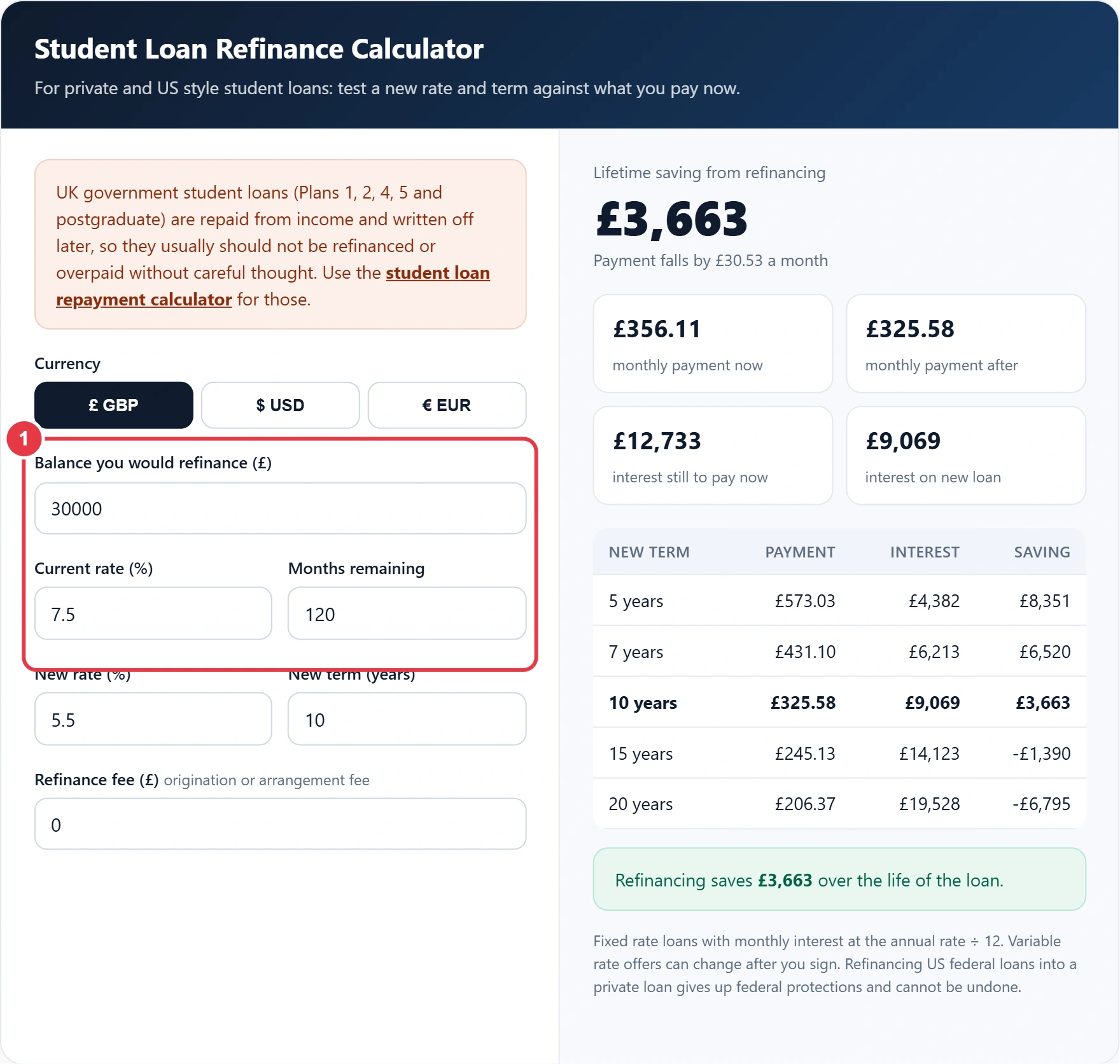
Choose £, $ or €, then add the balance you would refinance, its current interest rate and the number of monthly payments left on your statement.
Step 2: Enter the New Offer
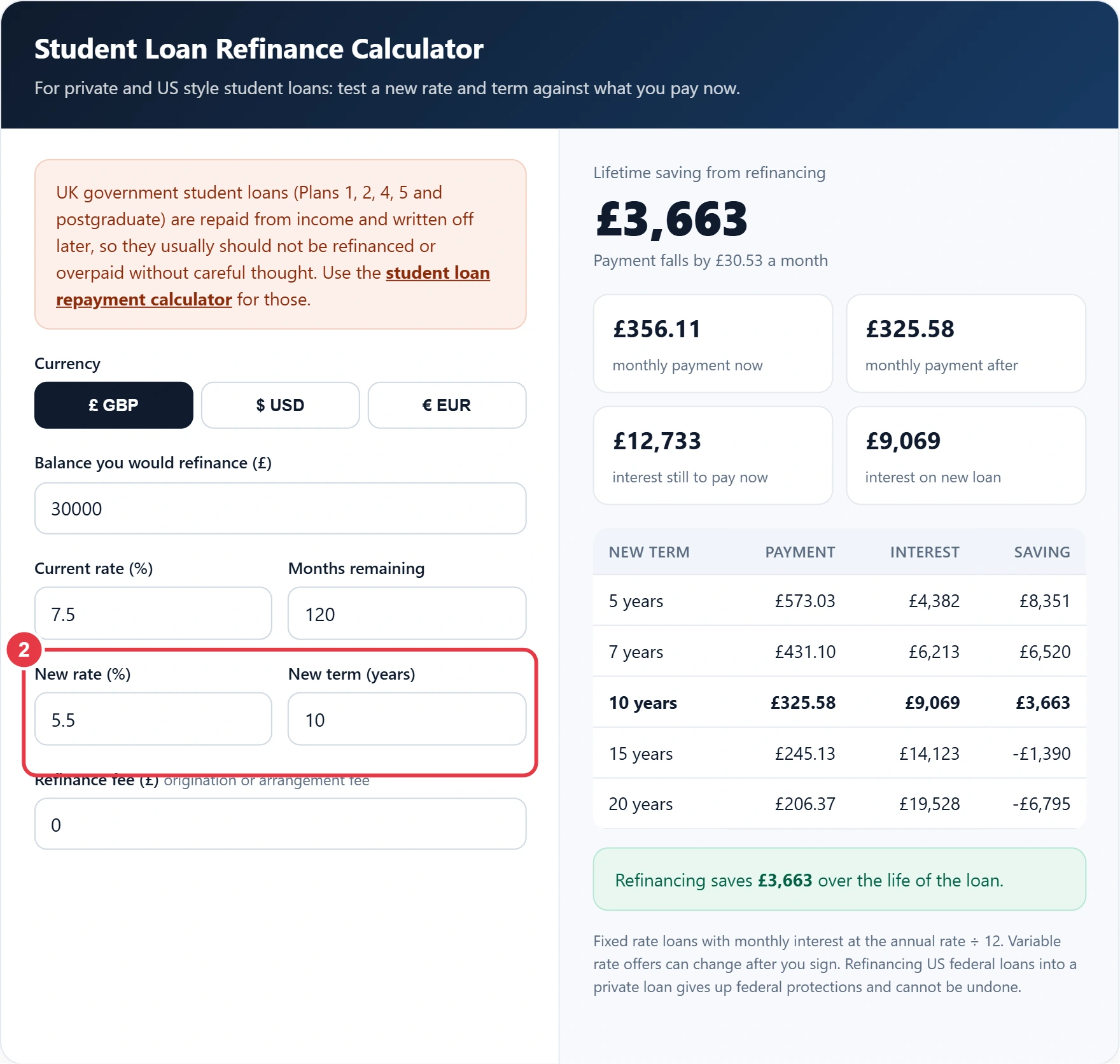
Type the fixed rate and term from a real quote. If you are weighing a personal loan instead, the loan calculator runs the same maths on a UK APR quote. The 5.5% default is only an example, as lenders price each borrower on credit history and income.
Step 3: Add Any Fee
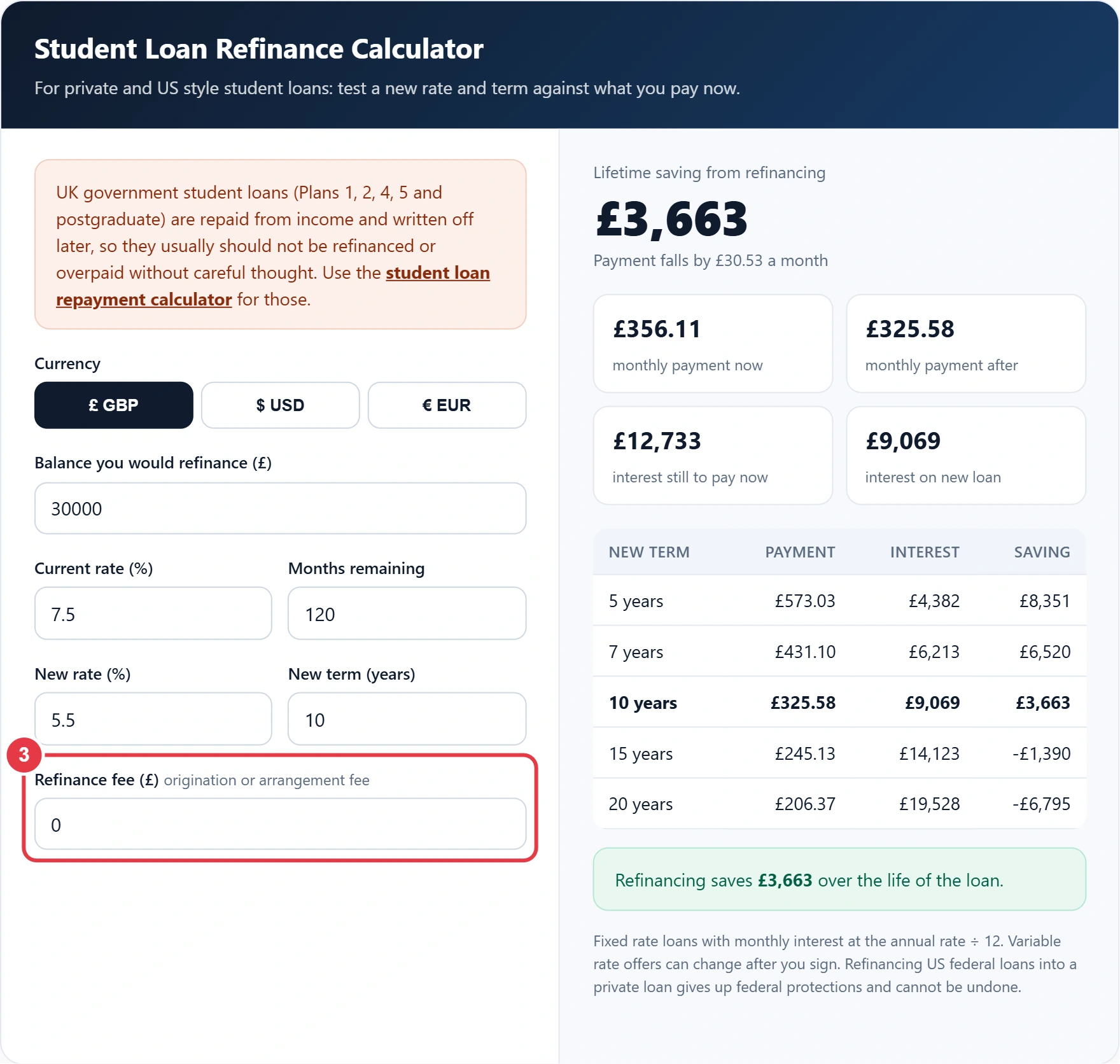
Many refinance lenders charge no fee, but some add an origination charge. Enter it as a cash amount so the calculator can show how many months of lower payments it takes to win it back.
Step 4: Compare the Results
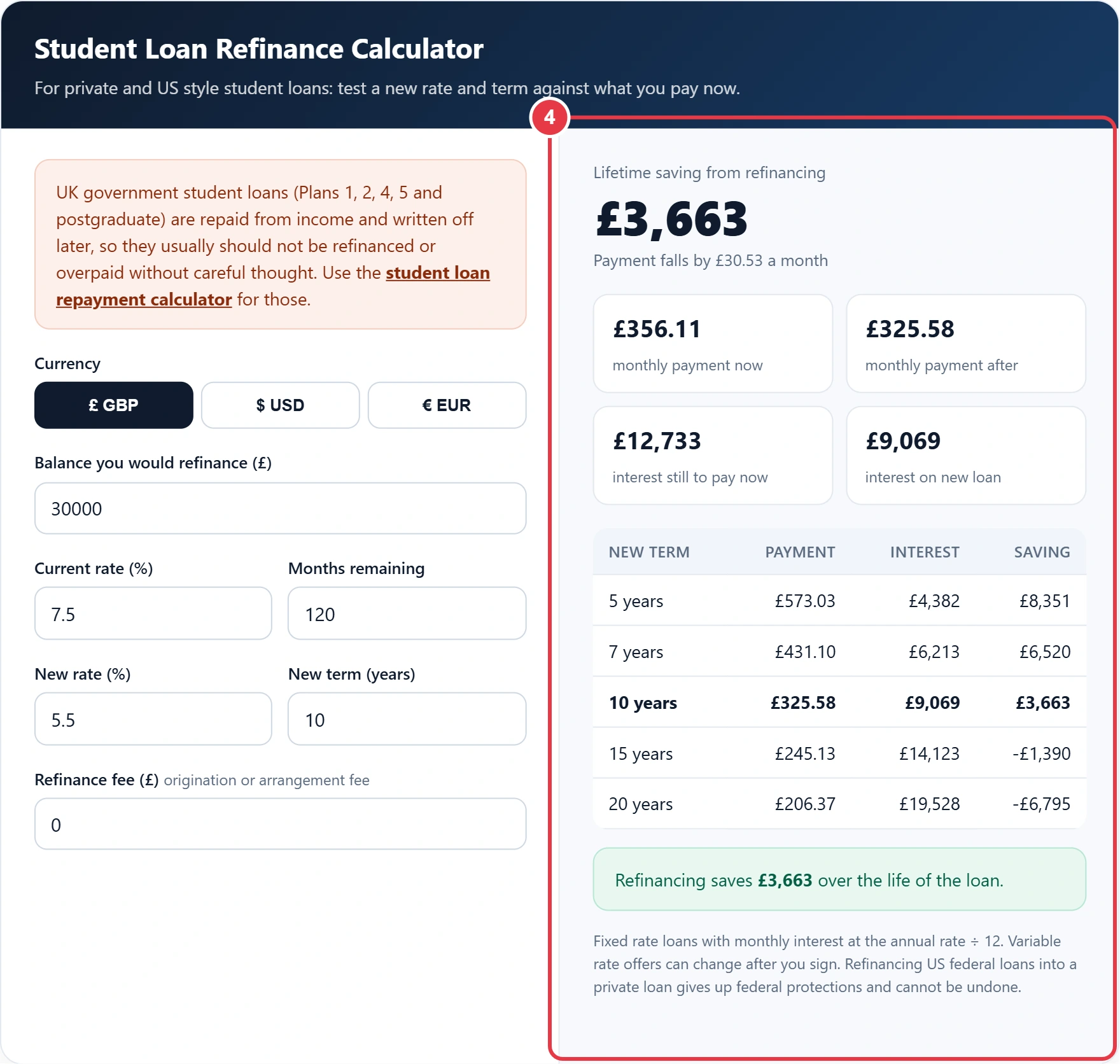
You see both monthly payments, the interest on each loan and the lifetime saving. The table repeats the comparison for 5 to 20 year terms, highlighting the one you chose.
Is It Worth Refinancing My Student Loan?
Refinancing is usually worth it when the new rate is at least one point lower and you keep the term the same or shorter, because stretching the term can wipe out the saving. Emily, a physiotherapist in Ohio, owes $30,000 of private loans at 7.5% with 120 months left, paying $356.11 a month and $12,733 in future interest. A lender offers 5.5%:
| New term at 5.5% | Monthly payment | Total interest | Saving |
|---|---|---|---|
| 5 years | $573.03 | $4,382 | $8,351 |
| 7 years | $431.10 | $6,213 | $6,520 |
| 10 years | $325.58 | $9,069 | $3,663 |
| 15 years | $245.13 | $14,123 | $1,390 extra cost |
| 20 years | $206.37 | $19,528 | $6,795 extra cost |
The 20 year option cuts her payment by about $150 a month yet costs $6,795 more overall. For US federal loans, the CFPB's guidance on refinancing warns that moving to a private lender loses income driven repayment, Public Service Loan Forgiveness and federal deferment, and cannot be reversed. UK borrowers should read the GOV.UK guide to what you repay instead: government loans take 9% of income above a threshold (6% for postgraduate loans) and are written off after 25 to 40 years depending on the plan.
Student Loan Refinance Terms You Should Know
These definitions explain the loan maths, fees and protections behind the student loan refinance calculator so you can compare offers before signing anything.
- Refinancing
- Replacing an existing debt with a new loan, usually on a different rate or term, and using the new funds to clear the old balance in full. Savings come from lower interest, though fees and a longer term can erase them.
- Annuity payment formula
- The standard equation for a fixed monthly payment that clears a loan exactly by its final month, combining the balance, the monthly rate and the number of payments. Early instalments are mostly interest, while later ones mainly repay capital.
- Origination fee
- A charge some lenders add for setting up a new loan, either deducted from the funds or added to the balance. The calculator includes it so that the lifetime saving reflects what the switch genuinely costs.
- Federal student loan
- A loan issued by the United States Department of Education, carrying protections such as income-driven repayment plans and forgiveness programmes. Moving it to a private lender removes those protections permanently.
- Fixed and variable rates
- A fixed rate stays the same for the whole term, while a variable rate moves with a benchmark index. Variable offers can start lower but may rise later, so a quoted saving is only certain on a fixed rate loan.
- Loan term
- The agreed number of months over which a loan is repaid. Extending it lowers each monthly payment but usually increases total interest, so a refinance with a longer term can look cheaper each month yet cost more overall.
</>Embed this calculator on your website
Add the free Student Loan Refinance Calculator to your own site or blog. Copy the code below and paste it into an HTML block. It resizes itself and works on phones.
How we checked this tool: the Tools Veria Editorial Team built this tool by hand, checked it against the official rules or published standards where they apply, and tested it against worked examples. Results are estimates for planning, not personal financial or tax advice. Read our editorial policy and disclaimer, or report an error.
Frequently Asked Questions
Should I refinance my UK Plan 2 student loan?
Usually not. Plan 2 repayments are 9% of income above the threshold and any balance is written off 30 years after you were first due to repay, so many borrowers never clear it. A private refinance would remove that write off.
Can I refinance US federal student loans?
Yes, but only with a private lender, and the CFPB warns it cannot be undone. You lose access to income driven repayment, Public Service Loan Forgiveness, federal deferment and forbearance, and discharge on death or disability.
How much lower should the rate be before I refinance?
A cut of at least one percentage point on a fixed rate is a sensible minimum, provided the term stays the same or shorter. On $30,000 over 10 years, moving from 7.5% to 5.5% saves $3,663.
Does a longer term save money when refinancing?
No. A longer term lowers the monthly payment but usually increases total interest. Emily's $30,000 loan at 5.5% over 20 years costs $6,795 more than staying on 7.5% for her remaining 10 years.
How long does it take to recover a refinance fee?
Divide the fee by the monthly saving. A $500 fee with a payment that falls from $356.11 to $325.58 is recovered in 17 months, after which the lower payment is pure saving.
Is a fixed or variable refinance rate better?
A fixed rate keeps your payment the same for the whole term, which this calculator assumes. A variable rate may start lower but can rise, so compare offers using a realistic higher rate as well.