Harriet runs a design consultancy in Manchester and pays herself a salary and dividends worth £250,000 this year. Her company also pays £45,000 into her pension, so she assumed she was comfortably inside the £60,000 limit. She was not, because the tapered annual allowance cuts that limit for people with income at her level, and her real ceiling for 2026/27 is £42,500.
The taper often arrives by surprise, usually after a bonus or a generous employer payment, and the cost is a tax bill at your top rate. Below, Harriet and three other savers show how the two income tests work, how far the allowance falls, and what you can still do once the year is over.
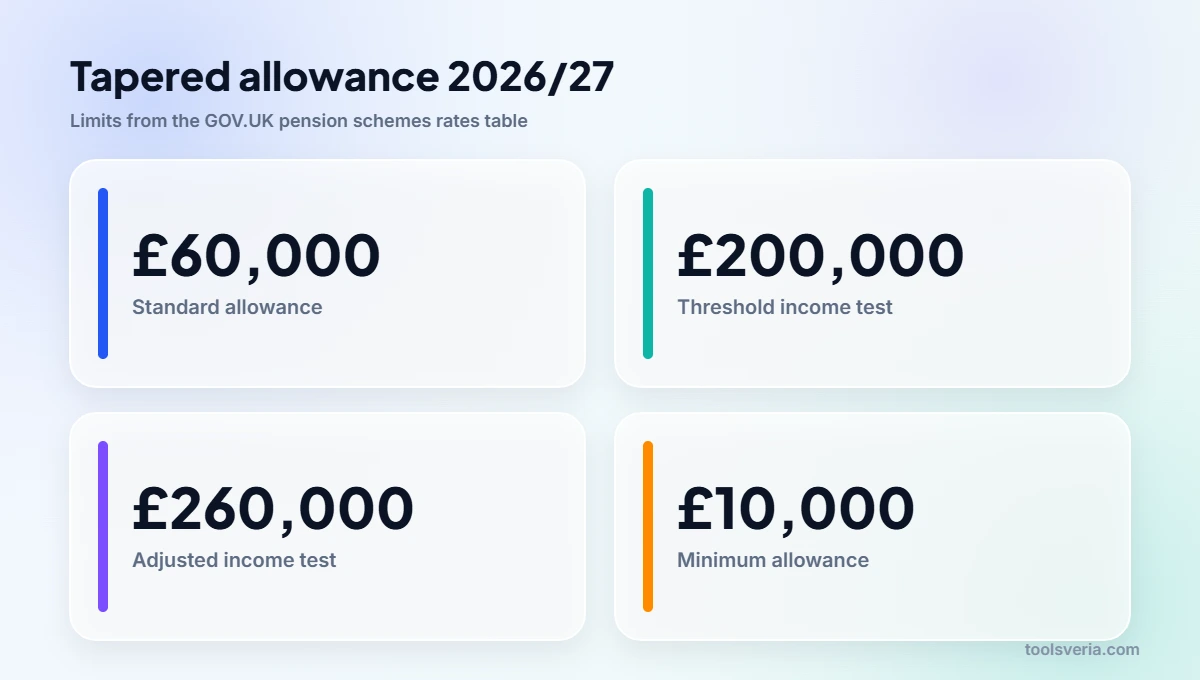
Quick answer: For 2026/27, GOV.UK says your £60,000 pension annual allowance is tapered only if threshold income is over £200,000 and adjusted income is over £260,000. It then falls by £1 for every £2 of adjusted income above £260,000, down to a £10,000 minimum at £360,000. Adjusted income of £300,000 gives a £40,000 allowance.
In This Guide
How does the tapered annual allowance work?
The tapered annual allowance reduces the £60,000 yearly limit on tax relieved pension saving for anyone whose threshold income is over £200,000 and whose adjusted income is over £260,000 in the same tax year. Both tests have to be failed. Fail only one and you keep the full £60,000.
In plain words, the sum is: take your adjusted income, subtract £260,000, halve what is left and take that figure off £60,000. If the answer falls below £10,000, your allowance is £10,000. The GOV.UK pension schemes rates table lists the £60,000 allowance, the £10,000 minimum and both income limits for 2026/27, and those figures have not moved since April 2023.
Every pound of pension input counts towards the limit, whoever pays it. Your own contributions are counted gross, so an £8,000 payment into a personal pension that the provider tops up to £10,000 uses £10,000 of allowance. Employer payments count in full, and in a final salary scheme the figure is the growth in your promised benefits, which the scheme reports on your pension savings statement.
What is the difference between threshold income and adjusted income?
Threshold income is roughly your taxable income after your own pension contributions, while adjusted income is your taxable income with all pension contributions, including your employer’s, added back in. Both start from net income, which is your total taxable income after reliefs such as pension contributions taken from salary before tax.
| Item | Threshold income (limit £200,000) | Adjusted income (limit £260,000) |
|---|---|---|
| Starting point | Net income | Net income |
| Personal pension paid under relief at source (gross) | Deducted | Not deducted |
| Workplace contributions under net pay | Stay deducted | Added back |
| Salary sacrifice set up after 8 July 2015 | Added back | Counted as employer contribution |
| Employer contributions | Ignored | Added |
For Harriet, the numbers run like this. Her salary of £180,000 and dividends of £70,000 give total income of £250,000. She pays £16,000 into a personal pension, which becomes £20,000 gross, so her threshold income is £230,000. Her adjusted income is £250,000 plus the company’s £45,000, which is £295,000. Both limits are passed, so the taper applies. If you take part of your pay as dividends, our dividend tax calculator gives you a firm income figure before you start this sum.

How much is the tapered annual allowance at different incomes?
The tapered annual allowance for 2026/27 is £60,000 minus half of your adjusted income above £260,000, with £10,000 as the lowest figure, assuming threshold income is also over £200,000. Each extra £10,000 of adjusted income removes £5,000 of allowance.
| Adjusted income | Reduction | Annual allowance 2026/27 |
|---|---|---|
| £260,000 or less | £0 | £60,000 |
| £280,000 | £10,000 | £50,000 |
| £295,000 | £17,500 | £42,500 |
| £300,000 | £20,000 | £40,000 |
| £320,000 | £30,000 | £30,000 |
| £340,000 | £40,000 | £20,000 |
| £360,000 or more | £50,000 or more | £10,000 |
Harriet’s £295,000 sits £35,000 above the line. Half of that is £17,500, so her allowance is £42,500. Her total pension input is her £20,000 gross plus the company’s £45,000, which is £65,000, leaving her £22,500 over before anything else is considered.
At the far end, Owen, a fund manager with adjusted income of £400,000, has the minimum £10,000 allowance. Any pension saving above that, from him or his employer, is exposed to the charge unless he has unused allowance from earlier years.
Can the threshold income test protect your full allowance?
Yes, if your threshold income is £200,000 or less, you keep the full £60,000 annual allowance even when your adjusted income is well over £260,000. That test exists so that people on moderate salaries with very generous employer contributions are not caught.
Sana is a senior engineer on a £190,000 salary, and her employer pays £80,000 into her pension as part of a retention package. Her adjusted income is £270,000, which would normally trigger the taper, but her threshold income is only £190,000, so her allowance stays at £60,000. She is still £20,000 over on input, which she covers with carry forward. If that £80,000 had come from salary she gave up under a sacrifice deal agreed after 8 July 2015, the sacrificed pay would be added back to her threshold income and the protection could disappear.
Bonuses cause the most surprises here. Liam earns £185,000 and expects a £20,000 bonus in March 2027, which would lift his threshold income to £205,000. His employer pays £70,000, so his adjusted income would be £275,000 and his allowance would drop to £52,500. A personal pension payment of £4,800, worth £6,000 gross, would bring his threshold income down to £199,000 and restore the full £60,000. Our salary sacrifice pension calculator shows how a sacrifice compares, but remember that sacrifice is added back for this test.

What happens if you go over your tapered annual allowance?
If your pension input is higher than your tapered annual allowance after carry forward, you pay the annual allowance charge on the excess at your own top rate of income tax, reported through Self Assessment. The charge removes the tax relief you received on the excess, so it is a clawback rather than a penalty.
Carry forward comes first. You can use unused allowance from the previous three tax years, provided you were a member of a registered pension scheme in each of them, and the oldest year is used first. For 2026/27 that means 2023/24, 2024/25 and 2025/26, each worth £60,000 at the standard level, although a year in which you were tapered only carries forward what was left of the reduced figure. Harriet has £15,000 unused from 2023/24, which cuts her excess from £22,500 to £7,500. At 45%, her charge is £3,375.
You do not have to find that money yourself. According to GOV.UK guidance on who must pay the charge, your scheme must pay it on request when the charge is more than £2,000 and your savings in that scheme are more than £60,000 for the year. You must ask by 31 July in the year after the following tax year, so 31 July 2028 for 2026/27. Harriet’s £3,375 charge and £65,000 of input in one scheme meet both conditions, and the scheme would reduce her pension to cover it.
How do the taper and the money purchase annual allowance interact?
If you have flexibly taken money from a defined contribution pension, the money purchase annual allowance of £10,000 limits further defined contribution saving, and your tapered allowance still applies on top. Use the GOV.UK steps for working out a tapered allowance to find your reduced figure first, because the £50,000 alternative allowance left for other saving is cut by the same taper.
Practical tips for anyone near the limits: check the pension savings statement from each scheme, because final salary growth can be larger than expected after a promotion; diary a review in February, before bonuses are paid; and keep a record of unused allowance for each of the last three years. Our pension tax relief calculator shows what relief a contribution earns, which is useful when you are weighing whether a payment above the allowance is still worth making.
Key points
- The standard pension annual allowance for 2026/27 is £60,000, set out by GOV.UK.
- The taper applies only when threshold income is over £200,000 and adjusted income is over £260,000.
- The allowance falls by £1 for every £2 of adjusted income above £260,000, to a minimum of £10,000.
- Unused allowance from the previous three tax years can be carried forward, oldest year first.
- Schemes must pay a charge over £2,000 on request when savings in that scheme exceed £60,000.
Tapered Annual Allowance Terms Explained
These definitions explain the limits, charges and reporting tools connected with the tapered annual allowance so high earners can spot problems before the tax year ends.
- Annual allowance
- The yearly cap on pension saving that can receive tax relief without triggering a charge, set at £60,000 for 2026/27 before any taper. It covers personal, employer and third party contributions across every scheme a person belongs to.
- Annual allowance charge
- A tax charge on pension input above the available allowance, levied at the saver’s marginal income tax rate so that the excess effectively loses its tax relief. It is normally reported through a Self Assessment return.
- Pension input amount
- The value counted against the allowance in a given year. For defined contribution schemes it is the total paid in, while for final salary schemes it is the increase in promised benefits measured using a statutory valuation method.
- Scheme pays
- An option allowing a pension scheme to settle an annual allowance charge on the member’s behalf, with the cost taken from their pension benefits. It avoids paying the bill from personal cash, though it permanently reduces retirement savings.
- Pension savings statement
- A yearly statement from a pension scheme showing the member’s pension input and the relevant annual allowance figures. Members facing the taper can use it to check exactly how much allowance their scheme has already used.
- Minimum tapered allowance
- The floor below which the taper cannot push the allowance, set at £10,000 and reached when adjusted income hits £360,000. Beyond that point any further income makes no difference to the pension saving limit.
Frequently Asked Questions
My salary is £150,000 but my employer pays £120,000 into my pension. Am I tapered?
No, not unless other income lifts your threshold income above £200,000. Your adjusted income would be about £270,000, but with threshold income near £150,000 you keep the full £60,000 allowance, although £120,000 of input is still £60,000 over.
Do dividends and rental profit count towards the £200,000 test?
Yes, both income tests start from net income, which includes salary, bonuses, dividends, savings interest, rental profit and self employed profit. Harriet’s £70,000 of dividends is one reason her threshold income reaches £230,000 for 2026/27.
My income is £300,000 this year but was £150,000 before. Is my carry forward reduced?
No, each earlier year uses its own allowance. If you were not tapered in 2023/24, 2024/25 or 2025/26, each of those years carries forward up to £60,000 minus what you actually paid in, even though your 2026/27 allowance is only £40,000.
Can I avoid the charge by asking my employer to stop contributing in March?
It can help, because employer contributions count towards both your pension input and your adjusted income. Removing £20,000 of contributions lowers adjusted income by £20,000, which restores £10,000 of allowance as well as cutting input, but check your contract before changing anything.
Harriet now knows her ceiling is £42,500 and that her £3,375 charge can be paid by her scheme. Run your own income and contributions through the calculator before the tax year ends on 5 April 2027, while there is still time to adjust. Figures checked October 2026.