Carlos and Elena closed on a $380,000 house outside Houston last spring and nearly missed one form that is worth more than $1,500 a year to them. The texas homestead exemption takes a slice off the taxable value of the home you live in before each local taxing unit sends its bill, and since voters approved a bigger school exemption in November 2025, that slice is larger than most older guides suggest.
Texas has no state property tax, so the saving is built up from your school district, county, city and any special districts, each with its own rate and its own rules. Below, three households show how each piece adds up for 2026, how to apply and what changes when you turn 65.
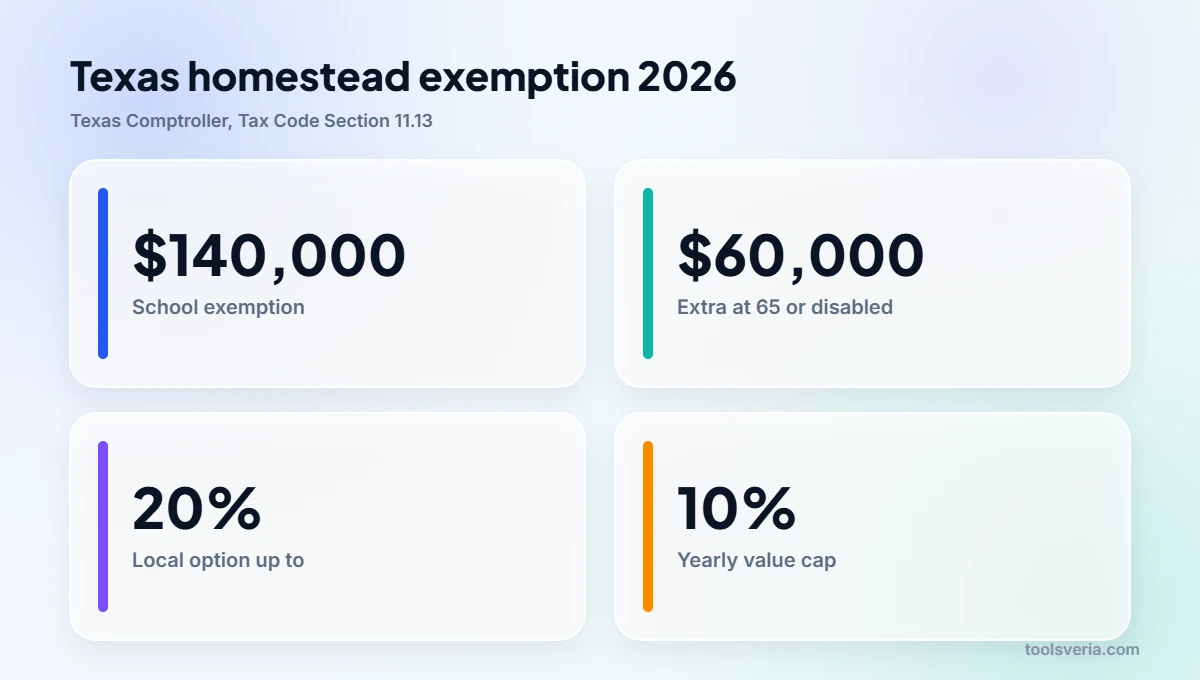
Quick answer: For 2026, every Texas school district must exempt $140,000 of a homestead’s appraised value, and owners 65 or older or disabled get an extra $60,000, for $200,000 in total, according to the Texas Comptroller. Counties and cities may add up to 20% more. At a $0.95 school rate, $140,000 saves $1,330 a year.
In This Guide
How much is the Texas homestead exemption in 2026?
The Texas homestead exemption in 2026 is $140,000 off your home’s appraised value for school district taxes, rising to $200,000 if you are 65 or older or disabled. Those two amounts are mandatory under Tax Code Section 11.13. Counties, cities and special districts can choose to add their own exemptions on top.
| Exemption | Who gives it | Amount |
|---|---|---|
| General school homestead exemption | Every school district (mandatory) | $140,000 |
| Extra school exemption, 65 or older or disabled | Every school district (mandatory) | $60,000 |
| Local option percentage exemption | Any taxing unit that adopts it | Up to 20% of value, at least $5,000 |
| Local exemption, 65 or older or disabled | Any taxing unit that adopts it | At least $3,000 |
| Disabled veteran rated 100% disabled | All taxing units | Total exemption on the homestead |
The figures are newer than many guides. Texas voters approved Proposition 13 on 4 November 2025, raising the school exemption from $100,000 to $140,000, and some pages still quote the $25,000 figure from before 2022. If a source gives you a school number other than $140,000, treat it as out of date.
The 20% option has a floor that matters for low values. On a home appraised at $20,000, 20% would be only $4,000, so the unit must give $5,000 instead. On Carlos and Elena’s $380,000 house, 20% is $76,000, well above the floor.
How much does the homestead exemption save in Texas?
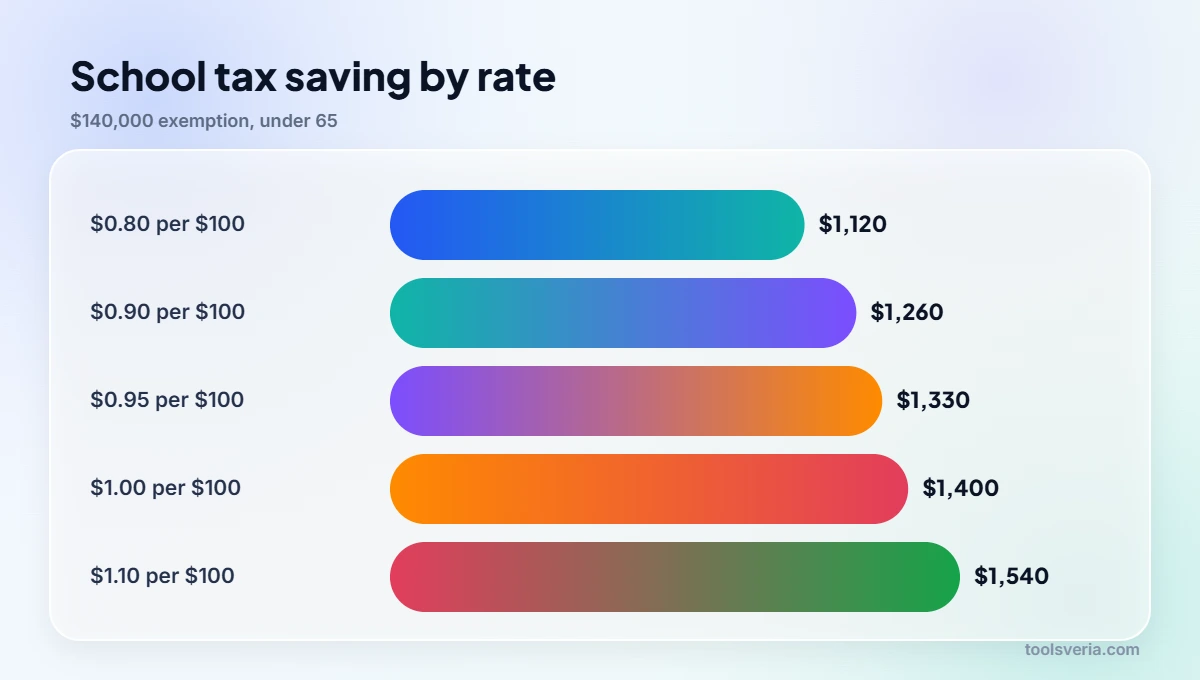
The homestead exemption saves the exemption amount multiplied by each taxing unit’s rate per $100 of value. In plain words: for each unit, divide the exemption by 100 and multiply by that unit’s rate. A $140,000 school exemption at a $0.95 rate saves $1,330 a year.
| School tax rate per $100 | Yearly saving under 65 ($140,000) | Yearly saving 65 or older, or disabled ($200,000) |
|---|---|---|
| $0.80 | $1,120 | $1,600 |
| $0.90 | $1,260 | $1,800 |
| $0.95 | $1,330 | $1,900 |
| $1.00 | $1,400 | $2,000 |
| $1.10 | $1,540 | $2,200 |
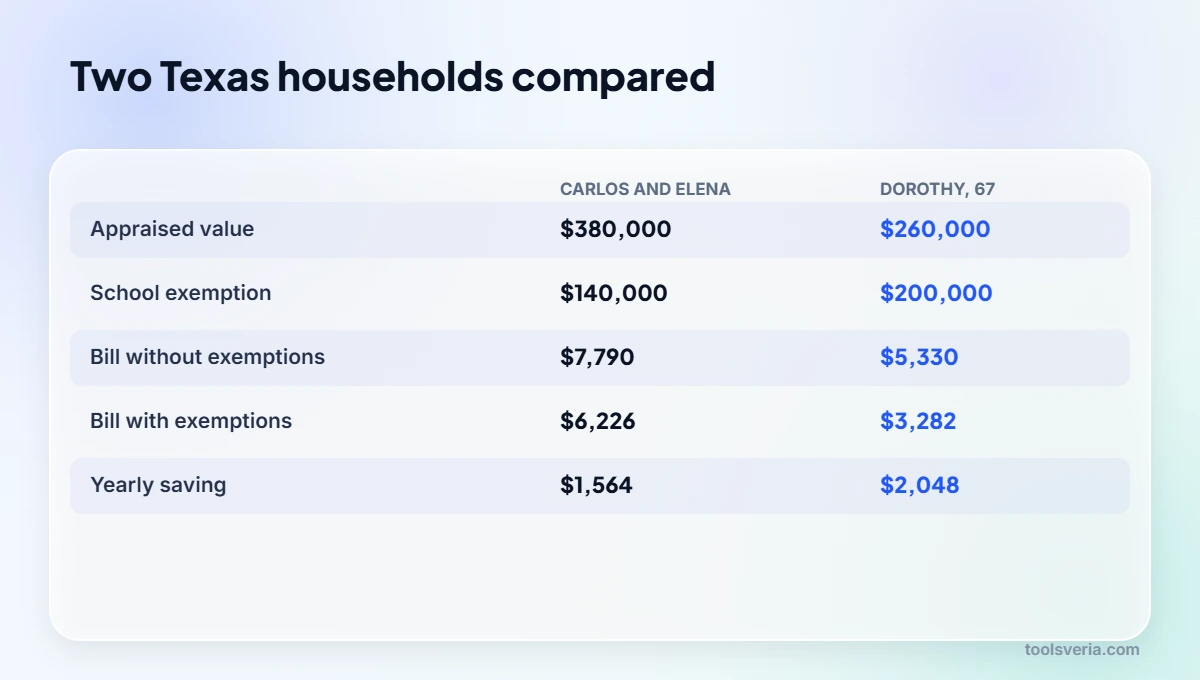
Here is Carlos and Elena’s full bill, using example rates rather than any real district’s: school $0.90, county $0.40 with a 20% local option exemption, city $0.50 with no homestead exemption, and $0.25 for other districts such as a hospital or community college. Without any exemption, $380,000 at a combined $2.05 per $100 would cost $7,790.
- School: $380,000 minus $140,000 leaves $240,000, so tax is $2,160 and the saving is $1,260.
- County: 20% of $380,000 is $76,000, leaving $304,000, so tax is $1,216 and the saving is $304.
- City and other districts: no exemption, so tax stays at $1,900 and $950.
- Total: $6,226 instead of $7,790, a saving of $1,564 a year or about $130.33 a month in escrow.
Escrow changes are where homeowners actually notice the saving. If your lender recalculates your monthly payment after the exemption lands, our percentage increase calculator shows how far the new figure has moved from the old one, which makes an escrow analysis letter easier to check.
What changes when you turn 65 or become disabled?
When you turn 65 or qualify as disabled, your school exemption rises from $140,000 to $200,000, any local senior or disability exemption your county or city has adopted applies, and your school taxes are capped by a tax ceiling. Each of those changes is separate, and the ceiling often matters most over time.
Dorothy is 67 and owns a home appraised at $260,000, with the same example rates as above and a county that adds a $10,000 local senior exemption. Her school exemption of $200,000 leaves $60,000 taxable, so her school tax is $540 and the saving is $1,800. At the county, 20% of her value ($52,000) plus the $10,000 senior exemption takes $62,000 off, saving $248. Her total bill falls from $5,330 to $3,282, a saving of $2,048 a year.
The ceiling then freezes her school tax. The Tarrant Appraisal District explains that school taxes for qualifying owners are limited to the amount paid in the first or second year they qualified, whichever is lower, so if Dorothy’s value climbs, her school bill stays at that level unless she adds new improvements such as an extension. Counties and cities can adopt a similar ceiling, but it is their choice.
Who qualifies for a homestead exemption in Texas?
You qualify for a Texas homestead exemption if you own the home and live in it as your principal residence. You can claim only one homestead at a time, and the exemption covers the house plus the land around it that you use as your home.
To apply, file the residence homestead application, Form 50-114, with your county appraisal district, not with each taxing unit. The Texas Comptroller says the general deadline is before May 1. Appraisal districts ask for a copy of your Texas driver’s licence or state ID, and the address on it must match the home you are claiming. Buyers such as Carlos and Elena no longer have to wait until the following 1 January before applying, so file soon after closing and ask the district how the first, part year will be handled.
You apply once, not every year, but tell the district if you move, rent the home out or stop living there. If you are deciding whether to buy at all, our rent vs buy property calculator lets you feed the lower post exemption tax figure into the comparison, which makes buying look noticeably better in high tax counties.
How does the 10% homestead cap limit your appraised value?
Once a home has a homestead exemption, its taxable appraised value cannot rise by more than 10% a year, even if the market value rises faster, apart from new improvements. This cap works alongside the exemption and protects you in years of fast price growth.
Suppose last year’s homestead appraised value was $350,000 and the district now puts the market value at $420,000, a 20% jump. The capped value is $385,000, which is $350,000 plus 10%. At the example combined rate of $2.05 per $100, the $35,000 gap is worth $717.50 in tax that year, before any exemption is applied. The 10% cap is reserved for homesteads, which is another reason to make sure the district shows your home as a homestead.
Does the Texas homestead exemption protect your home from creditors?
Yes, but that is a separate rule with the same name: the Texas Constitution protects a homestead from most creditors, with no dollar limit, up to 10 acres in a city and 100 acres in the country, or 200 acres for a family. The overview of homestead exemptions by state sets out those acreage limits, and our acre to square feet converter helps if your plat shows the lot in square feet.
Creditor protection does not stop a mortgage lender, the taxing units or a contractor who improved the home from enforcing what they are owed. On the federal side, property tax you pay on your home can be deducted if you itemise, and IRS Topic 503 on deductible taxes explains the rules, including the cap on state and local tax deductions. A larger exemption lowers the tax you can deduct, but it always leaves you better off overall, because a deduction only returns part of each dollar.
One more case worth knowing: a small home can be fully exempt from school tax. A $120,000 starter home in a district with a $0.90 rate has a $140,000 exemption that is bigger than its value, so the school tax falls to $0 and the saving is $1,080, not $1,260. If you later refinance, our mortgage refinance savings calculator works on the loan side while your escrow keeps the exemption.
Key points
- Every Texas school district gives a $140,000 homestead exemption for 2026.
- Owners 65 or older or disabled get an extra $60,000, for $200,000 off school taxes.
- Counties, cities and special districts may add up to 20% of value, with a $5,000 minimum.
- The saving for each unit is the exemption multiplied by its rate per $100.
- A homestead’s appraised value cannot rise by more than 10% a year, apart from new improvements.
- You apply once to your appraisal district, with a general deadline before May 1.
Texas Homestead Exemption Terms Explained
These terms explain the laws, ballot changes and special protections behind the Texas homestead exemption so new and older homeowners can claim every dollar available.
- Residence homestead
- A home that an individual owns and occupies as their principal residence, which qualifies for homestead exemptions under Texas law. A person can hold this status on only one property at any given time.
- Texas Tax Code Section 11.13
- The provision of the Texas Tax Code that sets out residence homestead exemptions, including the mandatory school district amounts and the local options other taxing units may adopt. Changes to it often depend on voter approval.
- Proposition 13 (2025)
- A Texas constitutional amendment approved by voters on November 4, 2025, that raised the mandatory school homestead exemption from $100,000 to $140,000. Guides quoting a lower school figure were written before this change took effect.
- Over 65 school tax ceiling
- A freeze on the school district tax a homeowner pays once they qualify as 65 or older or disabled. The bill then cannot rise above the level set in the qualifying year unless new improvements are added to the home.
- Disabled veteran exemption
- A complete exemption from property tax on the homestead of a veteran rated 100% disabled. Unlike the general school exemption, it applies across every taxing unit, including counties, cities and special districts.
- Homestead exemption application
- The form a homeowner files with the county appraisal district to claim the exemption, supported by identification such as a Texas driver’s license showing the property address. Once approved, it generally remains in place until ownership or occupancy changes.
Frequently Asked Questions
I bought my house in July 2026. Is it too late to claim this year?
No, buyers can apply in the year they buy rather than waiting for the next 1 January. File Form 50-114 with your appraisal district now and ask how the exemption applies to the months after you moved in.
My county gives nothing extra. Is the $140,000 still automatic?
The $140,000 school exemption is mandatory in every district, but it is not automatic: you must file the application once. County and city exemptions are optional, so a county that adopts none simply taxes your full value at its rate.
I turn 65 in November. When does the extra $60,000 start?
Tell your appraisal district once you turn 65, because the extra $60,000 school exemption and any local senior exemption are generally allowed for the whole year you reach 65. At a $0.95 school rate, that adds $570 to your yearly saving.
My home is worth $120,000. Can the exemption cut my school tax to zero?
Yes, the $140,000 school exemption is larger than a $120,000 appraised value, so your school taxable value is $0. County and city taxes still apply unless those units have adopted exemptions large enough to cover the rest.
Carlos and Elena’s one form is worth $1,564 a year, and Dorothy’s is worth $2,048 plus a frozen school bill. Put your own appraised value and the rates from last year’s tax statement into the calculator to see your figure. Figures checked October 2026.